

The DOI matches its Crossref record; 130 of the 130 references it cites were found in a registry or an index; none of the 84 sources its claims cite is checked for support yet.
Human-AI collaboration is not very collaborative yet: a taxonomy of interaction patterns in AI-assisted decision making from a systematic review
Open accessAbstract
Leveraging Artificial Intelligence (AI) in decision support systems has disproportionately focused on technological advancements, often overlooking the alignment between algorithmic outputs and human expectations. A human-centered perspective attempts to alleviate this concern by designing AI solutions for seamless integration with existing processes. Determining what information AI should provide to aid humans is vital, a concept underscored by explainable AI's efforts to justify AI predictions. However, how the information is presented, e.g., the sequence of recommendations and solicitation of interpretations, is equally crucial as complex interactions may emerge between humans and AI. While empirical studies have evaluated human-AI dynamics across domains, a common vocabulary for human-AI interaction protocols is lacking. To promote more deliberate consideration of interaction designs, we introduce a taxonomy of interaction patterns that delineate various modes of human-AI interactivity. We summarize the results of a systematic review of AI-assisted decision making literature and identify trends and opportunities in existing interactions across application domains from 105 articles. We find that current interactions are dominated by simplistic collaboration paradigms, leading to little support for truly interactive functionality. Our taxonomy offers a tool to understand interactivity with AI in decision-making and foster interaction designs for achieving clear communication, trustworthiness, and collaboration.
Overview
CoChat Summary
TL;DR
This systematic review of 105 empirical studies proposes a taxonomy of interaction patterns for AI-assisted decision making. It finds that current human-AI interactions are dominated by simple AI-first and AI-follow assistance, with limited support for more interactive collaboration.
Key findings
- Across 105 articles and 131 interaction sequences, AI-first assistance was most common (n = 67), followed by AI-follow assistance (n = 28); AI solutions were accompanied by additional information in 81% and 68% of those patterns, respectively.
- More interactive patterns were less frequent: Request-driven AI assistance (n = 25; 14 for direct solution, 13 for support information), Secondary assistance (n = 16), User-guided interactive adjustments (n = 9), Delegation (n = 9), and AI-guided dialogic user engagement (n = 6, of which 5 were conversational).
- Domains included healthcare (26/108), generic tasks (20/108), finance/business (15/108), and law (6/108); most evaluations used non-expert users (60/108), and less than 15% used artificial tasks. AI systems were simulated/Wizard of Oz (39/105), deep learning-based (34/105), or shallow models (35/105).
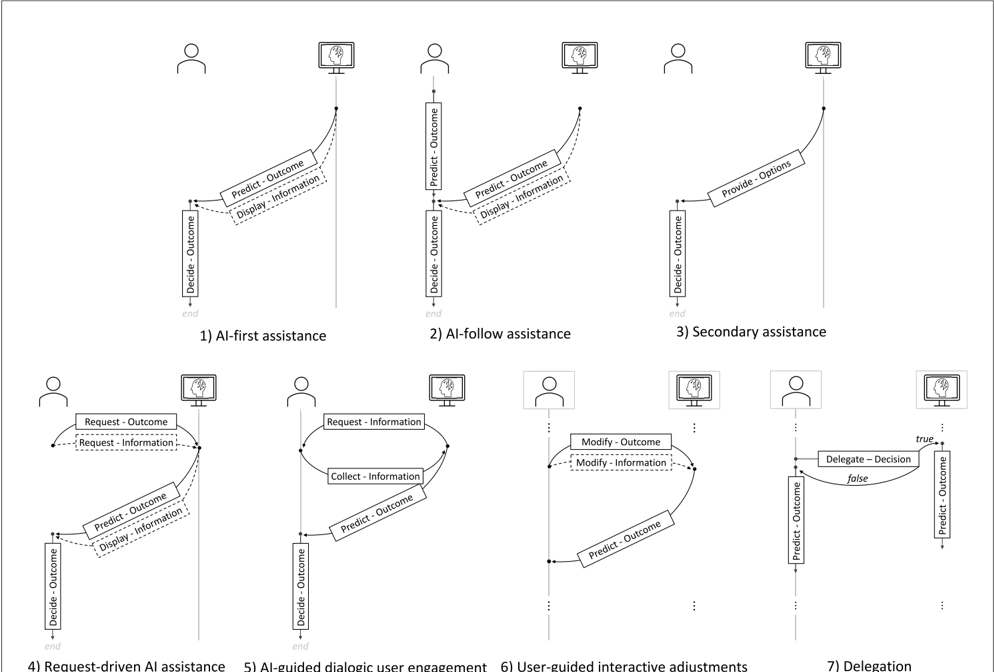
- The taxonomy comprises seven interaction patterns—AI-first assistance, AI-follow assistance, Secondary assistance, Request-driven AI assistance, AI-guided dialogic user engagement, User-guided interactive adjustments, and Delegation—plus an “Others” category.
Methods
- Systematic review of empirical human-AI decision-making studies from 2013 to June 2023 across ACM Digital Library, IEEE Xplore, Compendex, Scopus, and PubMed; the initial search returned 3,770 papers, 358 duplicates were removed, 3,412 were screened, and 105 articles were included.
- Inclusion required complete decision-making tasks, an implemented interface for human-AI interaction, screen-based/virtual/non-embodied setups, and empirical user studies; robotics, gaming, short papers (<8 pages), non-peer-reviewed works, and reviews/surveys were excluded.
- Data extraction coded context, AI system, and interaction building blocks (action-output pairs); interaction sequences were grouped iteratively into the taxonomy, and pattern frequency was quantified via automated search plus manual inspection.
Limitations
- Stated: search terminology may have excluded relevant work if interaction design was not explicitly mentioned; publication bias is possible; including only one healthcare-focused database alongside general databases may limit observed domain frequencies; analysis was restricted to screen-based interfaces; strict complete-decision-task criteria were used; some papers lacked sufficient interface detail for full recreation; and further use-case evaluations are needed to assess the taxonomy’s utility.
- Evident from the text: because interaction patterns are not mutually exclusive and the taxonomy was iteratively refined by the authors, category assignments may involve subjective interpretation.
- Evident from the text: the corpus ends in June 2023, so newer interaction patterns or studies published after that date are not represented.
Model-written summary. Check it against the paper before relying on it.
Integrity signals
Registry
Cites
Statistics
Figures

Verification
Claims the paper makes
0 Valid · 0 Not valid · 45 Not checked · 126 Own results and interpretations
A result the paper reports from its own data — it cites no other source for it, so there is none to check. The quote shows it is in the paper.
In the paper
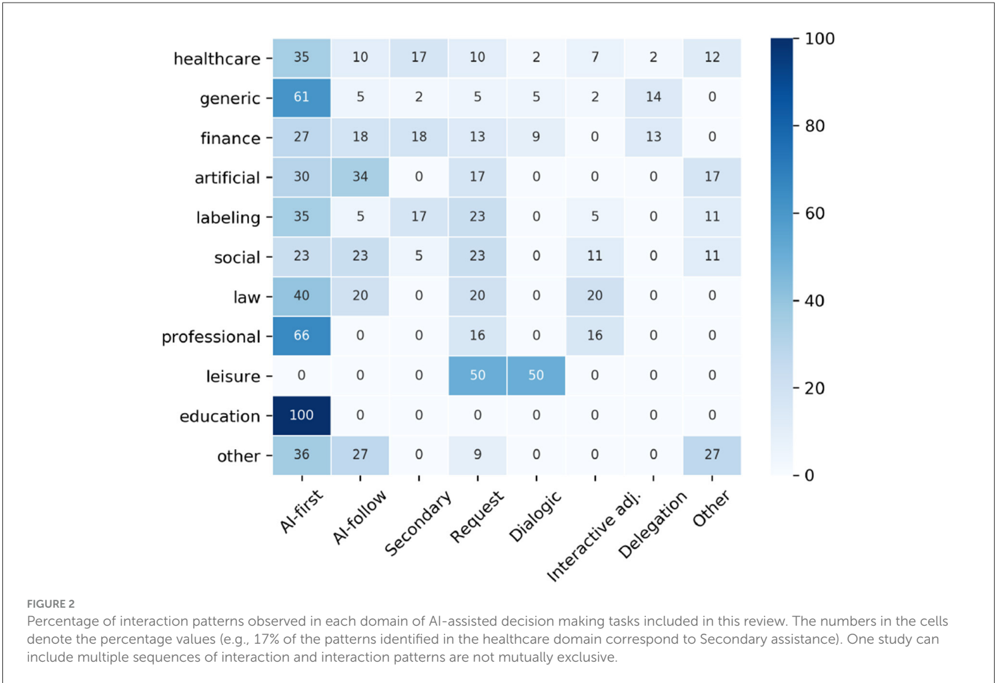
“Human-AI interactions in AI-advised decision makings in the healthcare domain mostly adhered to the AI-first assistance pattern (n = 14), followed by Secondary assistance (n = 7).”
§ Human-AI collaboration is not very collaborative yet: a taxonomy of interaction patterns in AI-assisted decision making from a systematic review > Domain Decision making task Total tasks
plainn = 7- Asserted: passes — The authors put it forward as true.
- Checkable: passes — It can be checked against evidence.
- Load-bearing: unclear — It is unclear whether the paper’s conclusions depend on it.
- Based: passes — The paper gives a reason why it holds.
A result the paper reports from its own data — it cites no other source for it, so there is none to check. The quote shows it is in the paper.
In the paper
“We identified one interaction that supported AI-guided dialogic user engagement, three interactions in the User-guided interactive adjustments, and one in which delegation was an option.”
§ Human-AI collaboration is not very collaborative yet: a taxonomy of interaction patterns in AI-assisted decision making from a systematic review > Domain Decision making task Total tasks
plainn = 3- Asserted: passes — The authors put it forward as true.
- Checkable: passes — It can be checked against evidence.
- Load-bearing: unclear — It is unclear whether the paper’s conclusions depend on it.
- Based: passes — The paper gives a reason why it holds.
A result the paper reports from its own data — it cites no other source for it, so there is none to check. The quote shows it is in the paper.
In the paper
“We present seven categories of interaction patterns that we have identified in our corpus, illustrated in Figure 1.”
§ Human-AI collaboration is not very collaborative yet: a taxonomy of interaction patterns in AI-assisted decision making from a systematic review > Results
plain- Asserted: passes — The authors put it forward as true.
- Checkable: passes — It can be checked against evidence.
- Load-bearing: passes — The paper’s conclusions depend on it.
- Based: passes — The paper gives a reason why it holds.
A check of a cited source is scheduled, or we don’t hold its full text yet; the claim is checked once it runs.
In the paper
“For instance, manipulations of the inputs result in new AI's outcome computations for exploratory purposes (Liu et al., 2021;Gu et al., 2023;Nguyen et al., 2018;Zytek et al., 2022;Suresh et al., 2022).”
§ Human-AI collaboration is not very collaborative yet: a taxonomy of interaction patterns in AI-assisted decision making from a systematic review > . Identification of interaction patterns in AI-assisted decision making studies
What the sources say
plainstates a cause- Asserted: passes — The authors put it forward as true.
- Checkable: passes — It can be checked against evidence.
- Load-bearing: unclear — It is unclear whether the paper’s conclusions depend on it.
- Based: passes — The paper gives a reason why it holds.
A result the paper reports from its own data — it cites no other source for it, so there is none to check. The quote shows it is in the paper.
In the paper
“Even though we identified multiple decision making tasks in applications that require a specialized population, where recruiting large numbers of participants is often challenging, the majority of human-AI interactions have been evaluated with non-expert uses (60/108).”
§ Human-AI collaboration is not very collaborative yet: a taxonomy of interaction patterns in AI-assisted decision making from a systematic review > Domain Decision making task Total tasks
plain- Asserted: passes — The authors put it forward as true.
- Checkable: passes — It can be checked against evidence.
- Load-bearing: unclear — It is unclear whether the paper’s conclusions depend on it.
- Based: passes — The paper gives a reason why it holds.
81 more claims
Create a free account to see all 171 claims and to verify the 77 references still open.
- Probably not a substantial claim. 73
- It may state two separate claims as one. 26
- The quote only partly states this claim. 2
Self-check
Percentages, sums and reported differences re-computed from the paper’s own numbers.
Rated minor: it would not touch a result — a value no result rests on, a p-value that stays on the same side of the significance level, or a conflict that is clerical, resolved elsewhere in the paper, or outside its own findings.
In the paper
“The type of AI systems behind the interactions with users in the studies that covered these decision-making tasks were distributed among three categories: simulated models or Wizard of Oz experiments (39/105), deep learning-based models (34/105), and shallow models (35/105).”
§ Human-AI collaboration is not very collaborative yet: a taxonomy of interaction patterns in AI-assisted decision making from a systematic review > Domain Decision making task Total tasks
Reported 105 · recomputed 108
Citations
Cites
A model for types and levels of human interaction with automation
Parasuraman, R., Sheridan, T. B., & Wickens, C. D. (2000) · IEEE Transactions on Systems, Man, and Cybernetics - Part A: Systems and Humans · doi:10.1109/3468.844354 · Cited by 4,195 · cited 1×
“We searched for relevant articles from five databases that cover Human-Computer Interaction (HCI) studies and related disciplines and selected 105 to conduct a detailed coding and analysis of the sequences of interactions that exist between humans and AI.”
Buçinca, Z., Malaya, M. B., & Gajos, K. Z. (2021) · arXiv · doi:10.48550/arxiv.2102.09692 · Cited by 1,124 · cited 3×
“…the decision making problem, we observe cases ( n = 10) in which users are given the ability to control when they want to receive the AI assistance via a request (Khadpe et al., 2020; Mackeprang et al., 2019; Baudel et al., 2021; Molina and Sundar, 2022; Gomez et al., 2023; Buçinca et al., 2021).”
Power to the People: The Role of Humans in Interactive Machine Learning
Amershi, S., Cakmak, M., Knox, W. B., & Kulesza, T. (2014) · AI Magazine · doi:10.1609/aimag.v35i4.2513 · Cited by 1,084
Toward a Deeper Understanding of the Role of Interaction in Information Visualization
Yi, J. S., Kang, Y. A., Stasko, J., & Jacko, J. A. (2007) · IEEE Transactions on Visualization and Computer Graphics · doi:10.1109/tvcg.2007.70515 · Cited by 1,031
Human-computer collaboration for skin cancer recognition
Tschandl, P., Rinner, C., Apalla, Z., Argenziano, G., Codella, N., Halpern, A., Janda, M., Lallas, A., Longo, C., Malvehy, J., et al. (2020) · Nature Medicine · doi:10.1038/s41591-020-0942-0 · Cited by 1,024
Zhang, Y., Liao, Q. V., & Bellamy, R. K. E. (2020) · Proceedings of the 2020 Conference on Fairness, Accountability, and Transparency · doi:10.1145/3351095.3372852 · Cited by 895
Does the Whole Exceed its Parts? The Effect of AI Explanations on Complementary Team Performance
Bansal, G., Wu, T., Zhou, J., Fok, R., Nushi, B., Kamar, E., Ribeiro, M. T., & Weld, D. (2021) · Proceedings of the 2021 CHI Conference on Human Factors in Computing Systems · doi:10.1145/3411764.3445717 · Cited by 757 · cited 2×
“…al., 2022; Riveiro and Thill, 2021, 2022; Lai et al., 2020; Bansal et al., 2021); question answering (Feng and Boyd-Graber, 2022; Silva et al., 2023; Bansal et al., 2021); speech classification (Tutul et al., 2021; Zhang and Lim, 2022) 20 Labeling Text labeling (Bernard et al., 2018; Schrills and…”
Does the Whole Exceed its Parts? The Effect of AI Explanations on Complementary Team Performance
Bansal, G., Wu, T., Zhou, J., Fok, R., Nushi, B., Kamar, E., Ribeiro, M. T., & Weld, D. S. (2020) · arXiv · doi:10.48550/arxiv.2006.14779 · Cited by 754
Fügener, A., Grahl, J., Gupta, A., & Ketter, W. (2022) · Information Systems Research · doi:10.1287/isre.2021.1079 · Cited by 478
Beyond Accuracy: The Role of Mental Models in Human-AI Team Performance
Bansal, G., Nushi, B., Kamar, E., Lasecki, W. S., Weld, D. S., & Horvitz, E. (2019) · Proceedings of the AAAI Conference on Human Computation and Crowdsourcing · doi:10.1609/hcomp.v7i1.5285 · Cited by 466
Research works printed but not linked: 1
- David, 2022, “Interaction templates: a data-driven approach for authoring robot programs,”, PLATEAU: 12th Annual Workshop at the Intersection of PL and HCI
Cited by
Items 101–200 of 211
Okeke, M. U. C., & Adamides, E. D. (2026) · Preprints.org · doi:10.20944/preprints202602.1282.v1
Okeke, M. U. C., & Abel, C. F. (2026) · Preprints.org · doi:10.20944/preprints202602.1282.v2
Interface Framework for Human-AI Collaboration within Intelligent User Interface EcosystemsPreprint
Andru, S., & Saksena, S. K. (2026) · arXiv (Cornell University) · doi:10.48550/arxiv.2602.22343
Lee, Y. J., Hwang, J., Lee, J., Ha, J., Gersich, K., & Lee, K.-S. (2026) · SSRN Electronic Journal · doi:10.2139/ssrn.6329635
Triantafyllopoulos, L., Paxinou, E., & Kalles, D. (2026) · Διεθνές Συνέδριο για την Ανοικτή & εξ Αποστάσεως Εκπαίδευση · doi:10.12681/icodl.8542
Od analizy do strategii: jak sztuczna inteligencja przekształca klasyczną analizę SWOT
Pajek, A. (2026) · Prace Naukowe Uniwersytetu Ekonomicznego we Wrocławiu · doi:10.15611/pn.2026.1.02
Ludwig, B. (2026) · doi:10.1515/9783111386690-025
GenAI-assisted visual decision-making: a framework for human–AI collaboration
Geerts, G. L., Geerts, L., & O’Leary, D. E. (2026) · Journal of Decision System · doi:10.1080/12460125.2026.2655904
Ye, L., Cai, X., Wang, X., Wang, J., Zheng, Y., Hu, X., Xu, T., Fu, D., Lu, P., Nan, Y., et al. (2026) · CHI Conference Extended Abstracts on Human Factors in Computing Systems (CHI EA) · doi:10.1145/3772363.3798906
Tong, J., Chen, Z., Zhao, Y., Liao, R., Choi, H., Wang, S., & Moraros, J. (2026) · CHI Conference Extended Abstracts on Human Factors in Computing Systems (CHI EA) · doi:10.1145/3772363.3798641
Agents Look Cooperative, Not Credible: Nonverbal Cues and the Credibility Gap in Human-Agent Teams
Yousefi, M., Shahi, A., Wen, R., Sharifi, M., Romera, A. J. J., Hoermann, S., & Piumsomboon, T. (2026) · CHI Conference Extended Abstracts on Human Factors in Computing Systems (CHI EA) · doi:10.1145/3772363.3798645
Generative AI and adaptive systems for customising help-seeking scaffolds: A systematic review
Jecha, J., Igweani, C. C., Banaras, A., Liang, Y., & Mwalyego, F. M. (2026) · Information Services & Use · doi:10.1177/18758789261486037
From Tools to Ecologies: Rethinking How AI Becomes Product
Shang, Y., & Liu, S. (2026) · interactions · doi:10.1145/3793427
Burianová, H. (2026) · Theseus (Ammattikorkeakoulujen)
Liu, Q. (2026) · International Journal of Digital Law and Governance · doi:10.1515/ijdlg-2025-0021
Measuring Collaborative Maturity in Human–AI Work: Development and Validation of the CIQ Scale
Raditya, A., Kaihatu, T. S., & Sutrisno, T. F. (2026) · Inkubis Jurnal Ekonomi dan Bisnis · doi:10.59261/inkubis.v8i1.188
Singh, A. B. (2026) · Education and human development · doi:10.5772/intechopen.1015315
A Taxonomy Of Algorithmic Co-Supervision
Oezdemir, F., Alizadeh, A., & Benlian, A. (2026) · Journal of the Association for Information Systems
Kumar, P., Mastana, A. S., Khanijou, S., & Luanrattana, R. (2026) · ShodhKosh Journal of Visual and Performing Arts · doi:10.29121/shodhkosh.v7.i10s.2026.7927
Hila, A. (2026) · arXiv (Cornell University) · doi:10.48550/arxiv.2605.21351
Addressing the Synergy Gap: The Six Elements of the Design SpacePreprint
Turchi, T., Wilson, B., Roach, M., Dix, A. J., & Malizia, A. (2026) · arXiv (Cornell University) · doi:10.48550/arxiv.2605.21635
Zebua, N. (2026) · Polygon Jurnal Ilmu Komputer dan Ilmu Pengetahuan Alam · doi:10.62383/polygon.v4i2.962
Darban, M. (2026) · Education and Information Technologies · doi:10.1007/s10639-026-14048-3
EMGen: Human-AI Collaboration to Generate Educational Material
Morland, R., Lin, F. O., & Jin, Q. (2026) · Lecture notes in computer science · doi:10.1007/978-981-92-0042-9_30
Lee, Y. J., Hwang, J., Lee, J., Ha, J., Gersich, K., & Lee, K.-S. (2026) · SSRN Electronic Journal · doi:10.2139/ssrn.6864440
For Those About to Rely—A Taxonomy of Experimental Studies on AI Reliance: Completed Research Paper
Schaschek, M., Spatscheck, N., & Winkelmann, A. (2026) · Lecture notes in information systems and organisation · doi:10.1007/978-3-032-08480-4_2
DARE: An Explainable AI-Visualization Framework for Ill-Defined Decision Making
Chatzimparmpas, A., & Dimara, E. (2026) · IEEE Transactions on Visualization and Computer Graphics · doi:10.1109/tvcg.2026.3701110
Designing cognition-driven Human-AI teaming: A Three-Layer Cognitive Framework (TriC)
Yin, Y., Jin, E., Pan, H., (324865), X. J., Zhang, Y., Liu, Y., Shen, M., & Gao, Z. (2026) · Computers in Human Behavior Reports · doi:10.2139/ssrn.6890561
Socio-Algorithmic Identity In The Age Of Generative AI
Taer, J. (2026) · Journal of the Association for Information Systems
Designing a Layered Learning Infrastructure with a Digital Twin Component
Aksovaara, S., Haapala, H., & Silvennoinen, M. (2026) · Bled eConference · doi:10.18690/um.fov.4.2026.5
Roos, G. (2026) · Advances in computational intelligence and robotics book series · doi:10.4018/979-8-3373-7036-1.ch004
Jump Into Comics: Can Reader-AI Interaction Boost Willingness to Pay
Yin, M. (2026) · International Journal of Human-Computer Interaction · doi:10.1080/10447318.2026.2688496
Put Ai to Use: AI Prediction Versus Human Judgement
Göndöcs, D. (2025) · Széchenyi István Egyetem · doi:10.15477/sze.rgdi.2025.004
Sun, X., Pan, T., Wang, Y., Wei, S., Bosch, J. A., Echizen, I., Ali, A. E., & Sugawara, S. (2026) · arXiv (Cornell University) · doi:10.48550/arxiv.2606.25489
Radtke, A., & Schnaubert, L. (2026) · Lecture notes in computer science · doi:10.1007/978-3-032-29760-0_54
Cohen, M. C., Rebensky, S., Flowers, A., Brown, J., & Klinefelter, Z. P. (2026) · Lecture notes in computer science · doi:10.1007/978-3-032-30015-7_11
Humanwashing - It Should Leave You Feeling Dirty
Wilson, B., Swana, M., Winter, P., & Roach, M. (2026) · Frontiers in artificial intelligence and applications · doi:10.3233/faia260513
Human-Centered Design of LLM-Powered Educational Chatbots: A Study with Secondary Teachers
Reichert, H., Briceno, D., Tabarsi, B. T., & Barnes, T. M. (2026) · Lecture notes in computer science · doi:10.1007/978-3-032-31048-4_32
-, S. A. (2025) · International Journal of Emerging Trends in Computer Science and Information Technology · doi:10.63282/3050-9246.ijetcsit-v6i2p117
A Human-Centered Interaction Framework for Multi-agent AI Reasoning in Enterprise Decision-Making
Saini, B. K., Gürtler, L. I., Auspurg, D., Peißner, M., & Kumar, C. (2026) · Lecture notes in computer science · doi:10.1007/978-3-032-29586-6_28
Supporting Bayesian Reasoning to Mitigate Over-Reliance in AI-Assisted Decision Making
Mikhaylova, D., Turchi, T., Cevolani, G., & Malizia, A. (2026) · Lecture notes in computer science · doi:10.1007/978-3-032-30849-8_6
The Psychology of Industrial Transformation
Roos, G., & Huth, M. (2026) · IGI Global eBooks · doi:10.4018/979-8-2600-3194-0.ch009
Explainability-as-a-Defense (XaaD) for Secure Healthcare AI
Basha, S. J., Veeraiah, D., & Lingamgunta, S. (2026) · Advances in computational intelligence and robotics book series · doi:10.4018/979-8-3373-9119-9.ch003
Schonewille, M. (2026) · Canadian Journal of Educational and Social Studies · doi:10.53103/cjess.v6i4.539
339Chapter 15 Operationalizing Agentic AI for Modern IT Service Management
Manjula, K., Purad, H. C., Raghava, & Thomas, J. O. (2026) · De Gruyter eBooks · doi:10.1515/9783112223062-015
Wang, J., & Lei, Y. (2026) · IET Collaborative Intelligent Manufacturing · doi:10.1049/cim2.70068
The impact of artificial intelligence on close protection and surveillance
van der Vegt, I. (2026) · Legal and Criminological Psychology · doi:10.1111/lcrp.70054
Harada, Y. (2026) · Cureus Journal of AI-Augmented Research · doi:10.7759/s44568-026-00185-3
Lim, T. (2026) · SSRN Electronic Journal · doi:10.2139/ssrn.6877758
The Role of AI in Shaping Organizational Culture and Values
Makinde, O. F. (2026) · Advances in computational intelligence and robotics book series · doi:10.4018/979-8-3373-5213-8.ch016
Linho, V. (2026) · Osuva (University of Vaasa)
Human-Centric Leadership in the Age of AI: Redefining HRD for Industry 5.0 Transformation
Yawson, R. M., & Woldeab, D. (2026) · Management and industrial engineering · doi:10.1007/978-3-032-19207-3_13
Strengthening Crisis Management Through Human-AI Collaboration in Incident Response
Saurombe, B., & Lebea, K. (2026) · International Conference on Electrical, Computer and Energy Technologies (ICECET) · doi:10.1109/icecet65726.2026.11632626
Accountability shift in human–AI collaborations
Jiang, Q. (2026) · Artificial Intelligence and Law · doi:10.1007/s10506-026-09536-3
Toward future accountability: Generative AI, social empathy, and participatory persona design
Park, G., Ju, M., & Kang, M. (2026) · Futures · doi:10.1016/j.futures.2026.103906
From Algorithm to Augmentation: Redefining Human–AI Dynamics in Modern Healthcare
Gresbek, M., & Schirmer, H. (2026) · IntechOpen eBooks · doi:10.5772/intechopen.1017039
Kocak, O., İdil, Ş., & Aydoğan, M. (2026) · Research Square · doi:10.21203/rs.3.rs-9615155/v1
Studying Human–AI Equilibrium in a Collaborative Task: An Experimental User Study
Donatis, G. D. (2026) · Aaltodoc (Aalto University)
College Students' Use of Generative AI for Learning via Reflective Writing
Ha, J. E., Huh, Y., & Jo, H. (2026) · Advances in computational intelligence and robotics book series · doi:10.4018/979-8-2600-3840-6.ch007
Shi, M., Deng, J., Li, L., Matthias, W., & Wang, Y. (2026) · Design and Artificial Intelligence · doi:10.1016/j.daai.2026.100102
Modeling the dynamics of goal pursuit: a scoping review of computational approaches
Budden, T., Alister, M., Ballard, T., Milyavskaya, M., & Ntoumanis, N. (2026) · Motivation and Emotion · doi:10.1007/s11031-026-10273-y
Imran, M., Ali, Z., & Ali, M. M. A. (2026) · International Journal of Computer Information Systems and Industrial Management Applications · doi:10.70917/ijcisim-2026-5330
Li, Z. "., Freeman, B., Raman, A., Rajkumar, K. A., Fang, X., Srivastava, R., Feiner, S., & Thakoor, K. A. (2026) · ACM Symposium on User Interface Software and Technology (UIST) · doi:10.1145/3830398.3830722
Cojocar, D. A., Rus, C. L., & Oţoiu, C. (2026) · Psihologia Resurselor Umane · doi:10.24837/pru.v24i1.625
Kerstan, S., Grote, G., & Schmutz, J. B. (2026) · Human Factors The Journal of the Human Factors and Ergonomics Society · doi:10.1177/00187208261477411
Xie, G., Bao, Q., Wang, Z., Shen, X., & You, F. (2026) · Current Psychology · doi:10.1007/s12144-026-10054-3
ForkSCOPE: Charting the Agentic Garden of Forking PathsPreprint
Balaji, A., Yeltekin, B. D., & Zheng, T. (2026) · arXiv (Cornell University) · doi:10.48550/arxiv.2609.12438
Zhou, X., Ichikawa, T., & Higashinaka, R. (2026) · Journal of Natural Language Processing · doi:10.5715/jnlp.33.1144
Adapting Socio-Technical Congruence to Human-Agent Collectives
Oppenlaender, J., Visuri, A., & Hosio, S. J. (2026) · ACM Conference on Human-AI Complementarity and Alignment · doi:10.1145/3834580.3838753
Zuraidy, N. A. (2026) · Jurnal Ekonomi Teknologi dan Bisnis (JETBIS) · doi:10.57185/3y62sf41
From Potential to Reality: Gaps in Realizing Human–AI Complementarity in Educational Tasks
Jiang, B., Wang, J., Lu, Y., Liu, J., & Jiang, Y. (2026) · International Journal of Human-Computer Interaction · doi:10.1080/10447318.2026.2732482
GRACE: A Collaborative Human-AI-Driven Decision Support Framework for Elderly Care Ecosystems
Baldissera, T. A., Camarinha-Matos, L. M., & Faveri, C. D. (2026) · Procedia Computer Science · doi:10.1016/j.procs.2026.08.108
Chaturvedi, A. (2026) · International Journal of Engineering Technology Research & Management · doi:10.67809/ijetrm.1789741162
The Impact of Artificial Intelligence on Labor, Employment Contracts, and Professional Identity
Makinde, O. F. (2026) · Advances in computational intelligence and robotics book series · doi:10.4018/979-8-3373-4642-7.ch006
Donatis, G. D. (2026) · UPM Digital Archive (Technical University of Madrid)
Preserving Person‐Centred Fundamental Care in Human‐ AI Collaboration: A Scoping Review
Kim, D., Son, Y. J., Kim, B., Lim, B., & Kim, S. (2026) · Journal of Advanced Nursing · doi:10.1111/jan.70757
Piridi, S., Asundi, S., Kamineni, S., & Dadi, C. B. (2026) · Cureus Journal of Computer Science. · doi:10.7759/s44389-026-00284-8
Dzieran, R., Dağli, C. H., & Marley, R. J. (2026) · Procedia Computer Science · doi:10.1016/j.procs.2026.08.182
Interrogating the Machine: A Human-AI Workflow for Structured Extraction From Historical Sources
Cherix, R., Fleury, M., & Mugellini, E. (2026) · European Conference on Arts & Humanities offical conference proceedings · doi:10.22492/issn.2188-1111.2026.32
Unpacking the Influence of Game Jams on Women's Careers
Almeida, L. A., Figueiredo, M. C., & de Souza, C. R. B. (2026) · Proceedings of the ACM on Human-Computer Interaction · doi:10.1145/3817031
Shi, H., Wang, K., Doherty, S., & DiFranzo, D. J. (2026) · arXiv (Cornell University) · doi:10.48550/arxiv.2609.27849
Hartikainen, M., Raisamo, R., & Väänänen, K. (2026) · Nordic Conference on Human-Computer Interaction · doi:10.1145/3829807.3829888
Qiao, T., Wang, X., Tian, Y., & Qian, J. (2026) · Journal of Organizational and End User Computing · doi:10.4018/joeuc.423164
Artificial intelligence-assisted design management model with a human-centered approach
Aghdam, Z. H., Amirkhizi, P. J., Pedrammehr, S., Nezhad, A. M. A., & Soleimanzadeh, M. (2026) · Cognition Technology & Work · doi:10.1007/s10111-026-00901-5
AIoT-Enabled Human–AI Collaboration for Smart City Environmental Monitoring
Banciu, C., Florea, A., Viorel, A., Şolea, C., Vinţan, M., & Crețulescu, R. (2026) · Applied Sciences · doi:10.3390/app16199668
CHIU, Y.-H., & Chen, C.-C. (2026) · Behaviour and Information Technology · doi:10.1080/0144929x.2026.2732025
Woolley, S. I., Collins, T., Khattak, K. A., Chernomorets, I., Arevalo, A., & Richardson, C. (2026) · arXiv (Cornell University) · doi:10.48550/arxiv.2609.38559
Koch, M., & Schenkl, M. (2026) · HMD Praxis der Wirtschaftsinformatik · doi:10.1365/s40702-026-01339-z
Kumalasari, J. T., Sintawati, I. D., & Puspitorini, I. (2026) · REMIK (Riset dan E-Jurnal Manajemen Informatika Komputer) · doi:10.33395/remik.v10i2.16175
Shi, M., Liang, M., & Hwang, B. (2026) · Journal of Management in Engineering · doi:10.1061/jmenea.meeng-7659
Organisational learning in dementia practice
Bartle, C. (2026) · Stirling Online Research Repository (University of Stirling)
From Artifacts to Actors: A Design Theory for Modeling Algorithmic Actors in Agentic Service Systems
Tugarin, N., & van Husen, C. (2026) · Systems · doi:10.3390/systems14101282
Peng, H. (2026) · Computer Assisted Language Learning · doi:10.1080/09588221.2026.2746697
Rollwagen, A., Schiller, E., Hummel, A., Ebertsch, K., Riener, A., & Steghöfer, J.-P. (2026) · arXiv (Cornell University) · doi:10.48550/arxiv.2610.18679
What UI Design Can Do For "Good" Oversight Work: A Three-Month Action Research StudyPreprint
Faas, C., Dargasz, L., Gabelmann, J., Jahn, F., Langer, M., Baum, K. L., & Feit, A. M. (2026) · arXiv (Cornell University) · doi:10.48550/arxiv.2610.16410
Artificial intelligence maturity in buyer–seller exchange
Burchett, M. R., Flaherty, K. E., Hughes, D. E., Malshe, A., & Mullins, R. R. (2026) · Journal of Personal Selling and Sales Management · doi:10.1080/08853134.2026.2743641
Following Delegation Traces to Study Human Oversight in Interaction with Multimodal AIPreprint
Chiatti, A., Matteucci, M., & Schiaffonati, V. (2026) · arXiv (Cornell University) · doi:10.48550/arxiv.2610.21948
Metadata
- Authors
- Gomez, C., Cho, S. M., Ke, S., Huang, C.-M., & Unberath, M.
- Affiliations
- Johns Hopkins University (US)
- Corresponding author
- Unberath, Mathias
- Venue
- Frontiers in Computer Science
- Publisher
- Frontiers Media SA
- Published
- 2025-01-06
- Volume
- 6
- ISSN
- 2624-9898 (ISSN-L)
- OpenAlex
- W4406083100
- Cited by
- 209
- References
- 129
- Citations by year
- 2026: 160 · 2025: 46
- FWCI
- 20.79
- Type
- journal article
- Language
- en
- Open access
- gold
- doi.org
- Licence
- Locations
- Frontiers in Computer Science (publishedVersion, cc-by)
- arXiv (Cornell University) (submittedVersion, cc-by-nc-nd)
- DOAJ (DOAJ: Directory of Open Access Journals) (submittedVersion, cc-by-sa)
- arXiv (Cornell University) (cc-by-nc-nd)
- Funders
- Johns Hopkins University
- Topics
- Social Sciences › Human Factors and Ergonomics › Human-Automation Interaction and Safety
- Physical Sciences › Computer Science › Artificial Intelligence › Explainable Artificial Intelligence (XAI)
- Physical Sciences › Computer Science › Human-Computer Interaction › Usability and User Interface Design
- Keywords
- human-AI collaboration, AI-assisted decision-making, interaction design, decision support system, explainable AI, trust in AI, human-centered AI, interaction protocols
About these checks
Registry, retraction, Cites and statistics results are computed, not judged, with one exception: a printed reference that no index lists is read once by a model before it counts as a citation error. Claims are extracted by a model and kept only when their quote appears verbatim in the text; each cited source is then checked, with a model’s help, for whether it says what the claim relies on. Those verdicts can be wrong — read the claim’s quote and the cited source before relying on one.
A language model drew the claims from the paper on 2026-11-14, under version 3 of the claim definition (model deepseek-v4.1-flash, prompt extract-v3).
A second model labelled each claim on 2026-11-14 (model jev-1.13-20260917, definition revision gold-guideline-v0.2).
Statistics and arithmetic are recomputed, not judged.
Confidence bands are shown only for fields calibrated on our annotated test set. None is calibrated yet, so no band is shown.
What counts as a claim ›How we measure confidence ›How we check this ›
Are you an author, or do you see a problem with this page? Request a review
Data sources
Bibliographic data: Semantic Scholar, OpenAlex, Crossref.
Contains information from the Semantic Scholar Academic Graph Datasets, made available under the ODC Attribution License (ODC-BY 1.0).
Semantic Scholar’s data is described in: Kinney, R., et al. (2023). The Semantic Scholar Open Data Platform. arXiv:2301.10140.
