

The DOI matches its Crossref record; 192 of the 192 references it cites were found in a registry or an index.
Personalization strategies in digital mental health interventions: a systematic review and conceptual framework for depressive symptoms
Open accessAbstract
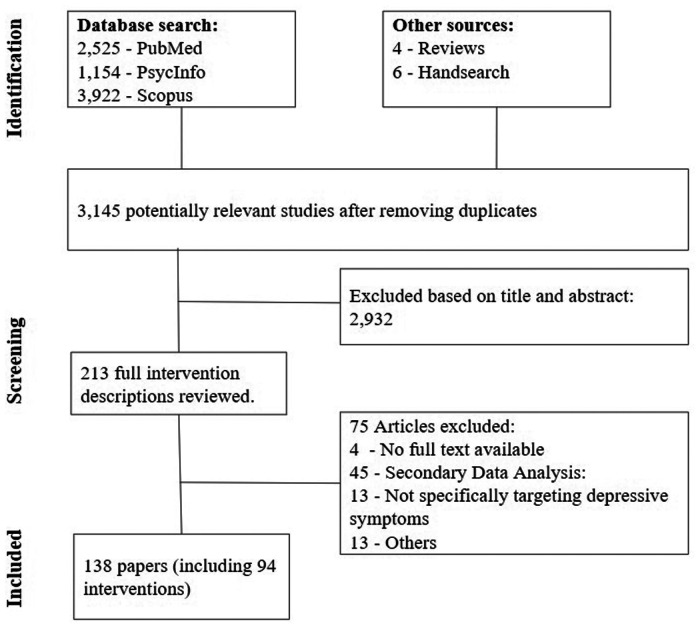
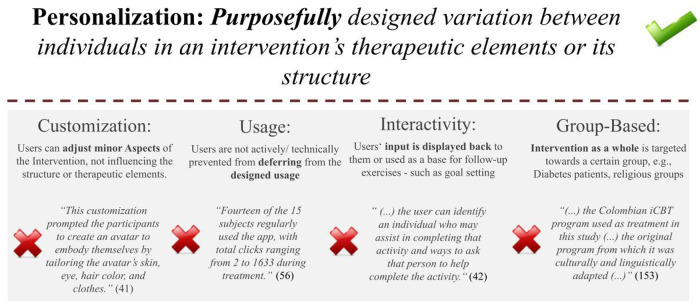
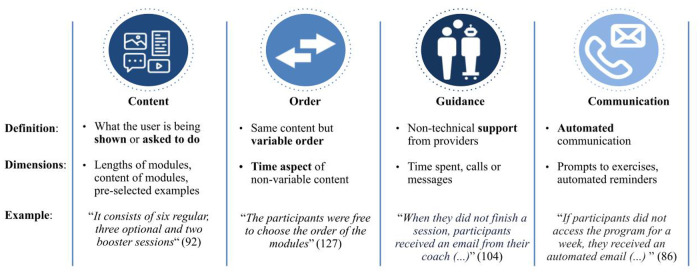
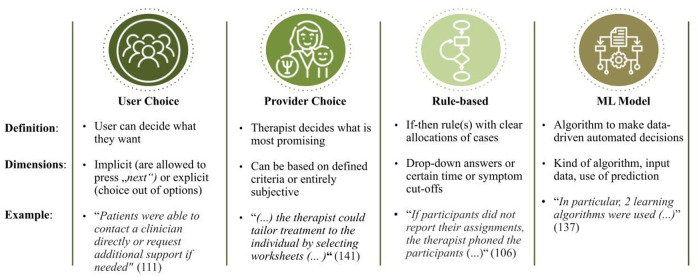
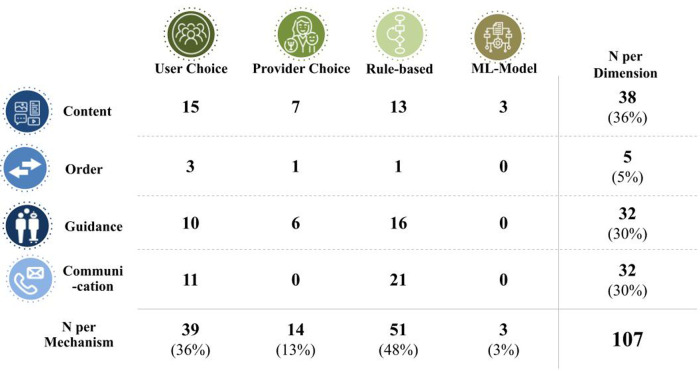
Introduction: Personalization is a much-discussed approach to improve adherence and outcomes for Digital Mental Health interventions (DMHIs). Yet, major questions remain open, such as (1) what personalization is, (2) how prevalent it is in practice, and (3) what benefits it truly has. Methods: We address this gap by performing a systematic literature review identifying all empirical studies on DMHIs targeting depressive symptoms in adults from 2015 to September 2022. The search in Pubmed, SCOPUS and Psycinfo led to the inclusion of 138 articles, describing 94 distinct DMHIs provided to an overall sample of approximately 24,300 individuals. Results: Our investigation results in the conceptualization of personalization as purposefully designed variation between individuals in an intervention's therapeutic elements or its structure. We propose to further differentiate personalization by what is personalized (i.e., intervention content, content order, level of guidance or communication) and the underlying mechanism [i.e., user choice, provider choice, decision rules, and machine-learning (ML) based approaches]. Applying this concept, we identified personalization in 66% of the interventions for depressive symptoms, with personalized intervention content (32% of interventions) and communication with the user (30%) being particularly popular. Personalization via decision rules (48%) and user choice (36%) were the most used mechanisms, while the utilization of ML was rare (3%). Two-thirds of personalized interventions only tailored one dimension of the intervention. Discussion: We conclude that future interventions could provide even more personalized experiences and especially benefit from using ML models. Finally, empirical evidence for personalization was scarce and inconclusive, making further evidence for the benefits of personalization highly needed. Systematic Review Registration: Identifier: CRD42022357408.
Overview
The claims and statistics of this paper haven’t been checked yet.
Run the check — free, no account needed. It reads the open-access text and checks the sources it cites.
Integrity signals
Registry
Cites
Statistics
Figures
Verification
Claims the paper makes
The claims and statistics of this paper haven’t been checked yet.
Run the check — free, no account needed. It reads the open-access text and checks the sources it cites.
Claims other papers make about this one
Each is checked against this paper’s own text: does it say what the citing paper says it does?
The source backs part of the claim, not all of it — or backs it for a different population, condition or comparison.
In the citing paper
“Similarly, Hornstein et al. in their study noted that incorporating personalization strategies in digital mental health interventions specifically designed around patients’ symptoms and needs could lead to better management of depressive symptoms among healthcare workers [42].”
From Mental Health in Healthcare Workers Post-COVID-19: A Latin American Review and Insights into Personalized Management Strategies (2024) · cites this paper as [42]
Experimental — accuracy not yet measuredThe source backs part of the claim, not all of it — or backs it for a different population, condition or comparison.
In the citing paper
“While this study design does not permit definitive causal attribution to the personalization component specifically, the observed patterns are consistent with conceptual frameworks, suggesting that content alignment with users’ cognitive-emotional profiles enhances engagement [8,34].”
From Schema-Informed Digital Mental Health Intervention for Maladaptive Cognitive-Emotional Patterns: Randomized Controlled Trial (2025) · cites this paper as [8]
Experimental — accuracy not yet measured
Self-check
Percentages, sums and reported differences re-computed from the paper’s own numbers.
The self-check needs the paper’s full text.
Citations
Cites
Preferred Reporting Items for Systematic Reviews and Meta-Analyses: the PRISMA statement
Moher, D., Liberati, A., Tetzlaff, J., Altman, D. G., & for the PRISMA Group (2009) · BMJ · doi:10.1136/bmj.b2535 · Cited by 83,823
Preferred Reporting Items for Systematic Reviews and Meta-Analyses: The PRISMA Statement
Moher, D., Liberati, A., Tetzlaff, J., Altman, D. G., & The PRISMA Group (2009) · PLoS Medicine · doi:10.1371/journal.pmed.1000097 · Cited by 64,042
Wang, G., Ma, R., Qiao, G., Wada, K., Aizawa, Y., & Satoh, T. (2015) · Integrative Medicine International · doi:10.1159/000368408 · Cited by 18,762
Ferrari, A. J., Charlson, F. J., Norman, R. E., Patten, S. B., Freedman, G., Murray, C. J. L., Vos, T., & Whiteford, H. A. (2013) · PLoS Medicine · doi:10.1371/journal.pmed.1001547 · Cited by 3,115
Epidemiology of Adult DSM-5 Major Depressive Disorder and Its Specifiers in the United States
Hasin, D. S., Sarvet, A. L., Meyers, J. L., Saha, T. D., Ruan, W. J., Stohl, M., & Grant, B. F. (2018) · JAMA Psychiatry · doi:10.1001/jamapsychiatry.2017.4602 · Cited by 1,737 · cited 2×
“Yet, major questions remain open, such as (1) what personalization is, (2) how prevalent it is in practice, and (3) what benefits it truly has.”
BackgroundPrevalence of Depression in the Community from 30 Countries between 1994 and 2014
Lim, G. Y., Tam, W. W., Lu, Y., Ho, C. S., Zhang, M. W., & Ho, R. C. (2018) · Scientific Reports · doi:10.1038/s41598-018-21243-x · Cited by 1,557
Predictability and Personalization in the Service Encounter
Surprenant, C. F., & Solomón, M. R. (1987) · Journal of Marketing · doi:10.2307/1251131 · Cited by 1,174
Depression sum-scores don’t add up: why analyzing specific depression symptoms is essential
Fried, E. I., & Nesse, R. M. (2015) · BMC Medicine · doi:10.1186/s12916-015-0325-4 · Cited by 981
Lamers, F., van Oppen, P., Comijs, H. C., Smit, J. H., Spinhoven, P., van Balkom, A. J. L. M., Nolen, W. A., Zitman, F. G., Beekman, A. T. F., & Penninx, B. W. J. H. (2011) · The Journal of Clinical Psychiatry · doi:10.4088/jcp.10m06176blu · Cited by 913
Karyotaki, E., Efthimiou, O., Miguel, C., Maas genannt Bermpohl, F., Furukawa, T. A., Cuijpers, P., Individual Patient Data Meta-Analyses for Depression (IPDMA-DE) Collaboration, Riper, H., Patel, V., Mira, A., et al. (2021) · JAMA Psychiatry · doi:10.1001/jamapsychiatry.2020.4364 · Cited by 866
Research works printed but not linked: 2
- Deighton, 1996, The future of interactive marketing, Harv Bus Rev, 74, 151
- Karyotaki, 2021, Internet-based cognitive behavioral therapy for depression: a systematic review and individual patient data network meta-analysis, JAMA Psychiatry, 78, 361, 10.1001/jamapsychiatry.2020.4364 · DOI · Paper page
Cited by
Sorted by citations
Zantvoort, K., Nacke, B., Görlich, D., Hornstein, S., Jacobi, C., & Funk, B. (2024) · npj Digital Medicine · doi:10.1038/s41746-024-01360-w · Cited by 111
Self-citationGkintoni, E., Vassilopoulos, S. P., & Νικολάου, Γ. (2025) · Medicina · doi:10.3390/medicina61030431 · Cited by 77
Digital Literacy 5.0 to Enhance Multicultural Education
Anurogo, D., Ramba, H. L., Putri, N. D., & Putri, U. M. P. (2023) · Multicultural Islamic Education Review · doi:10.23917/mier.v1i2.3414 · Cited by 103
Shaban, M. M., Sharaa, H. M., Amer, F. G. M., & Shaban, M. (2024) · BMC Nursing · doi:10.1186/s12912-024-01787-2 · Cited by 75
Lauffenburger, J. C., Yom‐Tov, E., Keller, P. A., McDonnell, M. E., Crum, K. L., Bhatkhande, G., Sears, E. S., Hanken, K. E., Bessette, L. G., Fontanet, C. P., et al. (2024) · npj Digital Medicine · doi:10.1038/s41746-024-01028-5 · Cited by 43
Bucher, A., Blazek, E. S., & Symons, C. T. (2024) · Mayo Clinic Proceedings Digital Health · doi:10.1016/j.mcpdig.2024.05.007 · Cited by 41
Heterogeneity of Treatment Effects in Internet- and Mobile-Based Interventions for Depression
Terhorst, Y., Kaiser, T., Brakemeier, E., Moshe, I., Philippi, P., Cuijpers, P. J., Baumeister, H., & Sander, L. (2024) · JAMA Network Open · doi:10.1001/jamanetworkopen.2024.23241 · Cited by 35
Wanniarachchi, V. U., Greenhalgh, C., Choi, A., & Warren, J. (2025) · Frontiers in Digital Health · doi:10.3389/fdgth.2025.1500220 · Cited by 40
Peng, R., Li, X., Guo, Y., Ning, H., Huang, J., Jiang, D., Feng, H., & Liu, Q. (2024) · Digital Health · doi:10.1177/20552076241234628 · Cited by 26
Personalization in digital health interventions for older adults with cancer: A scoping review
Hwang, M., & Jiang, Y. (2023) · Journal of Geriatric Oncology · doi:10.1016/j.jgo.2023.101652 · Cited by 23
Watkins, E. R., Warren, F. C., Newbold, A., Hulme, C. T., Cranston, T., Aas, B., Bear, H. A., Botella, C., Burkhardt, F., Ehring, T. W., et al. (2024) · The Lancet Digital Health · doi:10.1016/s2589-7500(24)00148-1 · Cited by 23
Personalisation and Recommendation for Mental Health Apps: A Scoping Review
Matthews, P., & Rhodes-Maquaire, C. (2024) · Behaviour and Information Technology · doi:10.1080/0144929x.2024.2356630 · Cited by 20
Wen, X., Li, Y., Zhang, Q., Yao, Z., Gao, X., Sun, Z., Fang, X., & Huang, W. (2025) · Scientific Reports · doi:10.1038/s41598-025-95726-z · Cited by 21
Zantvoort, K., Isacsson, N. H., Funk, B., & Kaldo, V. (2024) · Digital Health · doi:10.1177/20552076241248920 · Cited by 18
Self-citationThe latest developments with internet-based psychological treatments for depression
Andersson, G. (2024) · Expert Review of Neurotherapeutics · doi:10.1080/14737175.2024.2309237 · Cited by 17
Muñoz-Ortega, S., Santamaría-Guayaquil, D., Pluas-Borja, J., Alvarado-Villa, G., Sandoval, V., Alvarado, R., Cherrez-Ojeda, I., & Faytong-Haro, M. (2024) · Journal of Personalized Medicine · doi:10.3390/jpm14070680 · Cited by 18
“Similarly, Hornstein et al. in their study noted that incorporating personalization strategies in digital mental health interventions specifically designed around patients’ symptoms and needs could lead to better management of depressive symptoms among healthcare workers [42].”
BackgroundDefining and operationalizing personalized psychological treatment – a systematic literature review
Harnas, S. J., Knoop, H., Sprangers, M. A. G., & Braamse, A. M. J. (2024) · Cognitive Behaviour Therapy · doi:10.1080/16506073.2024.2333345 · Cited by 20
Bhattacharjee, A., Xu, S. Y., Rao, P., Zeng, Y., Meyerhoff, J., Ahmed, S. I., Mohr, D. C., Liut, M., Mariakakis, A. T., Kornfield, R., et al. (2025) · Designing Interactive Systems Conference · doi:10.1145/3715336.3735810 · Cited by 24
Eiselt, A.-K., Kirkendall, S., Xiong, E., Langner, D., & Goldfarb, M. B. (2026) · Frontiers in Digital Health · doi:10.3389/fdgth.2025.1713334 · Cited by 18
Singha, R., & Singha, S. (2024) · Advances in medical technologies and clinical practice book series · doi:10.4018/979-8-3693-1123-3.ch006 · Cited by 15
Jin, S., Kim, B., & Han, K. (2025) · CHI Conference on Human Factors in Computing Systems · doi:10.1145/3706598.3713732 · Cited by 24
Optimizing Workplace Digital Mental Health Interventions: Systematic Review and Meta-Analysis
Stratton, E., Morris, R. W., Milton, A. C., Deady, M., Choi, I., & Glozier, N. (2025) · Journal of Medical Internet Research · doi:10.2196/71253 · Cited by 17
Advancing youth co-design of ethical guidelines for AI-powered digital mental health tools
Figueroa, C. A., Ramos, G., Psihogios, A. M., Ekuban, E., Bansie, P., de Haas, M., Karnik, N. S., Ajilore, O., Anderson, E. E., & Stiles‐Shields, C. (2025) · Nature Mental Health · doi:10.1038/s44220-025-00467-7 · Cited by 12
Sequeira, L., Kassam, I., D’Arcey, J., Zhou, W., Junaid, S., Luo, S., Boparai, N., Tackaberry-Giddens, L., & Kidd, S. A. (2023) · Translational Behavioral Medicine · doi:10.1093/tbm/ibad070 · Cited by 12
Shrestha, P., Haghighi, P. D., Sharp, G., Xie, J., & McNaney, R. (2024) · Designing Interactive Systems Conference · doi:10.1145/3643834.3661539 · Cited by 12
Elmer, T., Wolf, M., Snippe, E., & Scholz, U. (2025) · JMIR Mental Health · doi:10.2196/74103 · Cited by 16
Behr, S., Fenski, F., Boettcher, J., Knaevelsrud, C., Hammelrath, L., Kovacs, G., Schirmer, W., Petrick, H., Becker, P., & Schaeuffele, C. (2024) · Internet Interventions · doi:10.1016/j.invent.2024.100723 · Cited by 11
Jackson, H. M., Gulliver, A., Hasking, P. A., Leach, L., Batterham, P. J., Calear, A. L., & Farrer, L. M. (2024) · Digital Health · doi:10.1177/20552076241277175 · Cited by 16
Watkins, E. R., Warren, F. C., Newbold, A., Hulme, C., Cranston, T., Aas, B., Bear, H., Botella, C., Burkhardt, F., Ehring, T., et al. (2024) · The Lancet Digital Health · doi:10.1016/s2589-7500(24)00149-3 · Cited by 12
Evaluating AI-Driven Mental Health Solutions: A Hybrid Fuzzy Multi-Criteria Decision-Making Approach
Ojo, Y., Makinde, O. A., Babatunde, O. V., Babatunde, G. B., & Okeowo, S. (2025) · AI · doi:10.3390/ai6010014 · Cited by 11
Yang, T.-T., Zheng, H.-X., Cao, S., Jing, M.-L., Ju, H., Zuo, Y., Chen, Q., & Zhang, J.-J. (2025) · Journal of Medical Internet Research · doi:10.2196/68762 · Cited by 12
Empathy by Design: Reframing the Empathy Gap Between AI and Humans in Mental Health Chatbots
Howcroft, A., & Blake, H. (2025) · Information · doi:10.3390/info16121074 · Cited by 13
Hornstein, S., Scharfenberger, J., Lueken, U., Wundrack, R., & Hilbert, K. (2024) · npj Digital Medicine · doi:10.1038/s41746-024-01121-9 · Cited by 10
Self-citationA systematic review on personalization of treatment components in IBIs for mental disorders
Schaeuffele, C., Zagorscak, P., Langerwisch, V., Wilke, J., Medvedeva, Y., & Knaevelsrud, C. (2025) · Internet Interventions · doi:10.1016/j.invent.2025.100840 · Cited by 11
Park, S. Y., Yourell, J., McAlister, K. L., & Huberty, J. (2023) · JMIR Formative Research · doi:10.2196/54284 · Cited by 22
Developing a Guided Web App for Postpartum Depression Symptoms: User-Centered Design Approach
Franco, P., Olhaberry, M., Muzard, A., Harismendy, Á., & Kelders, S. M. (2024) · JMIR Formative Research · doi:10.2196/56319 · Cited by 11
Jones, C., Cui, Y., Jeminiwa, R. N., Bajracharya, E., Chang, K., & Ma, T. (2024) · JMIR Diabetes · doi:10.2196/58327 · Cited by 14
Tang, T. S., Klein, G., Görges, M., Yip, A. K. W., Fisher, L., Polonsky, W. H., Hessler, D., & Taylor, D. (2024) · Diabetic Medicine · doi:10.1111/dme.15451 · Cited by 8
Recommendations for Mental Health Chatbot Conversations: An Integrative Review
Nieminen, H., Vartiainen, A., Bond, R., Laukkanen, E., Mulvenna, M. D., & Kuosmanen, L. (2025) · Journal of Advanced Nursing · doi:10.1111/jan.16762 · Cited by 7
Baumel, A. (2025) · Frontiers in Digital Health · doi:10.3389/fdgth.2025.1541676 · Cited by 7
Jung, H. W., Park, J. Y., Holoubek, T., Kim, W. J., & Park, J. (2025) · International Journal of Social Robotics · doi:10.1007/s12369-025-01323-5 · Cited by 11
Kutá, B., Novák, L., Žídková, R., Fürstová, J., Maliňáková, K., de Winter, A. F., & Hušek, V. (2025) · JMIR Mental Health · doi:10.2196/82642 · Cited by 12
Reuther, C., Lundgren, J., Gottvall, M., Ljungberg, J., Woodford, J., & von Essén, L. (2024) · Digital Health · doi:10.1177/20552076241260513 · Cited by 6
Hornstein, S., Lueken, U., Wundrack, R., & Hilbert, K. (2024) · JMIR AI · doi:10.2196/63701 · Cited by 6
Self-citationvan Deursen, D. S., Mobach, L., Salemink, E., Blankers, M., & Wiers, R. W. H. J. (2025) · Behaviour Research and Therapy · doi:10.1016/j.brat.2025.104718 · Cited by 6
Baird, A. M., & Xia, Y. (2024) · Business & Information Systems Engineering · doi:10.1007/s12599-024-00867-6 · Cited by 6
Adjei-Boateng, D., & Ikoh, C. L. (2025) · Cureus · doi:10.7759/cureus.85943 · Cited by 7
Matias, I., Farhat-ul-Ain, F.-U., Akhmetzyanova, D., & Tomberg, V. (2024) · ACM Conference on User Modeling, Adaptation and Personalization (UMAP) · doi:10.1145/3631700.3665241 · Cited by 9
Jackson, H. M., Batterham, P. J., Ohan, J. L., Calear, A. L., & Farrer, L. M. (2024) · BMC Psychiatry · doi:10.1186/s12888-024-05953-3 · Cited by 8
Hadjistavropoulos, H. D., Peynenburg, V. A., Sapkota, R. P., Titov, N., & Dear, B. F. (2024) · Internet Interventions · doi:10.1016/j.invent.2024.100758 · Cited by 4
Isacsson, N. H., Zantvoort, K., Forsell, E., Boman, M., & Kaldo, V. (2024) · Internet Interventions · doi:10.1016/j.invent.2024.100773 · Cited by 5
Self-citationKatsiroumpa, A., Konstantakopoulou, O., Moisoglou, I., Gallos, P., Galani, O., Lialiou, P., Tsiachri, M., & Galanis, P. (2025) · Healthcare · doi:10.3390/healthcare13243269 · Cited by 9
User experience and safety of generative AI-based mental health chatbots: Scoping review protocol
Olisaeloka, L., Richardson, C., & Vigo, D. (2026) · PLoS ONE · doi:10.1371/journal.pone.0341631 · Cited by 3
Personalized Digital Solutions for Mental Health
Ropero, J., Denecke, K., Rivera-Romero, O., & Gabarrón, E. (2023) · Studies in health technology and informatics · doi:10.3233/shti230797 · Cited by 3
Willemsen, R. F., Versluis, A., Aardoom, J. J., Petrus, A. H. J., Silven, A. V., Chavannes, N. H., & van Dijke, A. (2024) · International Journal of Medical Informatics · doi:10.1016/j.ijmedinf.2024.105485 · Cited by 2
Jeong, S., Kim, H., Lho, S. K., Hwang, I., Mun, S., Kim, S., Lim, H., Kim, H., Shin, M.-S., & Moon, W. (2025) · Journal of Medical Internet Research · doi:10.2196/65892 · Cited by 2
“In addition, incorporating process-level metrics (eg, perceived fit, emotional resonance, and user satisfaction) would help clarify the mechanisms through which personalization influences engagement and outcomes [8].”
InfluentialBirkeland, M. S., Blestad, C., Skar, A. S., Arnberg, F. K., & Jensen, T. K. (2025) · European Journal of Psychotraumatology · doi:10.1080/20008066.2025.2481703 · Cited by 2
Smith, A. C., Ahuvia, I. L., Zapata, J. P., Cohen, K. A., Graham, A. K., & Schleider, J. L. (2025) · Behaviour Research and Therapy · doi:10.1016/j.brat.2025.104809 · Cited by 2
Frameworks for Developing Digital Mental Health Interventions
Neto, D. D., Sebastião, R., Baptista, T. M., & Petkari, E. (2025) · European Psychologist · doi:10.1027/1016-9040/a000571 · Cited by 2
Schouten, M. J. E., Goudriaan, A. E., Schaub, M. P., Dekker, J., & Blankers, M. (2024) · Psychological Medicine · doi:10.1017/s0033291724000953 · Cited by 2
Ganjali, R., Sabbagh, M. G., & Eslami, S. (2025) · Frontiers in Digital Health · doi:10.3389/fdgth.2024.1386012 · Cited by 3
Myklebost, S. B., Nordgreen, T., Ronold, E. H., Heltne, A., & Hammar, Å. (2025) · Acta Psychiatrica Scandinavica · doi:10.1111/acps.70019 · Cited by 2
Isacsson, N. H., Gómez-Zaragozá, L., Abdesslem, F. B., Boman, M., & Kaldo, V. (2025) · Internet Interventions · doi:10.1016/j.invent.2025.100879 · Cited by 2
Dealing with Diversity in Digital Psychological Interventions for Young People: A Structured Review
Jahedi, F., Henman, P. W. F., & Ryan, J. C. (2024) · ACI Open · doi:10.1055/s-0044-1788563 · Cited by 1
Digital Mental Health Apps: Key Features and User Engagement for Better Wellness
Rocha, C., Martinho, D., Conceição, L., Nováis, P., & Marreiros, G. (2024) · Lecture notes in computer science · doi:10.1007/978-3-031-77731-8_39 · Cited by 1
Shastry, K. A., & Lakshmi, M. (2025) · Springer eBooks · doi:10.1007/978-3-031-80056-6_4 · Cited by 1
Forde, S. A., Rea, S., Racine, E., & Coppinger, T. C. (2025) · Research Involvement and Engagement · doi:10.1186/s40900-025-00735-x · Cited by 1
Fenski, F., Becker, S., Dahlhues, S., Esch, L.-F., Froehlich, K., Haedrich, A., Karg, A., Krugel, A., Merico, V., Riemann, C., et al. (2025) · BMC Digital Health · doi:10.1186/s44247-025-00178-0 · Cited by 1
A literature review of remote mental health screening: barriers, potential solutions, and tools
Quiram, N., Salam, T., Sadjadpour, F., Hosseinichimeh, N., Jarvis, L. R., & Soghier, L. M. (2025) · Frontiers in Digital Health · doi:10.3389/fdgth.2025.1670691 · Cited by 2
Digital Mental Health Treatments for Depression
Ramos, G., Karyotaki, E., Mohr, D. C., & Schueller, S. M. (2025) · Psychiatric Clinics of North America · doi:10.1016/j.psc.2025.08.023 · Cited by 1
Auyeung, L., Mak, W. W. S., & Tsang, E. Z. (2025) · Computers in Human Behavior Reports · doi:10.1016/j.chbr.2025.100880 · Cited by 1
Designing Resilient Educational Ecologies for Mental Health in Techno-Social Learning Environments
Alam, A. (2025) · IGI Global eBooks · doi:10.4018/979-8-3373-5007-3.ch001 · Cited by 1
Amarti, K., Čihařová, M., Provoost, S., Schulte, M. H. J., Kleiboer, A. M., el Hassouni, A., Gonçalves, G., & Riper, H. M. (2025) · Internet Interventions · doi:10.1016/j.invent.2025.100900 · Cited by 1
Klein, A., Song, J., Chim, J., Keren, L., Triantafyllopoulos, A., Schuller, B., Liakata, M., & Atzil-Slonim, D. (2026) · JMIR Formative Research · doi:10.2196/71230 · Cited by 1
Jung, L., Guth, M., Schönfeld, P., Fuchs, M., Vatter, H., Selaskowski, B., Wiebe, A., Philipsen, A., & Braun, N. (2026) · Journal of Technology in Behavioral Science · doi:10.1007/s41347-026-00613-7 · Cited by 1
Personalised AI Coaching Technology: A Systematic Mapping Review
Vitale, J., Cenacchi, F., Kraus, M., Orji, F. A., Richards, D., Orji, R., Conati, C., & Berkovsky, S. (2026) · ACM Transactions on Interactive Intelligent Systems · doi:10.1145/3820900 · Cited by 1
Gresser, L. A., Lalgi, T. J., Wollenberg, P. J., Diel, A., Jansen, C., Robitzsch, R., Teufel, M., Bäuerle, A., & Robitzsch, A. (2026) · BMC Psychiatry · doi:10.1186/s12888-026-08390-6 · Cited by 1
Gitlin, L. N., McClure, L. A., Webster, M. J., Lyketsos, C. G., & Kales, H. C. (2026) · Journal of the American Geriatrics Society · doi:10.1111/jgs.70637 · Cited by 1
Zainal, N. H., Rajendra, S. J., Doren, N. V., Salamanca-Sanabria, A., Curtiss, J. E., & Keng, S. (2025) · BMC Psychiatry · doi:10.1186/s12888-025-07372-4 · Cited by 2
Watkins, E. R., Warren, F. C., Newbold, A., Hulme, C. T., Cranston, T., Aas, B., Bear, H. A., Botella, C., Burkhardt, F., Ehring, T. W., et al. (2024) · SSRN Electronic Journal · doi:10.2139/ssrn.4837551
User-Centered Usability Evaluation of the DiaCare App for Diabetes Self-Management: A uMARS Analysis
Kurnia, A., Said, F. M., & Panduragan, S. L. (2024) · Al-Rafidain Journal of Medical Sciences · doi:10.54133/ajms.v7i2.1499
Siddiqui, S., Khan, A. A., Khan, M. A., & Sosan, R. (2025) · Springer eBooks · doi:10.1007/978-3-031-81433-4_5
Zantvoort, K., Matthiesen, J., Bjurner, P., Bendix, M., Brefeld, U., Funk, B., & Kaldo, V. (2025) · Internet Interventions · doi:10.1016/j.invent.2025.100828 · Cited by 1
Self-citationLisowska, A., Lewis, N., Gabanelli, P., Fraterman, I., Sacchi, L., Quaglini, S., Szymon Wilk, A., & Mor Peleg, B. (2025) · Lecture notes of the Institute for Computer Sciences, Social Informatics and Telecommunications Engineering · doi:10.1007/978-3-031-85572-6_6
Wu, L., Zhu, C., Seguin, J. P., Xie, J., Kulkarni, P., Li, M., & Olivier, P. L. (2025) · doi:10.2196/preprints.76695
Aslani, A., Khademian, F., Ravangard, R., Nami, M., Jafari, P., & Bastani, P. (2025) · Current Psychology · doi:10.1007/s12144-025-08054-w
Purnamasari, A., Said, A., Indriani, C., Lisnawati, L., & Andas, A. M. (2025) · The Malaysian Journal of Nursing · doi:10.31674/mjn.2025.v17i01.015
Amarti, K., Čihařová, M., Provoost, S., Schulte, M. H. J., Kleiboer, A. M., el Hassouni, A., Gonçalves, G., & Riper, H. M. (2025) · SSRN Electronic Journal · doi:10.2139/ssrn.5357442
Morley, J. (2025) · Wiley eBooks · doi:10.1002/9781394240821.ch13
Kutá, B., Novák, L., Žídková, R., Fürstová, J., Maliňáková, K., de Winter, A. F., & Hušek, V. (2025) · doi:10.2196/preprints.82642
A comparative study on persuasive strategies in anxiety disorder application
Zailani, A. U., Ahmad, W. N. W., & Tuah, N. M. (2025) · AIP conference proceedings · doi:10.1063/5.0299316
Yeung, S. K., Leung, F. H. T., Lee, J. T., Cheung, G. M. H., Li, C. W., & Mak, W. W. S. (2025) · doi:10.2196/preprints.71165
Gresser, L. A., Lalgi, T. J., Wollenberg, P. J., Diel, A., Jansen, C., Robitzsch, R., Teufel, M., Bäuerle, A., & Robitzsch, A. (2025) · doi:10.2196/preprints.84009
Yeung, S. K., Leung, F. H. T., Lee, J. C. M., Cheung, G. M. H., Li, C. W., & Mak, W. W. S. (2025) · JMIR Human Factors · doi:10.2196/71165
de Vries, M., Begeman, M., Derksen, M. E., Goudriaan, A. E., & Blankers, M. (2026) · JMIR Human Factors · doi:10.2196/86752
Modeling Gen Z’s Emotional Engagement in AI-driven Personalized Playlist: Spotify Daylist Case Study
Michaela, I., Vianca, S., & Handayani, F. (2025) · International Conference on Information Management and Technology (ICIMTech) · doi:10.1109/icimtech67074.2025.11265176
Southwick, L., Gonzales, R. E., Bellini, L. M., Asch, D. A., Mitra, N., Balachandran, M., Wolk, C. B., Becker‐Haimes, E. M., Kishton, R. E., Beck, S., et al. (2025) · JMIR Formative Research · doi:10.2196/74086
Jackson, H. M., Batterham, P. J., Ohan, J. L., Calear, A. L., & Farrer, L. M. (2024) · Figshare · doi:10.6084/m9.figshare.26756740
Metadata
- Authors
- Hornstein, S., Zantvoort, K., Lueken, U., Funk, B., & Hilbert, K.
- Affiliations
- Humboldt-Universität zu Berlin (DE)
- Leuphana University of Lüneburg (DE)
- Corresponding author
- Hornstein, Silvan
- Venue
- Frontiers in Digital Health
- Publisher
- Frontiers Media SA
- Published
- 2023-05-22
- Volume
- 5
- Pages
- 1170002-1170002
- ISSN
- 2673-253X (ISSN-L)
- PMC
- PMC10239832
- OpenAlex
- W4377294815
- Cited by
- 134
- References
- 187
- Citations by year
- 2026: 43 · 2025: 50 · 2024: 36 · 2023: 5
- FWCI
- 4.55
- Type
- journal article
- Language
- en
- Open access
- gold
- doi.org
- Licence
- Locations
- Frontiers in Digital Health (publishedVersion, cc-by)
- PubMed Central (publishedVersion, cc-by)
- PubMed (publishedVersion)
- edoc Publication server (Humboldt University of Berlin) (submittedVersion, cc-by)
- DOAJ (DOAJ: Directory of Open Access Journals) (submittedVersion, cc-by-sa)
- Multilingual Matters (Channel View Publications) (submittedVersion, cc-by)
- edoc Publication server (Humboldt University of Berlin) (cc-by)
- PubData (cc-by)
- Funders
- Deutsche Forschungsgemeinschaft (491192747)
- Humboldt-Universität zu Berlin
- Topics
- Social Sciences › Psychology › Applied Psychology › Digital Mental Health Interventions
- Health Sciences › Health Professions › General Health Professions › Mobile Health and mHealth Applications
- Social Sciences › Psychology › Experimental and Cognitive Psychology › Anxiety, Depression, Psychometrics, Treatment, Cognitive Processes
- Keywords
- personalization, digital mental health interventions, depressive symptoms, depression, user choice, decision rules, machine learning, conceptual framework
About these checks
Registry, retraction, Cites and statistics results are computed, not judged, with one exception: a printed reference that no index lists is read once by a model before it counts as a citation error. Claims are extracted by a model and kept only when their quote appears verbatim in the text; each cited source is then checked, with a model’s help, for whether it says what the claim relies on. Those verdicts can be wrong — read the claim’s quote and the cited source before relying on one.
Statistics and arithmetic are recomputed, not judged.
Confidence bands are shown only for fields calibrated on our annotated test set. None is calibrated yet, so no band is shown.
What counts as a claim ›How we measure confidence ›How we check this ›
Are you an author, or do you see a problem with this page? Request a review
