

Real world effectiveness of subcutaneous semaglutide in type 2 diabetes: A retrospective, cohort study (Sema-MiDiab01)
Open accessThe DOI matches its Crossref record; 49 of the 49 references it cites were found in a registry or an index.
Abstract
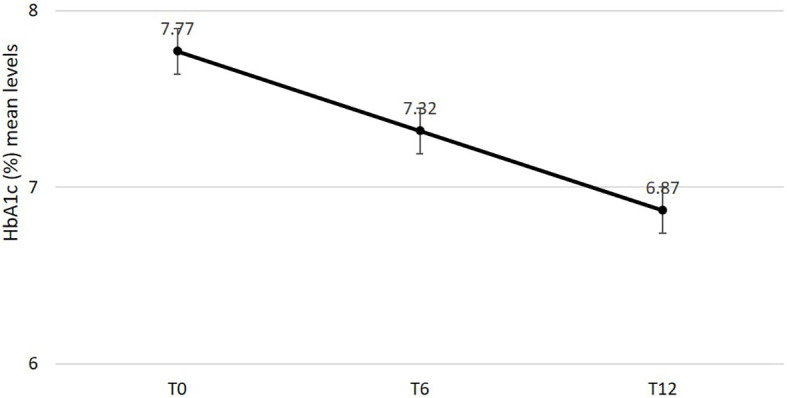
Introduction: Aim of the present study was to evaluate the real-world impact of once-weekly (OW) subcutaneous semaglutide on different end-points indicative of metabolic control, cardiovascular risk factors, and beta-cell function in type 2 diabetes (T2D). Methods: This was a retrospective, observational study conducted in 5 diabetes clinics in Italy. Changes in HbA1c, fasting blood glucose (FBG), body weight, blood pressure, lipid profile, renal function, and beta-cell function (HOMA-B) during 12 months were evaluated. Results: Overall, 594 patients (97% GLP-1RA naïve) were identified (mean age 63.9 ± 9.5 years, 58.7% men, diabetes duration 11.4 ± 8.0 years). After 6 months of treatment with OW semaglutide, HbA1c levels were reduced by 0.90%, FBG by 26 mg/dl, and body weight by 3.43 kg. Systolic blood pressure, total and LDL-cholesterol significantly improved. Benefits were sustained at 12 months. Renal safety was documented. HOMA-B increased from 40.2% to 57.8% after 6 months (p<0.0001). Discussion: The study highlighted benefits of semaglutide on metabolic control, multiple CV risk factors, and renal safety in the real-world. Semaglutide seems to be an advisable option for preservation of β-cell function and early evidence suggests it might have a role in modifying insulin resistance (HOMA-IR), the pathogenetic basis of prediabetes and T2D.
Overview
The claims and statistics of this paper haven’t been checked yet.
Free: it reads the open-access text and checks the first 5 claims that cite a source we can check. Create a free account to check every claim.
Integrity signals
Registry
Cites
Statistics
Figures
Verification
Claims the paper makes
The claims and statistics of this paper haven’t been checked yet.
Free: it reads the open-access text and checks the first 5 claims that cite a source we can check. Create a free account to check every claim.
Self-check
Percentages, sums and reported differences re-computed from the paper’s own numbers.
The self-check needs the paper’s full text.
Citations
Cites
IDF Diabetes Atlas: Global estimates of diabetes prevalence for 2017 and projections for 2045
Cho, N. H., Shaw, J. E., Karuranga, S., Huang, Y., da Rocha Fernandes, J. D., Ohlrogge, A. W., & Malanda, B. (2018) · Diabetes Research and Clinical Practice · doi:10.1016/j.diabres.2018.02.023 · Cited by 7,283
Semaglutide and Cardiovascular Outcomes in Patients with Type 2 Diabetes
Marso, S. P., Bain, S. C., Consoli, A., Eliaschewitz, F. G., Jódar, E., Leiter, L. A., Lingvay, I., Rosenstock, J., Seufert, J., Warren, M. L., et al. (2016) · New England Journal of Medicine · doi:10.1056/nejmoa1607141 · Cited by 6,900
Ahlqvist, E., Storm, P., Käräjämäki, A., Martinell, M., Dorkhan, M., Carlsson, A., Vikman, P., Prasad, R. B., Aly, D. M., Almgren, P., et al. (2018) · The Lancet Diabetes & Endocrinology · doi:10.1016/s2213-8587(18)30051-2 · Cited by 2,335
GLP-1 receptor agonists in the treatment of type 2 diabetes - state-of-the-art
Nauck, M. A., Quast, D. R., Wefers, J., & Meier, J. J. (2021) · Molecular Metabolism · doi:10.1016/j.molmet.2020.101102 · Cited by 1,647 · cited 1×
“Semaglutide is the most recent available GLP-1RA; it has a sequence homology of 94% compared to human GLP-1 and is the first analogue available in both injectable and oral formulation (15).”
Background9. Pharmacologic Approaches to Glycemic Treatment: Standards of Medical Care in Diabetes—2022
American Diabetes Association Professional Practice Committee (2022) · Diabetes Care · doi:10.2337/dc22-s009 · Cited by 1,555
Discovery of the once-weekly glucagon-like peptide-1 (GLP-1) analogue semaglutide
Lau, J., Bloch, P., Schäffer, L., Pettersson, I., Spetzler, J., Kofoed, J., Madsen, K., Knudsen, L. B., McGuire, J., Steensgaard, D. B., et al. (2015) · Journal of Medicinal Chemistry · doi:10.1021/acs.jmedchem.5b00726 · Cited by 1,105 · cited 1×
“OW semaglutide is indicated in subjects with uncontrolled type 2 diabetes as a monotherapy when the use of metformin is contraindicated, or as an add-on therapy with other glucoselowering drugs, including insulin (18, 19); furthermore, based on the most recent guidelines, it can be considered for use as a first-line t…”
BackgroundNauck, M. A., Kleine, N., �rskov, C., Holst, J. J., Willms, B., & Creutzfeldt, W. (1993) · Diabetologia · doi:10.1007/bf00401145 · Cited by 1,092
Pratley, R. E., Aroda, V. R., Lingvay, I., Lüdemann, J., Andreassen, C., Navarria, A., & Viljoen, A. (2018) · The Lancet Diabetes & Endocrinology · doi:10.1016/s2213-8587(18)30024-x · Cited by 790
Sorli, C., Harashima, S.-I., Tsoukas, G. M., Unger, J., Karsbøl, J. D., Hansen, T., & Bain, S. C. (2017) · The Lancet Diabetes & Endocrinology · doi:10.1016/s2213-8587(17)30013-x · Cited by 745
Interpretation and Impact of Real-World Clinical Data for the Practicing Clinician
Blonde, L., Khunti, K., Harris, S. B., Meizinger, C., & Skolnik, N. S. (2018) · Advances in Therapy · doi:10.1007/s12325-018-0805-y · Cited by 714 · cited 1×
“As known, real-world studies allow to assess whether the results of experimental studies can be reproduced in broader samples of patients managed under routine clinical practice (24).”
Background
Research works printed but not linked: 2
- Di Folco, 2022, Effects of semaglutide on cardiovascular risk factors and eating behaviors in type 2 diabetes, Acta Diabetol, 59, 10.1007/s00592-022-01936-6 · DOI · Paper page
- 44. Di Loreto C, Minarelli V, Nasini G, Norgiolini R, Del Sindaco P. Effectiveness in real world of once weekly semaglutide in people with type 2 diabetes: Glucagon-like peptide receptor agonist naive or switchers from other glucagon-like peptide receptor agonists: Results from a retrospective observational study in umbria. Diabetes Ther (2022) 13(3):551-67. doi: 10.1007/s13300-022-01218-y · DOI · Paper page
Cited by
Singh, A., Shadangi, S., Gupta, P. K., & Rana, S. (2025) · Comprehensive Physiology · doi:10.1002/cph4.70003 · Cited by 163
Semaglutide and cancer: A systematic review and meta-analysis
Nagendra, L., BG, H., Sharma, M., & Dutta, D. (2023) · Diabetes & Metabolic Syndrome: Clinical Research & Reviews · doi:10.1016/j.dsx.2023.102834 · Cited by 86
Effectiveness and safety of drugs for obesity
Henderson Lewis, K., Sloan, C. E., Bessesen, D. H., & Arterburn, D. (2024) · BMJ · doi:10.1136/bmj-2022-072686 · Cited by 66
Glucagon-like peptide-1 receptor agonists and muscle mass effects
Ceasovschih, A., Asaftei, A., Lupo, M. G., Kotlyarov, S., Bartušková, H., Balta, A., Sorodoc, V., Sorodoc, L., & Banach, M. (2025) · Pharmacological Research · doi:10.1016/j.phrs.2025.107927 · Cited by 64
Janež, A., Muzurović, E. M., Bogdański, P., Czupryniak, L., Fábryová, Ľ., Fras, Z., Guja, C., Haluzík, M., Kempler, P., Lalic, N. M., et al. (2024) · Diabetes Therapy · doi:10.1007/s13300-024-01615-5 · Cited by 70
“C 91.13 vs. 81.88 mg/ dl, p = 0.0002; TC 167.07 vs. 155.61 mg/dl; p < 0.0001) [54].”
InfluentialType 2 diabetes mellitus pharmacological remission with dapagliflozin plus oral semaglutide
Lunati, M. E., Cimino, V., Bernasconi, D. P., Gandolfi, A., Morpurgo, P. S., Tinari, C., Lazzaroni, E., Baruffaldi, L., Muratori, M., Montefusco, L. B., et al. (2023) · Pharmacological Research · doi:10.1016/j.phrs.2023.107040 · Cited by 36
“Oral semaglutide is a GLP-1RA that has shown effectiveness in ameliorating both glycometabolic and is the first GLP-1RA developed as an oral medication, allowing an earlier initiation of GLP-1RA therapy [11,12].”
Self-citationBerra, C., Manfrini, R., Bifari, F., Cipponeri, E., Ghelardi, R., Centofanti, L., Mortola, U., Lunati, E., Bucciarelli, L. G., Cimino, V., et al. (2024) · Pharmacological Research · doi:10.1016/j.phrs.2024.107517 · Cited by 20
Self-citationMiao, X., Davoudi, M., Alitotonchi, Z., Ahmadi, E. S., Amraee, F., Alemi, A., & Afrisham, R. (2025) · Diabetology & Metabolic Syndrome · doi:10.1186/s13098-025-01581-3 · Cited by 20
“A 6-month treatment with semaglutide reduced LDL-C and TC, whereas the decrease in TG became apparent only after 12 months [53].”
An updated patent review of GLP-1 receptor agonists (2020-present)
Lu, W., Zhou, Z., Jiang, N., & Han, J. (2023) · Expert Opinion on Therapeutic Patents · doi:10.1080/13543776.2023.2274905 · Cited by 17
Wang, W., Huang, F., & Han, C. (2023) · Diabetes Therapy · doi:10.1007/s13300-023-01459-5 · Cited by 14
“semaglutide preserves b-cell function well in the T2DM population [13, 14].”
BackgroundAlenzi, S., Alzahrani, A., Aljaloud, A., Alanazi, K., & Alarfaj, S. J. (2024) · Frontiers in Endocrinology · doi:10.3389/fendo.2024.1395651 · Cited by 11
“Furthermore, we found a statistically signi fi cant reduction in FBG, BMI, total cholesterol, and LDL in line with existing literature (15, 33).”
Resultde Lucas, M. D. G., Caballero, I., Fernández‐García, J. C., Domínguez-Rodríguez, M., Moreno-Moreno, P., Jiménez-Millán, A., Botana-López, M. A., Avilés, B., Merino-Torres, J. F., Soto, A., et al. (2023) · Frontiers in Endocrinology · doi:10.3389/fendo.2023.1240279 · Cited by 10
Bonora, B. M., Giaccari, A., Consoli, A., Broglio, F., Avogaro, A., Fadini, G. P., & for the GLIMPLES Study Investigators (2025) · Diabetes/Metabolism Research and Reviews · doi:10.1002/dmrr.70045 · Cited by 7
Yao, Y., Liu, N., Chen, S., Sun, M., & Guo, Y. (2025) · European journal of medical research · doi:10.1186/s40001-025-03241-8 · Cited by 7
“Among the included studies, four studies included T2D patients [27, 32, 37, 40], another four studies included T2D at higher CVD [36, 38, 39, 41], seven studies included patients with T2D combined with CVD [28–31, 33, 34], and the remaining two studies included patients with T2D had established…”
InfluentialKatz, G. (2025) · Hormone and Metabolic Research · doi:10.1055/a-2569-7315 · Cited by 7
Ethnic differences in adipose tissue dysfunction and insulin resistance: a scoping review
AlShehab, M., Costabile, A., Patterson, M., & Hakim, O. (2025) · Diabetes Research and Clinical Practice · doi:10.1016/j.diabres.2025.112363 · Cited by 6
Buse, J. B., Christensen, H. N., Harty, B. J., Cziraky, M. J., Willey, V. J., & Skibsted, S. (2025) · BMJ Open Diabetes Research & Care · doi:10.1136/bmjdrc-2025-005161 · Cited by 6
Liu, J., Xu, W., Zhang, Y., Jia, Y., Bai, S., Er, L., & Du, R. (2025) · BMC Cardiovascular Disorders · doi:10.1186/s12872-025-05300-8 · Cited by 4
“For example, treatment with glucose-lowering drugs (such as glucagon-like peptide-1 receptor agonist, GLP-1RA) improves insulin sensitivity [40].”
Khare, S., Osumili, B., Debackere, N., Keapoletswe, K., Falato, S., Raoul, T., & Coles, B. (2024) · Advances in Therapy · doi:10.1007/s12325-024-03002-9 · Cited by 4
Barakat, G. M., Hassan, S. E. H., Akhdar, H., Duong-Trung, N., & Ramadan, W. (2026) · JMIR AI · doi:10.2196/86960 · Cited by 2
“Such predictive resources allow for more accurate therapeutic decisions, improving short-term results and long-term disease management [23].”
Buenaventura, D. C., Ramos, A. F. G., Valencia, C. M. B., Aguilar-Londoño, C., Coronel-Restrepo, N., Monsalve, C., Cuesta, D., & Rincón, A. R. (2024) · Frontiers in Endocrinology · doi:10.3389/fendo.2024.1372992 · Cited by 3
Pereira, A. W. M., Pereira, J. A., & Ferreira, S. (2024) · Research Society and Development · doi:10.33448/rsd-v13i7.46426 · Cited by 2
Fang, B., Liu, F., Luo, J., Song, N., Liu, C., Ji, W., An, X., Xie, Q., Yang, Y., & Li, X. (2025) · Diabetes Metabolic Syndrome and Obesity · doi:10.2147/dmso.s535325 · Cited by 1
“30 GLP-1RAs typically lead to decreased appetite and food intake, resulting in weight loss.”
Yu, Z., Fu, D., Xu, J., Lin, C., Yin, G., Cai, D., Jiang, H., Ling, K., Chen, J., & Zhuo, Y. (2026) · Frontiers in Endocrinology · doi:10.3389/fendo.2026.1756581 · Cited by 1
Utilizing Semaglutide for Addressing Type-2 Diabetes and Obesity
Gupta, R., & Sharma, S. (2025) · Current Signal Transduction Therapy · doi:10.2174/0115743624346660250317013032 · Cited by 2
Berra, C., Manfrini, R., Bifari, F., Cipponeri, E., Ghelardi, R., Centofanti, L., Mortola, U., Lunati, E., Bucciarelli, L. G., Cimino, V., et al. (2025) · Pharmacological Research · doi:10.1016/j.phrs.2025.107640
Self-citationReza, A. A. (2024) · Pécsi Egyetemi Archívum (University of Pécs)
Ekinci, E. I., Maldonado, S. G., Unseld, A., Arrubla, J., Hennige, A. M., & Schoelch, C. (2026) · Diabetes Obesity and Metabolism · doi:10.1111/dom.70861
“Semaglutide similarly increased HOMA-β [37], decreased HOMA-IR [37, 38], and increased rates of insulin secretion compared with placebo [39], with comparable effects observed in adults with overweight or obesity without diabetes [40].”
GLP-1R and GIPR crosstalk modulates insulinotropic signaling pathways
Lindquist, P., Dijkhof, L. R. H., Drzazga, A. K., Sabatier, P., Stępniewski, T. M., Granlund, L., Lechner, M. Y., Zhong, Y., Gasbjerg, L. S., Hartmann, B., et al. (2026) · Cell chemical biology · doi:10.1016/j.chembiol.2026.06.003
Metadata
- Authors
- Berra, C. C., Rossi, M. C., Mirani, M., Ceccarelli Ceccarelli, D., Romano, C., Sassi, L., Peretti, E., Favacchio, G., Pastore, I., Folini, L., Graziano, G., Lunati, M. E., Solerte, S. B., & Fiorina, P.
- Affiliations
- MultiMedica (IT)
- Center for Outcomes Research and Clinical Epidemiology (IT)
- IRCCS Humanitas Research Hospital (IT)
- Ospedale di Circolo e Fondazione Macchi (IT)
- ASST Fatebenefratelli Sacco (IT)
- University of Pavia (IT)
- University of Milan (IT)
- Corresponding author
- Berra, Cesare C.
- Rossi, Maria Chiara
- ORCID
- Venue
- Frontiers in Endocrinology
- Publisher
- Frontiers Media SA
- Published
- 2023-01-18
- Volume
- 13
- Pages
- 1099451-1099451
- ISSN
- 1664-2392 (ISSN-L)
- PMC
- PMC9889982
- OpenAlex
- W4317107805
- Semantic Scholar
- 224562d58fbca460fe2bbab5da22ff6de198fdf5
- Cited by
- 28
- References
- 49
- Citations by year
- 2026: 4 · 2025: 12 · 2024: 7 · 2023: 5
- FWCI
- 5.74
- Type
- journal article
- Language
- en
- Open access
- gold
- doi.org
- Licence
- Locations
- Frontiers in Endocrinology (publishedVersion, cc-by)
- PubMed Central (publishedVersion, cc-by)
- PubMed (publishedVersion)
- Archivio Istituzionale della Ricerca (Universita Degli Studi Di Milano) (submittedVersion, other-oa)
- DOAJ (DOAJ: Directory of Open Access Journals) (submittedVersion, cc-by-sa)
- Funders
- Novo Nordisk
- Topics
- Health Sciences › Medicine › Endocrinology, Diabetes and Metabolism › Diabetes Treatment and Management
- Health Sciences › Medicine › Endocrinology, Diabetes and Metabolism › Diabetes Management and Research
- Health Sciences › Medicine › Endocrinology, Diabetes and Metabolism › Diabetes, Cardiovascular Risks, and Lipoproteins
- Keywords
- semaglutide, type 2 diabetes, GLP-1 receptor agonists, glycemic control, HbA1c, fasting blood glucose, weight loss, blood pressure, lipid profile, renal safety, beta-cell function, HOMA-β, insulin resistance, cardiovascular risk factors, real-world effectiveness
- MeSH terms
- Semaglutide, Aged, Body Weight, Diabetes Mellitus, Type 2, Female, Glycated Hemoglobin, Humans, Hypoglycemic Agents, Male, Middle Aged, Retrospective Studies, Cohort Studies
About these checks
Registry, retraction, Cites and statistics results are computed, not judged, with one exception: a printed reference that no index lists is read once by a model before it counts as a citation error. Claims are extracted by a model and kept only when their quote appears verbatim in the text; each cited source is then checked, with a model’s help, for whether it says what the claim relies on. Those verdicts can be wrong — read the claim’s quote and the cited source before relying on one.
Statistics and arithmetic are recomputed, not judged.
Confidence bands are shown only for fields calibrated on our annotated test set. None is calibrated yet, so no band is shown.
What counts as a claim ›How we measure confidence ›How we check this ›
Are you an author, or do you see a problem with this page? Request a review
Data sources
Bibliographic data: Semantic Scholar, OpenAlex, Crossref.
Contains information from the Semantic Scholar Academic Graph Datasets, made available under the ODC Attribution License (ODC-BY 1.0).
Semantic Scholar’s data is described in: Kinney, R., et al. (2023). The Semantic Scholar Open Data Platform. arXiv:2301.10140.
