

Treatment of Acquired Hypothalamic Obesity: Now and the Future
The DOI matches its Crossref record; 144 of the 144 references it cites were found in a registry or an index.
Abstract
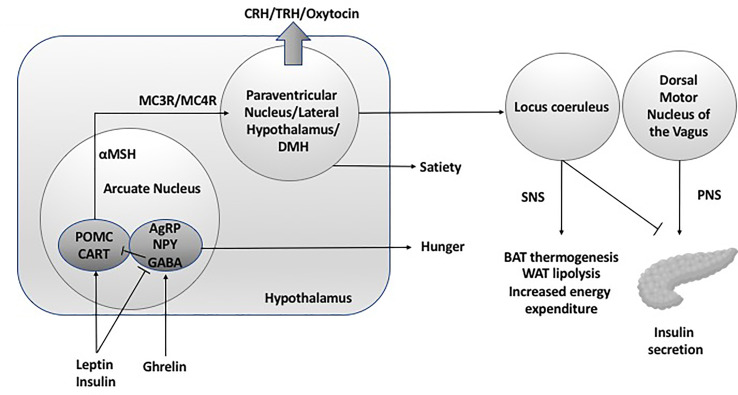
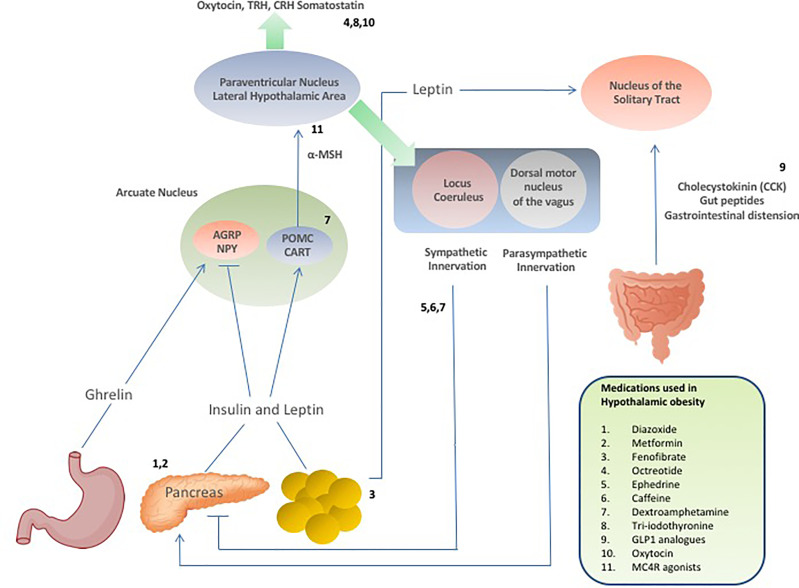
The hypothalamus is the centre of neuroendocrine regulation of energy homeostasis and appetite. Maldevelopment of, or damage to, the key hypothalamic nuclei disrupts the coordinated balance between energy intake and expenditure leading, to rapid and excessive weight gain. Hypothalamic obesity is compounded by a disruption of the hypothalamic-pituitary axis, sleep disruption, visual compromise, and neurological and vascular sequalae. Amongst suprasellar tumors, craniopharyngioma is the most common cause of acquired hypothalamic obesity, either directly or following surgical or radiotherapeutic intervention. At present, therapy is limited to strategies to manage obesity but with a modest and variable impact. Current approaches include optimizing pituitary hormone replacement, calorie restriction, increased energy expenditure through physical activity, behavioral interventions, pharmacotherapy and bariatric surgery. Current pharmacotherapeutic approaches include stimulants that increase energy consumption, anti-diabetic agents, hypothalamic–pituitary substitution therapy, octreotide, and methionine aminopeptidase 2 (MetAP2) inhibitors. Some pharmacological studies of hypothalamic obesity report weight loss or stabilization but reported intervention periods are short, and others report no effect. The impact of bariatric surgery on weight loss in hypothalamic obesity again is variable. Novel or combined approaches to manage hypothalamic obesity are thus required to achieve credible and sustained weight loss. Identifying etiological factors contributing hypothalamic obesity may lead to multi-faceted interventions targeting hyperphagia, insulin resistance, decreased energy expenditure, sleep disturbance, hypopituitarism and psychosocial morbidity. Placebo-controlled trials using current single, or combination therapies are required to determine the impact of therapeutic agents. A well-defined approach to defining the location of hypothalamic damage may support the use of future targeted therapies. Intranasal oxytocin is currently being investigated as an anorexogenic agent. Novel agents including those targeting pro-opimelanocortin-C and AgRP/NPY expressing neurons and the MC4 receptor may result in better outcomes. This article discusses the current challenges in the management of hypothalamic obesity in children and young people and future therapeutic approaches to increasing weight loss and quality of life in these patients.
Overview
The claims and statistics of this paper haven’t been checked yet.
Free: it reads the open-access text and checks the first 5 claims that cite a source we can check. Create a free account to check every claim.
Integrity signals
Registry
Cites
Statistics
Figures
Verification
Claims the paper makes
The claims and statistics of this paper haven’t been checked yet.
Free: it reads the open-access text and checks the first 5 claims that cite a source we can check. Create a free account to check every claim.
Claims other papers make about this one
Each is checked against this paper’s own text: does it say what the citing paper says it does?
The cited source says what the claim attributes to it.
In the citing paper
“Several pharmaceutical interventions have been reported to be effective for hypothalamic hyperphagia, although this is also not one size fits all with, in each study, responders and nonresponders (3, 19, 118).”
From Management of Acquired Hypothalamic Dysfunction and the Hypothalamic Syndrome; It Is More Than Obesity (2025) · cites this paper as [118]
Self-check
Percentages, sums and reported differences re-computed from the paper’s own numbers.
The self-check needs the paper’s full text.
Citations
Cites
Serum Immunoreactive-Leptin Concentrations in Normal-Weight and Obese Humans
Considine, R. V., Sinha, M. K., Heiman, M. L., Kriauciunas, A., Stephens, T. W., Nyce, M. R., Ohannesian, J. P., Marco, C. C., McKee, L. J., Bauer, T. L., et al. (1996) · New England Journal of Medicine · doi:10.1056/nejm199602013340503 · Cited by 6,326
Central nervous system control of food intake and body weight
Morton, G. J., Cummings, D. E., Baskin, D. G., Barsh, G. S., & Schwartz, M. W. (2006) · Nature · doi:10.1038/nature05026 · Cited by 2,503
Taheri, S., Lin, L., Austin, D., Young, T., & Mignot, E. (2004) · PLoS Medicine · doi:10.1371/journal.pmed.0010062 · Cited by 2,477
Leptin activates anorexigenic POMC neurons through a neural network in the arcuate nucleus
Cowley, M. A., Smart, J. L., Rubinstein, M., Cerdán, M. G., Diano, S., Horvath, T. L., Cone, R. D., & Low, M. J. (2001) · Nature · doi:10.1038/35078085 · Cited by 2,356
Role of Brain Insulin Receptor in Control of Body Weight and Reproduction
Brüning, J. C., Gautam, D., Burks, D. J., Gillette, J., Schubert, M., Orban, P. C., Klein, R., Krone, W., Müller-Wieland, D., & Kahn, C. R. (2000) · Science · doi:10.1126/science.289.5487.2122 · Cited by 2,235
Effects of Recombinant Leptin Therapy in a Child with Congenital Leptin Deficiency
Farooqi, I. S., Jebb, S. A., Langmack, G., Lawrence, E., Cheetham, C. H., Prentice, A. M., Hughes, I. A., McCamish, M. A., & O'Rahilly, S. (1999) · New England Journal of Medicine · doi:10.1056/nejm199909163411204 · Cited by 1,998
Antagonism of central melanocortin receptors in vitro and in vivo by agouti-related protein
Ollmann, M. M., Wilson, B. D., Yang, Y.-K., Kerns, J. A., Chen, Y., Gantz, I., & Barsh, G. S. (1997) · Science · doi:10.1126/science.278.5335.135 · Cited by 1,881
The role of depot fat in the hypothalamic control of food intake in the rat
Kennedy, G. C. (1953) · Proceedings of the Royal Society of London. Series B - Biological Sciences · doi:10.1098/rspb.1953.0009 · Cited by 1,425
Chronic intracerebroventricular infusion of insulin reduces food intake and body weight of baboons
Woods, S. C., Lotter, E. C., McKay, L. D., & Porte, D. (1979) · Nature · doi:10.1038/282503a0 · Cited by 1,114
Amphetamine: Effects on Catecholamine Systems and Behavior
Seiden, L. S., Sabol, K. E., & Ricaurte, G. A. (1993) · Annual Review of Pharmacology and Toxicology · doi:10.1146/annurev.pa.33.040193.003231 · Cited by 827
Research works printed but not linked: 6
- von Mohr U. Hypertrophie Der Hypophysis Cerebri Und Dadurch Bedingter Druck Auf Die Hirngrundfläche, Insbesondere Auf Die Sehnerven, Das Chiasma Desselben Und Den Linksseitigen Hirnschenkel. Wochenschr Ges Heilkd (1840) 6: 556–71.
- The Hypothalamus. A Report of the Henderson Trust Lectures. Edinb Med J (1936) 43(12): 769–74. PMC5303373 29648143
- Brobeck JR Tepperman J Long CNH. Experimental Hypothalamic Hyperphagia in the Albino Rat. Yale J Biol Med (1943) 15: 831–53. PMC2601393 21434115
- Poretti A Grotzer MA Ribi K Schönle E Boltshauser E. Outcome of Craniopharyngioma in Children: Long-Term Complications and Quality of Life. Dev Med Child Neurol. 2004;46:220–229, Elliott RE, Wisoff JH. Surgical Management of Giant Pediatric craniopharyngiomas. J Neurosurg Pediatr (2010) 46: 403–16. 15077699
- Spoudeas HA Saran F Pizer B. A Multimodality Approach to the Treatment of Craniopharyngiomas Avoiding Hypothalamic Morbidity: A UK Perspective. J Pediatr Endocrinol Metab (2006) Suppl 1: 447–51. 16700323
- Kanoski SE Grill HJ. Hippocampus Contributions to Food Intake Control: Mnemonic, Neuroanatomical, and Endocrine Mechanisms. Biol Psychiat (2017) 81(9): 748–56. doi: 10.1016/j.biopsych.2015.09.011 PMC4809793 26555354 · DOI · Paper page
Cited by
Roth, C. L., Scimia, C., Shoemaker, A. H., Gottschalk, M., Miller, J., Yuan, G., Malhotra, S., & Abuzzahab, M. J. (2024) · The Lancet Diabetes & Endocrinology · doi:10.1016/s2213-8587(24)00087-1 · Cited by 76
Kayadjanian, N., Hsu, E. A., Wood, A. M., & Carson, D. S. (2023) · The Journal of Clinical Endocrinology & Metabolism · doi:10.1210/clinem/dgad488 · Cited by 28
Treatment of Hypothalamic Obesity With GLP-1 Analogs
Dimitri, P., & Roth, C. L. (2024) · Journal of the Endocrine Society · doi:10.1210/jendso/bvae200 · Cited by 25
Self-citationvan Santen, H. M., & Müller, H. L. (2025) · Endocrine Reviews · doi:10.1210/endrev/bnaf025 · Cited by 21
Metadata
- Authors
- Dimitri, P.
- Venue
- Frontiers in Endocrinology
- Publisher
- Frontiers Media SA
- Published
- 2022-04-06
- Volume
- 13
- ISSN
- 1664-2392
- PMC
- PMC9019363
- Cited by
- 65
- References
- 144
About these checks
Registry, retraction, Cites and statistics results are computed, not judged, with one exception: a printed reference that no index lists is read once by a model before it counts as a citation error. Claims are extracted by a model and kept only when their quote appears verbatim in the text; each cited source is then checked, with a model’s help, for whether it says what the claim relies on. Those verdicts can be wrong — read the claim’s quote and the cited source before relying on one.
Statistics and arithmetic are recomputed, not judged.
Confidence bands are shown only for fields calibrated on our annotated test set. None is calibrated yet, so no band is shown.
What counts as a claim ›How we measure confidence ›How we check this ›
Are you an author, or do you see a problem with this page? Request a review
Data sources
Bibliographic data: Semantic Scholar, OpenAlex, Crossref.
Contains information from the Semantic Scholar Academic Graph Datasets, made available under the ODC Attribution License (ODC-BY 1.0).
Semantic Scholar’s data is described in: Kinney, R., et al. (2023). The Semantic Scholar Open Data Platform. arXiv:2301.10140.
