

The DOI matches its Crossref record; 134 of the 134 references it cites were found in a registry or an index.
Nanobodies and Nanobody-Based Human Heavy Chain Antibodies As Antitumor Therapeutics
Open accessAbstract
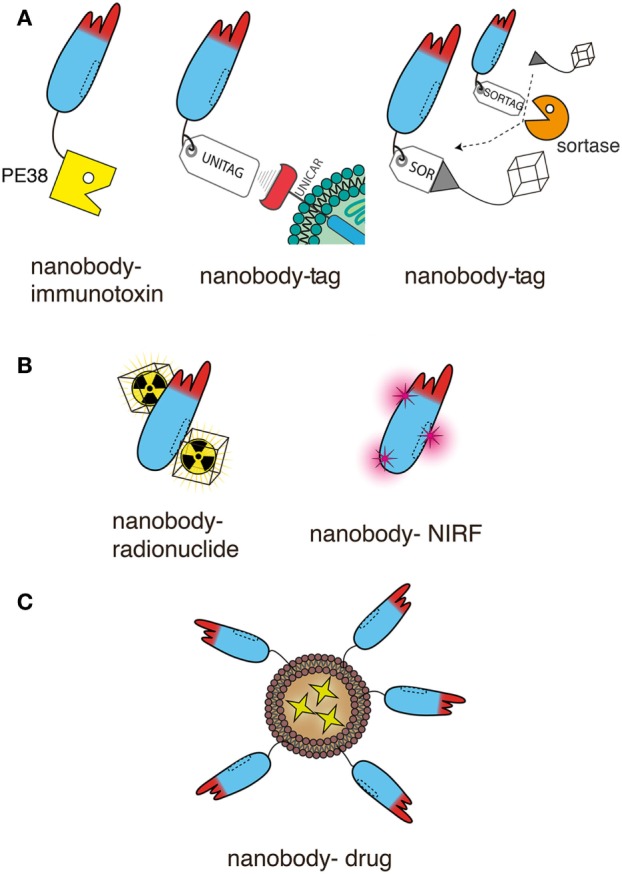
Monoclonal antibodies have revolutionized cancer therapy. However, delivery to tumor cells in vivo is hampered by the large size (150 kDa) of conventional antibodies. The minimal target recognition module of a conventional antibody is composed of two non-covalently associated variable domains (VH and VL). The proper orientation of these domains is mediated by their hydrophobic interface and is stabilized by their linkage to disulfide-linked constant domains (CH1 and CL). VH and VL domains can be fused via a genetic linker into a single chain variable fragment (scFv). scFv modules in turn can be fused to one another, e.g. to generate a bispecific T cell engager (BiTE), or they can be fused in various orientations to antibody hinge and Fc domains to generate bi- and multispecific antibodies. However, the inherent hydrophobic interaction of VH and VL domains limits the stability and solubility of engineered antibodies, often causing aggregation and/or mispairing of V-domains. Nanobodies (15 kDa) and nanobody-based human heavy chain antibodies (75 kDa) can overcome these limitations. Camelids naturally produce antibodies composed only of heavy chains in which the target recognition module is composed of a single variable domain (VHH or nanobody). Advantageous features of nanobodies include their small size, high solubility, high stability, and excellent tissue penetration in vivo. Nanobodies can readily be linked genetically to Fc-domains, other nanobodies, peptide tags, or toxins and can be conjugated chemically at a specific site to drugs, radionuclides, photosensitizers, and nanoparticles. These properties make them particularly suited for specific and efficient targeting of tumors in vivo. Chimeric nanobody-heavy chain antibodies combine advantageous features of nanobodies and human Fc domains in about half the size of a conventional antibody. In this review, we discuss recent developments and perspectives for applications of nanobodies and nanobody-based human heavy chain antibodies as anti-tumor therapeutics.
Overview
The claims and statistics of this paper haven’t been checked yet.
Run the check — free, no account needed. It reads the open-access text and checks the sources it cites.
Integrity signals
Registry
Cites
Statistics
Figures
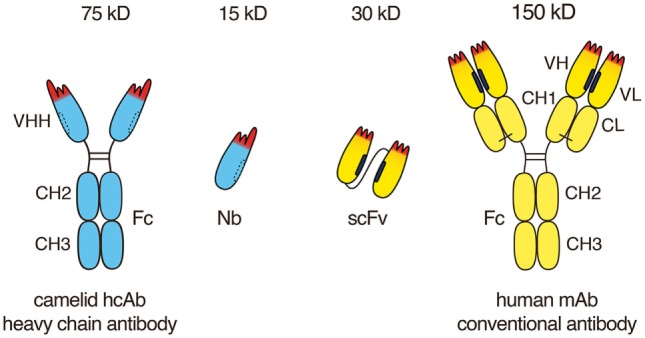
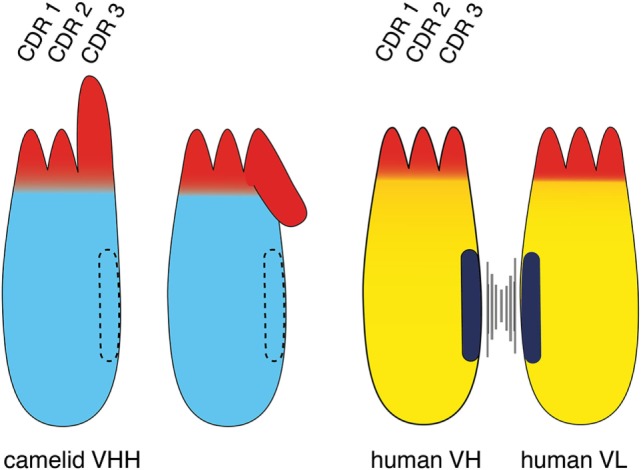
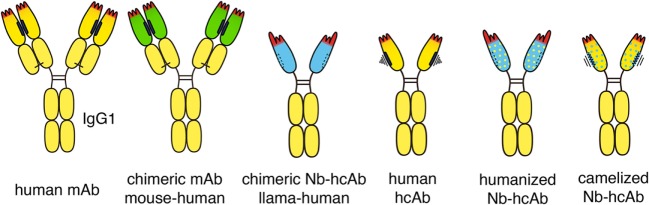
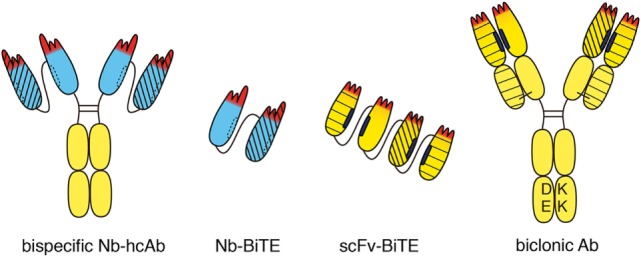

Verification
Claims the paper makes
The claims and statistics of this paper haven’t been checked yet.
Run the check — free, no account needed. It reads the open-access text and checks the sources it cites.
Claims other papers make about this one
Each is checked against this paper’s own text: does it say what the citing paper says it does?
The source backs part of the claim, not all of it — or backs it for a different population, condition or comparison.
In the citing paper
“One of the most promising is the H chain only antibody, or nanobody that are naturally occurring in camelids (llamas, alpacas and camels) [27] and sharks [228, 229] (reviewed by Muyldermans [230] and Bannas et al. [27]).”
From Computational approaches to therapeutic antibody design: established methods and emerging trends (2020) · cites this paper as [27]
Experimental — accuracy not yet measuredIn the citing paper
“The accumulated methodology of computational antibody protocols could potentially be applied to novel antibody formats with intrinsically better biophysical properties, such as nanobodies [27].”
From Computational approaches to therapeutic antibody design: established methods and emerging trends (2020) · cites this paper as [27]
In the citing paper
“Single domain antibodies have attracted attention because of their smaller size and better biophysical properties with respect to antibodies (higher stability and lower suspected immunogenicity) [27].”
From Computational approaches to therapeutic antibody design: established methods and emerging trends (2020) · cites this paper as [27]
Self-check
Percentages, sums and reported differences re-computed from the paper’s own numbers.
The self-check needs the paper’s full text.
Citations
Cites
Delivering nanomedicine to solid tumors
Jain, R. K., & Stylianopoulos, T. (2010) · Nature Reviews Clinical Oncology · doi:10.1038/nrclinonc.2010.139 · Cited by 3,265 · cited 1×
“The abnormal structure of rapidly growing tumor vasculature, combined with the lack of proper lymphatic drainage, leads to the accumulation of nanoparticles (122, 123).”
BackgroundNaturally occurring antibodies devoid of light chains
Hamers-Casterman, C., Atarhouch, T., Muyldermans, S., Robinson, G., Hammers, C., Songa, E. B., Bendahman, N., & Hammers, R. (1993) · Nature · doi:10.1038/363446a0 · Cited by 3,241 · cited 2×
“In 1993, naturally occurring heavy chain antibodies were discovered serendipitously while analyzing the serum of a dromedary in a practical biochemistry course at the University of Brussels (30).”
BackgroundRapid generation of functional human IgG antibodies derived from Fab-on-phage display libraries
Jostock, T., Vanhove, M., Brepoels, E., van Gool, R., Daukandt, M., Wehnert, A., van Hegelsom, R., Dransfield, D., Sexton, D., Devlin, M., et al. (2004) · Journal of Immunological Methods · doi:10.1016/j.jim.2004.03.014 · Cited by 2,572
Nanobodies: natural single-domain antibodies
Muyldermans, S. (2013) · Annual Review of Biochemistry · doi:10.1146/annurev-biochem-063011-092449 · Cited by 2,304
Scott, A. M., Wolchok, J. D., & Old, L. J. (2012) · Nature reviews. Cancer · doi:10.1038/nrc3236 · Cited by 2,244
Blinatumomab versus Chemotherapy for Advanced Acute Lymphoblastic Leukemia
Kantarjian, H. M., Stein, A. S., Gökbuget, N., Fielding, A. K., Schuh, A. C., Ribera, J., Wei, A. H., Dombret, H., Foà, R., Bassan, R., et al. (2017) · New England Journal of Medicine · doi:10.1056/nejmoa1609783 · Cited by 2,204 · cited 1×
“Blinatumumab, for example, contains a CD19-specific scFv linked to a CD3-specific scFv (54).”
BackgroundReshaping human antibodies for therapy
Riechmann, L., Clark, M., Waldmann, H., & Winter, G. P. (1988) · Nature · doi:10.1038/332323a0 · Cited by 1,565 · cited 2×
“Campath-H1 (anti-CD52), for example, contains CDR loops from the parental rat mAb grafted onto the VH and VL domains of human IgG1 kappa (42).”
BackgroundThe therapeutic monoclonal antibody market
Ecker, D. M., Jones, S. D., & Levine, H. L. (2014) · mAbs · doi:10.4161/19420862.2015.989042 · Cited by 1,369
Adeno-Associated Virus (AAV) as a Vector for Gene Therapy
Naso, M. F., Tomkowicz, B., Perry, W. L., & Strohl, W. R. (2017) · BioDrugs · doi:10.1007/s40259-017-0234-5 · Cited by 1,362 · cited 1×
“, for the long-term expression of a therapeutic proteins in vivo (130, 131).”
BackgroundDrug targeting to tumors: Principles, pitfalls and (pre-) clinical progress
Lammers, T., Kiessling, F., Hennink, W. E., & Storm, G. (2012) · Journal of Controlled Release · doi:10.1016/j.jconrel.2011.09.063 · Cited by 1,324 · cited 1×
“The abnormal structure of rapidly growing tumor vasculature, combined with the lack of proper lymphatic drainage, leads to the accumulation of nanoparticles (122, 123).”
Background
Cited by
Sorted by citations
The therapeutic potential of nanobodies
Jovčevska, I., & Muyldermans, S. (2020) · BioDrugs · doi:10.1007/s40259-019-00392-z · Cited by 749
Extracellular ATP and P2 purinergic signalling in the tumour microenvironment
Virgilio, F. D., Sarti, A. C., Falzoni, S., Marchi, E. D., & Adinolfi, E. (2018) · Nature reviews. Cancer · doi:10.1038/s41568-018-0037-0 · Cited by 748
Antibody Structure and Function: The Basis for Engineering Therapeutics
Chiu, M. L., Goulet, D. R., Teplyakov, A., & Gilliland, G. L. (2019) · Antibodies · doi:10.3390/antib8040055 · Cited by 711
“hydrophobic interfaces that allow for chain pairing, VHH and VNAR domains are naturally monomeric and tend to have more hydrophilic surfaces [511].”
BackgroundEngineered probiotics for local tumor delivery of checkpoint blockade nanobodies
Gurbatri, C. R., Lia, I., Vincent, R., Coker, C., Castro, S., Treuting, P. M., Hinchliffe, T. E., Arpaia, N., & Danino, T. (2020) · Science Translational Medicine · doi:10.1126/scitranslmed.aax0876 · Cited by 647
“Unlike antibodies with a molecular size of approximately 150 kDa, Nbs are only 15 kDa and lack an Fc region, which requires glycosylation by mammalian cells, and can therefore be produced recombinantly in bacteria (30, 31).”
BackgroundHuang, Y., Guo, X., Wu, Y., Chen, X., Feng, L., Xie, N., & Shen, G. (2024) · Signal Transduction and Targeted Therapy · doi:10.1038/s41392-024-01745-z · Cited by 537
Metadata
- Authors
- Bannas, P., Hambach, J., & Koch-Nolte, F.
- Affiliations
- University Medical Center Hamburg-Eppendorf (DE)
- Venue
- Frontiers in Immunology
- Publisher
- Frontiers Media SA
- Published
- 2017-11-22
- Volume
- 8
- Pages
- 1603-1603
- ISSN
- 1664-3224 (ISSN-L)
- PMC
- PMC5702627
- OpenAlex
- W2769445535
- Cited by
- 572
- References
- 134
- Citations by year
- 2026: 51 · 2025: 68 · 2024: 93 · 2023: 62 · 2022: 70 · 2021: 85 · 2020: 68 · 2019: 48 · 2018: 27
- FWCI
- 5.92
- Type
- journal article
- Language
- en
- Open access
- gold
- doi.org
- Licence
- cc-by
- Locations
- Frontiers in Immunology (publishedVersion, cc-by)
- Europe PMC (PubMed Central) (publishedVersion, cc-by)
- PubMed Central (publishedVersion, cc-by)
- PubMed (publishedVersion)
- DOAJ (DOAJ: Directory of Open Access Journals) (submittedVersion)
- Funders
- Wilhelm Sander-Stiftung (2012.113.2)
- Topics
- Life Sciences › Immunology and Microbiology › Immunology › Monoclonal and Polyclonal Antibodies Research
- Life Sciences › Immunology and Microbiology › Immunology › Toxin Mechanisms and Immunotoxins
- Health Sciences › Medicine › Radiology, Nuclear Medicine and Imaging › Radiopharmaceutical Chemistry and Applications
- Keywords
- nanobodies, VHH, camelid antibodies, antibody engineering, tumor targeting, antibody aggregation, bispecific T-cell engagers, antibody-drug conjugates, radionuclide conjugation, photosensitizer conjugation, nanoparticle conjugation, cancer immunotherapy
About these checks
Registry, retraction, Cites and statistics results are computed, not judged, with one exception: a printed reference that no index lists is read once by a model before it counts as a citation error. Claims are extracted by a model and kept only when their quote appears verbatim in the text; each cited source is then checked, with a model’s help, for whether it says what the claim relies on. Those verdicts can be wrong — read the claim’s quote and the cited source before relying on one.
Statistics and arithmetic are recomputed, not judged.
Confidence bands are shown only for fields calibrated on our annotated test set. None is calibrated yet, so no band is shown.
What counts as a claim ›How we measure confidence ›How we check this ›
Are you an author, or do you see a problem with this page? Request a review
