

From hyperglycemia to intervertebral disc damage: exploring diabetic-induced disc degeneration
Open accessThe DOI matches its Crossref record; 125 of the 125 references it cites were found in a registry or an index.
Abstract
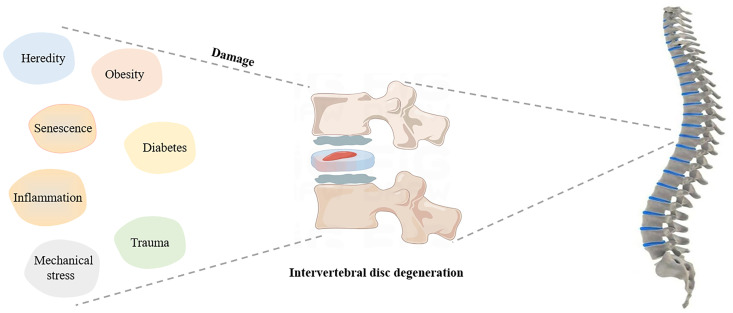
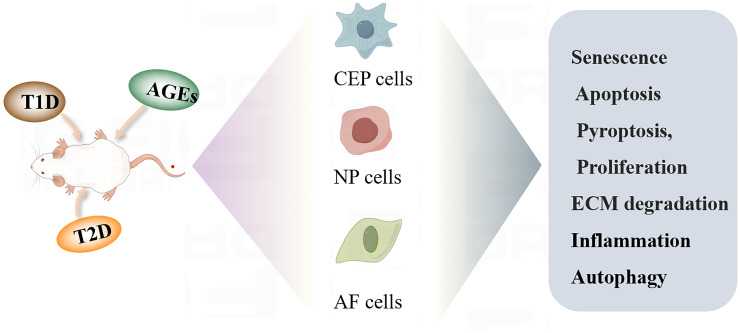
The incidence of lumbar disc herniation has gradually increased in recent years, and most patients have symptoms of low back pain and nerve compression, which brings a heavy burden to patients and society alike. Although the causes of disc herniation are complex, intervertebral disc degeneration (IDD) is considered to be the most common factor. The intervertebral disc (IVD) is composed of the upper and lower cartilage endplates, nucleus pulposus, and annulus fibrosus. Aging, abnormal mechanical stress load, and metabolic disorders can exacerbate the progression of IDD. Among them, high glucose and high-fat diets (HFD) can lead to fat accumulation, abnormal glucose metabolism, and inflammation, which are considered important factors affecting the homeostasis of IDD. Diabetes and advanced glycation end products (AGEs) accumulation- can lead to various adverse effects on the IVD, including cell senescence, apoptosis, pyroptosis, proliferation, and Extracellular matrix (ECM) degradation. While current research provides a fundamental basis for the treatment of high glucose-induced IDD patients. further exploration into the mechanisms of abnormal glucose metabolism affecting IDD and in the development of targeted drugs will provide the foundation for the effective treatment of these patients. We aimed to systematically review studies regarding the effects of hyperglycemia on the progress of IDD.
Overview
The claims and statistics of this paper haven’t been checked yet.
Free: it reads the open-access text and checks the first 5 claims that cite a source we can check. Create a free account to check every claim.
Integrity signals
Registry
Cites
Statistics
Figures
Verification
Claims the paper makes
The claims and statistics of this paper haven’t been checked yet.
Free: it reads the open-access text and checks the first 5 claims that cite a source we can check. Create a free account to check every claim.
Claims other papers make about this one
Each is checked against this paper’s own text: does it say what the citing paper says it does?
The check wasn’t confident either way, so it gives no verdict — never disputed.
In the citing paper
“The GLP-1R signaling pathway may also affect the expression of MMP-13 and ADAMTS5, by reducing the signal transduction caused by IL-1β, thus decreasing their synthesis.345,346”
From Glucagon-like peptide-1 receptor: mechanisms and advances in therapy (2024) · cites this paper as [346]
Experimental — accuracy not yet measured
Self-check
Percentages, sums and reported differences re-computed from the paper’s own numbers.
The self-check needs the paper’s full text.
Citations
Cites
4 retracted
Wang, W., Li, P., Xu, J., Wu, X., Guo, Z., Fan, L., Song, R., Wang, J., Wei, L., & Teng, H. (2018) · Bioscience Reports · doi:10.1042/bsr20171454 · Cited by 75
RetractedShan, L., Yang, D., Zhu, D., Feng, F., & Li, X. (2019) · Bioscience Reports · doi:10.1042/bsr20190853 · Cited by 30 · cited 1×
“In mechanism, inhibition of JNK pathway and p38 MAPK signal pathways may attenuate the effect of high glucose on apoptosis of the AF cells (105).”
BackgroundRetractedPang, L., Yang, K., & Zhang, Z. (2020) · Bioscience Reports · doi:10.1042/bsr20200262 · Cited by 14 · cited 1×
“After high glucose induction, the protein expression of ER stress markers CHOP, ATF-6, and ATF-6 signi fi cantly increased and induced apoptosis in the AF cells (106).”
BackgroundRetractedLiu, Z., Zhang, Z., Zhang, A., Zhang, F., Du, W., Zhang, Y., Zhang, R., Xu, J., Wu, X., Zhang, C., et al. (2019) · Bioscience Reports · doi:10.1042/bsr20190170 · Cited by 11 · cited 1×
“On the other hand, the addition of osteogenic protein-1 (OP-1) reverses NP matrix catabolism induced by high glucose (95).”
BackgroundRetractedShedding light on the cell biology of extracellular vesicles
van Niel, G., D'Angelo, G., & Raposo, G. (2018) · Nature Reviews Molecular Cell Biology · doi:10.1038/nrm.2017.125 · Cited by 8,369
Atkinson, M. A., Eisenbarth, G. S., & Michels, A. W. (2014) · The Lancet · doi:10.1016/s0140-6736(13)60591-7 · Cited by 2,931 · cited 11×
“These studies show that T1D is an important factor in promoting the progress of IDD, and that effective blood glucose control is the key strategy to delay IDD.”
BackgroundInfluentialGlucagon-like peptide 1 (GLP-1)
Müller, T. D., Finan, B., Bloom, S. R., D'Alessio, D., Drucker, D. J., Flatt, P. R., Fritsche, A., Gribble, F., Grill, H. J., Habener, J. F., et al. (2019) · Molecular Metabolism · doi:10.1016/j.molmet.2019.09.010 · Cited by 1,868 · cited 1×
“Glucagon-like peptide-1 (GLP-1) is a key intestinal insulin-stimulating hormone that regulates glucose and energy homeostasis (108, 109).”
BackgroundRole of cytokines in intervertebral disc degeneration: pain and disc content
Risbud, M. V., & Shapiro, I. M. (2014) · Nature Reviews Rheumatology · doi:10.1038/nrrheum.2013.160 · Cited by 1,767
Experimental and Therapeutic Medicine
(2026) · Experimental and Therapeutic Medicine · doi:10.3892/etm · Cited by 1,728
Knezevic, N. N., Candido, K. D., Vlaeyen, J. W. S., Van Zundert, J., & Cohen, S. P. (2021) · The Lancet · doi:10.1016/s0140-6736(21)00733-9 · Cited by 1,345
Cited by
Glucagon-like peptide-1 receptor: mechanisms and advances in therapy
Zheng, Z., Zong, Y., Ma, Y., Tian, Y., Pang, Y., Zhang, C., & Gao, J. (2024) · Signal Transduction and Targeted Therapy · doi:10.1038/s41392-024-01931-z · Cited by 1,036
Simone, M. D., Choucha, A., Ciaglia, E., Conti, V., Pecoraro, G., Santurro, A., Puca, A. A., Cascella, M., & İaconetta, G. (2024) · Journal of Clinical Medicine · doi:10.3390/jcm13195915 · Cited by 68
“A growing body of evidence has shown that pyroptosis mediated by the NLRP3 inflammasome plays a significant role in IVDD [37,38].”
BackgroundKong, C.-G., & Park, J. (2025) · Diagnostics · doi:10.3390/diagnostics15121510 · Cited by 14
“Immunohistochemical analysis in human IVDD samples has demonstrated increased levels of these cytokines and their receptors [3,11,13,29,30].”
InfluentialGradišnik, L., Kocivnik, N., Maver, U., & Velnar, T. (2025) · Bioengineering · doi:10.3390/bioengineering13010040 · Cited by 17
“Similarly, a sedentary lifestyle and poor posture reduce spinal flexibility and diminish the beneficial mechanical stimuli necessary for maintaining healthy IVD metabolism [32,33,65,66].”
InfluentialWu, Z., Chen, J., Luo, W., & Kuang, T. (2025) · Frontiers in Pharmacology · doi:10.3389/fphar.2025.1605764 · Cited by 13
Wang, L., Shao, Q., Wu, H., & Cheng, L. (2025) · Frontiers in Endocrinology · doi:10.3389/fendo.2025.1618984 · Cited by 5
Yang, W., Hao, C., Wang, N., Xie, J., Zhou, B., Yang, Z., Zheng, A., Wei, J., Li, C., Xie, C., et al. (2026) · Gut Microbes · doi:10.1080/19490976.2026.2661854 · Cited by 3
“While GLP-1 exerts systemic glycemic control and attenuates high-glucose-induced apoptosis, 218 FGF21 and adiponectin act locally to restore autophagic flux and suppress NF-κB-driven inflammation.”
Hua, K., Yu, H.-C., & Hsu, H.-T. (2025) · International Journal of Molecular Sciences · doi:10.3390/ijms26199819 · Cited by 3
Obesity-induced intervertebral disk degeneration: pathophysiology and clinical implications
Bharti, P. S., Gorai, P. K., Dutt, H., Gupta, Y., Malik, G., Rani, N., & Shankar, V. (2026) · International Journal of Obesity · doi:10.1038/s41366-026-02130-2 · Cited by 2
“Additionally, a diet high in sugar and fat promotes systemic in fl ammation and oxidative stress, negatively impacting disc health [70, 71].”
Xu, P., Li, K., Yuan, J., Zhao, J., Pan, H., Pan, C., Xiong, W., Tan, J., Li, T., Huang, G., et al. (2024) · Frontiers in Immunology · doi:10.3389/fimmu.2024.1465126 · Cited by 3
“The intervertebral disc, situated between two adjacent vertebrae, comprises the annulus fi brosus (AF), nucleus pulposus (NP), and cartilaginous endplate (CEP) located above and below the vertebrae (3, 4).”
BackgroundSun, Q., Zhang, H., Wang, H., Ji, G., Zhao, Y.-H., Li, G.-C., Guo, S.-S., Lin, L.-F., Jin, Y.-J., Zhang, X., et al. (2025) · Frontiers in Bioengineering and Biotechnology · doi:10.3389/fbioe.2025.1639117 · Cited by 1
Self-citationDu, Y., Zhao, K., Liu, C., Wang, G., Liang, Y., Cai, C., Zhang, W., Sun, W., Jin, Z., Ma, J., et al. (2025) · Scientific Reports · doi:10.1038/s41598-025-23875-2 · Cited by 1
Li, Z., Mao, Z., Wan, B., & Zhang, X. (2026) · Medicine · doi:10.1097/md.0000000000047206 · Cited by 1
“[15,16] Kamei et al’s study on the ratio of the signal intensity of the lumbar intervertebral disc nucleus pulposus to that of the spinal cord cone found that the ratios of each intervertebral disc were negatively correlated with age, and the degree of negative correlation was more pronounced in…”
Self-citationThe Impact of Modern Lifestyles on Spinal Health in the Pediatric Population: A Narrative Review
Zaborowska-Sapeta, K. A., Tymińska-Wójcik, P., Sonza, A., Kluszczyński, M., & Skowrońska, A. (2026) · Children · doi:10.3390/children13030341 · Cited by 1
“Hyperglycemia and dyslipidemia are also recognised as risk factors for IVDD severity [84,85].”
Glucose concentration modulates bovine intervertebral disc response under physiological loading
Zuncheddu, D., Mürner, M., Klavins, K., Stoddart, M. J., Creemers, L. B., & Grad, S. (2026) · Frontiers in Bioengineering and Biotechnology · doi:10.3389/fbioe.2026.1751565 · Cited by 1
“Multiple mechanisms, including microangiopathy, cellular senescence, and advanced glycation end products, have been proposed to contribute to IDD in diabetic patients (Li et al., 2024).”
Zhang, L., Zhao, W., Yang, H., Deng, T., & Li, Y. (2025) · JOR Spine · doi:10.1002/jsp2.70109 · Cited by 2
“Dysregulated glucose metabolism has been identified as a significant risk factor in the pathogenesis of IDD [47].”
Hu, Q., Wang, X., Zhang, Z., Yin, X., Ao, J., & Qin, J. (2025) · European Spine Journal · doi:10.1007/s00586-025-08808-x
Ding, L., Gu, R., Liu, X., Li, X., Cui, H., Cheng, S., Shi, Y., Zhu, T., Hu, Z., & Zhang, Y. (2025) · Research Square · doi:10.21203/rs.3.rs-6250034/v1
Shah`, M., ahmed, A., Sajid, M. A. A., Raheem, A., khan, M. U., & Nadeemullah (2025) · Pakistan Journal Of Neurological Surgery · doi:10.36552/pjns.v29i2.1074
Xu, Z., Zhou, S., Hu, Y., Yuan, L., Chen, G., Jiang, S., Guo, X., Zhong, W., Li, W., Zhou, F., et al. (2025) · BMC Musculoskeletal Disorders · doi:10.1186/s12891-025-09292-6
“Furthermore, the elderly group had a higher proportion of patients with diabetes mellitus, which is known to exacerbate IDD [22].”
Li, X., Shuid, A. N., Miswan, M. F. M., Cao, D., Zhang, X., Mao, P., Tian, Y., & Yuan, H. (2026) · Journal of Pain Research · doi:10.2147/jpr.s590969
“24 This obvious difference between the risk factor profiles highlights the inadequacy of a one-size-fits-all approach to prevention and management.”
Self-citationPopov, A. I., Perfiliev, О. V., Leontieva, F. S., Morozenko, D. V., Tomas, T. S., & Lantinov, O. V. (2026) · Актуальні проблеми сучасної медицини Вісник Української медичної стоматологічної академії · doi:10.31718/2077-1096.26.1.75
Cellular and molecular mechanisms of diabetes-mediated disc degeneration
Wang, H. Y., Suo, M., Wang, K., Chen, S., Liu, X., Wang, Q., Wang, Z., Chen, X., & Li, Z. (2026) · Frontiers in Endocrinology · doi:10.3389/fendo.2026.1785260
“The buildup of both DM and AGEs might result in many detrimental consequences on IVD, such as cellular senescence, apoptosis, and ECM destruction (182).”
Pathophysiology and current understanding of degenerative disc disease
Gradišnik, L., Prestor, B., Žele, T., Kocivnik, N., Maver, U., & Velnar, T. (2026) · World Journal of Orthopedics · doi:10.5312/wjo.v17.i5.117153
Prim, M. D. (2026) · Springer eBooks · doi:10.1007/978-3-032-18097-1_12
Li, T. Y., Wang, B., Wang, A., Fan, N., Ma, Z. Y., & Zang, L. (2026) · Frontiers in Medicine · doi:10.3389/fmed.2026.1801937
Zhang, H., Tian, J., Lu, Y., Yu, D., Wu, H., Lu, Y., Yu, L., & Luo, Z. (2026) · BMC Musculoskeletal Disorders · doi:10.1186/s12891-026-10040-7
“Multiple experimental and review studies have elaborated the central role of AGEs in diabetes-related IVDD [54, 56], supporting the conclusion that T2D is a reliable risk factor for IVDD.”
Eggshell-derived biomaterials for bone healing modulation
Arias, J. I., & Arias, J. I. (2026) · Elsevier eBooks · doi:10.1016/b978-0-443-27438-1.00017-7
Preconditioning Mesenchymal Stem Cells to Enhance Performance in the Degenerate Nucleus Pulposus
Maparu, A. K., Rajagopal, K., Iyer, K., Mauck, R. L., & Smith, L. J. (2026) · Tissue Engineering Part B Reviews · doi:10.1177/19373368261450742 · Cited by 1
Xu, T., Cheng, M., Dong, R., Kang, M., & Qu, Y. (2026) · Nano Research · doi:10.26599/nr.2026.94908923
Li, M., Deng, H., Xu, H., Zhou, Q., & Zhao, S. (2026) · Frontiers in Aging · doi:10.3389/fragi.2026.1842955
Yi, Z., Liao, C., Wu, T., Liu, J., Zeng, K., & 贺宪 (2026) · Frontiers in Surgery · doi:10.3389/fsurg.2026.1778866
“Chronic hyperglycemia leads to the formation of advanced glycation end products (AGEs) and microvascular damage, accelerating disc degeneration and impairing repair capacity, thereby increasing recurrence risk (21, 22).”
Zhang, S., Liu, S., Zhou, M., Wang, J., Zhang, Y., Zhong, H., & Ning, G. (2026) · Molecular Neurobiology · doi:10.1007/s12035-026-06090-6
“Additionally, it protects cartilage by inhibiting MAPK or activating the PI3K/Akt anti-inflammatory pathway [133, 134 ].”
Hasoon, J. J., Nguyen, A., Viswanath, O., Urits, I., & Robinson, C. L. (2026) · Current Pain and Headache Reports · doi:10.1007/s11916-026-01546-9
“Insulin resistance is independently associated with low back pain, and hyperglycemia promotes inter-vertebral disc degeneration through advanced glycation end-product accumulation, enhanced cell apoptosis, and extracellular matrix degradation [18–20].”
Ma, D., Zhao, J., Guo, K., Liu, W., 殷洪年, Zhan, Y., Zhao, R., Wang, J., & Ma, T. (2026) · Journal of Inflammation Research · doi:10.2147/jir.s651180
Metadata
- Authors
- Li, S., Du, J., Huang, Y., Gao, S., Zhao, Z., Chang, Z., Zhang, X., & He, B.
- Affiliations
- Xi'an Honghui Hospital (CN)
- Corresponding author
- He, BaoRong
- Venue
- Frontiers in Immunology
- Publisher
- Frontiers Media SA
- Published
- 2024-02-20
- Volume
- 15
- Pages
- 1355503-1355503
- ISSN
- 1664-3224 (ISSN-L)
- PMC
- PMC10912372
- OpenAlex
- W4391969990
- Cited by
- 32
- References
- 124
- Citations by year
- 2026: 18 · 2025: 11 · 2024: 3
- FWCI
- 2.39
- Type
- journal article
- Language
- en
- Open access
- gold
- doi.org
- Licence
- Locations
- Frontiers in Immunology (publishedVersion, cc-by)
- PubMed Central (publishedVersion, cc-by)
- PubMed (publishedVersion)
- DOAJ (DOAJ: Directory of Open Access Journals) (submittedVersion, cc-by-sa)
- Topics
- Health Sciences › Medicine › Orthopedics and Sports Medicine › Spine and Intervertebral Disc Pathology
- Health Sciences › Medicine › Rheumatology › Osteoarthritis Treatment and Mechanisms
- Health Sciences › Medicine › Surgery › Cervical and Thoracic Myelopathy
- Keywords
- intervertebral disc degeneration, hyperglycemia, diabetes mellitus, lumbar disc herniation, advanced glycation end products, extracellular matrix degradation, nucleus pulposus, annulus fibrosus, high-fat diet, glucose metabolism, inflammation, cellular senescence, apoptosis, pyroptosis, low back pain
- MeSH terms
- Nucleus Pulposus, Diabetes Mellitus, Glucose, Humans, Hyperglycemia, Intervertebral Disc Displacement, Intervertebral Disc Degeneration
About these checks
Registry, retraction, Cites and statistics results are computed, not judged, with one exception: a printed reference that no index lists is read once by a model before it counts as a citation error. Claims are extracted by a model and kept only when their quote appears verbatim in the text; each cited source is then checked, with a model’s help, for whether it says what the claim relies on. Those verdicts can be wrong — read the claim’s quote and the cited source before relying on one.
Statistics and arithmetic are recomputed, not judged.
Confidence bands are shown only for fields calibrated on our annotated test set. None is calibrated yet, so no band is shown.
What counts as a claim ›How we measure confidence ›How we check this ›
Are you an author, or do you see a problem with this page? Request a review
Data sources
Bibliographic data: Semantic Scholar, OpenAlex, Crossref.
Contains information from the Semantic Scholar Academic Graph Datasets, made available under the ODC Attribution License (ODC-BY 1.0).
Semantic Scholar’s data is described in: Kinney, R., et al. (2023). The Semantic Scholar Open Data Platform. arXiv:2301.10140.
