

The DOI matches its Crossref record; 25 of the 25 references it cites were found in a registry or an index.
Artificial Intelligence in Skin Cancer Diagnostics: The Patients' Perspective
Open accessAbstract
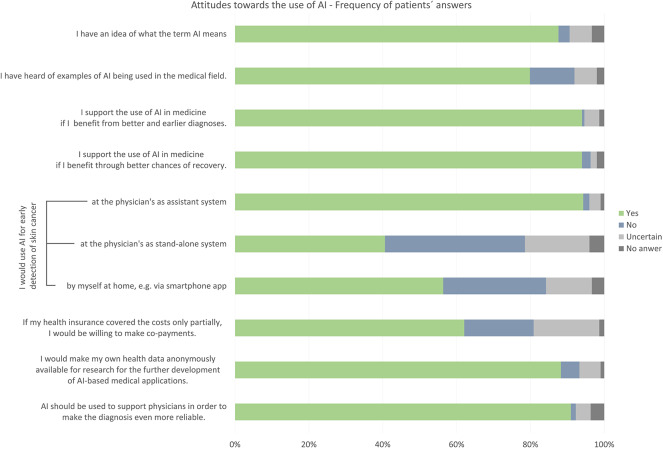
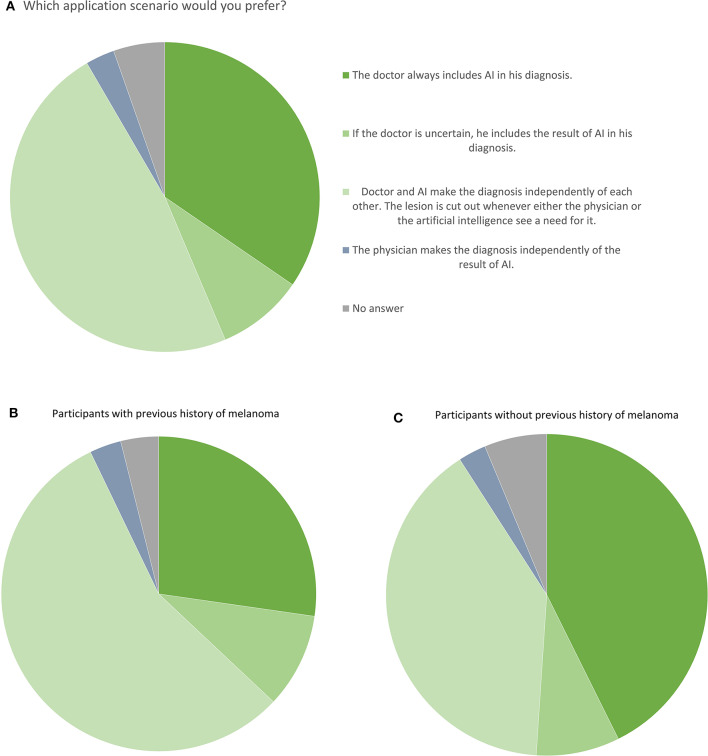
Background: Artificial intelligence has shown promise in numerous experimental studies, particularly in skin cancer diagnostics. Translation of these findings into the clinic is the logical next step. This translation can only be successful if patients’ concerns and questions are addressed suitably. We therefore conducted a survey to evaluate the patients’ view of artificial intelligence in melanoma diagnostics in Germany. Participants and Methods: A web-based questionnaire was designed using LimeSurvey, sent by e-mail to university hospitals and melanoma support groups and advertised on social media. The anonymous questionnaire evaluated patients’ expectations and concerns towards artificial intelligence in general as well as their attitudes towards different application scenarios. Descriptive analysis was performed with expression of categorical variables as percentages and 95% confidence intervals. Statistical tests were performed to investigate associations between sociodemographic data and selected items of the questionnaire. Results: 298 people (154 with melanoma diagnosis, 143 without) responded to the questionnaire. About 94% [95% CI = 0.913 – 0.967] of respondents supported the use of artificial intelligence in medical approaches. 88% [95% CI = 0.846 – 0.919] would even make their own health data anonymously available for the further development of AI-based applications in medicine. Only 41% [95% CI = 0.350 – 0.462] of respondents were amenable to the use of artificial intelligence as stand-alone system, 94% [95% CI = 0.917 – 0.969 to its use as assistant system for physicians. In sub-group analyses, only minor differences were detectable. Respondents with a previous history of melanoma were more amenable to the use of AI applications for early detection even at home. They would prefer an application scenario where physician and AI classify the lesions independently. With respect to AI-based applications in medicine, patients were concerned about insufficient data protection, impersonality and susceptibility to errors, but expected faster, more precise and unbiased diagnostics, less diagnostic errors and support for physicians. Conclusions: The vast majority of participants exhibited a positive attitude towards the use of artificial intelligence in melanoma diagnostics, especially as an assistance system.
Overview
The claims and statistics of this paper haven’t been checked yet.
Run the check — free, no account needed. It reads the open-access text and checks the sources it cites.
Integrity signals
Registry
Cites
Statistics
Figures
Verification
Claims the paper makes
The claims and statistics of this paper haven’t been checked yet.
Run the check — free, no account needed. It reads the open-access text and checks the sources it cites.
Claims other papers make about this one
Each is checked against this paper’s own text: does it say what the citing paper says it does?
In the citing paper
“The results of previous empirical studies on patients’ acceptance or trust in AI are somewhat conflicting. Some studies have shown that participants are more accepting of AI if it is proven to be more accurate than providers26,29 or if the use of AI fits societal and cultural norms.35,36 However, other studies have found that trust in AI did not increase when participants were informed that the AI”
From Patient perspectives on informed consent for medical AI: A web-based experiment (2024) · cites this paper as [29]
Self-check
Percentages, sums and reported differences re-computed from the paper’s own numbers.
The self-check needs the paper’s full text.
Citations
Cites
Dermatologist-level classification of skin cancer with deep neural networks
Esteva, A., Kuprel, B., Novoa, R. A., Ko, J., Swetter, S. M., Blau, H. M., & Thrun, S. (2017) · Nature · doi:10.1038/nature21056 · Cited by 14,362
On Pixel-Wise Explanations for Non-Linear Classifier Decisions by Layer-Wise Relevance Propagation
Bach, S., Binder, A., Montavon, G., Klauschen, F., Müller, K.-R., & Samek, W. (2015) · PLOS ONE · doi:10.1371/journal.pone.0130140 · Cited by 4,524
International evaluation of an AI system for breast cancer screening
McKinney, S. M., Sieniek, M., Godbole, V., Godwin, J., Antropova, N., Ashrafian, H., Back, T., Chesus, M., Corrado, G. S., Darzi, A., et al. (2020) · Nature · doi:10.1038/s41586-019-1799-6 · Cited by 3,287
Artificial intelligence in medical practice: the question to the answer?
Miller, D. D., & Brown, E. W. (2018) · The American Journal of Medicine · doi:10.1016/j.amjmed.2017.10.035 · Cited by 774
Medical students' attitude towards artificial intelligence: a multicentre survey
Pinto dos Santos, D., Giese, D., Brodehl, S., Chon, S. H., Staab, W., Kleinert, R., Maintz, D., & Baeßler, B. (2019) · European Radiology · doi:10.1007/s00330-018-5601-1 · Cited by 754
Governing artificial intelligence: ethical, legal and technical opportunities and challenges
Cath, C. (2018) · Philosophical Transactions of the Royal Society A: Mathematical, Physical and Engineering Sciences · doi:10.1098/rsta.2018.0080 · Cited by 745
Brinker, T. J., Hekler, A., Enk, A. H., Klode, J., Hauschild, A., Berking, C., Schilling, B., Haferkamp, S., Schadendorf, D., Holland-Letz, T., et al. (2019) · European Journal of Cancer · doi:10.1016/j.ejca.2019.04.001 · Cited by 605
Self-citationDeep neural networks are superior to dermatologists in melanoma image classification
Brinker, T. J., Hekler, A., Enk, A. H., Berking, C., Haferkamp, S., Hauschild, A., Weichenthal, M., Klode, J., Schadendorf, D., Holland-Letz, T., et al. (2019) · European Journal of Cancer · doi:10.1016/j.ejca.2019.05.023 · Cited by 415
Self-citationPhysician Confidence in Artificial Intelligence: An Online Mobile Survey
Oh, S., Kim, J. H., Choi, S.-W., Lee, H. J., Hong, J., & Kwon, S. H. (2019) · Journal of Medical Internet Research · doi:10.2196/12422 · Cited by 387
Han, S. S., Park, G. H., Lim, W., Kim, M. S., Na, J. I., Park, I., & Chang, S. E. (2018) · PLoS ONE · doi:10.1371/journal.pone.0191493 · Cited by 305
Cited by
Sorted by citations
Items 101–196 of 196
Impact of direct use of artificial intelligence algorithms on patient autonomy in dermatology
Karaa, S. (2024) · Annales de Dermatologie et de Vénéréologie · doi:10.1016/j.annder.2024.103245 · Cited by 5
Perceptions of Artificial Intelligence-Assisted Care for Children With a Respiratory Complaint
Ramgopal, S., Kapes, J., Alpern, E. R., Carroll, M. S., Heffernan, M. E., Simon, N.-J. E., Florin, T. A., & Macy, M. L. (2023) · Hospital Pediatrics · doi:10.1542/hpeds.2022-007066 · Cited by 5
Understanding patient views and acceptability of predictive software in osteoporosis identification
Manning, F., Mahmoud, A., & Meertens, R. M. (2023) · Radiography · doi:10.1016/j.radi.2023.08.011 · Cited by 5
Martini, N. D., Dhaliwal, N. K., Alipour, E., Scahill, S., & Sajtos, L. (2026) · JMIR Formative Research · doi:10.2196/83030 · Cited by 5
TOPLUM YAPAY ZEKA İLE DENTAL TANI KONMASINA HAZIR MI?
Güneç, H. G., Gökyay, S. S., Kaya, E., & Aydın, K. C. (2022) · Selcuk Dental Journal · doi:10.15311/selcukdentj.915522 · Cited by 4
Vo, V., Woode, M. E., Carter, S. M., Degeling, C., & Chen, G. (2025) · Value in Health · doi:10.1016/j.jval.2025.06.013 · Cited by 6
Krogh, M., Nielsen, M. G., Petersen, G. B., Jensen, M. S. A., Jensen, M. B., Vorum, H., Bruun, N. H., & Kristensen, J. K. (2025) · Frontiers in Medicine · doi:10.3389/fmed.2025.1610114 · Cited by 4
Personalized Medicine Through AI-Driven Imaging
Doke, R. R., Rajguru, J. R., & Vinchurkar, K. (2026) · Springer eBooks · doi:10.1007/978-3-032-02963-8_7 · Cited by 3
Investigation of Denoising Techniques for Removal of Hair and Noise from Dermoscopic Images
Khattar, S., & Bajaj, R. (2023) · International Conference on Sustainable Computing and Smart Systems (ICSCSS) · doi:10.1109/icscss57650.2023.10169807 · Cited by 3
Abdollahimajd, F., Abbası, F., Motamedi, A., Koohi, N., Robati, R. M., & Gorji, M. (2025) · Journal of Research in Medical Sciences · doi:10.4103/jrms.jrms_607_24 · Cited by 5
Veterinary Experiences can Inform One Health Strategies for Animal Coronaviruses
Chan, O. S. K., Bradley, K. C. F., Grioni, A., Lau, S. K. P., Li, W., Magouras, I., Naing, T., Padula, A. M., To, E. M. W., Tun, H. M., et al. (2021) · EcoHealth · doi:10.1007/s10393-021-01545-9 · Cited by 3
AI on Oral Mucosal Lesion Detection
Keser, G., Pekiner, F. N., & Orhan, K. (2023) · Springer eBooks · doi:10.1007/978-3-031-43827-1_9 · Cited by 3
Early diagnosis of skin oncologic diseases using artificial intelligence technologies
Samokhin, S. О., Патрушев, А. В., Akaeva, Y. I., Parfenov, S. A., & Кутелев, Г. Г. (2024) · Vestnik dermatologii i venerologii · doi:10.25208/vdv16746 · Cited by 3
Jutzi, T. B., Krieghoff‐Henning, E., & Brinker, T. J. (2022) · Aktuelle Dermatologie · doi:10.1055/a-1514-2013 · Cited by 3
Self-citationSenthil, V., Shreyaa, V., & Kothandapany, V. (2022) · doi:10.22541/au.167235618.88986321/v1 · Cited by 4
AI-Powered Dermatology: Revolutionizing Skin Cancer Detection Through Machine Learning Algorithms
Dubey, P., Bande, P., Shukla, R., Kshatri, S. S., Nayak, M., & Sharma, R. (2024) · International Conference on Cybernation and Computation (CYBERCOM) · doi:10.1109/cybercom63683.2024.10803244 · Cited by 2
Versorgungsforschung zum Einsatz von künstlicher Intelligenz in der Gesundheitsversorgung
Weigl, M., & Wenderott, K. (2024) · Springer eBooks · doi:10.1007/978-3-658-42863-1_43 · Cited by 2
Preprocessed Vision Transformers and Classical Classifiers in Diagnosing Skin Diseases
Şenol, B., & Demiroğlu, U. (2025) · DÜMF Mühendislik Dergisi · doi:10.24012/dumf.1577835 · Cited by 2
Chourasia, P. K., Coffel, M., Conklin, J., Wood, W. A., & Khairat, S. (2025) · Journal of Patient Experience · doi:10.1177/23743735251380949 · Cited by 2
AI and healthcare: surveying patient perspectives on artificial intelligence in neurosurgery
Shah, H., Ali, M., Kilgallon, J. L., Pema, P. M., O’Malley, G. R., Goldstein, I. M., & Patel, N. V. (2025) · Journal of Clinical Neuroscience · doi:10.1016/j.jocn.2025.111731 · Cited by 2
Chu, T., Chen, X., Zhang, Q., Zhou, H., Chen, L., & Jiang, K. (2026) · Journal of Multidisciplinary Healthcare · doi:10.2147/jmdh.s572035 · Cited by 2
A comparative analysis for skin cancer detection by using explainable deep learning
Havva Hazel, A. R. A. S., & Doğan, N. (2026) · Neural Computing and Applications · doi:10.1007/s00521-025-11809-y · Cited by 2
Pesapane, F., Giambersio, E., Rotili, A., Grasso, R., Gaeta, A., Battaglia, O., Conti, L., Pizzoli, S. F. M., Raimondi, S., Gandini, S., et al. (2026) · JCO Clinical Cancer Informatics · doi:10.1200/cci-25-00210 · Cited by 3
Steeb, T., Wessely, A., Heppt, M. V., Erdmann, M., Klug, S. J., & Berking, C. (2023) · Cancer Medicine · doi:10.1002/cam4.5717 · Cited by 2
Skin Cancer Detection Using Convolution Neural Network
Mitra, D., Patel, D., Bhavsar, M., Sule, T., & Sharma, A. K. (2023) · International Conference on Innovative Sustainable Computational Technologies (CISCT) · doi:10.1109/cisct57197.2023.10351329 · Cited by 2
Messelink, M. A., Fadaei, S., Verhoef, L. M., Welsing, P. M. J., Nijhof, N., & Westland, H. (2024) · Rheumatology · doi:10.1093/rheumatology/keae202 · Cited by 2
Emerging Applications of Artificial Intelligence in Dermatopathology
Smith, M. P., & Schulman, J. M. (2024) · Current Dermatology Reports · doi:10.1007/s13671-024-00431-1 · Cited by 2
UCM-NetV2: An efficient and accurate deep learning model for skin lesion segmentation
Yuan, C., Zhao, D., & Agaian, S. С. (2025) · Journal of Economy and Technology · doi:10.1016/j.ject.2025.02.001 · Cited by 2
Classification of melanoma skin cancer using convolutional neural network
Lokesh, S., France, K. C., & Eliyas, S. (2024) · International Conference on Electrical Electronics and Computing Technologies (ICEECT) · doi:10.1109/iceect61758.2024.10739043 · Cited by 2
Enhancing Patients' E-Health Engagement Through Artificial Intelligence
Chauhan, A. S., Gulati, C., Mathur, G., & Sankpal, S. (2024) · Advances in healthcare information systems and administration book series · doi:10.4018/979-8-3693-5468-1.ch002 · Cited by 1
Fardos, M. I., Miller, P. A., Ward, J., & Miller, R. (2025) · Dermatologic Surgery · doi:10.1097/dss.0000000000004690 · Cited by 1
Duke, S. A., Sandøe, P., Skelly, T., & Holm, S. H. (2025) · Big Data & Society · doi:10.1177/20539517251386035 · Cited by 4
Patient Perspectives Towards Artificial Intelligence in Heart Failure Care
Suepiantham, S., & Katira, R. (2025) · Cureus · doi:10.7759/cureus.98378 · Cited by 1
Factors involved in facial skin cancer patients' experiences, needs and concerns
Ho, J. O. Y., Hjalmarsson, C., Fan, K., & Rogers, S. N. (2025) · Advances in Oral and Maxillofacial Surgery · doi:10.1016/j.adoms.2025.100595 · Cited by 1
Potas, N., ERKILIÇ, C. E., Caner, S., & Fritsch, S. J. (2026) · Work · doi:10.1177/10519815261429412 · Cited by 1
Nagel, J., Hollmann, K., Alt, A. K., Renner, T. J., & Conzelmann, A. (2026) · Digital Health · doi:10.1177/20552076251410978 · Cited by 2
Newman‐Hung, N. J., Wahle, C. F., Mao, Y. V., Khabaz, K., Azari, K. K., Benhaim, P., Christ, A. B., Stavrakis, A. I., Bernthal, N. M., & Wessel, L. E. (2026) · JAAOS Global Research and Reviews · doi:10.5435/jaaosglobal-d-25-00081 · Cited by 1
Dzwonkowska, A., Dzwonkowski, J., Kozłowska, A., Przybysz, K., Rachoń, J., Stadnik, L., Szerenos, N., Trocka, D., Woroniecka, N., & Zienkiewicz, N. (2026) · International Journal of Innovative Technologies in Social Science · doi:10.31435/ijitss.3(51).2026.6375 · Cited by 1
Hautkrebserkennung: Wie künstliche Intelligenz die Diffenzialdiagnose schärft
Jutzi, T. B., & Brinker, T. J. (2020) · Deutsches Ärzteblatt · doi:10.3238/persderma.2020.06.12.03 · Cited by 1
Self-citationImage Classification of Skin Cancer: Using Deep Learning as a Tool for Skin Self-examinations
Anderson, K., & Hori, S. S. (2021) · Lecture notes in computer science · doi:10.1007/978-3-030-91241-3_1 · Cited by 1
Jutzi, T. B., Krieghoff‐Henning, E., & Brinker, T. J. (2022) · Onkologische Welt · doi:10.1055/a-1899-7021 · Cited by 1
Self-citationImage-based Classification of Skin Cancer using Convolution Neural Network
Mondal, P., Bhatia, A., Panjwani, R., Panchamia, S., & Dokare, I. (2023) · International Conference on Intelligent Technologies (CONIT) · doi:10.1109/conit59222.2023.10205738 · Cited by 1
Artificial Intelligence in Skin Cancer: A Literature Review from Diagnosis to Prevention and Beyond
Ghorbani, A. (2023) · International Journal of Bioinformatics and Intelligent Computing · doi:10.61797/ijbic.v2i2.251 · Cited by 1
THE ANALYSIS STUDY OF ARTIFICIAL INTELIGENCE FOR SKIN CANCER : A COMPREHENSIVE SYSTEMATIC REVIEW
Juwita, T. A., & Siregar, I. S. (2024) · Journal of Advance Research in Medical & Health Science · doi:10.61841/nrx3cg60 · Cited by 1
Abidi, N. Y., Abidi, Z., Hanrahan, B., Kaur, M. P., Kerego, Y., Pellegrino, A. N., & Thulasi, V. (2024) · Artificial intelligence · doi:10.5772/intechopen.115279 · Cited by 1
Artificial Intelligence in Skin Cancer: A Literature Review from Diagnosis to Prevention and Beyond
Said, K. K., Rhaimi, C. B., & Alatresh, S. A. (2024) · Journal for Research in Applied Sciences and Biotechnology · doi:10.55544/jrasb.3.5.26 · Cited by 1
Bathelt, F., Reinecke, I., Sedlmayr, B., Hoehne, S., Gierschner, C., & Sedlmayr, M. (2022) · Studies in health technology and informatics · doi:10.3233/shti220908 · Cited by 1
Healthcare Voice AI Assistants: Factors Influencing Trust and Intention to UsePreprint
Zhan, X., Abdi, N., Seymour, W., & Such, J. M. (2024) · arXiv (Cornell University) · doi:10.48550/arxiv.2401.04543 · Cited by 1
Pomi, F. L., Incorvaia, L., Badalamenti, G., Russo, A. D., Vaccaro, M., Gangemi, S., & Borgia, F. (2024) · Preprints.org · doi:10.20944/preprints202403.0962.v1 · Cited by 1
Kumar, A., Kumar, D. V. S., Sinha, P., & Megha, R. (2024) · Research Square · doi:10.21203/rs.3.rs-4979499/v1 · Cited by 1
Isbanner, S., O’Shaughnessy, P., Steel, D. G., Wilcock, S., & Carter, S. M. (2022) · doi:10.2196/preprints.37611
Role of Artificial Intelligence in Revolutionizing Cancer Detection and Treatment: A Review
Kulshrestha, S., & Goel, A. (2022) · Lecture notes in networks and systems · doi:10.1007/978-981-19-0976-4_51
Schaarup, J. R., Aggarwal, R., Dalsgaard, E., Norman, K., Dollerup, O. L., Ashrafian, H., Witte, D. R., Sandbæk, A., & Hulmán, Á. (2022) · SSRN Electronic Journal · doi:10.2139/ssrn.4181697
Jutzi, T. B., Krieghoff‐Henning, E., & Brinker, T. J. (2022) · Laryngo-Rhino-Otologie · doi:10.1055/a-1949-3639
Self-citationArtificial Intelligence and Malignant Melanoma : A Review
Ramezanpour, P., Sasani, S., & Rad, S. G. (2022) · Journal of Student Research · doi:10.47611/jsrhs.v11i3.2675
Health related quality of life and associated symptoms in barrett’s esophagus patients
Loon, M. C. M. V. D. E. (2024) · doi:10.26481/dis.20240327me
Grundprinzipien der künstlichen Intelligenz in der Dermatologie erklärt am Beispiel des Melanoms
Hartmann, T. J., Passauer, J., Hartmann, J., Schmidberger, L., Kneilling, M., & Volc, S. (2024) · JDDG Journal der Deutschen Dermatologischen Gesellschaft · doi:10.1111/ddg.15322_g
Fekete, G. L., Iantovics, L. B., Fekete, J. E., & Fekete, L. (2024) · Life · doi:10.3390/life14091062
Americans' Distrust in AI-assisted Diagnosis Surpasses Partisanship and Demographic Lines (Preprint)Preprint
decisions, Z. A., & decisions, Z. A. (2024) · doi:10.2196/preprints.66083
Assessing Pretrained Model Through Transfer Multi-Task Learn For Melanoma Classification
Xie, H., & Zhang, Y. (2024) · International Conference on Cloud and Big Data Computing (ICCBDC) · doi:10.1145/3694860.3694871
Oluwasegun, A. A., Evwiekpaefe, A. E., Odion, P. O., Awujoola, O. J., Bright, A. O., Adelegan, O. R., Uwa, C. O., & Malami, M. G. (2024) · Advances in healthcare information systems and administration book series · doi:10.4018/979-8-3693-7277-7.ch008
Foresman, G., Joshua, B., Tran, A., McRae, K., Kazi, S., Schubel, L., Visconti, A., Gallagher, W., & Miller, K. (2024) · doi:10.2196/preprints.69564
Patient Attitudes Toward Artificial Intelligence in Cancer Care: A Scoping ReviewPreprint
Hilbers, D., Nekain, N., Bates, A. T., & Nuñez, J.-J. (2025) · medRxiv · doi:10.1101/2025.03.15.25324029
McRae, C., Zhang, T. D., Seeley, L. D., Anderson, M., Turner, L., & Graham, L. (2025) · doi:10.2196/preprints.75454
Kyriakidou, O., & Varvatsoulis, G. (2025) · International perspectives on equality, diversity and inclusion · doi:10.1108/s2051-233320250000012015
Currieri, T., Cicceri, G., Cannata, S., Cirrincione, G., Lovino, M., Militello, C., Prinzi, F., Pasero, E. G. A., & Vitabile, S. (2025) · Lecture notes in computer science · doi:10.1007/978-3-031-90714-2_2
Haut-Screening-Apps in der klinischen Praxis
Gerschewski, F. E. (2025) · hautnah · doi:10.1007/s12326-025-00721-w
Martini, N. D., Dhaliwal, N., Alipour, E., Scahill, S. L., & Sajtos, L. (2025) · doi:10.2196/preprints.83030
Retracted: Automatically Early Detection of Skin Cancer using Hybrid Neural Network Models
Sahu, S. R., Poongothai, S., Nayak, M. S. S., Rawal, R. K., Aijaz, M., & Kalra, G. (2025) · International Conference on Computing Methodologies and Communication (ICCMC) · doi:10.1109/iccmc65190.2025.11140682
RetractedThe Role of Artificial Intelligence in Psoriasis
Swathi, N. L., Muhammad, S., Muzzamil, M., Arun, A., Athul, H., & AlEdani, E. M. (2025) · Updates in clinical dermatology · doi:10.1007/978-3-031-78139-1_3
Transgender individuals’ perspectives on teledermatology-based acne research
Gold, S., Delgado, F., Siira, M. R., Alcid, C., Willner, S., Kucirek, D., Owen‐Smith, A. A., Rotemberg, V. M., Operario, D., Escoffery, C., et al. (2025) · Archives of Dermatological Research · doi:10.1007/s00403-025-04402-9
Nanofiber-based diagnostics for cancer inflammation
Kaur, J., Konar, A., Ghosh, P., Barwant, M. M., & Kadyan, P. (2025) · Elsevier eBooks · doi:10.1016/b978-0-443-27745-0.00009-0
Artificial Intelligence in Dermatology Among Saudi Adults: Cross-Sectional Survey Study (Preprint)Preprint
Alanazi, S. K., Alanazi, L. N., Alsindi, Z. S., Almulla, S. A., Almulhim, N. A., & Alojail, H. Y. (2025) · doi:10.2196/preprints.83422
The German Artificial Intelligence Experience and Attitude Survey (AIEAS)
Gnambs, T., Griese, F., & Zinn, S. (2026) · Psychological Test Adaptation and Development · doi:10.1027/2698-1866/a000118
Setiawan, A. W. (2025) · Beyond Technology Summit on Informatics International Conference (BTS-I2C) · doi:10.1109/bts-i2c67944.2025.11399458 · Cited by 1
Deep Learning for Classification and Prognosis of Melanoma in Whole-Slide Images: A Review
Liu, J., Liu, L., & An, X. (2026) · American Journal of Dermatopathology · doi:10.1097/dad.0000000000003239
Almulhem, M., Almusailem, A., Alayesh, M., Najimah, A. B., Karam, H. B., Alsaleem, H., Almajhad, H., Alessa, Z. K., & Alfridan, M. M. (2026) · Cureus · doi:10.7759/cureus.104430
BGPANet: Bi-Granular progressive attention for imbalanced skin lesion diagnosis
Liu, M., Guo, R., Yu, X., Yu, Z., Xiao, Z., & Jiang, X. (2026) · Expert Systems with Applications · doi:10.1016/j.eswa.2026.132169
Patients’ Perspectives on the Implementation of AI in Radiological Diagnostics: Focus Group Study
Karger, C. R. (2026) · Journal of Medical Internet Research · doi:10.2196/89178 · Cited by 5
An, X., Liu, L., Liu, M., & Liu, J. (2026) · Journal of Imaging Informatics in Medicine · doi:10.1007/s10278-026-01947-7
Operational and Translational Challenges of AI in Ophthalmology Imaging Systems
Espaillat, A. (2026) · Springer eBooks · doi:10.1007/978-3-032-19336-0_23
Asees, A., Shah, V. K., Sadur, A., & Choudhary, S. (2026) · Journal of the American Academy of Dermatology · doi:10.1016/j.jaad.2026.04.1938
Human Factors in Human-AI Interaction
Zhang, J., Zhang, L., & Sun, X. (2026) · Springer eBooks · doi:10.1007/978-981-95-5585-7_18
Kuppanda, P. M., Janda, M., & Caffery, L. J. (2026) · Interactive Journal of Medical Research · doi:10.2196/92969
Real-world diagnostic performance of artificial intelligence in skin cancer screening
Earnshaw, C. H., Cheung, K., Arshad, F., Moore, R., Al‐Janabi, A., & McMullen, E. (2026) · Skin Health and Disease · doi:10.1093/skinhd/vzag068
Gillan, C., Liszewski, B., Hsu, A., Rahman, F. H., Ebady, M., Nielsen, M. K., Aloysious, C., Lai, Y., Brown, E. M., Donaldson, H., et al. (2026) · Journal of medical imaging and radiation sciences · doi:10.1016/j.jmir.2026.102436
Artificial Intelligence in Dermatology Among Saudi Adults: Cross-Sectional Survey Study
Alanazi, S. K., Alanazi, L. N., Alsindi, Z. S., Almulla, S. A., Almulhim, N. A., & Alojail, H. Y. (2026) · Healthcare · doi:10.3390/healthcare14131963
AI Enabled Skin Cancer Detection and Virtual Dermatology Assistant using Deep Learning
Kiruthika, R., Ivana Jessica, S., Rasiga, S., Deva Dharshini, R., & Subika, M. (2026) · International conference Computer Networks and Inventive Communication Technologies · doi:10.1109/iccnct68477.2026.11590101
Imaging in Cutaneous Melanoma: Current Workup, Surveillance, and Emerging Directions
Willem, H., Aguilar, T., Cowman, A. W., Lourdault, K., & Essner, R. (2026) · Cancers · doi:10.3390/cancers18142215
Gillan, C., Liszewski, B., Hsu, A., Rahman, F. H., Ebady, M., Nielsen, M. K., Aloysious, C., Lai, Y., Brown, E. M., Donaldson, H., et al. (2026) · Journal of Applied Clinical Medical Physics · doi:10.1002/acm2.70658
Bradbury, J. L., Rodrigues, T. S., Nilsen, O. J., Kumarasiri, M., Nanayakkara, S., Sajeev, J., Luc, M., Rayoo, R., Yeoh, J., Theuerle, J. D., et al. (2026) · Journal of the Society for Cardiovascular Angiography & Interventions · doi:10.1016/j.jscai.2026.105624
Veterans’ willingness to use home-based telehealth and artificial intelligence for dermatology
Peracca, S. B., Zepeda, E. D., Lachica, O., Lamkin, R. P., Collins, O. E., Gifford, A. L., King, H. A., Jackson, G. L., Wei, M. L., de la Feld, S. F., et al. (2026) · Journal of Investigative Dermatology · doi:10.1016/j.jid.2026.08.012
Mushtaq, S., & Singh, O. (2026) · SN Computer Science · doi:10.1007/s42979-026-05385-8
Sharma, R., Kumar, S., Abdulla, S., Bajaj, K., Prabha, C., & Jain, S. (2026) · Intelligent Systems with Applications · doi:10.1016/j.iswa.2026.200746
Metadata
- Authors
- Jutzi, T. B., Krieghoff-Henning, E. I., Holland-Letz, T., Utikal, J. S., Hauschild, A., Schadendorf, D., Sondermann, W., Fröhling, S., Hekler, A., Schmitt, M., Maron, R. C., & Brinker, T. J.
- Affiliations
- German Cancer Research Center (DE)
- University Hospital Schleswig-Holstein (DE)
- Essen University Hospital (DE)
- Corresponding author
- Brinker, Titus J.
- ORCID
- Venue
- Frontiers in Medicine
- Publisher
- Frontiers Media SA
- Published
- 2020-06-02
- Volume
- 7
- Pages
- 233-233
- ISSN
- 2296-858X (ISSN-L)
- PMC
- PMC7326111
- OpenAlex
- W3033209670
- Cited by
- 196
- References
- 25
- Citations by year
- 2026: 31 · 2025: 44 · 2024: 47 · 2023: 26 · 2022: 30 · 2021: 17 · 2020: 1
- FWCI
- 6.68
- Type
- journal article
- Language
- en
- Open access
- gold
- doi.org
- Licence
- Locations
- Frontiers in Medicine (publishedVersion, cc-by)
- PubMed Central (publishedVersion, cc-by)
- PubMed (publishedVersion)
- DOAJ (DOAJ: Directory of Open Access Journals) (submittedVersion, cc-by-sa)
- Topics
- Health Sciences › Medicine › Oncology › Cutaneous Melanoma Detection and Management
- Health Sciences › Medicine › Health Informatics › Artificial Intelligence in Healthcare and Education
- Physical Sciences › Computer Science › Artificial Intelligence › AI in cancer detection
- Keywords
- artificial intelligence, melanoma, patient attitudes, patient perspectives, early detection, data protection, patient trust, sociodemographic factors
About these checks
Registry, retraction, Cites and statistics results are computed, not judged, with one exception: a printed reference that no index lists is read once by a model before it counts as a citation error. Claims are extracted by a model and kept only when their quote appears verbatim in the text; each cited source is then checked, with a model’s help, for whether it says what the claim relies on. Those verdicts can be wrong — read the claim’s quote and the cited source before relying on one.
Statistics and arithmetic are recomputed, not judged.
Confidence bands are shown only for fields calibrated on our annotated test set. None is calibrated yet, so no band is shown.
What counts as a claim ›How we measure confidence ›How we check this ›
Are you an author, or do you see a problem with this page? Request a review
