

Reframing faculty development for digital transformation and generative AI in higher education
Open accessThe DOI matches its Crossref record; 16 of the 16 references it cites were found in a registry or an index; 29 of the 37 sources its claims cite were checked for support.
Abstract
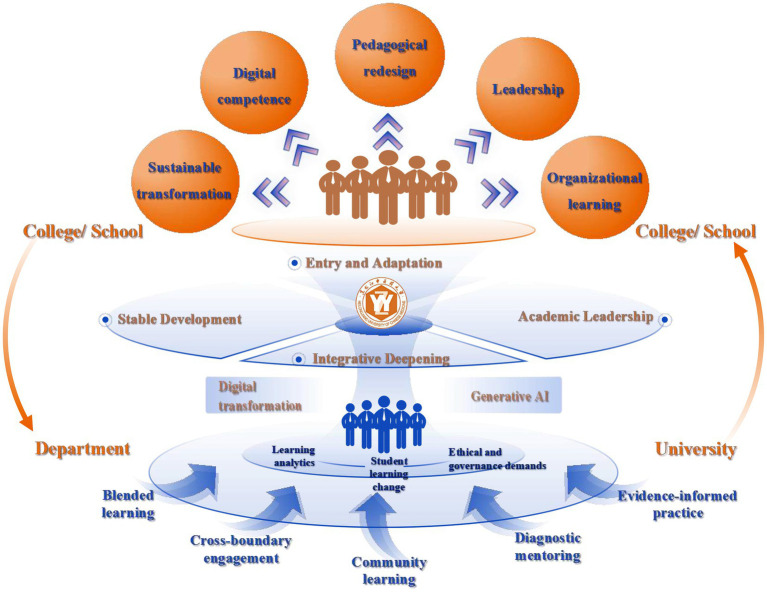
As educational digitalization continues to deepen and generative artificial intelligence rapidly enters higher education teaching contexts, faculty professional development is undergoing a profound transformation from tool use to pedagogical redesign and from individual adaptation to organizational change. However, current faculty development practices still tend to substitute standardized training for differentiated support, making it difficult to address the diverse needs of teachers at different career stages in digital competence, curricular innovation, disciplinary integration, and academic leadership. To enhance the transparency of the framework-building process, this study was informed by explicit review questions, database-based literature retrieval, and thematic synthesis. Building on scholarship on teacher digital competence, teacher professional development theory, and the practice of digital transformation in higher education, with Heilongjiang University of Chinese Medicine serving as the institutional context for framework formulation, this paper offers a systematic account of the stage-specific developmental tasks of university faculty in the digital era and advances a multi-level, developmental framework. The framework is organizationally supported by coordination across three institutional levels—university, school, and department—structured around four developmental stages: entry and adaptation, stable development, deep integration, and academic leadership, and implemented through five pathways: blended professional learning, cross-boundary linkage, community-based mutual learning, diagnostic mentoring, and evidence-informed practice. The study contends that faculty development should move beyond a narrow focus on digital tool training and instead emphasize the systematic development of capacities related to pedagogical improvement, disciplinary reconfiguration, digital ethics, and organizational leadership. This framework helps enhance the stage-specific relevance, practical explanatory power, and organizational operability of faculty development, while also providing a theoretical reference for designing faculty development systems in digitally transformed universities.
Overview
CoChat Summary
TL;DR
This conceptual review synthesizes literature on faculty digital competence and professional development to propose a "three-tier, four-stage, five-pathway" framework for faculty development under digital transformation and generative AI. It argues faculty development should move beyond digital tool training toward pedagogical redesign, disciplinary reconfiguration, digital ethics, and organizational leadership.
Key findings
- The framework is organized around three institutional levels (university, school, department), four developmental stages (entry and adaptation, stable development, integrative deepening, academic leadership), and five implementation pathways (blended professional learning, cross-boundary linkage, community-based mutual learning, diagnostic mentoring, evidence-informed practice).
- Stage-specific needs are mapped as: entry-stage faculty need pedagogical integration and mentoring; stable-stage faculty need curricular innovation, evidence-driven improvement, and research translation; integrative-deepening faculty need disciplinary reconfiguration and ethical discernment; leadership-stage faculty need platform building, cross-boundary collaboration, evidence-informed leadership, and normative leadership (Table 1).
- The paper contends that gains in digital competence do not necessarily produce high-quality teaching practice; the key issue is whether teachers can design instruction coherently around course goals, learning activities, and assessment.
- It argues evaluation should shift from counting training hours to practice-based outcomes (course redesign, digital resources, improved interaction, evidence-based assessment, team contribution), and that generative AI expands the agenda from competence enhancement to normative governance (digital ethics, data responsibility, algorithmic bias, academic integrity, student agency).
Methods
- Design: a literature-based review and framework-building study, guided by three review questions on stage-specific needs, institutional support structures, and synthesis into a transferable framework anchored in the institutional context of Heilongjiang University of Chinese Medicine.
- Data sources: literature retrieved from Web of Science Core Collection, Scopus, ERIC, and PubMed, with search terms clustered around faculty/teacher development, digital competence, higher education context, and technological transformation; backward reference checking was also used. Inclusion required focus on higher education teachers/faculty and digital competence or faculty development; K–12-only studies, student-only outcomes, and purely technical descriptions were excluded.
- Analysis: iterative reading and thematic synthesis, with recurring concepts coded under three integrative dimensions (career-stage developmental needs, institutional levels of organizational support, professional development pathways), then compared and consolidated into the final framework. The process was structured with reference to the Population–Concept–Context (PCC) principle and aligned where applicable with PRISMA-ScR transparency items.
Limitations
- The paper states no explicit limitations section; no limitations are declared in the text.
- Evident from the text: the framework is derived from thematic synthesis of literature rather than empirical testing or validation, and is formulated within a single institutional context (Heilongjiang University of Chinese Medicine), which the paper itself frames as an anchoring context rather than a tested setting.
- Evident from the text: no search dates, database yield counts, number of records screened/included, or quality appraisal procedures are reported, so the review's reproducibility and coverage cannot be assessed from the manuscript as written.
Model-written summary. Check it against the paper before relying on it.
Integrity signals
Registry
Cites
Statistics
Figures
Verification
Claims the paper makes
19 Valid · 0 Not valid · 5 Not checked · 22 Own results and interpretations
The cited sources support only part of this claim — read each source’s verdict below.
In the paper
“Existing studies show that the focus of research on university teachers’ digital competence is shifting from whether they can use digital tools to whether they can develop stable, reflective, and transferable digital teaching practices within specific disciplinary and instructional contexts (4–7).”
§ Reframing faculty development for digital transformation and generative AI in higher education > Introduction
What the sources say
- Partly supportedcites [4] Tondeur, 2023, The HeDiCom framework: higher education teachers' digital competencies for the future, Educ Technol Res Dev sourceExperimental — accuracy not yet measured
In “Essential digital skills” (page unavailable), the paper argues that the focus should shift from proficiency with specific tools toward the capacity to learn new ones. “Teachers’ digital practice” and “Teachers’ professional learning” describe context-specific design, evaluation, and reflection. The paper does not establish that research as a whole has already shifted, or specifically characterize the resulting teaching practices as stable and transferable. (LLM, conf=0.84)
- Partly supportedcites [5] Amare, 2024, Surveying the digital competencies of health profession educators at Ethiopian higher education institutions, Ethiop J Health Sci sourceExperimental — accuracy not yet measured
The Discussion (page not provided) says digital competence involves more than using computers and describes applying technology to pedagogical practice through a consistent approach. It does not establish a shift in research focus or address reflective, transferable practices across specific disciplinary and instructional contexts. (LLM, conf=0.83)
- Partly supportedcites [6] Cook, 2023, Digital competence for emergency remote teaching in higher education: understanding the present and anticipating the future, Educ Technol Res Dev sourceExperimental — accuracy not yet measured
The Background describes moving beyond technical proficiency, and the Findings identify reflection over time and transfer of digital practices across teaching contexts as competencies. The Discussion characterizes competence as technical, contextual, and iterative. The paper does not establish a general shift in the research field toward *stable* practices; its account instead emphasizes continual redesign and adaptation. Page numbers were not available in our copy. (LLM, conf=0.86)
- Partly supportedcites [7] Zhao, 2021, Digital competence in higher education research: a systematic literature review, Comput Educ sourceExperimental — accuracy not yet measured
Split into 2 atoms — 0 confirmed, 2 partially supported, 0 disputed, 0 misattributed, 0 unverifiable. Expand the claim to see per-atom verdicts.
plainstates an association- Asserted: passes — The authors put it forward as true.
- Checkable: passes — It can be checked against evidence.
- Load-bearing: passes — The paper’s conclusions depend on it.
- Based: passes — The paper gives a reason why it holds.
- Partly supported
The cited sources support only part of this claim — read each source’s verdict below.
In the paper
“Studies have shown that blended professional development programs in higher education can positively strengthen teachers’ reflective practice, awareness of instructional design, and confidence in digital teaching, provided that such training is continuously tied to actual course practice rather than delivered through one-time intensive instruction (9, 13).”
§ Reframing faculty development for digital transformation and generative AI in higher education > Stage-specific developmental needs of faculty professional development in the context of digital transformation > Stable development: from tool use to curricular innovation
What the sources say
- Partly supportedcites [9] Garone, 2022, Evaluating professional development for blended learning in higher education: a synthesis of qualitative evidence, Educ Inf Technol (Dordr) sourceExperimental — accuracy not yet measured
Split into 2 atoms — 0 confirmed, 2 partially supported, 0 disputed, 0 misattributed, 0 unverifiable. Expand the claim to see per-atom verdicts.
- Partly supportedcites [13] Tomej, 2022, Blended and (not so) splendid teaching and learning: higher education insights from university teachers during the Covid-19 pandemic, Int J Educ Res Open sourceExperimental — accuracy not yet measured
Split into 2 atoms — 0 confirmed, 2 partially supported, 0 disputed, 0 misattributed, 0 unverifiable. Expand the claim to see per-atom verdicts.
plainstates a possible cause- Asserted: passes — The authors put it forward as true.
- Checkable: passes — It can be checked against evidence.
- Load-bearing: passes — The paper’s conclusions depend on it.
- Based: passes — The paper gives a reason why it holds.
- Partly supported
The cited sources support only part of this claim — read each source’s verdict below.
In the paper
“Only in this way can teachers truly develop digital teaching innovation capacities that are disciplinary, transferable, and demonstrable (4, 14).”
§ Reframing faculty development for digital transformation and generative AI in higher education > Stage-specific developmental needs of faculty professional development in the context of digital transformation > Integrative deepening: from digital competence to disciplinary reconfiguration
What the sources say
- Partly supportedcites [4] Tondeur, 2023, The HeDiCom framework: higher education teachers' digital competencies for the future, Educ Technol Res Dev sourceExperimental — accuracy not yet measured
Split into 2 atoms — 0 confirmed, 2 partially supported, 0 disputed, 0 misattributed, 0 unverifiable. Expand the claim to see per-atom verdicts.
- Not checked — no full text of the sourcecites [14] Youm, 2019, Technological pedagogical content knowledge among medical educators: what is our readiness to teach with technology?, Acad Med source
plainstates a cause- Asserted: passes — The authors put it forward as true.
- Checkable: passes — It can be checked against evidence.
- Load-bearing: passes — The paper’s conclusions depend on it.
- Based: passes — The paper gives a reason why it holds.
- Partly supported
The cited sources support only part of this claim — read each source’s verdict below.
In the paper
“Studies on learning analytics indicate that teaching data are not limited to student management purposes, but can also provide evidence to help teachers improve classroom interaction, assessment design, and feedback quality (11).”
§ Reframing faculty development for digital transformation and generative AI in higher education > Reconstructing the “three-tier, four-stage, five-pathway” framework for faculty development in higher education > Five pathways in concert: supporting sustained growth through multiple routes
What the sources say
- Partly supportedcites [11] Hernandez-de-Menendez, 2022, Learning analytics: state of the art, Int J Interact Des Manuf sourceExperimental — accuracy not yet measured
The Introduction says faculty can use learning analytics to track student interactions and intervene, while the Results say it provides feedback to professors and helps them give students actionable feedback. The paper also discusses improving learning design, but the passages do not specifically establish that teachers use the data to improve assessment design; its interaction examples concern online learning rather than classroom interaction generally. Section labels are available, but page numbers are not. (LLM, conf=0.83)
hedgedstates a possible cause- Asserted: passes — The authors put it forward as true.
- Checkable: passes — It can be checked against evidence.
- Load-bearing: passes — The paper’s conclusions depend on it.
- Based: passes — The paper gives a reason why it holds.
- Partly supported
The cited sources support only part of this claim — read each source’s verdict below.
In the paper
“Relevant research has shown that the development of teachers’ digital competence is jointly shaped by career stage, institutional environment, resource support, and opportunities for professional learning; therefore, tiered support is more effective than uniform training in improving the efficiency of faculty development (4).”
§ Reframing faculty development for digital transformation and generative AI in higher education > Reconstructing the “three-tier, four-stage, five-pathway” framework for faculty development in higher education > Four-stage progression: aligning developmental priorities with career stages
What the sources say
- Partly supportedcites [4] Tondeur, 2023, The HeDiCom framework: higher education teachers' digital competencies for the future, Educ Technol Res Dev sourceExperimental — accuracy not yet measured
The Professional learning section says teachers’ development should reflect their educational context, and the Validation of the dimension teachers’ professional learning section says experts advised providing support and time to improve digital practice (page numbers unavailable). The paper also identifies professional learning as part of digital competence, but these passages do not address career stage or establish that the four named factors jointly shape its development. (LLM, conf=0.84)
plainstates a cause- Asserted: passes — The authors put it forward as true.
- Checkable: passes — It can be checked against evidence.
- Load-bearing: passes — The paper’s conclusions depend on it.
- Based: passes — The paper gives a reason why it holds.
- Partly supported
5 more claims · 4 with their cited sources checked
Create a free account to see all 46 claims and to verify the 3 references still open.
- It may state two separate claims as one. 20
- Probably not a substantial claim. 25
Citations
Cites
European Framework for the Digital Competence of Educators: DigCompEdu
(2017) · RePEc: Research Papers in Economics · doi:10.2760/178382 · Cited by 1,276
Digital competence in higher education research: a systematic literature review
Zhao, Y., Pinto Llorente, A. M., & Sánchez Gómez, M. C. (2021) · Computers & Education · doi:10.1016/j.compedu.2021.104212 · Cited by 653 · cited 2×
“…that gains in faculty digital competence do not necessarily lead to high-quality teaching practice; the crucial issue is whether teachers can create digitally supported instructional designs that are coherently organized around course goals, learning activities, and assessment strategies (5–7).”
Instructional Coaching as High-Quality Professional Development
Desimone, L. M., & Pak, K. (2017) · Theory Into Practice · doi:10.1080/00405841.2016.1241947 · Cited by 427 · cited 1×
“Current research suggests that centers for teaching and learning in higher education are under increasing pressure to maintain balance in the AI era, as they must both encourage faculty to experiment with new tools and guard against risks including opacity, injustice, and dehumanization (15).”
Mah, D.-K., & Groß, N. (2024) · International Journal of Educational Technology in Higher Education · doi:10.1186/s41239-024-00490-1 · Cited by 218 · cited 1×
“…the ability to support teaching governance through the use of course data, instructional evidence, and student feedback (11); and fourth, normative leadership capacity, namely the ability to develop transferable institutional experience in AI use, data ethics, and academic integrity (3, 16, 17).”
A systematic review of systematic reviews on blended learning: trends, gaps and future directions
Ashraf, M. A., Yang, M., Zhang, Y., Denden, M., Tlili, A., Liu, J., Huang, R., & Burgos, D. (2021) · Psychology Research and Behavior Management · doi:10.2147/prbm.s331741 · Cited by 187
Lockee, B. B. (2021) · Educational Technology Research and Development · doi:10.1007/s11423-020-09836-8 · Cited by 124 · cited 1×
“…technological support, when disconnected from actual course practice, readily leads to fragmented learning; by contrast, embedded, contextualized, and feed-back-driven forms of development are more effective in helping new faculty move from operational competence to pedagogical competence (9, 10).”
The HeDiCom framework: higher education teachers' digital competencies for the future
Tondeur, J., Howard, S., Van Zanten, M., Gorissen, P., Van der Neut, I., Uerz, D., & Kral, M. (2023) · Educational technology research and development · doi:10.1007/s11423-023-10193-5 · Cited by 115
Learning analytics: state of the art
Hernández-de-Menéndez, M., Morales-Menendez, R., Escobar, C. A., & Ramírez Mendoza, R. A. (2022) · International Journal on Interactive Design and Manufacturing (IJIDeM) · doi:10.1007/s12008-022-00930-0 · Cited by 93 · cited 3×
“Studies on learning analytics indicate that teaching data are not limited to student management purposes, but can also provide evidence to help teachers improve classroom interaction, assessment design, and feedback quality (11).”
InfluentialDeveloping early career teachers’ professional digital competence: a systematic literature review
Masoumi, D., & Noroozi, O. (2025) · European Journal of Teacher Education · doi:10.1080/02619768.2023.2229006 · Cited by 79
Do communities of practice enhance faculty development?
Abigail, L. K. M. (2016) · Health Professions Education · doi:10.1016/j.hpe.2016.08.004 · Cited by 76
Research works printed but not linked: 2
- 2018, ICT Competency Framework for Teachers
- Foster, 2023, OECD Digital Education Outlook 2023: Towards an Effective Digital Education Ecosystem
Metadata
- Authors
- Hou, Z., Chen, J., & Zhang, H.
- Affiliations
- Heilongjiang University of Chinese Medicine (CN)
- College of Basic Medical and Sciences, Heilongjiang University of Chinese Medicine
- Corresponding author
- Chen, Jing
- ORCID
- Hou, Zhitao
- Venue
- Frontiers in Medicine
- Publisher
- Frontiers Media SA
- Published
- 2026-07-03
- Volume
- 13
- Pages
- 1864520-1864520
- ISSN
- 2296-858X (ISSN-L)
- PMC
- PMC13377356
- OpenAlex
- W7167231569
- Semantic Scholar
- d167398d2be15dbcaacd917bb931e2ae55b91eac
- Cited by
- 0
- References
- 15
- FWCI
- 0.00
- Type
- journal article
- Language
- en
- Open access
- gold
- doi.org
- Licence
- Locations
- Frontiers in Medicine (publishedVersion, cc-by)
- PubMed (publishedVersion)
- PubMed Central (publishedVersion, cc-by)
- DOAJ (DOAJ: Directory of Open Access Journals) (submittedVersion)
- Funders
- Heilongjiang University
- Ministry of Education of the People's Republic of China
- Natural Science Foundation of Heilongjiang Province (YQ2022H019, XJJYB2021022, 81904307)
- Heilongjiang University of Chinese Medicine (81904307, XJJYB2021022, YQ2022H019)
- Topics
- Social Sciences › Education › Digital Transformation of Higher Education
- Social Sciences › Education › Evaluation of Teaching Practices
- Social Sciences › Education › Digital literacy in education
- Keywords
- faculty development, generative AI in higher education, digital transformation, teacher professional development, digital competence of teachers, academic leadership, digital ethics, mentoring, evidence-informed practice, curriculum innovation, higher education institutions
About these checks
Registry, retraction, Cites and statistics results are computed, not judged, with one exception: a printed reference that no index lists is read once by a model before it counts as a citation error. Claims are extracted by a model and kept only when their quote appears verbatim in the text; each cited source is then checked, with a model’s help, for whether it says what the claim relies on. Those verdicts can be wrong — read the claim’s quote and the cited source before relying on one.
The claim verdicts this report counts are experimental: their accuracy is not yet measured.
A language model drew the claims from the paper on 2026-10-10, under version 3 of the claim definition (model deepseek-v4.1-flash, prompt extract-v3).
A second model labelled each claim on 2026-10-10 (model jev-1.13-20260917, definition revision gold-guideline-v0.2).
Cited sources are checked with a language model’s help (gpt-6-sol).
Statistics and arithmetic are recomputed, not judged.
Confidence bands are shown only for fields calibrated on our annotated test set. None is calibrated yet, so no band is shown.
What counts as a claim ›How we measure confidence ›How we check this ›
Are you an author, or do you see a problem with this page? Request a review
How to cite
Cite CoChat for the checks on this page, and the paper for its own findings.
- This page
- CoChat. (2026). Citation check: Reframing faculty development for digital transformation and generative AI in higher education. https://app.cochat.ai/papers/10.3389/fmed.2026.1864520
- The paper
- Hou, Z., Chen, J., & Zhang, H. (2026). Reframing faculty development for digital transformation and generative AI in higher education. Frontiers in Medicine. https://doi.org/10.3389/fmed.2026.1864520
Data sources
Bibliographic data: Semantic Scholar, OpenAlex, Crossref.
Contains information from the Semantic Scholar Academic Graph Datasets, made available under the ODC Attribution License (ODC-BY 1.0).
Semantic Scholar’s data is described in: Kinney, R., et al. (2023). The Semantic Scholar Open Data Platform. arXiv:2301.10140.
