

The DOI matches its Crossref record; 98 of the 98 references it cites were found in a registry or an index.
A comprehensive review of probiotics and human health-current prospective and applications
Open accessAbstract
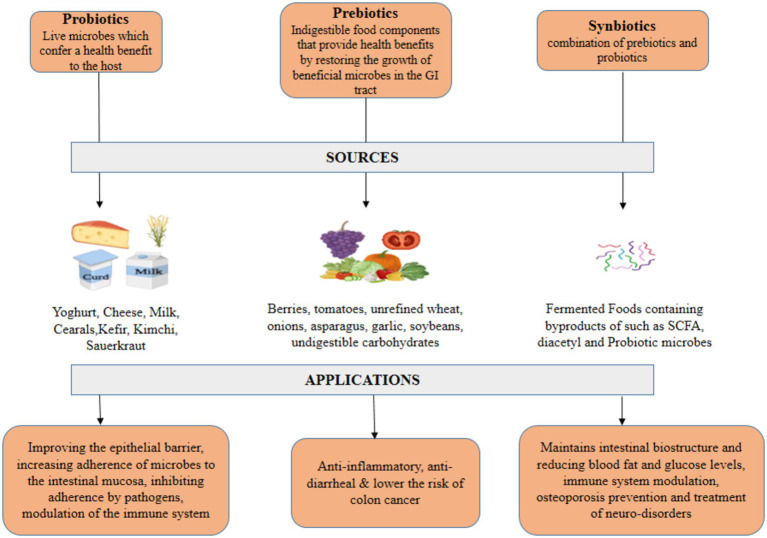
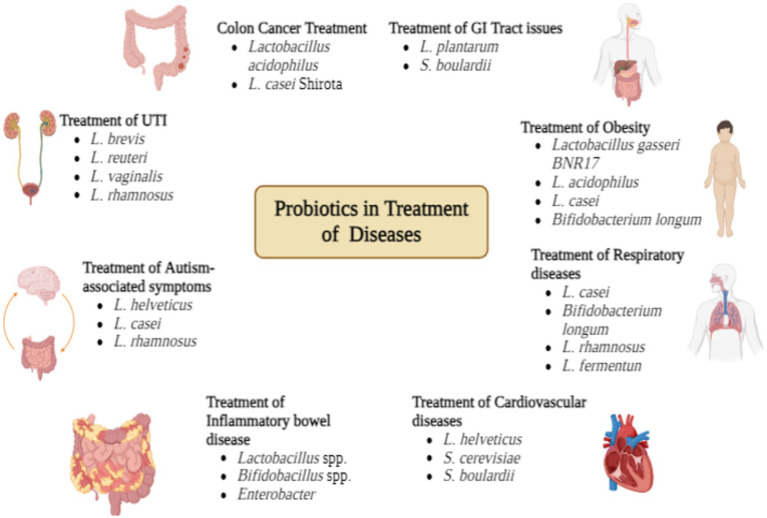
The beneficial properties of probiotics have always been a point of interest. Probiotics play a major role in maintaining the health of Gastrointestinal Tract (GIT), a healthy digestive system is responsible for modulating all other functions of the body. The effectiveness of probiotics can be enhanced by formulating them with prebiotics the formulation thus formed is referred to as synbiotics. It not only improves the viability and stability of probiotic cells, but also inhibits the growth of pathogenic strains. Lactobacillus and Bifidobacterium spp. are most commonly used as probiotics. The other microbial spp. that can be used as probiotics are Bacillus, Streptococcus , Enterococcus , and Saccharomyces . Probiotics can be used for the treatment of diabetes, obesity, inflammatory, cardiovascular, respiratory, Central nervous system disease (CNS) and digestive disorders. It is also essential to encapsulate live microorganisms that promote intestinal health. Encapsulation of probiotics safeguards them against risks during production, storage, and gastrointestinal transit. Heat, pressure, and oxidation eradicate probiotics and their protective qualities. Encapsulation of probiotics prolongs their viability, facilitates regulated release, reduces processing losses, and enables application in functional food products. Probiotics as microspheres produced through spray drying or coacervation. This technique regulates the release of gut probiotics and provides stress resistance. Natural encapsulating materials including sodium alginate, calcium chloride, gel beads and polysaccharide promoting safeguards in probiotics during the digestive process. However, several methods including, spray drying where liquid is atomized within a heated air chamber to evaporate moisture and produce dry particles that improves the efficacy and stability of probiotics. Additionally, encapsulating probiotics with prebiotics or vitamins enhance their efficacy. Probiotics enhance immune system efficacy by augmenting the generation of antibodies and immunological cells. It combats illnesses and enhances immunity. Recent studies indicate that probiotics may assist in the regulation of weight and blood glucose levels and influence metabolism and insulin sensitivity. Emerging research indicates that the “gut-brain axis” connects mental and gastrointestinal health. Probiotics may alleviate anxiety and depression via influencing neurotransmitter synthesis and inflammation. Investigations are underway about the dermatological advantages of probiotics that forecasting the onsite delivery of probiotics, encapsulation is an effective technique and requires more consideration from researchers. This review focuses on the applications of probiotics, prebiotics and synbiotics in the prevention and treatment of human health.
Overview
The claims and statistics of this paper haven’t been checked yet.
Run the check — free, no account needed. It reads the open-access text and checks the sources it cites.
Integrity signals
Registry
Cites
Statistics
Figures
Verification
Claims the paper makes
The claims and statistics of this paper haven’t been checked yet.
Run the check — free, no account needed. It reads the open-access text and checks the sources it cites.
Claims other papers make about this one
Each is checked against this paper’s own text: does it say what the citing paper says it does?
The source backs part of the claim, not all of it — or backs it for a different population, condition or comparison.
In the citing paper
“Collectively, these taxa account for the majority of probiotic strains evaluated in clinical trials worldwide and have well-documented roles in gastrointestinal health and diarrheal disease management.10-12”
From Safety and efficacy concerns in Indian probiotics: Insights from whole-genome sequencing and in vitro assessment (2026) · cites this paper as [11]
Experimental — accuracy not yet measuredThe cited source says what the claim attributes to it.
In the citing paper
“Also, these products represent globally established probiotic categories, including lactic acid bacteria (notably Lactobacillus rhamnosus GG and other Lactobacillus spp.), Bifidobacterium spp., spore-forming Bacillus spp., and yeast-based probiotics (S. boulardii).”
From Safety and efficacy concerns in Indian probiotics: Insights from whole-genome sequencing and in vitro assessment (2026) · cites this paper as [11]
Self-check
Percentages, sums and reported differences re-computed from the paper’s own numbers.
The self-check needs the paper’s full text.
Citations
Cites
Cryan, J. F., O'Riordan, K. J., Cowan, C. S. M., Sandhu, K. V., Bastiaanssen, T. F. S., Boehme, M., Codagnone, M. G., Cussotto, S., Fulling, C., Golubeva, A. V., et al. (2019) · Physiological Reviews · doi:10.1152/physrev.00018.2018 · Cited by 5,286
Probiotics and prebiotics in intestinal health and disease: from biology to the clinic
Sanders, M. E., Merenstein, D. J., Reid, G., Gibson, G. R., & Rastall, R. A. (2019) · Nature Reviews Gastroenterology & Hepatology · doi:10.1038/s41575-019-0173-3 · Cited by 2,059
Gut microbiome structure and metabolic activity in inflammatory bowel disease
Franzosa, E. A., Sirota-Madi, A., Avila-Pacheco, J., Fornelos, N., Haiser, H. J., Reinker, S., Vatanen, T., Hall, A. B., Mallick, H., McIver, L. J., et al. (2018) · Nature Microbiology · doi:10.1038/s41564-018-0306-4 · Cited by 1,995
Gut microbiota in colorectal cancer: mechanisms of action and clinical applications
Wong, S. H., & Yu, J. (2019) · Nature Reviews Gastroenterology & Hepatology · doi:10.1038/s41575-019-0209-8 · Cited by 1,382
Probiotics, prebiotics and synbiotics- a review
Pandey, K. R., Naik, S. R., & Vakil, B. V. (2015) · Journal of Food Science and Technology · doi:10.1007/s13197-015-1921-1 · Cited by 1,350
Probiotic Mechanisms of Action
Bermúdez-Brito, M., Plaza‐Díaz, J., Muñoz‐Quezada, S., Gómez‐Llorente, C., & Gil, Á. (2012) · Annals of Nutrition and Metabolism · doi:10.1159/000342079 · Cited by 1,326
Anti-Inflammatory and Immunomodulatory Effects of Probiotics in Gut Inflammation: A Door to the Body
Cristofori, F., Dargenio, V. N., Dargenio, C., Miniello, V. L., Barone, M., & Francavilla, R. (2021) · Frontiers in Immunology · doi:10.3389/fimmu.2021.578386 · Cited by 985
Benefaction of probiotics for human health: A review
George Kerry, R., Patra, J. K., Gouda, S., Park, Y., Shin, H.-S., & Das, G. (2018) · Journal of Food and Drug Analysis · doi:10.1016/j.jfda.2018.01.002 · Cited by 898
Gut microbiota imbalance and colorectal cancer
Gagnière, J. (2016) · World Journal of Gastroenterology · doi:10.3748/wjg.v22.i2.501 · Cited by 890
Probiotics Mechanism of Action on Immune Cells and Beneficial Effects on Human Health
Mazziotta, C., Tognon, M., Martini, F., Torreggiani, E., & Rotondo, J. C. (2023) · Cells · doi:10.3390/cells12010184 · Cited by 889
Research works printed but not linked: 1
- Hosseinvand, 2022, Stability of the emulsion and hysicochemical characteristics of low- fat on storage time using Hydroxypropyl Distarch phosphate (E1442) and Xantan gum as fat replacers, Nutr. Food Sci. Res., 9, 43, 10.29252/nfsr.9.1.43 · DOI
Cited by
Sorted by citations
Kezer, G., Paramithiotis, S., Khwaldia, K., Harahap, I. A., Čagalj, M., Šimat, V., Smaoui, S., Elfalleh, W., Özoğul, F., & Esatbeyoglu, T. (2025) · Frontiers in Microbiology · doi:10.3389/fmicb.2025.1651965 · Cited by 63
The human microbiome in clinical translation: from bench to bedside
Bautista, J., Echeverría, C. E., Maldonado-Noboa, I., Ojeda-Mosquera, S., Hidalgo-Tinoco, C., & López-Cortés, A. (2025) · Frontiers in Microbiology · doi:10.3389/fmicb.2025.1632435 · Cited by 55
Kurhaluk, N., Kamiński, P., Bilski, R., Kołodziejska, R., Woźniak, A., & Ткаченко, Г. М. (2025) · International Journal of Molecular Sciences · doi:10.3390/ijms26083658 · Cited by 50
Probiotic Development Strategy Centered on Stability and Regulatory Considerations
Kim, H., Haque, M. A., Razzak, M. A., Jang, M. J., Song, S., & Ku, S. (2026) · Comprehensive Reviews in Food Science and Food Safety · doi:10.1111/1541-4337.70320 · Cited by 43
Enteric Delivery of Probiotics: Challenges, Techniques, and Activity Assays
Sun, C., Zhang, Z., Sun, Y., Sun, X., Jin, Y., Zhu, J., Yu, J., & Wu, T. (2025) · Foods · doi:10.3390/foods14132318 · Cited by 36
Metadata
- Authors
- Sarita, B., Samadhan, D., Hassan, M. Z., & Kovaleva, E. G.
- Affiliations
- Ural Federal University (RU)
- Corresponding author
- Sarita, Bhutada
- Venue
- Frontiers in Microbiology
- Publisher
- Frontiers Media SA
- Published
- 2025-01-06
- Volume
- 15
- Pages
- 1487641-1487641
- ISSN
- 1664-302X (ISSN-L)
- PMC
- PMC11743475
- OpenAlex
- W4406110509
- Cited by
- 250
- References
- 98
- Citations by year
- 2026: 161 · 2025: 89
- FWCI
- 20.51
- Type
- journal article
- Language
- en
- Open access
- gold
- doi.org
- Licence
- Locations
- Frontiers in Microbiology (publishedVersion, cc-by)
- PubMed Central (publishedVersion, cc-by)
- PubMed (publishedVersion)
- Electronic Archive of Ural Federal University (ELAR UrFU) (publishedVersion, cc-by)
- DOAJ (DOAJ: Directory of Open Access Journals) (submittedVersion, cc-by-sa)
- Topics
- Life Sciences › Agricultural and Biological Sciences › Food Science › Probiotics and Fermented Foods
- Life Sciences › Agricultural and Biological Sciences › Food Science › Microencapsulation and Drying Processes
- Health Sciences › Nursing › Nutrition and Dietetics › Microbial Metabolites in Food Biotechnology
- Keywords
- probiotics, prebiotics, synbiotics, probiotic encapsulation, probiotic stability, Lactobacillus, Bifidobacterium, spray drying, coacervation, gut-brain axis, immunomodulation, diabetes mellitus, obesity, gut microbiota, functional foods, probiotic delivery
About these checks
Registry, retraction, Cites and statistics results are computed, not judged, with one exception: a printed reference that no index lists is read once by a model before it counts as a citation error. Claims are extracted by a model and kept only when their quote appears verbatim in the text; each cited source is then checked, with a model’s help, for whether it says what the claim relies on. Those verdicts can be wrong — read the claim’s quote and the cited source before relying on one.
Statistics and arithmetic are recomputed, not judged.
Confidence bands are shown only for fields calibrated on our annotated test set. None is calibrated yet, so no band is shown.
What counts as a claim ›How we measure confidence ›How we check this ›
Are you an author, or do you see a problem with this page? Request a review
