

The DOI matches its Crossref record; 61 of the 61 references it cites were found in a registry or an index.
Quorum sensing regulators and non-ribosomal peptide synthetases govern antibacterial secretions in Xenorhabdus szentirmaii
Open accessPublished version of a preprint
Abstract
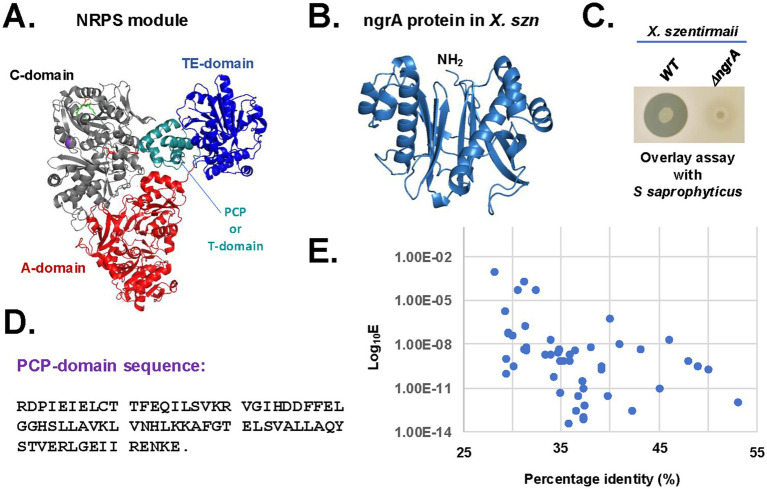
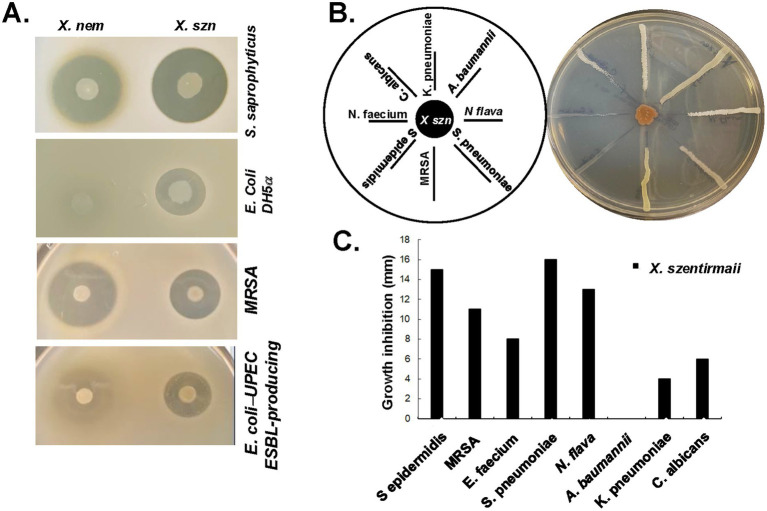
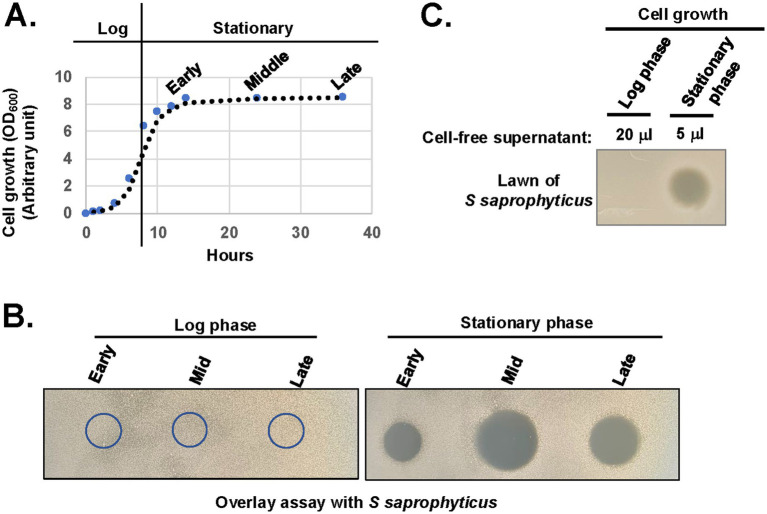
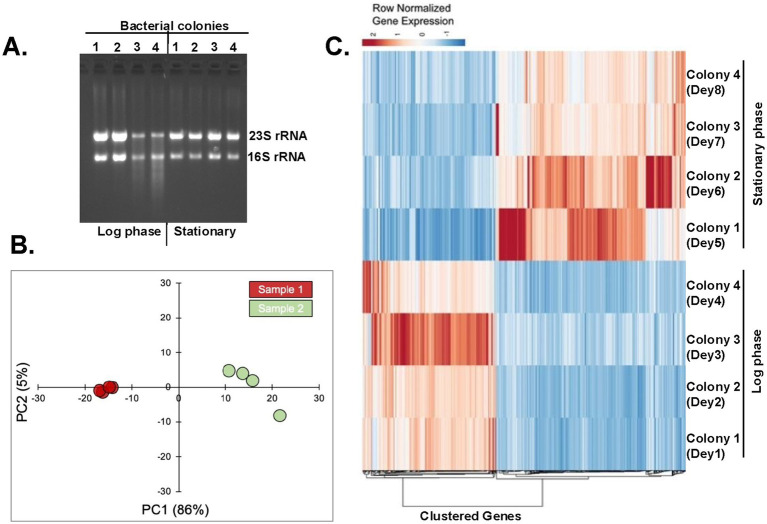
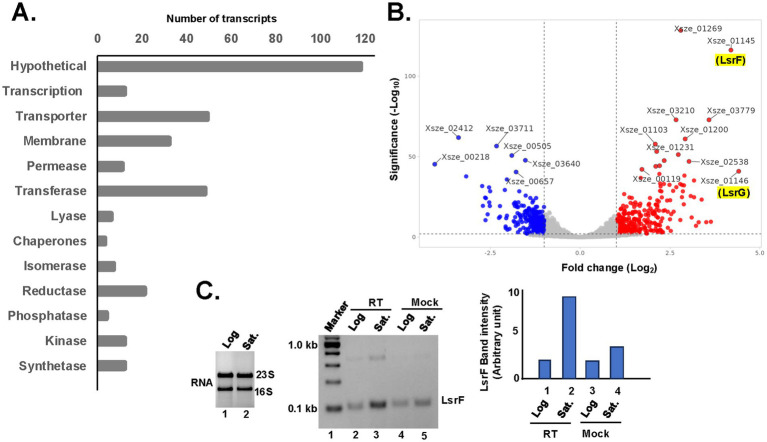
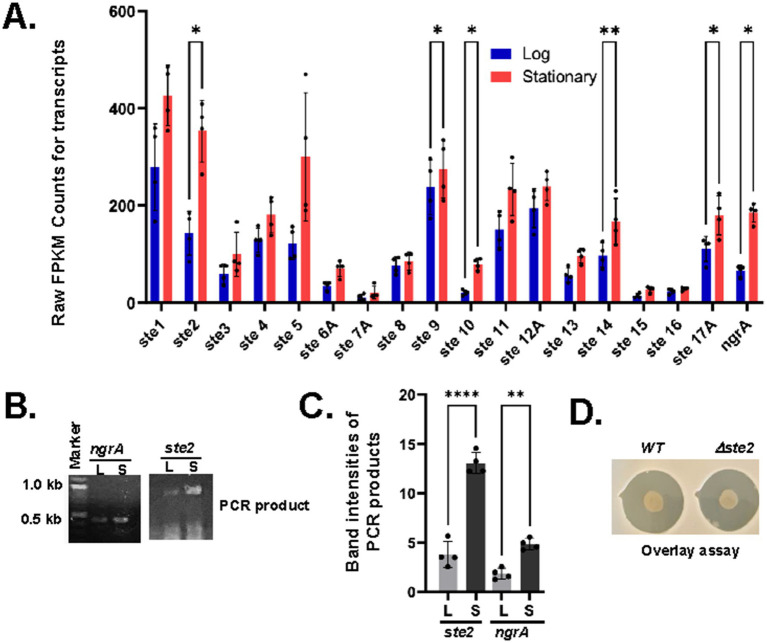
The decades-long gap in antibiotic discovery has led to a significant health crisis due to antimicrobial resistance (AMR). The bacterial genus Xenorhabdus , which forms symbiotic relationships with the soil nematode Steinernema , are known to secrete a variety of antimicrobial compounds with potential effectiveness against AMR. These antimicrobial compounds are primarily bio-synthesized by non-ribosomal peptide synthetases (NRPS) and polyketide synthase (PKS) genes. In this study, we report that X. szentirmaii produces high levels of antibiotic activity during the stationary phase against diverse bacteria including known antibiotic resistant pathogens. It possesses 17 operons to encode predicted NRPS and PKS enzymes, designated as ste1 through ste17 . The ste15-ste16 and ste17 operons are predicted to produce the known antibiotics Pax peptide and Fabclavine, respectively. Additionally, the newly identified operons ste3 , ste4 , ste5 , ste8, ste9 , and ste14 consist of single genes, each containing two or more NRPS genes. The ste13 operon harbors two NRPS genes, while the ste7 and ste12 operons contain three NRPS genes each. Further, RNA-seq analysis showed that lsrF that encodes a quorum sensing autoinducer-2 (AI-2) thiolase was expressed at high levels during stationary phase. These findings provide evidence that X. szentirmaii uses quorum sensing (QS) to synchronize the expression of multiple NRPS and PKS enzymes responsible for synthesizing various antimicrobial compounds. This study underscores the potential to leverage these regulatory insights for maximizing commercial applications of novel antibiotics combating AMR, as well as broader industrial uses.
Overview
The claims and statistics of this paper haven’t been checked yet.
Run the check — free, no account needed. It reads the open-access text and checks the sources it cites.
Integrity signals
Registry
Cites
Statistics
Figures
Verification
Claims the paper makes
The claims and statistics of this paper haven’t been checked yet.
Run the check — free, no account needed. It reads the open-access text and checks the sources it cites.
Self-check
Percentages, sums and reported differences re-computed from the paper’s own numbers.
The self-check needs the paper’s full text.
Citations
Cites
Moderated estimation of fold change and dispersion for RNA-seq data with DESeq2
Love, M. I., Huber, W., & Anders, S. (2014) · Genome Biology · doi:10.1186/s13059-014-0550-8 · Cited by 95,106
STAR: ultrafast universal RNA-seq aligner
Dobin, A., Davis, C. A., Schlesinger, F., Drenkow, J., Zaleski, C., Jha, S., Batut, P., Chaisson, M., & Gingeras, T. R. (2013) · Bioinformatics · doi:10.1093/bioinformatics/bts635 · Cited by 51,709
Highly accurate protein structure prediction with AlphaFold
Jumper, J., Evans, R., Pritzel, A., Green, T., Figurnov, M., Ronneberger, O., Tunyasuvunakool, K., Bates, R., Žídek, A., Potapenko, A., et al. (2021) · Nature · doi:10.1038/s41586-021-03819-2 · Cited by 43,764
fastp: an ultra-fast all-in-one FASTQ preprocessor
Chen, S., Zhou, Y., Chen, Y., & Gu, J. (2018) · Bioinformatics · doi:10.1093/bioinformatics/bty560 · Cited by 29,721
Global burden of bacterial antimicrobial resistance in 2019: a systematic analysis
Murray, C. J. L., Ikuta, K. S., Sharara, F., Swetschinski, L., Robles Aguilar, G., Gray, A., Han, C., Bisignano, C., Rao, P., Wool, E., et al. (2022) · The Lancet · doi:10.1016/s0140-6736(21)02724-0 · Cited by 16,316
Bacterial competition: surviving and thriving in the microbial jungle
Hibbing, M. E., Fuqua, C., Parsek, M. R., & Peterson, S. B. (2010) · Nature Reviews Microbiology · doi:10.1038/nrmicro2259 · Cited by 2,689
Antibacterial drug discovery in the resistance era
Brown, E. D., & Wright, G. D. (2016) · Nature · doi:10.1038/nature17042 · Cited by 2,330
Blin, K., Shaw, S., Augustijn, H. E., Reitz, Z. L., Biermann, F., Alanjary, M., Fetter, A., Terlouw, B. R., Metcalf, W. W., Helfrich, E. J. N., et al. (2023) · Nucleic Acids Research · doi:10.1093/nar/gkad344 · Cited by 2,290
Bacterial Quorum Sensing: Its Role in Virulence and Possibilities for Its ControlPreprint
Rutherford, S. T., & Bassler, B. L. (2012) · Cold Spring Harbor Perspectives in Medicine · doi:10.1101/cshperspect.a012427 · Cited by 2,158
Antimicrobial Resistance: Implications and Costs
Dadgostar, P. (2019) · Infection and Drug Resistance · doi:10.2147/idr.s234610 · Cited by 2,024
Metadata
- Authors
- Dey, R., Valle, D. O., Chakraborty, A., Mayer, K. A., Uppala, J. K., Chakraborty, A., Mirza, S., Skwor, T., Forst, S., & Dey, M.
- Affiliations
- University of Wisconsin–Milwaukee (US)
- La Jolla Institute for Immunology (US)
- Corresponding author
- Dey, Madhusudan
- ORCID
- Venue
- Frontiers in Microbiology
- Publisher
- Frontiers Media SA
- Published
- 2025-03-12
- Volume
- 16
- Pages
- 1560663-1560663
- ISSN
- 1664-302X (ISSN-L)
- PMC
- PMC11936946
- OpenAlex
- W4408379288
- Cited by
- 1
- References
- 61
- Citations by year
- 2026: 1
- FWCI
- 0.57
- Type
- journal article
- Language
- en
- Open access
- gold
- doi.org
- Licence
- Locations
- Frontiers in Microbiology (publishedVersion, cc-by)
- bioRxiv (Cold Spring Harbor Laboratory) (acceptedVersion)
- PubMed Central (publishedVersion, cc-by)
- PubMed (publishedVersion)
- DOAJ (DOAJ: Directory of Open Access Journals) (submittedVersion, cc-by-sa)
- Topics
- Life Sciences › Immunology and Microbiology › Applied Microbiology and Biotechnology › Microbial Natural Products and Biosynthesis
- Life Sciences › Biochemistry, Genetics and Molecular Biology › Molecular Biology › Bacterial biofilms and quorum sensing
- Life Sciences › Immunology and Microbiology › Microbiology › Antimicrobial Peptides and Activities
- Keywords
- Xenorhabdus szentirmaii, quorum sensing, nonribosomal peptide synthetase, polyketide synthase, antimicrobial peptides, antibiotic resistance, AI-2 signaling, stationary phase gene expression, novel antibiotics
About these checks
Registry, retraction, Cites and statistics results are computed, not judged, with one exception: a printed reference that no index lists is read once by a model before it counts as a citation error. Claims are extracted by a model and kept only when their quote appears verbatim in the text; each cited source is then checked, with a model’s help, for whether it says what the claim relies on. Those verdicts can be wrong — read the claim’s quote and the cited source before relying on one.
Statistics and arithmetic are recomputed, not judged.
Confidence bands are shown only for fields calibrated on our annotated test set. None is calibrated yet, so no band is shown.
What counts as a claim ›How we measure confidence ›How we check this ›
Are you an author, or do you see a problem with this page? Request a review
How to cite
Cite CoChat for the checks on this page, and the paper for its own findings.
- This page
- CoChat. (2026). Citation check: Quorum sensing regulators and non-ribosomal peptide synthetases govern antibacterial secretions in Xenorhabdus szentirmaii. https://app.cochat.ai/papers/10.3389/fmicb.2025.1560663
- The paper
- Dey, R., Valle, D. O., Chakraborty, A., Mayer, K. A., Uppala, J. K., Chakraborty, A., Mirza, S., Skwor, T., Forst, S., & Dey, M. (2025). Quorum sensing regulators and non-ribosomal peptide synthetases govern antibacterial secretions in Xenorhabdus szentirmaii. Frontiers in Microbiology. https://doi.org/10.3389/fmicb.2025.1560663
Data sources
Bibliographic data: Semantic Scholar, OpenAlex, Crossref.
Contains information from the Semantic Scholar Academic Graph Datasets, made available under the ODC Attribution License (ODC-BY 1.0).
Semantic Scholar’s data is described in: Kinney, R., et al. (2023). The Semantic Scholar Open Data Platform. arXiv:2301.10140.
