

The DOI matches its Crossref record; 360 of the 361 references it cites were found in a registry or an index.
Allosteric Regulation at the Crossroads of New Technologies: Multiscale Modeling, Networks, and Machine Learning
Open accessAbstract
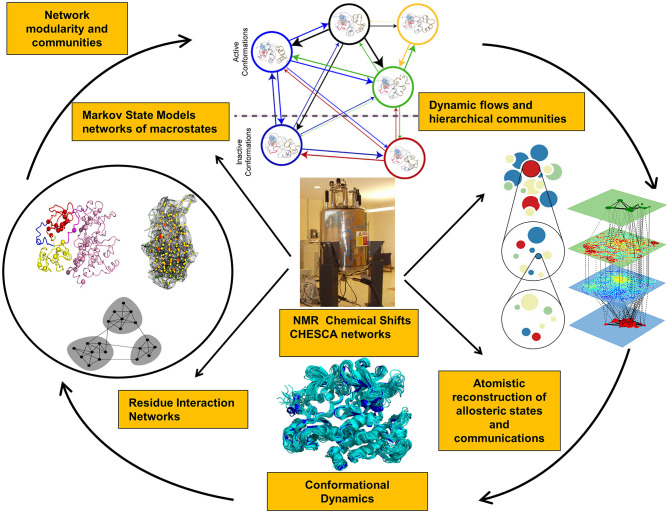
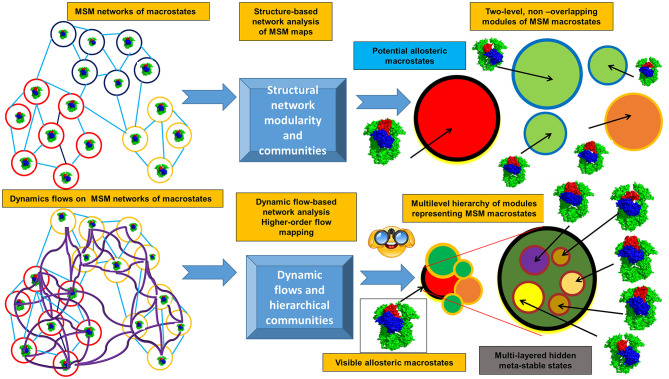
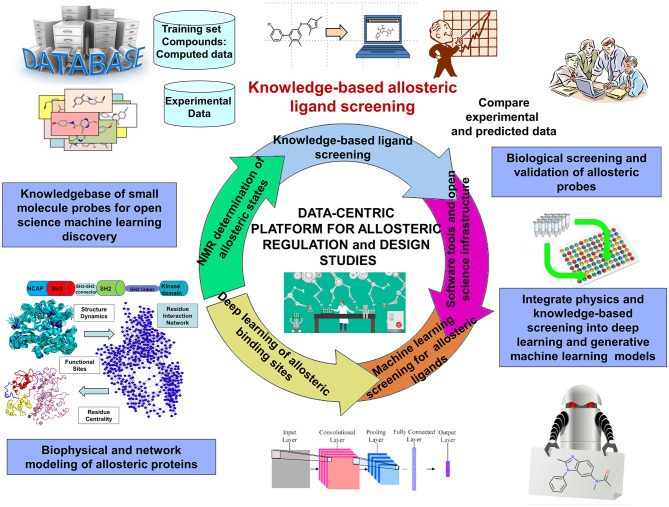
Allosteric regulation is a common mechanism employed by complex biomolecular systems for regulation of activity and adaptability in the cellular environment, serving as an effective molecular tool for cellular communication. As an intrinsic but elusive property, allostery is a ubiquitous phenomenon where binding or disturbing of a distal site in a protein can functionally control its activity and is considered as the "second secret of life." The fundamental biological importance and complexity of these processes require a multi-faceted platform of synergistically integrated approaches for prediction and characterization of allosteric functional states, atomistic reconstruction of allosteric regulatory mechanisms and discovery of allosteric modulators. The unifying theme and overarching goal of allosteric regulation studies in recent years have been integration between emerging experiment and computational approaches and technologies to advance quantitative characterization of allosteric mechanisms in proteins. Despite significant advances, the quantitative characterization and reliable prediction of functional allosteric states, interactions, and mechanisms continue to present highly challenging problems in the field. In this review, we discuss simulation-based multiscale approaches, experiment-informed Markovian models, and network modeling of allostery and information-theoretical approaches that can describe the thermodynamics and hierarchy allosteric states and the molecular basis of allosteric mechanisms. The wealth of structural and functional information along with diversity and complexity of allosteric mechanisms in therapeutically important protein families have provided a well-suited platform for development of data-driven research strategies. Data-centric integration of chemistry, biology and computer science using artificial intelligence technologies has gained a significant momentum and at the forefront of many cross-disciplinary efforts. We discuss new developments in the machine learning field and the emergence of deep learning and deep reinforcement learning applications in modeling of molecular mechanisms and allosteric proteins. The experiment-guided integrated approaches empowered by recent advances in multiscale modeling, network science, and machine learning can lead to more reliable prediction of allosteric regulatory mechanisms and discovery of allosteric modulators for therapeutically important protein targets.
Overview
The claims and statistics of this paper haven’t been checked yet.
Run the check — free, no account needed. It reads the open-access text and checks the sources it cites.
Integrity signals
Registry
Cites
Statistics
Figures
Verification
Claims the paper makes
The claims and statistics of this paper haven’t been checked yet.
Run the check — free, no account needed. It reads the open-access text and checks the sources it cites.
Claims other papers make about this one
Each is checked against this paper’s own text: does it say what the citing paper says it does?
In the citing paper
“AlphaFold, which predicts single ranked structures for a protein sequence, is unable to address directly allosteric mechanisms, which are based on the populations of conformational states in the ensembles.”
From AlphaFold, Artificial Intelligence (AI), and Allostery (2022) · cites this paper as [107]
Self-check
Percentages, sums and reported differences re-computed from the paper’s own numbers.
The self-check needs the paper’s full text.
Citations
Cites
LeCun, Y., Bengio, Y., & Hinton, G. (2015) · Nature · doi:10.1038/nature14539 · Cited by 84,126
Human-level control through deep reinforcement learning
Mnih, V., Kavukcuoglu, K., Silver, D., Rusu, A. A., Veness, J., Bellemare, M. G., Graves, A., Riedmiller, M., Fidjeland, A. K., Ostrovski, G., et al. (2015) · Nature · doi:10.1038/nature14236 · Cited by 30,357
Unpaired image-to-image translation using cycle-consistent adversarial networks
Zhu, J.-Y., Park, T., Isola, P., & Efros, A. A. (2017) · 2017 IEEE International Conference on Computer Vision (ICCV) · doi:10.1109/iccv.2017.244 · Cited by 23,602
Reducing the dimensionality of data with neural networks
Hinton, G. E., & Salakhutdinov, R. R. (2006) · Science · doi:10.1126/science.1127647 · Cited by 20,928
Mastering the game of Go without human knowledge
Silver, D., Schrittwieser, J., Simonyan, K., Antonoglou, I., Huang, A., Guez, A., Hubert, T., Baker, L., Lai, M., Bolton, A., et al. (2017) · Nature · doi:10.1038/nature24270 · Cited by 9,084
ON THE NATURE OF ALLOSTERIC TRANSITIONS: A PLAUSIBLE MODEL.
Monod, J., Wyman, J., & Changeux, J. (1965) · Journal of Molecular Biology · doi:10.1016/s0022-2836(65)80285-6 · Cited by 7,681
Maps of random walks on complex networks reveal community structure
Rosvall, M., & Bergstrom, C. T. (2008) · Proceedings of the National Academy of Sciences · doi:10.1073/pnas.0706851105 · Cited by 4,583
Measuring Information Transfer
Schreiber, T. (2000) · Physical Review Letters · doi:10.1103/physrevlett.85.461 · Cited by 4,571
Automatic Chemical Design Using a Data-Driven Continuous Representation of Molecules
Gómez-Bombarelli, R., Wei, J. N., Duvenaud, D., Hernández-Lobato, J. M., Sánchez-Lengeling, B., Sheberla, D., Aguilera-Iparraguirre, J., Hirzel, T. D., Adams, R. P., & Aspuru-Guzik, A. (2018) · ACS Central Science · doi:10.1021/acscentsci.7b00572 · Cited by 3,106
SeqGAN: Sequence Generative Adversarial Nets with Policy Gradient
Yu, L., Zhang, W., Wang, Y.-X., & Yu, Y. H. (2017) · Proceedings of the AAAI Conference on Artificial Intelligence · doi:10.1609/aaai.v31i1.10804 · Cited by 2,422
Research works printed but not linked: 1
- Verkhivker, 2016, Dissecting allosteric regulatory mechanisms of the Hsp90 chaperone interactions with the protein kinase clients: Integrating structural bioinformatics with multiscale atomistic simulations and biophysical experiments, Abst. Pap. Am. Chem. Soc., 251, 2
Cited by
Sorted by citations
AlphaFold, Artificial Intelligence (AI), and Allostery
Nussinov, R., Zhang, M., Liu, Y., & Jang, H. (2022) · The Journal of Physical Chemistry B · doi:10.1021/acs.jpcb.2c04346 · Cited by 190
Allostery: Allosteric Cancer Drivers and Innovative Allosteric Drugs
Nussinov, R., Zhang, M., Maloney, R., Liu, Y., Tsai, C.-J., & Jang, H. (2022) · Journal of Molecular Biology · doi:10.1016/j.jmb.2022.167569 · Cited by 66
Machine learning approaches in predicting allosteric sites
Nerín-Fonz, F., & Cournia, Z. (2024) · Current Opinion in Structural Biology · doi:10.1016/j.sbi.2024.102774 · Cited by 62
Perspectives on Computational Enzyme Modeling: From Mechanisms to Design and Drug Development
Nam, K., Shao, Y., Major, D. T., & Wolf‐Watz, M. (2024) · ACS Omega · doi:10.1021/acsomega.3c09084 · Cited by 57
New Insights into the Cooperativity and Dynamics of Dimeric Enzymes
Chen, K.-W., Sun, T., & Wu, Y. (2023) · Chemical Reviews · doi:10.1021/acs.chemrev.3c00042 · Cited by 46
Metadata
- Authors
- Verkhivker, G. M., Agajanian, S., Hu, G., & Tao, P.
- Affiliations
- Chapman University (US)
- Soochow University (CN)
- Southern Methodist University (US)
- Corresponding author
- Verkhivker, Gennady M.
- Venue
- Frontiers in Molecular Biosciences
- Publisher
- Frontiers Media SA
- Published
- 2020-07-09
- Volume
- 7
- Pages
- 136-136
- ISSN
- 2296-889X (ISSN-L)
- PMC
- PMC7363947
- OpenAlex
- W3041792613
- Cited by
- 76
- References
- 361
- Citations by year
- 2026: 8 · 2025: 11 · 2024: 15 · 2023: 13 · 2022: 15 · 2021: 10 · 2020: 4
- FWCI
- 1.01
- Type
- journal article
- Language
- en
- Open access
- gold
- doi.org
- Licence
- Locations
- Frontiers in Molecular Biosciences (publishedVersion, cc-by)
- PubMed Central (publishedVersion, cc-by)
- PubMed (publishedVersion)
- Chapman University Digital Commons (Chapman University) (submittedVersion, cc-by)
- DOAJ (DOAJ: Directory of Open Access Journals) (submittedVersion, cc-by-sa)
- Funders
- Chapman University
- National Institute of General Medical Sciences (R15GM122013)
- Topics
- Life Sciences › Biochemistry, Genetics and Molecular Biology › Molecular Biology › Protein Structure and Dynamics
- Life Sciences › Biochemistry, Genetics and Molecular Biology › Molecular Biology › Receptor Mechanisms and Signaling
- Life Sciences › Pharmacology, Toxicology and Pharmaceutics › Drug Discovery › Computational Drug Discovery Methods
- Keywords
- allosteric regulation, allosteric proteins, allosteric modulators, multiscale modeling, Markov model, protein-protein interaction network, information theory, deep learning, deep reinforcement learning, allosteric mechanism
About these checks
Registry, retraction, Cites and statistics results are computed, not judged, with one exception: a printed reference that no index lists is read once by a model before it counts as a citation error. Claims are extracted by a model and kept only when their quote appears verbatim in the text; each cited source is then checked, with a model’s help, for whether it says what the claim relies on. Those verdicts can be wrong — read the claim’s quote and the cited source before relying on one.
Statistics and arithmetic are recomputed, not judged.
Confidence bands are shown only for fields calibrated on our annotated test set. None is calibrated yet, so no band is shown.
What counts as a claim ›How we measure confidence ›How we check this ›
Are you an author, or do you see a problem with this page? Request a review
