

The DOI matches its Crossref record; 69 of the 71 references it cites were found in a registry or an index.
Deep Learning with Convolutional Neural Networks Applied to Electromyography Data: A Resource for the Classification of Movements for Prosthetic Hands
Open accessAbstract
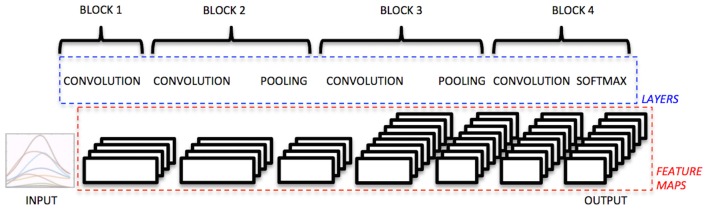
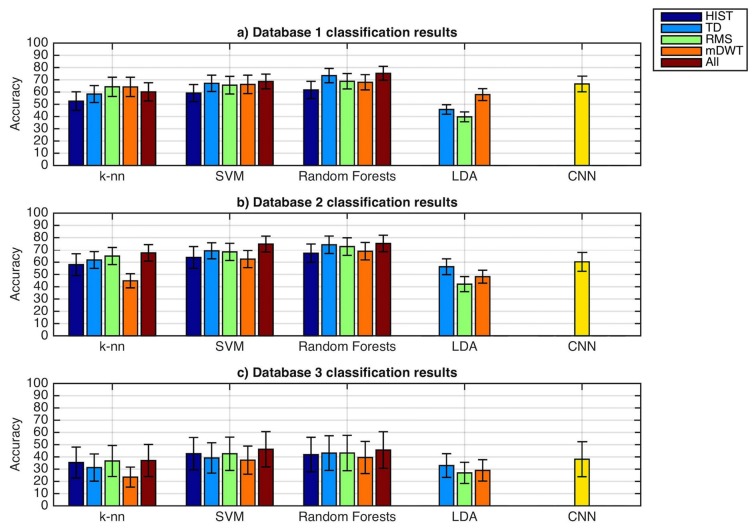
Natural control methods based on surface electromyography (sEMG) and pattern recognition are promising for hand prosthetics. However, the control robustness offered by scientific research is still not sufficient for many real life applications, and commercial prostheses are capable of offering natural control for only a few movements. In recent years deep learning revolutionized several fields of machine learning, including computer vision and speech recognition. Our objective is to test its methods for natural control of robotic hands via sEMG using a large number of intact subjects and amputees. We tested convolutional networks for the classification of an average of 50 hand movements in 67 intact subjects and 11 transradial amputees. The simple architecture of the neural network allowed to make several tests in order to evaluate the effect of pre-processing, layer architecture, data augmentation and optimization. The classification results are compared with a set of classical classification methods applied on the same datasets. The classification accuracy obtained with convolutional neural networks using the proposed architecture is higher than the average results obtained with the classical classification methods, but lower than the results obtained with the best reference methods in our tests. The results show that convolutional neural networks with a very simple architecture can produce accurate results comparable to the average classical classification methods. They show that several factors (including pre-processing, the architecture of the net and the optimization parameters) can be fundamental for the analysis of sEMG data. Larger networks can achieve higher accuracy on computer vision and object recognition tasks. This fact suggests that it may be interesting to evaluate if larger networks can increase sEMG classification accuracy too.
Overview
The claims and statistics of this paper haven’t been checked yet.
Run the check — free, no account needed. It reads the open-access text and checks the sources it cites.
Integrity signals
Registry
Cites
Statistics
Figures
Verification
Claims the paper makes
The claims and statistics of this paper haven’t been checked yet.
Run the check — free, no account needed. It reads the open-access text and checks the sources it cites.
Claims other papers make about this one
Each is checked against this paper’s own text: does it say what the citing paper says it does?
The source backs part of the claim, not all of it — or backs it for a different population, condition or comparison.
In the citing paper
“Pattern recognition control of myoelectric prostheses is also getting popularity due to its better classification of EMG signals (user intentions) using various methods, i.e., linear discriminant analysis classifier, tacit learning system, deep learning with convolutional neural network (Adewuyi et al., 2016; Atzori et al., 2016; Fani et al., 2016; Oyama et al., 2016), etc.”
From Selectivity and Longevity of Peripheral-Nerve and Machine Interfaces: A Review. (2017) · cites this paper as Atzori et al., 2016
Experimental — accuracy not yet measured
Self-check
Percentages, sums and reported differences re-computed from the paper’s own numbers.
The self-check needs the paper’s full text.
Citations
Cites
Breiman, L. (2001) · Machine Learning · doi:10.1023/a:1010933404324 · Cited by 133,538 · cited 1×
“They include: random Forests (Breiman, 2001), SVM (Cristianini and Shawe-Taylor, 2000) and k-Nearest Neighbors (Duda et al., 2001).”
MethodImageNet classification with deep convolutional neural networks
Krizhevsky, A., Sutskever, I., & Hinton, G. E. (2017) · Communications of the ACM · doi:10.1145/3065386 · Cited by 112,155 · cited 1×
“However, in the field of computer vision in 2012, deep learning approaches won one of the largest object recognition challenges (the ILSVRC) decreasing the previous top-5 error rate by more than 10% (Krizhevsky and Hinton, 2010; Goodfellow et al., 2016).”
BackgroundHuman-level control through deep reinforcement learning
Mnih, V., Kavukcuoglu, K., Silver, D., Rusu, A. A., Veness, J., Bellemare, M. G., Graves, A., Riedmiller, M., Fidjeland, A. K., Ostrovski, G., et al. (2015) · Nature · doi:10.1038/nature14236 · Cited by 30,357 · cited 1×
“Moreover, they have also improved the performance of reinforcement learning, where a machine or software agent is able to maximize its performance by itself performing trials and errors (Mnih et al., 2015; Goodfellow et al., 2016).”
BackgroundDelving Deep into Rectifiers: Surpassing Human-Level Performance on ImageNet Classification
He, K., Zhang, X., Ren, S., & Sun, J. (2015) · 2015 IEEE International Conference on Computer Vision (ICCV) · doi:10.1109/iccv.2015.123 · Cited by 19,741 · cited 1×
“Since then, only techniques based on convolutional neural networks have won this competition, leading to top-5 error rates lower than 5% (He et al., 2015; Goodfellow et al., 2016).”
BackgroundThe pascal visual object classes (VOC) challenge
Everingham, M., Van Gool, L., Williams, C. K. I., Winn, J., & Zisserman, A. (2010) · International Journal of Computer Vision · doi:10.1007/s11263-009-0275-4 · Cited by 19,599 · cited 1×
“The usefulness of benchmark databases has been demonstrated repeatedly in other fields, e.g., in the machine vision and image analysis communities (Müller et al., 2009; Everingham et al., 2010).”
BackgroundSeel, N. M. (2012) · Springer eBooks · doi:10.1007/978-1-4419-1428-6_5195 · Cited by 19,482
An Introduction to Support Vector Machines and Other Kernel-based Learning Methods
Cristianini, N., & Shawe-Taylor, J. (2000) · doi:10.1017/cbo9780511801389 · Cited by 13,855
(2016) · Cited by 11,679
Hinton, G., Deng, L., Yu, D., Dahl, G., Mohamed, A.-R., Jaitly, N., Senior, A., Vanhoucke, V., Nguyen, P., Sainath, T., et al. (2012) · IEEE Signal Processing Magazine · doi:10.1109/msp.2012.2205597 · Cited by 10,260 · cited 1×
“Since 2010, the application of deep learning techniques to speech recognition has allowed a quick and impressive reduction of error rate (Dahl et al., 2010; Deng et al., 2010b, 2013; Hinton et al., 2012; Goodfellow et al., 2016).”
BackgroundRussell, E. L., Chiang, L. H., & Braatz, R. D. (2000) · Advances in industrial control · doi:10.1007/978-1-4471-0409-4_3 · Cited by 7,938
Research works printed but not linked: 2
- Feix, 2009, A comprehensive grasp taxonomy, 2
- Goodfellow, 2016, Deep Learning (Book in preparation).
Cited by
Sorted by citations
Deep learning for healthcare applications based on physiological signals: A review
Faust, O., Hagiwara, Y., Hong, T. J., Lih, O. S., & Acharya, U. R. (2018) · Computer Methods and Programs in Biomedicine · doi:10.1016/j.cmpb.2018.04.005 · Cited by 1,081
“, 2016 [65] Hand movement classification CNN NinaPro DB [62] accuracy: 66.”
BackgroundApplications of deep learning and reinforcement learning to biological data
Mahmud, M., Kaiser, M. S., Hussain, A., & Vassanelli, S. (2018) · IEEE Transactions on Neural Networks and Learning Systems · doi:10.1109/tnnls.2018.2790388 · Cited by 765
“[184] and Park and Lee [185] decoded hand movements from EMG signals.”
Deep Learning for Electromyographic Hand Gesture Signal Classification Using Transfer Learning
Côté‐Allard, U., Fall, C. L., Drouin, A., Campeau‐Lecours, A., Gosselin, C., Glette, K., Laviolette, F., & Gosselin, B. J. (2019) · IEEE Transactions on Neural Systems and Rehabilitation Engineering · doi:10.1109/tnsre.2019.2896269 · Cited by 789
“Recently, researchers have proposed deep learning approaches [4], [5], [6], shifting the paradigm from feature engineering to feature learning.”
BackgroundMethodDeep Learning in Mining Biological Data
Mahmud, M., Kaiser, M. S., McGinnity, T. M., & Hussain, A. (2021) · Cognitive Computation · doi:10.1007/s12559-020-09773-x · Cited by 478
Comparison of six electromyography acquisition setups on hand movement classification tasks
Pizzolato, S., Tagliapietra, L., Cognolato, M., Reggiani, M., Müller, H., & Atzori, M. (2017) · PLoS ONE · doi:10.1371/journal.pone.0186132 · Cited by 429
“Offline data analysis on public benchmark datasets on the other hand can be performed by any researcher worldwide (including a wide community of scientists that are highly specialized in machine learning) and it allows the immediate comparison of different methods (including very recent ones [8]) and setups.”
Background
Metadata
- Authors
- Atzori, M., Cognolato, M., & Müller, H.
- Affiliations
- HES-SO University of Applied Sciences and Arts Western Switzerland (CH)
- Corresponding author
- Atzori, Manfredo
- Venue
- Frontiers in Neurorobotics
- Publisher
- Frontiers Media SA
- Published
- 2016-09-07
- Volume
- 10
- Pages
- 9-9
- ISSN
- 1662-5218 (ISSN-L)
- PMC
- PMC5013051
- OpenAlex
- W2516710120
- Cited by
- 684
- References
- 71
- Citations by year
- 2026: 53 · 2025: 70 · 2024: 72 · 2023: 92 · 2022: 93 · 2021: 96 · 2020: 77 · 2019: 74 · 2018: 42 · 2017: 15
- FWCI
- 20.96
- Type
- journal article
- Language
- en
- Open access
- gold
- doi.org
- Licence
- cc-by
- Locations
- Frontiers in Neurorobotics (publishedVersion, cc-by)
- Europe PMC (PubMed Central) (publishedVersion, cc-by)
- PubMed Central (publishedVersion, cc-by)
- PubMed (publishedVersion)
- DOAJ (DOAJ: Directory of Open Access Journals) (submittedVersion, cc-by-sa)
- ArODES (HES-SO (https://www.hes-so.ch/)) (submittedVersion, cc-by)
- Padua Research Archive (University of Padova) (submittedVersion, cc-by)
- Funders
- Schweizerischer Nationalfonds zur Förderung der Wissenschaftlichen Forschung (#132700, #160837)
- Topics
- Physical Sciences › Engineering › Biomedical Engineering › Muscle activation and electromyography studies
- Life Sciences › Neuroscience › Cognitive Neuroscience › EEG and Brain-Computer Interfaces
- Life Sciences › Neuroscience › Cellular and Molecular Neuroscience › Neuroscience and Neural Engineering
- Keywords
- surface electromyography, hand movement classification, prosthetic hand control, convolutional neural networks, transradial amputees, data augmentation, neural network architecture, classification accuracy
About these checks
Registry, retraction, Cites and statistics results are computed, not judged, with one exception: a printed reference that no index lists is read once by a model before it counts as a citation error. Claims are extracted by a model and kept only when their quote appears verbatim in the text; each cited source is then checked, with a model’s help, for whether it says what the claim relies on. Those verdicts can be wrong — read the claim’s quote and the cited source before relying on one.
Statistics and arithmetic are recomputed, not judged.
Confidence bands are shown only for fields calibrated on our annotated test set. None is calibrated yet, so no band is shown.
What counts as a claim ›How we measure confidence ›How we check this ›
Are you an author, or do you see a problem with this page? Request a review
