

The DOI matches its Crossref record; 193 of the 193 references it cites were found in a registry or an index.
Outside in: Unraveling the Role of Neuroinflammation in the Progression of Parkinson's Disease
Open accessAbstract
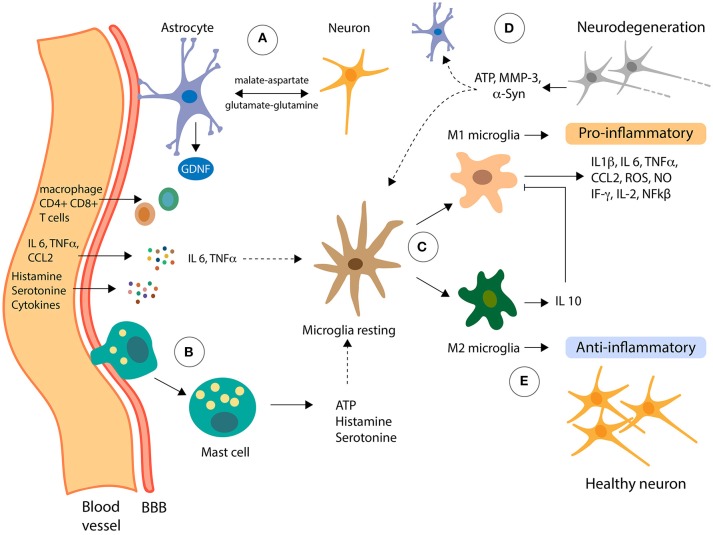
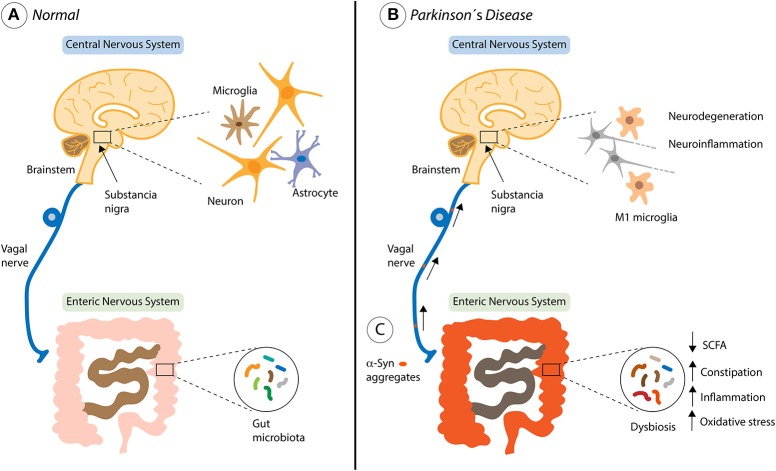
Neuroinflammation is one of the most important processes involved in the pathogenesis of Parkinson's disease (PD). The current concept of neuroinflammation comprises an inflammation process, which occurs in the central nervous system due to molecules released from brain-resident and/or blood-derived immune cells. Furthermore, the evidence of the contribution of systemic delivered molecules to the disease pathogenesis, such as the gut microbiota composition, has been increasing during the last years. Under physiological conditions, microglia and astrocytes support the well-being and well-function of the brain through diverse functions, including neurotrophic factor secretion in both intact and injured brain. On the other hand, genes that cause PD are expressed in astrocytes and microglia, shifting their neuroprotective role to a pathogenic one, contributing to disease onset and progression. In addition, growth factors are a subset of molecules that promote cellular survival, differentiation and maturation, which are critical signaling factors promoting the communication between cells, including neurons and blood-derived immune cells. We summarize the potential targeting of astrocytes and microglia and the systemic contribution of the gut microbiota in neuroinflammation process archived in PD.
Overview
The claims and statistics of this paper haven’t been checked yet.
Run the check — free, no account needed. It reads the open-access text and checks the sources it cites.
Integrity signals
Registry
Cites
Statistics
Figures
Verification
Claims the paper makes
The claims and statistics of this paper haven’t been checked yet.
Run the check — free, no account needed. It reads the open-access text and checks the sources it cites.
Claims other papers make about this one
Each is checked against this paper’s own text: does it say what the citing paper says it does?
In the citing paper
“In fact, neuroinflammation is closely related to neurodegenerative diseases, as Huntington’s [133], Alzheimer’s [134] and Parkinson’s disease [135] and neuropsychiatric disorders, such as major depressive disorder, bipolar disorder and anxiety [136].”
From Hyperactivation of P2X7 receptors as a culprit of COVID-19 neuropathology (2021) · cites this paper as [135]
Self-check
Percentages, sums and reported differences re-computed from the paper’s own numbers.
The self-check needs the paper’s full text.
Citations
Cites
2 retracted
Zhao, Y., Haney, M. J., Gupta, R., Bohnsack, J. P., He, Z., Kabanov, A. V., & Batrakova, E. V. (2014) · PLoS ONE · doi:10.1371/journal.pone.0106867 · Cited by 144
RetractedMani, S., Sekar, S., Barathidasan, R., Manivasagam, T., Thenmozhi, A. J., Sevanan, M., Chidambaram, S. B., Essa, M. M., Guillemin, G. J., & Sakharkar, M. K. (2018) · Neurotoxicity Research · doi:10.1007/s12640-018-9869-3 · Cited by 79
RetractedStaging of brain pathology related to sporadic Parkinson’s disease
Braak, H., Tredici, K. D., Rüb, U., de Vos, R. A. I., Jansen Steur, E. N. H., & Braak, E. (2003) · Neurobiology of Aging · doi:10.1016/s0197-4580(02)00065-9 · Cited by 10,777
Mutation in the α-Synuclein Gene Identified in Families with Parkinson's Disease
Polymeropoulos, M. H., Lavedan, C., Leroy, E., Ide, S. E., Dehejia, A., Dutra, A., Pike, B., Root, H., Rubenstein, J., Boyer, R., et al. (1997) · Science · doi:10.1126/science.276.5321.2045 · Cited by 8,240
Neurotoxic reactive astrocytes are induced by activated microglia
Liddelow, S. A., Guttenplan, K. A., Clarke, L. E., Bennett, F. C., Bohlen, C. J., Schirmer, L., Bennett, M. L., Münch, A. E., Chung, W.-S., Peterson, T. C., et al. (2017) · Nature · doi:10.1038/nature21029 · Cited by 7,971
Parkinson's disease: clinical features and diagnosis
Jankovic, J. (2008) · Journal of Neurology, Neurosurgery & Psychiatry · doi:10.1136/jnnp.2007.131045 · Cited by 5,720
Astrocytes: Biology and pathology
Sofroniew, M. V., & Vinters, H. V. (2010) · Acta Neuropathologica · doi:10.1007/s00401-009-0619-8 · Cited by 5,196
Host-gut microbiota metabolic interactions
Nicholson, J. K., Holmes, E., Kinross, J., Burcelin, R., Gibson, G., Jia, W., & Pettersson, S. (2012) · Science · doi:10.1126/science.1223813 · Cited by 4,760
Mind-altering microorganisms: the impact of the gut microbiota on brain and behaviour
Cryan, J. F., & Dinan, T. G. (2012) · Nature Reviews Neuroscience · doi:10.1038/nrn3346 · Cited by 4,572
Microglia-mediated neurotoxicity: uncovering the molecular mechanisms
Block, M. L., Zecca, L., & Hong, J.-S. (2007) · Nature Reviews Neuroscience · doi:10.1038/nrn2038 · Cited by 4,110
Cited by
Sorted by citations
The blood-brain barrier in aging and neurodegeneration
Knox, E. G., Aburto, M. R., Clarke, G., Cryan, J. F., & O’Driscoll, C. M. (2022) · Molecular Psychiatry · doi:10.1038/s41380-022-01511-z · Cited by 738
Impact of microbiota on central nervous system and neurological diseases: the gut-brain axis
Ma, Q., Xing, C., Long, W., Wang, H. Y., Liu, Q., & Wang, R. (2019) · Journal of Neuroinflammation · doi:10.1186/s12974-019-1434-3 · Cited by 767
Vascular Inflammation and Oxidative Stress: Major Triggers for Cardiovascular Disease
Steven, S., Frenis, K., Oelze, M. W., Kalinovic, S., Kuntić, M., Jiménez, M. T. B., Vujačić-Mirski, K., Helmstädter, J., Kröller‐Schön, S., Münzel, T. F., et al. (2019) · Oxidative Medicine and Cellular Longevity · doi:10.1155/2019/7092151 · Cited by 756
Glutamate-induced excitotoxicity in Parkinson's disease: The role of glial cells
Iovino, L., Tremblay, M., & Civiero, L. (2020) · Journal of Pharmacological Sciences · doi:10.1016/j.jphs.2020.07.011 · Cited by 387
Kopp, K. O., Glotfelty, E. J., Li, Y., & Greig, N. H. (2022) · Pharmacological Research · doi:10.1016/j.phrs.2022.106550 · Cited by 298
Metadata
- Authors
- Troncoso-Escudero, P., Parra, A., Nassif, M., & Vidal, R. L.
- Affiliations
- Universidad Mayor (CL)
- Venue
- Frontiers in Neurology
- Publisher
- Frontiers Media SA
- Published
- 2018-10-15
- Volume
- 9
- Pages
- 860-860
- ISSN
- 1664-2295 (ISSN-L)
- PMC
- PMC6232883
- OpenAlex
- W2895971387
- Cited by
- 191
- References
- 193
- Citations by year
- 2026: 12 · 2025: 27 · 2024: 22 · 2023: 38 · 2022: 35 · 2021: 19 · 2020: 32 · 2019: 6
- FWCI
- 1.35
- Type
- journal article
- Language
- en
- Open access
- gold
- doi.org
- Locations
- Frontiers in Neurology (publishedVersion, cc-by)
- Europe PMC (PubMed Central) (publishedVersion, cc-by)
- PubMed Central (publishedVersion, cc-by)
- PubMed (publishedVersion)
- DOAJ (DOAJ: Directory of Open Access Journals) (submittedVersion)
- Universidad de Chile (submittedVersion, cc-by-nc-nd)
- Funders
- Fondo Nacional de Desarrollo Científico y Tecnológico (1150608, 11160288)
- Comisión Nacional de Investigación Científica y Tecnológica (21160843, 21181114)
- Topics
- Life Sciences › Neuroscience › Neurology › Neuroinflammation and Neurodegeneration Mechanisms
- Health Sciences › Medicine › Clinical Neurology › Parkinson's Disease Mechanisms and Treatments
- Life Sciences › Biochemistry, Genetics and Molecular Biology › Molecular Biology › Nuclear Receptors and Signaling
- Keywords
- Parkinson's disease, neuroinflammation, microglia, astrocytes, gut microbiota, systemic inflammation, disease progression, neuroprotective factors, growth factors, neurotrophic factors, immune cells, therapeutic targeting
About these checks
Registry, retraction, Cites and statistics results are computed, not judged, with one exception: a printed reference that no index lists is read once by a model before it counts as a citation error. Claims are extracted by a model and kept only when their quote appears verbatim in the text; each cited source is then checked, with a model’s help, for whether it says what the claim relies on. Those verdicts can be wrong — read the claim’s quote and the cited source before relying on one.
Statistics and arithmetic are recomputed, not judged.
Confidence bands are shown only for fields calibrated on our annotated test set. None is calibrated yet, so no band is shown.
What counts as a claim ›How we measure confidence ›How we check this ›
Are you an author, or do you see a problem with this page? Request a review
