

Interpretable machine learning for early predicting the risk of ventilator-associated pneumonia in ischemic stroke patients in the intensive care unit
Open accessThe DOI matches its Crossref record; 36 of the 36 references it cites were found in a registry or an index.
Abstract
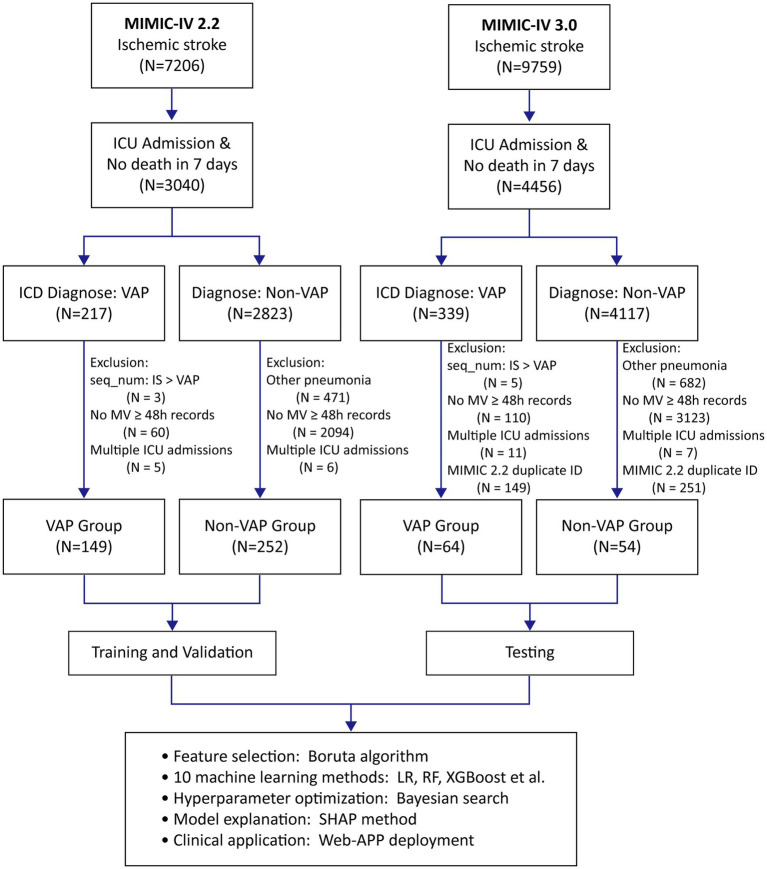
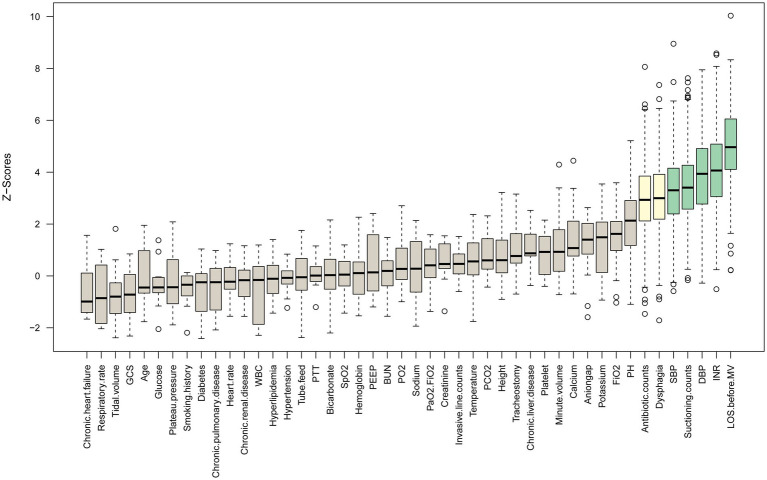
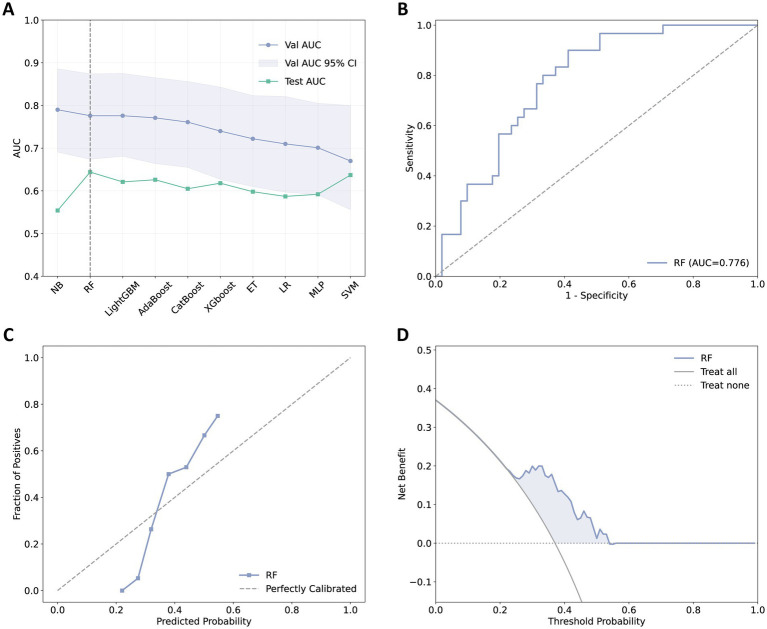
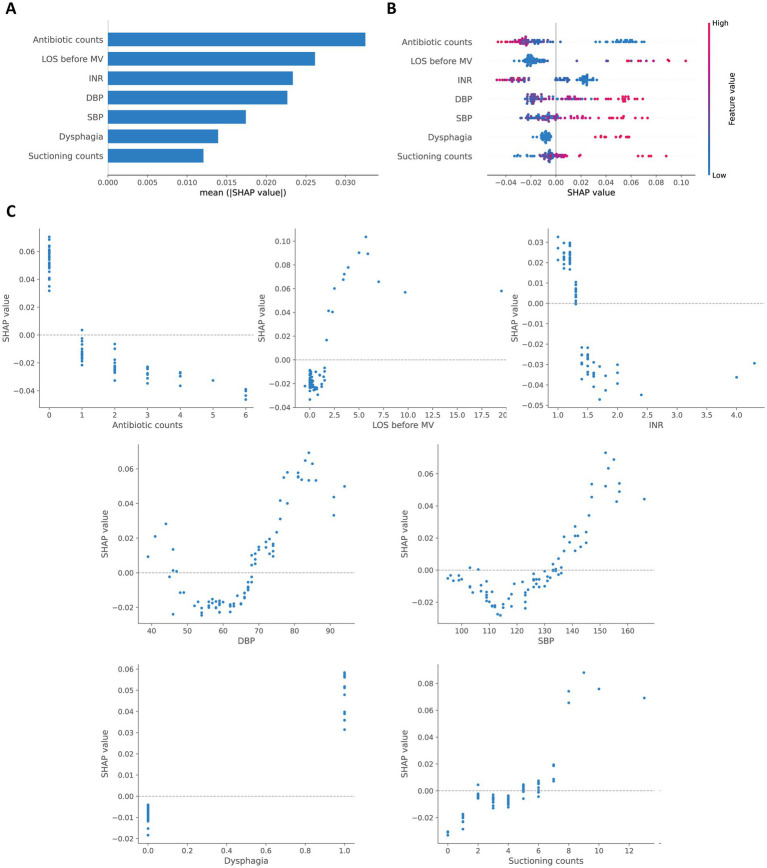
Background: The incidence of ventilator-associated pneumonia (VAP) in ischemic stroke (IS) patients is linked to a variety of detrimental outcomes. Current approaches for the early identification of individuals at high risk for developing VAP are limited and often lack clinical interpretability. The goal of this study is to develop and validate an interpretable machine learning (ML) model for early predicting VAP risk in IS patients in the intensive care unit (ICU). Methods: Data on IS patients were extracted from versions 2.2 and 3.0 of the Medical Information Mart for Intensive Care-IV database, with version 2.2 being used for model training and internal validation and version 3.0 for external testing. The primary outcome was the incidence of VAP post-ICU admission. The Boruta algorithm was used to select features prior to developing 10 ML models. The Shapley Additive Explanation (SHAP) method was employed to assess the global and local interpretability of the model’s decision-making process. The final model and Streamlit were used for developing and launching an online web application. Results: A total of 419 IS patients were included, with 401 in the derivation and 118 in the test group. Following feature selection, seven clinical characteristics were incorporated in the ML model: systolic and diastolic blood pressure, international normalized ratio, length of stay before mechanical ventilation, dysphagia, antibiotic counts and suctioning counts. Among the 10 evaluated ML models, the Random Forest (RF) model outperformed the others, achieving an internal validation AUC of 0.776, accuracy of 0.704, sensitivity of 0.900, and specificity of 0.588. In external testing, performance dropped to an AUC of 0.644, accuracy of 0.610, sensitivity of 0.688, and specificity of 0.519, raising concerns about the model’s generalizability. Conclusion: The RF model is reliable in early identifying high-risk IS patients for VAP. The SHAP method offers clear and intuitive explanations for individual risk assessment. The web-based tool has the potential to improve clinical outcomes by promptly recognizing patients at increased VAP risk and facilitating early intervention, further multicenter prospective studies are required to validate its generalizability and practical utility.
Overview
The claims and statistics of this paper haven’t been checked yet.
Free: it reads the open-access text and checks the first 5 claims that cite a source we can check. Create a free account to check every claim.
Integrity signals
Registry
Cites
Statistics
Figures
Verification
Claims the paper makes
The claims and statistics of this paper haven’t been checked yet.
Free: it reads the open-access text and checks the first 5 claims that cite a source we can check. Create a free account to check every claim.
Self-check
Percentages, sums and reported differences re-computed from the paper’s own numbers.
The self-check needs the paper’s full text.
Citations
Cites
Feature Selection with the Boruta Package
Kursa, M. B., & Rudnicki, W. R. (2010) · Journal of Statistical Software · doi:10.18637/jss.v036.i11 · Cited by 5,659 · cited 1×
“By iteratively eliminating features that do not outperform their shadow counterparts, the algorithm robustly identifies truly informative features (12).”
Collins, G. S., Moons, K. G. M., Dhiman, P., Riley, R. D., Beam, A. L., Van Calster, B., Ghassemi, M., Liu, X., Reitsma, J. B., van Smeden, M., et al. (2024) · BMJ · doi:10.1136/bmj-2023-078378 · Cited by 4,718
MIMIC-IV, a freely accessible electronic health record dataset
Johnson, A. E. W., Bulgarelli, L., Shen, L., Gayles, A., Shammout, A., Horng, S., Pollard, T. J., Hao, S., Moody, B., Gow, B., et al. (2023) · Scientific Data · doi:10.1038/s41597-022-01899-x · Cited by 3,401
World Stroke Organization (WSO): Global Stroke Fact Sheet 2022
Feigin, V. L., Brainin, M., Norrving, B., Martins, S., Sacco, R. L., Hacke, W., Fisher, M., Pandian, J., & Lindsay, P. (2022) · International Journal of Stroke · doi:10.1177/17474930211065917 · Cited by 2,979 · cited 1×
“According to World Stroke Organization statistics for 2022, stroke continues to be the second leading cause of mortality and the third leading cause of disability worldwide, thereby posing a significant threat to public health (1).”
Dysphagia After Stroke: Incidence, Diagnosis, and Pulmonary Complications
Martino, R., Foley, N., Bhogal, S., Diamant, N., Speechley, M., & Teasell, R. (2005) · Stroke · doi:10.1161/01.str.0000190056.76543.eb · Cited by 1,973 · cited 1×
“Recent studies have further confirmed that stroke-related dysphagia significantly increases the risk of pulmonary infection, underscoring the clinical importance of early dysphagia screening in stroke patients (22, 23).”
Torres, A., Niederman, M. S., Chastre, J., Ewig, S., Fernandez-Vandellos, P., Hanberger, H., Kollef, M., Li Bassi, G., Luna, C. M., Martin-Loeches, I., et al. (2017) · European Respiratory Journal · doi:10.1183/13993003.00582-2017 · Cited by 1,387 · cited 1×
“According to current guidelines on VAP treatment (32), prophylactic antibiotic use is generally not recommended to prevent VAP, due to the risk of long-term or unnecessary antibiotic use fostering resistant bacterial strains, increasing the burden of antibiotic resistance for both patients and…”
Ventilator-associated pneumonia in adults: a narrative review
Papazian, L., Klompas, M., & Luyt, C.-E. (2020) · Intensive Care Medicine · doi:10.1007/s00134-020-05980-0 · Cited by 1,010 · cited 1×
“Stroke patients undergoing MV are at increased risk for a serious pulmonary complication known as ventilator-associated pneumonia (VAP), which may have a devastating impact on their respiratory function and overall prognosis (3).”
Complications and Outcome After Acute Stroke: Does Dysphagia Matter?
Smithard, D. G., O'Neill, P. A., Park, C., Morris, J., Wyatt, R., England, R., & Martin, D. F. (1996) · Stroke · doi:10.1161/01.str.27.7.1200 · Cited by 734 · cited 1×
“Stroke patients often experience dysphagia, with incidence rates ranging from 30 to 50% (15, 16).”
Hilkens, N. A., Casolla, B., Leung, T. W., & de Leeuw, F.-E. (2024) · The Lancet · doi:10.1016/s0140-6736(24)00642-1 · Cited by 681 · cited 1×
“Ischemic stroke (IS) is the most prevalent type, accounting for 60%–70% of all instances (2).”
Johnson, A., Bulgarelli, L., Pollard, T., Gow, B., Moody, B., Horng, S., Celi, L. A., & Mark, R. (2024) · PhysioNet · doi:10.13026/07hj-2a80 · Cited by 524
Johnson, A., Bulgarelli, L., Pollard, T., Horng, S., Celi, L. A., & Mark, R. (2023) · PhysioNet · doi:10.13026/s6n6-xd98 · Cited by 524
Risk factors, inpatient care, and outcomes of pneumonia after ischemic stroke
Finlayson, O., Kapral, M., Hall, R., Asllani, E., Selchen, D., & Saposnik, G. (2011) · Neurology · doi:10.1212/wnl.0b013e31823152b1 · Cited by 409
Early Assessments of Dysphagia and Aspiration Risk in Acute Stroke Patients
Ramsey, D. J. C., Smithard, D. G., & Kalra, L. (2003) · Stroke · doi:10.1161/01.str.0000066309.06490.b8 · Cited by 385
Swallowing Disorders following Acute Stroke: Prevalence and Diagnostic Accuracy
Mann, G., Hankey, G. J., & Cameron, D. (2000) · Cerebrovascular Diseases · doi:10.1159/000016094 · Cited by 384
Prediction Tools for Stroke Rehabilitation
Stinear, C. M., Smith, M.-C., & Byblow, W. D. (2019) · Stroke · doi:10.1161/strokeaha.119.025696 · Cited by 224
Variables Associated With 7-Day, 30-Day, and 1-Year Fatality After Ischemic Stroke
Saposnik, G., Hill, M. D., O'Donnell, M., Fang, J., Hachinski, V., & Kapral, M. K. (2008) · Stroke · doi:10.1161/strokeaha.107.510362 · Cited by 209
Screening for aspiration risk associated with dysphagia in acute stroke
Boaden, E., Burnell, J., Hives, L., Dey, P., Clegg, A., Lyons, M. W., Lightbody, C. E., Hurley, M. A., Roddam, H., McInnes, E., et al. (2021) · Cochrane Database of Systematic Reviews · doi:10.1002/14651858.cd012679.pub2 · Cited by 159
Machine learning applications in stroke medicine: advancements, challenges, and future prospectives
Daidone, M., Ferrantelli, S., & Tuttolomondo, A. (2023) · Neural Regeneration Research · doi:10.4103/1673-5374.382228 · Cited by 140
Al‐Khaled, M., Matthis, C., Binder, A., Mudter, J., Schattschneider, J., Pulkowski, U., Strohmaier, T., Niehoff, T., Zybur, R., Eggers, J., et al. (2016) · Cerebrovascular Diseases · doi:10.1159/000445299 · Cited by 137
Maggiore, S. M., Lellouche, F., Pignataro, C., Girou, E., Maître, B., Richard, J.-C., Lemaire, F., Brun‐Buisson, C., & Brochard, L. J. (2013) · Respiratory Care · doi:10.4187/respcare.02265 · Cited by 135 · cited 1×
“Although this may seem contradictory, frequent invasive suctioning can impair mucociliary function and compromise airway mucosal integrity, thereby weakening the natural immune barrier and increasing susceptibility to bacterial colonization (29, 30).”
Subglottic Secretion Drainage and Objective Outcomes
Caroff, D. A., Li, L., Muscedere, J., & Klompas, M. (2015) · Critical Care Medicine · doi:10.1097/ccm.0000000000001414 · Cited by 125 · cited 1×
“Multiple studies have demonstrated that subglottic suctioning can significantly reduce the incidence of VAP by limiting microbial colonization around the endotracheal tube (26, 27).”
Prevention of Ventilator-Associated Pneumonia and Ventilator-Associated Conditions
Damas, P., Frippiat, F., Ancion, A., Canivet, J.-L., Lambermont, B. C., Layios, N., Massion, P. B., Morimont, P., Nys, M., Piret, S., et al. (2014) · Critical Care Medicine · doi:10.1097/ccm.0000000000000674 · Cited by 112
Myny, D., Depuydt, P. O., COLARDYN, F. A., & Blot, S. I. (2005) · Acta Clinica Belgica · doi:10.1179/acb.2005.022 · Cited by 100 · cited 1×
“Our research indicates that a longer ICU stay before MV may increase the incidence of VAP, which is consistent with previous studies (33, 34), presumably due to the positive link between ICU stay duration and infection risk.”
Kasuya, Y., Hargett, J. L., Lenhardt, R., Heine, M. F., Doufas, A. G., Remmel, K. S., Ramírez, J. A., & Akça, O. (2010) · Journal of Critical Care · doi:10.1016/j.jcrc.2010.09.006 · Cited by 75
Comprehensive Review: Machine and Deep Learning in Brain Stroke Diagnosis
Fernandes, J. N. D., Cardoso, V. E. M., Comesaña-Campos, A., & Pinheira, A. (2024) · Sensors · doi:10.3390/s24134355 · Cited by 75 · cited 1×
“Although machine learning (ML) methods have demonstrated promising results in predictive modeling within clinical research (6, 7), early predictive models specifically targeting VAP risk in IS patients remain scarce.”
WHAT INFLUENCES OUTCOME OF STROKE – PYREXIA OR DYSPHAGIA?
Sharma, J., Fletcher, S., Vassallo, M., & Ross, I. (2001) · International Journal of Clinical Practice · doi:10.1111/j.1742-1241.2001.tb10970.x · Cited by 68
National Sentinel Stroke Audit 1998–2011
CLOUD, G. C., Hoffman, A., & Rudd, A. (2013) · Clinical Medicine · doi:10.7861/clinmedicine.13-5-444 · Cited by 68 · cited 1×
“Dysphagia is associated with prolonged hospital stays, increased healthcare costs, and an elevated risk of persistent disability and mortality (17–21).”
Risk factors for and impact of poststroke pneumonia in patients with acute ischemic stroke
Yuan, M., Li, Q., Zhang, R., Zhang, W., Zou, N., Qin, X., & Cai, Z. (2021) · Medicine · doi:10.1097/md.0000000000025213 · Cited by 49 · cited 1×
“Large-scale prospective studies have reported similar findings, demonstrating that dysphagia following acute ischemic stroke markedly increases the risk of pneumonia and is independently associated with poor outcomes and higher mortality (24, 25).”
Favretto, D. O., Silveira, R. C. D. C. P., Canini, S. R. M. D. S., Garbin, L. M., Braga, F. T. M. M., & Dalrí, M. C. B. (2012) · Revista Latino-Americana de Enfermagem · doi:10.1590/s0104-11692012000500023 · Cited by 48
Liang, J., Yin, Z., Li, Z., Gu, H., Yang, K., Xiong, Y., Wang, Y., & Wang, C. (2022) · Stroke and Vascular Neurology · doi:10.1136/svn-2020-000746 · Cited by 44
Yang, C.-C., Shih, N.-C., Chang, W., Huang, S., & Chien, C. (2011) · BMC Health Services Research · doi:10.1186/1472-6963-11-289 · Cited by 36 · cited 1×
“Early and accurate identification of IS patients at high risk for VAP remains a critical yet challenging aspect of clinical management, as delayed diagnosis can result in worsened patient outcomes and increased clinical burden (4, 5).”
Risk factors for pulmonary infection in elderly patients with acute stroke: A meta-analysis
You, Q., Bai, D., Wu, C., Wang, H., Chen, X., Gao, J., & Hou, C. (2022) · Heliyon · doi:10.1016/j.heliyon.2022.e11664 · Cited by 15
Subglottic suction frequency and adverse ventilator-associated events during critical illness
Abdallah, H. O., Weingart, M., Fuller, R., Pegues, D. A., Fitzpatrick, R., & Kelly, B. J. (2021) · Infection Control and Hospital Epidemiology · doi:10.1017/ice.2020.1298 · Cited by 9 · cited 1×
“However, our study observed a significant link between increased suctioning frequency and a higher risk of VAP in IS patients, which is consistent with the findings of Abdallah et al. (28).”
Shamsizadeh, M., Jouzdani, A. F., & Rahimi‐Bashar, F. (2022) · Critical Care Research and Practice · doi:10.1155/2022/4826933 · Cited by 9
Gouder, C., Agius, M., Gamoudi, D., Gamoudi, N., Farrugia, D., Borg, M., & Micallef, J. (2014) · European Respiratory Journal · doi:10.1183/13993003/erj.44.suppl_58.p2573 · Cited by 2 · cited 1×
“Warfarin has been shown to have a protective effect for community-acquired pneumonia, probably due to its effect on disturbed thrombin formation and alveolar fibrin deposition (31).”
Johnson, A., Bulgarelli, L., Pollard, T., Gow, B., Moody, B., Horng, S., Celi, L. A., & Mark, R. (2024) · PhysioNet · doi:10.13026/hxp0-hg59
Research works printed but not linked: 1
- Lundberg SM Lee SI. A unified approach to interpreting model predictions. In Proceedings of the 31st International Conference on Neural Information Processing Systems (NIPS'17). Curran Associates Inc. (2017) 4768–4777
Cited by
Cao, H., Gui, L., Wei, J., Zheng, M., Cheng, M., & Ning, C. (2025) · BMC Cardiovascular Disorders · doi:10.1186/s12872-025-05231-4 · Cited by 4
Self-citationZarantonello, F., De Cassai, A., Pettenuzzo, T., Sella, N., Mormando, G., Bolzon, A., Fulvio, G. A., Bertoncello, C. A., & Boscolo, A. (2026) · Korean journal of anesthesiology · doi:10.4097/kja.251142 · Cited by 3
“Although 41.1% of the studies reported EHR integration, only 10.7% achieved a combination of EHR connectivity and real-time deployment [14,18,21,29,50,52,54,58,76,78,86,108], confirming that data access alone does not ensure operational availability.”
InfluentialHajikarimloo, B., Mohammadzadeh, I., Tos, S. M., Hashemi, R., Khoshrou, A., Amjadzadeh, M., Dehghan, M., Aghajan, S., Goudarzi, E., Najari, D., et al. (2026) · Neurocritical Care · doi:10.1007/s12028-026-02450-1 · Cited by 6
Li, C., Zhang, T., Chen, H., Wang, S., Wang, L., Huan, Y., Liu, J., & Liu, L. (2026) · Frontiers in Neurology · doi:10.3389/fneur.2026.1848730 · Cited by 1
“The SHAP (Shapley Additive Explanations) method, grounded in cooperative game theory, was employed to interpret the optimal model (15).”
Zhang, Y., Lin, M., Zhou, Y.-X., Lin, X., Wei, Y., Li, B., Li, J., Luo, H., Deng, Y., Qin, Z., et al. (2026) · Frontiers in Neurology · doi:10.3389/fneur.2026.1666960
“Although existing tools (e.g., Bayesian networks or machine learning models) improve prediction performance, they lack interpretability, failing to clarify the mechanisms of key risk factors (e.g., inflammatory indices or respiratory function parameters) (20).”
Metadata
- Authors
- Cao, H., Wei, J., Hua, P., & Yang, S.
- Affiliations
- Sun Yat-sen University (CN)
- First Affiliated Hospital of Guangzhou University of Chinese Medicine (CN)
- Corresponding author
- Hua, Ping
- Yang, Songran
- Venue
- Frontiers in Neurology
- Publisher
- Frontiers Media SA
- Published
- 2025-05-07
- Volume
- 16
- Pages
- 1513732-1513732
- ISSN
- 1664-2295 (ISSN-L)
- PMC
- PMC12092222
- OpenAlex
- W4410184250
- Cited by
- 7
- References
- 34
- Citations by year
- 2026: 6 · 2025: 1
- FWCI
- 5.71
- Type
- journal article
- Language
- en
- Open access
- gold
- doi.org
- Licence
- Locations
- Frontiers in Neurology (publishedVersion, cc-by)
- PubMed Central (publishedVersion, cc-by)
- PubMed (publishedVersion)
- DOAJ (DOAJ: Directory of Open Access Journals) (submittedVersion, cc-by-sa)
- Funders
- National Natural Science Foundation of China (201704030032, 81771165)
- Topics
- Health Sciences › Medicine › Critical Care and Intensive Care Medicine › Nosocomial Infections in ICU
- Physical Sciences › Computer Science › Artificial Intelligence › Machine Learning in Healthcare
- Health Sciences › Health Professions › Health Information Management › Artificial Intelligence in Healthcare
- Keywords
- ventilator-associated pneumonia, ischemic stroke, risk prediction, intensive care unit, model interpretability, SHAP, random forest, MIMIC-IV, dysphagia, mechanical ventilation, antibiotic use, blood pressure, international normalized ratio
About these checks
Registry, retraction, Cites and statistics results are computed, not judged, with one exception: a printed reference that no index lists is read once by a model before it counts as a citation error. Claims are extracted by a model and kept only when their quote appears verbatim in the text; each cited source is then checked, with a model’s help, for whether it says what the claim relies on. Those verdicts can be wrong — read the claim’s quote and the cited source before relying on one.
Statistics and arithmetic are recomputed, not judged.
Confidence bands are shown only for fields calibrated on our annotated test set. None is calibrated yet, so no band is shown.
What counts as a claim ›How we measure confidence ›How we check this ›
Are you an author, or do you see a problem with this page? Request a review
Data sources
Bibliographic data: Semantic Scholar, OpenAlex, Crossref.
Contains information from the Semantic Scholar Academic Graph Datasets, made available under the ODC Attribution License (ODC-BY 1.0).
Semantic Scholar’s data is described in: Kinney, R., et al. (2023). The Semantic Scholar Open Data Platform. arXiv:2301.10140.
