

The DOI matches its Crossref record; 164 of the 165 references it cites were found in a registry or an index.
On the relationship between anxiety and error monitoring: a meta-analysis and conceptual framework
Open accessAbstract
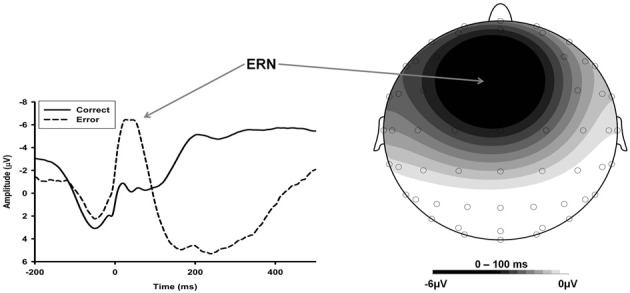
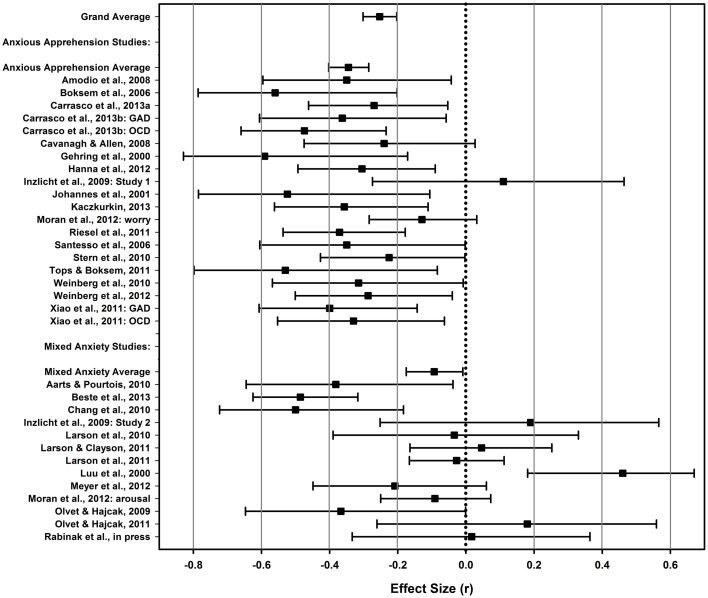
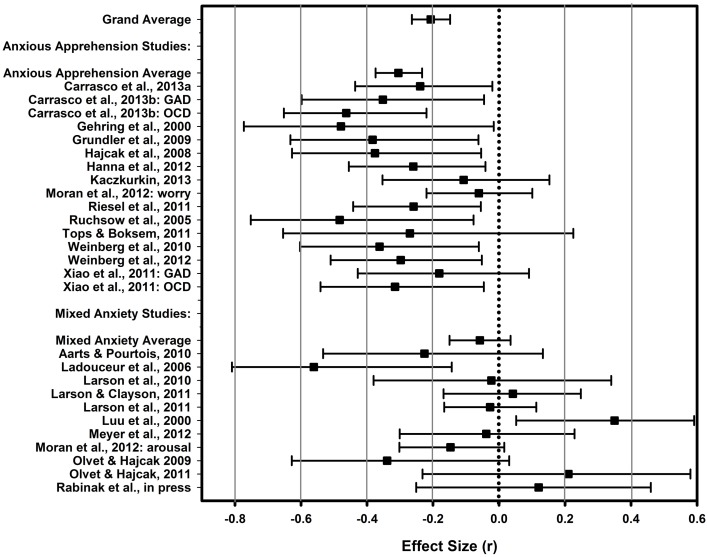
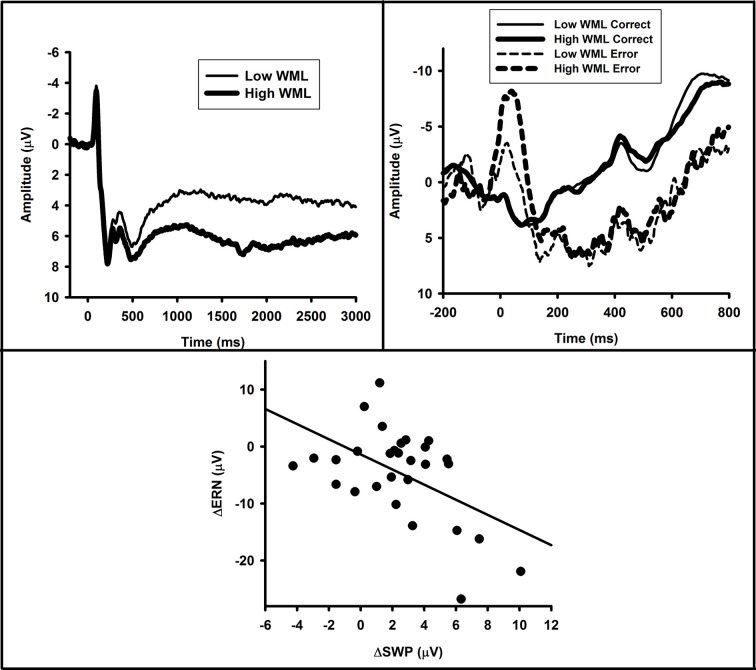
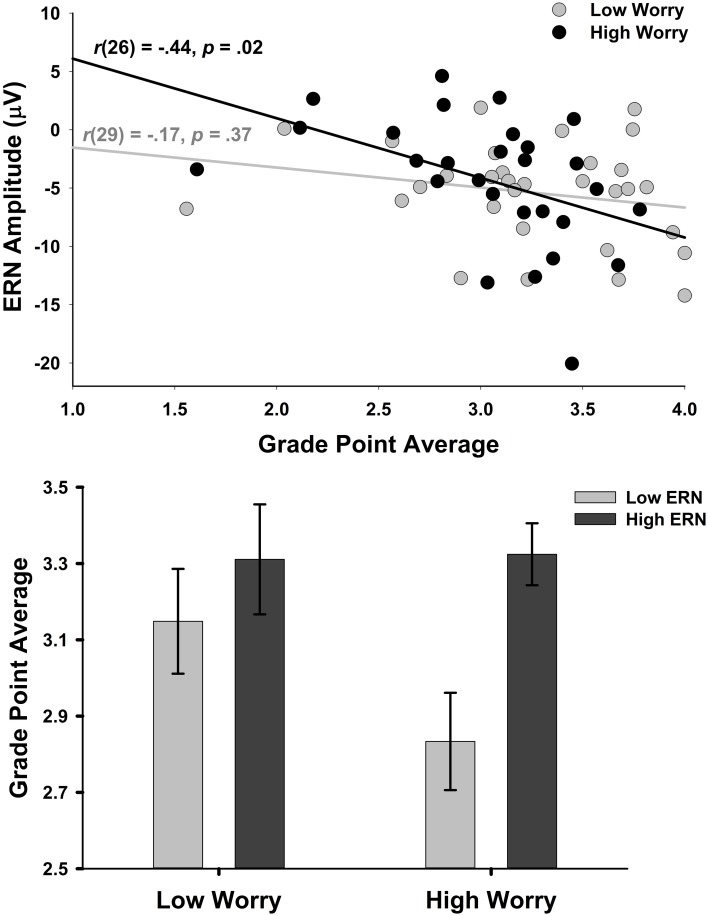
Research involving event-related brain potentials has revealed that anxiety is associated with enhanced error monitoring, as reflected in increased amplitude of the error-related negativity (ERN). The nature of the relationship between anxiety and error monitoring is unclear, however. Through meta-analysis and a critical review of the literature, we argue that anxious apprehension/worry is the dimension of anxiety most closely associated with error monitoring. Although, overall, anxiety demonstrated a robust, "small-to-medium" relationship with enhanced ERN (r = -0.25), studies employing measures of anxious apprehension show a threefold greater effect size estimate (r = -0.35) than those utilizing other measures of anxiety (r = -0.09). Our conceptual framework helps explain this more specific relationship between anxiety and enhanced ERN and delineates the unique roles of worry, conflict processing, and modes of cognitive control. Collectively, our analysis suggests that enhanced ERN in anxiety results from the interplay of a decrease in processes supporting active goal maintenance and a compensatory increase in processes dedicated to transient reactivation of task goals on an as-needed basis when salient events (i.e., errors) occur.
Overview
The claims and statistics of this paper haven’t been checked yet.
Run the check — free, no account needed. It reads the open-access text and checks the sources it cites.
Integrity signals
Registry
Cites
Statistics
Figures
Verification
Claims the paper makes
The claims and statistics of this paper haven’t been checked yet.
Run the check — free, no account needed. It reads the open-access text and checks the sources it cites.
Claims other papers make about this one
Each is checked against this paper’s own text: does it say what the citing paper says it does?
The source backs part of the claim, not all of it — or backs it for a different population, condition or comparison.
In the citing paper
“From the perspective of Attentional Control Theory, it is possible that persistent obsessions and severe anxiety in pediatric OCD interfere with the efficient functioning of the goal‐directed attentional system that may not be as well compensated for by an enhanced ERN in youths as in adults (Eysenck et al. 2007; Moser et al. 2013).”
From Reaction Time Variability and Electrophysiological Indices of Performance Monitoring in Youths With Attention-Deficit/Hyperactivity Disorder and Obsessive-Compulsive Disorder (2026) · cites this paper as Moser et al. 2013
Experimental — accuracy not yet measuredThe cited source says what the claim attributes to it.
In the citing paper
“Meta-analytic evidence supports the ERN as a potential biomarker for psychopathology, with anxiety symptoms associated with larger (more negative) amplitudes (Moser et al., 2013) and externalizing symptoms associated with smaller (less negative) amplitudes (Lutz et al., 2021).”
From Foster care intervention protects cognitive control skills in young adults exposed to institutional rearing (2026) · cites this paper as Moser et al., 2013
Self-check
Percentages, sums and reported differences re-computed from the paper’s own numbers.
The self-check needs the paper’s full text.
Citations
Cites
Diagnostic and Statistical Manual of Mental Disorders
Williams, J. B. W., & First, M. B. (2013) · Oxford University Press eBooks · doi:10.1093/acrefore/9780199975839.013.104 · Cited by 109,845
Statistical Power Analysis for the Behavioral Sciences
Muller, K. E., & Cohen, J. (1989) · Technometrics · doi:10.2307/1270020 · Cited by 99,603
Kessler, R. C., Berglund, P., Demler, O., Jin, R., Merikangas, K. R., & Walters, E. E. (2005) · Archives of General Psychiatry · doi:10.1001/archpsyc.62.6.593 · Cited by 20,391
Studies of interference in serial verbal reactions
Stroop, J. R. (1935) · Journal of Experimental Psychology · doi:10.1037/h0054651 · Cited by 18,622
(2010) · Intellectum (Universidad de La Sabana) · doi:10.1111/j.1467- · Cited by 16,131
Conflict monitoring and cognitive control
Botvinick, M. M., Braver, T. S., Barch, D. M., Carter, C. S., & Cohen, J. D. (2001) · Psychological Review · doi:10.1037/0033-295x.108.3.624 · Cited by 7,351
Carver, C. S., & White, T. L. (1994) · Journal of Personality and Social Psychology · doi:10.1037/0022-3514.67.2.319 · Cited by 7,306
Effects of noise letters upon the identification of a target letter in a nonsearch task
Eriksen, B. A., & Eriksen, C. W. (1974) · Perception & Psychophysics · doi:10.3758/bf03203267 · Cited by 7,230
Cognitive and emotional influences in anterior cingulate cortex
Bush, G., Luu, P., & Posner, M. I. (2000) · Trends in Cognitive Sciences · doi:10.1016/s1364-6613(00)01483-2 · Cited by 6,259
(2023) · doi:10.1126/science · Cited by 6,063
Research works printed but not linked: 3
- Barlow D. H. (2002). Anxiety and Its Disorders, 2nd Edn. New York, NY: Guilford Press
- Matthews G. Joyner J. Gililand K. Campbell S. E. Faulconner S. (1999). Validation of a comprehensive stress state questionnaire: towards a state “Big three”? in Handbook of Coping: Theory, Research, and Applications, eds Mervielde I. Deary I. J. De Fruyt F. Ostendorf F. (Tilburg, NL: Tilburg University Press), 333– 350
- Moran T. P. Moser J. S. (2012). Working memory load enhances action monitoring: implications for the study of anxiety, in Poster presented at the 52nd Annual Conference for the Society for Psychophysiological Research, (New Orleans, LA).
Cited by
Sorted by citations
Frontal theta as a mechanism for cognitive control
Cavanagh, J. F., & Frank, M. J. (2014) · Trends in Cognitive Sciences · doi:10.1016/j.tics.2014.04.012 · Cited by 2,726
Penninx, B. W., Pine, D. S., Holmes, E. A., & Reif, A. (2021) · The Lancet · doi:10.1016/s0140-6736(21)00359-7 · Cited by 740
Frontal midline theta reflects anxiety and cognitive control: Meta-analytic evidence
Cavanagh, J. F., & Shackman, A. J. (2014) · Journal of Physiology-Paris · doi:10.1016/j.jphysparis.2014.04.003 · Cited by 684
Emotional foundations of cognitive control
Inzlicht, M., Bartholow, B. D., & Hirsh, J. B. (2015) · Trends in Cognitive Sciences · doi:10.1016/j.tics.2015.01.004 · Cited by 542
Making sense of all the conflict: A theoretical review and critique of conflict-related ERPs
Larson, M. J., Clayson, P. E., & Clawson, A. (2014) · International Journal of Psychophysiology · doi:10.1016/j.ijpsycho.2014.06.007 · Cited by 454
Metadata
- Authors
- Moser, J. S., Moran, T. P., Schroder, H. S., Donnellan, M. B., & Yeung, N.
- Affiliations
- Michigan State University (US)
- University of Oxford (GB)
- Corresponding author
- Moser, Jason S.
- Venue
- Frontiers in Human Neuroscience
- Publisher
- Frontiers Media SA
- Published
- 2013
- Volume
- 7
- Pages
- 466-466
- ISSN
- 1662-5161 (ISSN-L)
- PMC
- PMC3744033
- OpenAlex
- W2008540085
- Cited by
- 445
- References
- 165
- Citations by year
- 2026: 31 · 2025: 24 · 2024: 33 · 2023: 26 · 2022: 45 · 2021: 45 · 2020: 31 · 2019: 33 · 2018: 35 · 2017: 48 · 2016: 33 · 2015: 32 · 2014: 24 · 2013: 1
- FWCI
- 2.55
- Type
- journal article
- Language
- en
- Open access
- gold
- doi.org
- Licence
- cc-by
- Locations
- Frontiers in Human Neuroscience (publishedVersion, cc-by)
- Europe PMC (PubMed Central) (publishedVersion, cc-by)
- PubMed Central (publishedVersion, cc-by)
- PubMed (publishedVersion)
- DOAJ (DOAJ: Directory of Open Access Journals) (submittedVersion, cc-by-sa)
- Topics
- Life Sciences › Neuroscience › Cognitive Neuroscience › Neural and Behavioral Psychology Studies
- Social Sciences › Psychology › Experimental and Cognitive Psychology › Anxiety, Depression, Psychometrics, Treatment, Cognitive Processes
- Life Sciences › Neuroscience › Cognitive Neuroscience › Neurobiology of Language and Bilingualism
- Keywords
- anxiety, error monitoring, error-related negativity, event-related potentials, anxious apprehension, worry, conflict processing, cognitive control, goal maintenance
About these checks
Registry, retraction, Cites and statistics results are computed, not judged, with one exception: a printed reference that no index lists is read once by a model before it counts as a citation error. Claims are extracted by a model and kept only when their quote appears verbatim in the text; each cited source is then checked, with a model’s help, for whether it says what the claim relies on. Those verdicts can be wrong — read the claim’s quote and the cited source before relying on one.
Statistics and arithmetic are recomputed, not judged.
Confidence bands are shown only for fields calibrated on our annotated test set. None is calibrated yet, so no band is shown.
What counts as a claim ›How we measure confidence ›How we check this ›
Are you an author, or do you see a problem with this page? Request a review
