

The DOI matches its Crossref record; 64 of the 64 references it cites were found in a registry or an index.
Learning to modulate one’s own brain activity: The effect of spontaneous mental strategies
Open accessAbstract
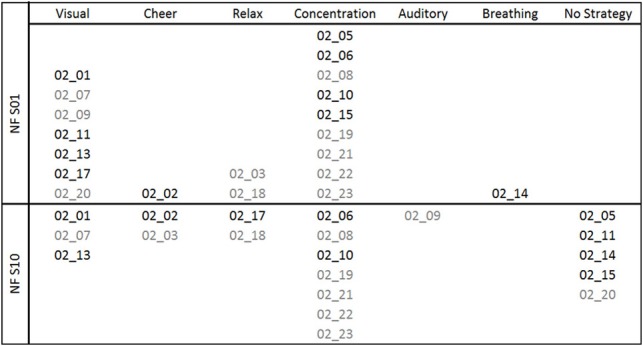
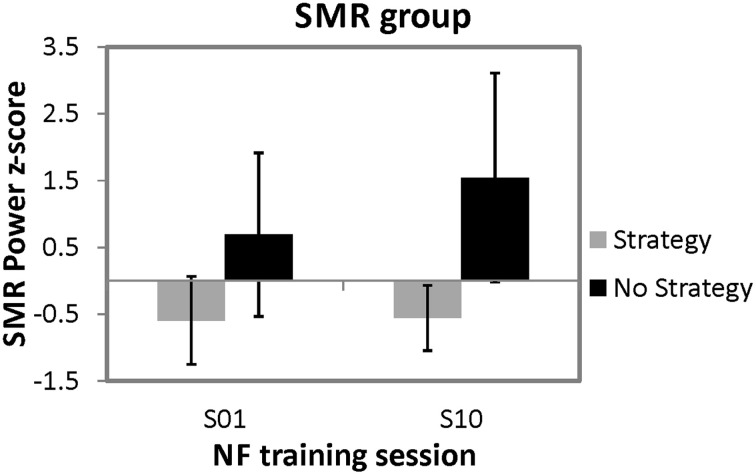
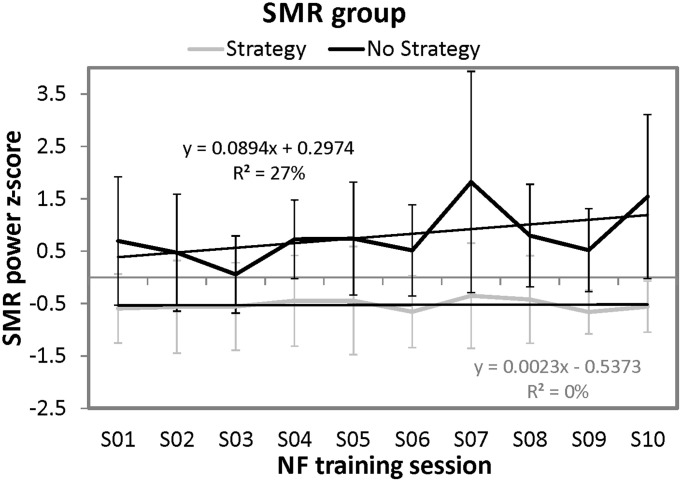
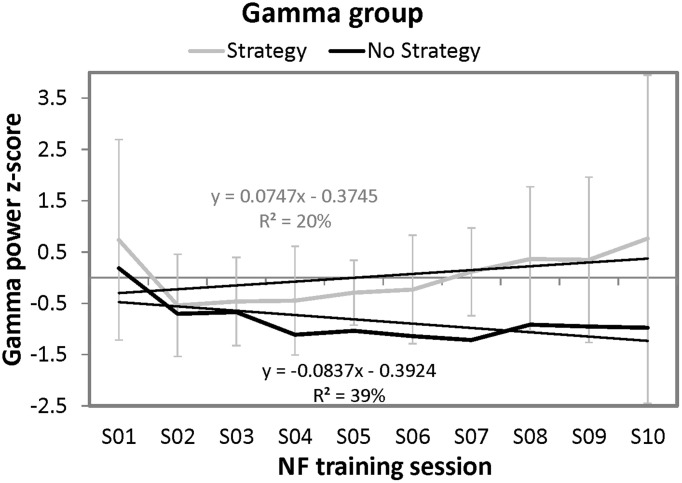
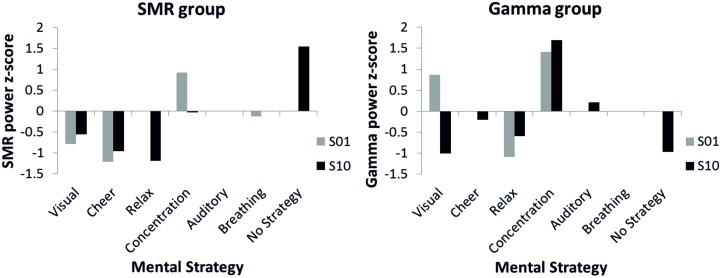
Using neurofeedback (NF), individuals can learn to modulate their own brain activity, in most cases electroencephalographic (EEG) rhythms. Although a large body of literature reports positive effects of NF training on behavior and cognitive functions, there are hardly any reports on how participants can successfully learn to gain control over their own brain activity. About one third of people fail to gain significant control over their brain signals even after repeated training sessions. The reasons for this failure are still largely unknown. In this context, we investigated the effects of spontaneous mental strategies on NF performance. Twenty healthy participants performed either a SMR (sensorimotor rhythm, 12-15 Hz) based or a Gamma (40-43 Hz) based NF training over ten sessions. After the first and the last training session, they were asked to write down which mental strategy they have used for self-regulating their EEG. After the first session, all participants reported the use of various types of mental strategies such as visual strategies, concentration, or relaxation. After the last NF training session, four participants of the SMR group reported to employ no specific strategy. These four participants showed linear improvements in NF performance over the ten training sessions. In contrast, participants still reporting the use of specific mental strategies in the last NF session showed no changes in SMR based NF performance over the ten sessions. This effect could not be observed in the Gamma group. The Gamma group showed no prominent changes in Gamma power over the NF training sessions, regardless of the mental strategies used. These results indicate that successful SMR based NF performance is associated with implicit learning mechanisms. Participants stating vivid reports on strategies to control their SMR probably overload cognitive resources, which might be counterproductive in terms of increasing SMR power.
Overview
The claims and statistics of this paper haven’t been checked yet.
Run the check — free, no account needed. It reads the open-access text and checks the sources it cites.
Integrity signals
Registry
Cites
Statistics
Figures
Verification
Claims the paper makes
The claims and statistics of this paper haven’t been checked yet.
Run the check — free, no account needed. It reads the open-access text and checks the sources it cites.
Claims other papers make about this one
Each is checked against this paper’s own text: does it say what the citing paper says it does?
The source backs part of the claim, not all of it — or backs it for a different population, condition or comparison.
In the citing paper
“Notably, no explicit strategies or instructions were given as, with few exceptions [204], implicit strategies have been shown to produce better outcomes [205–210].”
From Infraslow closed-loop brain training for anxiety and depression (ISAD): a protocol for a randomized, double-blind, sham-controlled pilot trial in adult females with internalizing disorders (2022) · cites this paper as [207]
Experimental — accuracy not yet measuredIn the citing paper
“Better performance could be due to decoder recalibration [29], re-parameterizations of the BCI, and the application and adoption of better mental strategies [9,64,65], among other factors.”
From The Cybathlon BCI race: Successful longitudinal mutual learning with two tetraplegic users (2018) · cites this paper as [64]
In the citing paper
“No apparent “breakthroughs” are evident, which could support the only likely alternative hypothesis, that of the employment of better mental strategies sparking immediate, rather than gradual, improvements [9,64].”
From The Cybathlon BCI race: Successful longitudinal mutual learning with two tetraplegic users (2018) · cites this paper as [64]
Self-check
Percentages, sums and reported differences re-computed from the paper’s own numbers.
The self-check needs the paper’s full text.
Citations
Cites
Brain–computer interfaces for communication and control
Wolpaw, J. R., Birbaumer, N., McFarland, D. J., Pfurtscheller, G., & Vaughan, T. M. (2002) · Clinical Neurophysiology · doi:10.1016/s1388-2457(02)00057-3 · Cited by 7,927
Event-related EEG/MEG synchronization and desynchronization: basic principles
Pfurtscheller, G., & Lopes da Silva, F. H. (1999) · Clinical Neurophysiology · doi:10.1016/s1388-2457(99)00141-8 · Cited by 7,328
Induced root-secreted phenolic compounds as a belowground plant defense
Lanoue, A., Burlat, V., Schurr, U., & Röse, U. S. R. (2010) · Plant Signaling & Behavior · doi:10.4161/psb.5.8.12337 · Cited by 5,462
Long-term meditators self-induce high-amplitude gamma synchrony during mental practice
Lutz, A., Greischar, L. L., Rawlings, N. B., Ricard, M., & Davidson, R. J. (2004) · Proceedings of the National Academy of Sciences · doi:10.1073/pnas.0407401101 · Cited by 1,328 · cited 2×
“Studies on meditators showed that Gamma power was intensified during meditation, and that Gamma is apparently associated with feelings of kindness and compassion (Banquet, 1973; Lutz et al., 2004; Rubik, 2011).”
BackgroundComparing an Individual's Test Score Against Norms Derived from Small Samples
Crawford, J. R., & Howell, D. C. (1998) · The Clinical Neuropsychologist · doi:10.1076/clin.12.4.482.7241 · Cited by 1,264
The operational analysis of psychological terms.
Skinner, B. F. (1945) · Psychological Review · doi:10.1037/h0062535 · Cited by 1,262
Motor imagery activates primary sensorimotor area in humans
Pfurtscheller, G., & Neuper, C. (1997) · Neuroscience Letters · doi:10.1016/s0304-3940(97)00889-6 · Cited by 1,052
Self-citationCrawford, J. R., & Garthwaite, P. H. (2002) · Neuropsychologia · doi:10.1016/s0028-3932(01)00224-x · Cited by 829
The neural basis of metacognitive ability
Fleming, S. M., & Dolan, R. J. (2012) · Philosophical Transactions of the Royal Society B: Biological Sciences · doi:10.1098/rstb.2011.0417 · Cited by 747
Neuper, C., Scherer, R., Reiner, M., & Pfurtscheller, G. (2005) · Cognitive Brain Research · doi:10.1016/j.cogbrainres.2005.08.014 · Cited by 744
Self-citation
Cited by
Sorted by citations
Closed-loop brain training: the science of neurofeedback
Sitaram, R., Ros, T., Stoeckel, L., Haller, S., Scharnowski, F., Lewis-Peacock, J., Weiskopf, N., Blefari, M. L., Rana, M., Oblak, E., et al. (2017) · Nature Reviews Neuroscience · doi:10.1038/nrn.2016.164 · Cited by 1,306
Ros, T., Enriquez-Geppert, S., Zotev, V., Young, K. D., Wood, G., Whitfield-Gabrieli, S., Wan, F., Vuilleumier, P., Vialatte, F., Van De Ville, D., et al. (2020) · Brain · doi:10.1093/brain/awaa009 · Cited by 399
Self-citationEEG-based brain–computer interfaces
McFarland, D. J., & Wolpaw, J. R. (2017) · Current Opinion in Biomedical Engineering · doi:10.1016/j.cobme.2017.11.004 · Cited by 283
Alkoby, O., Abu-Rmileh, A., Shriki, O., & Todder, D. (2017) · Neuroscience · doi:10.1016/j.neuroscience.2016.12.050 · Cited by 212
Jeunet, C., Jahanpour, E., & Lotte, F. (2016) · Journal of Neural Engineering · doi:10.1088/1741-2560/13/3/036024 · Cited by 192
Metadata
- Authors
- Kober, S. E., Witte, M., Ninaus, M., Neuper, C., & Wood, G.
- Affiliations
- University of Graz (AT)
- Corresponding author
- Wood, Guilherme
- Venue
- Frontiers in Human Neuroscience
- Publisher
- Frontiers Media SA
- Published
- 2013
- Volume
- 7
- Pages
- 695-695
- ISSN
- 1662-5161 (ISSN-L)
- PMC
- PMC3798979
- OpenAlex
- W2041078369
- Cited by
- 225
- References
- 62
- Citations by year
- 2026: 15 · 2025: 11 · 2024: 17 · 2023: 22 · 2022: 24 · 2021: 21 · 2020: 22 · 2019: 14 · 2018: 21 · 2017: 17 · 2016: 11 · 2015: 13 · 2014: 16 · 2013: 1
- FWCI
- 7.44
- Type
- journal article
- Language
- en
- Open access
- gold
- doi.org
- Licence
- cc-by
- Locations
- Frontiers in Human Neuroscience (publishedVersion, cc-by)
- Europe PMC (PubMed Central) (publishedVersion, cc-by)
- PubMed Central (publishedVersion, cc-by)
- PubMed (publishedVersion)
- DOAJ (DOAJ: Directory of Open Access Journals) (submittedVersion, cc-by-sa)
- Unipub UB Graz (Universität Graz) (submittedVersion, cc-by)
- Funders
- European Commission (287320)
- Topics
- Life Sciences › Neuroscience › Cognitive Neuroscience › EEG and Brain-Computer Interfaces
- Life Sciences › Neuroscience › Cognitive Neuroscience › Neural dynamics and brain function
- Social Sciences › Arts and Humanities › Philosophy › Free Will and Agency
- Keywords
- neurofeedback, self-regulation of brain activity, sensorimotor rhythm, gamma band, implicit learning, cognitive resource allocation
About these checks
Registry, retraction, Cites and statistics results are computed, not judged, with one exception: a printed reference that no index lists is read once by a model before it counts as a citation error. Claims are extracted by a model and kept only when their quote appears verbatim in the text; each cited source is then checked, with a model’s help, for whether it says what the claim relies on. Those verdicts can be wrong — read the claim’s quote and the cited source before relying on one.
Statistics and arithmetic are recomputed, not judged.
Confidence bands are shown only for fields calibrated on our annotated test set. None is calibrated yet, so no band is shown.
What counts as a claim ›How we measure confidence ›How we check this ›
Are you an author, or do you see a problem with this page? Request a review
