

The DOI matches its Crossref record; 2 of the 2 references it cites were found in a registry or an index.
Is Virtual Reality Training More Effective Than Traditional Physical Training on Balance and Functional Mobility in Healthy Older Adults? A Systematic Review and Meta-Analysis
Open accessAbstract
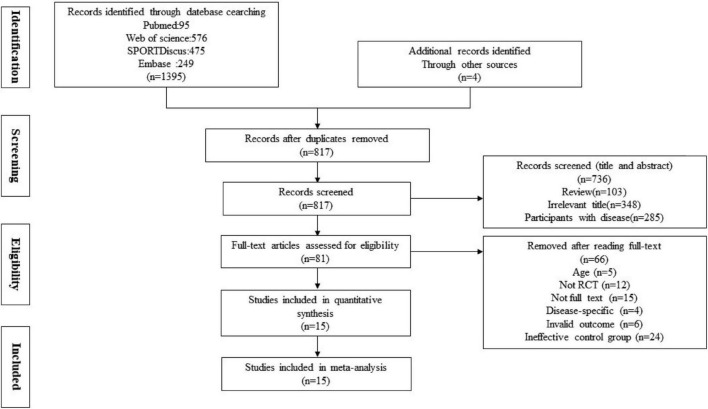
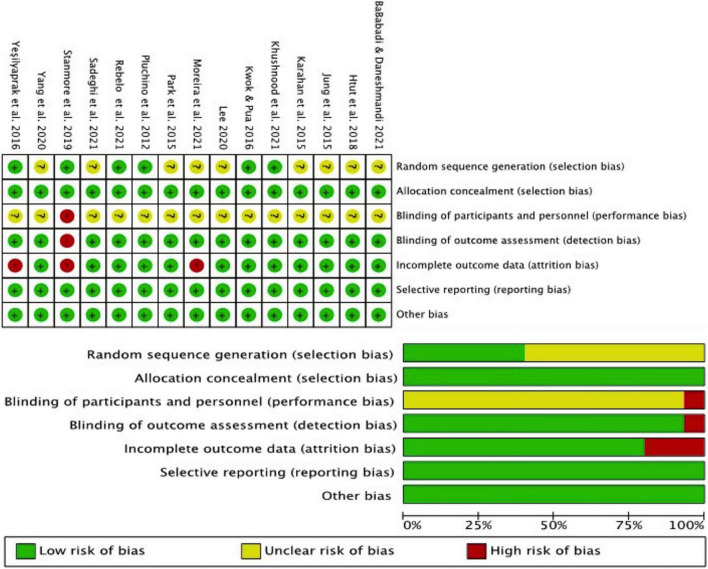
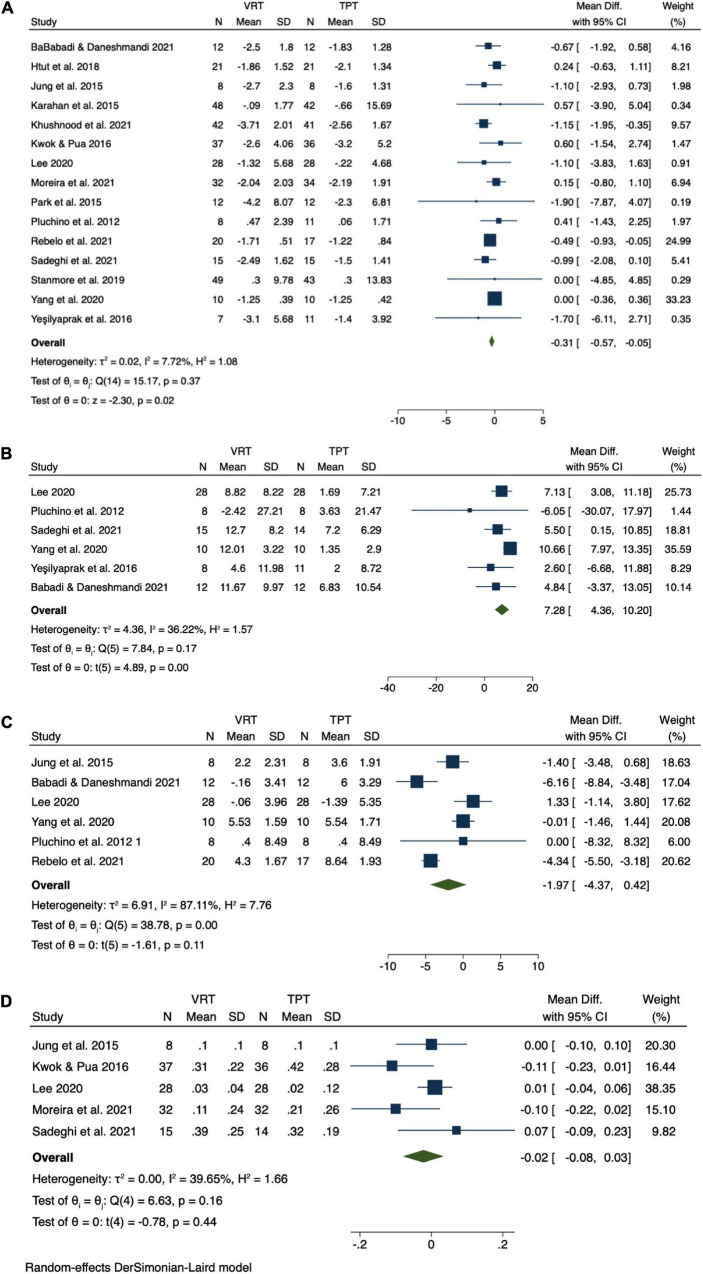
Objective: The studies showed the benefits of virtual reality training (VRT) for functional mobility and balance in older adults. However, a large variance in the study design and results is presented. We, thus, completed a systematic review and meta-analysis to quantitatively examine the effects of VRT on functional mobility and balance in healthy older adults. Methods: We systematically reviewed the publications in five databases. Studies that examine the effects of VRT on the measures of functional mobility and balance in healthy older adults were screened and included if eligible. Subgroup analyses were completed to explore the effects of different metrics of the intervention design (e.g., session time) on those outcomes related to functional mobility and balance. Results: Fifteen studies of 704 participants were included. The quality of these studies was good. Compared to traditional physical therapy (TPT), VRT induced greater improvement in TUG (MD = −0.31 s, 95% CI = −0.57 to −0.05, p = 0.02, I 2 = 6.34%) and one-leg stance with open eyes (OLS-O) (MD = 7.28 s, 95% CI = 4.36 to 10.20, p = 0.00, I 2 = 36.22%). Subgroup analyses revealed that immersive VRT with more than 800 min of total intervention time over 8 weeks and at least 120 min per week and/or designed by the two motor-learning principles was optimal for functional mobility and balance. Conclusion: Virtual reality training can significantly improve functional mobility and balance in healthy older adults compared to TPT, and the findings provided critical knowledge of the optimized design of VRT that can inform future studies with more rigorous designs. Systematic Review Registration: [ https://www.crd.york.ac.uk/PROSPERO/ ], identifier [CRD42021297085].
Overview
The claims and statistics of this paper haven’t been checked yet.
Run the check — free, no account needed. It reads the open-access text and checks the sources it cites.
Integrity signals
Registry
Cites
Statistics
Figures
Verification
Claims the paper makes
The claims and statistics of this paper haven’t been checked yet.
Run the check — free, no account needed. It reads the open-access text and checks the sources it cites.
Claims other papers make about this one
Each is checked against this paper’s own text: does it say what the citing paper says it does?
The cited source says what the claim attributes to it.
In the citing paper
“In recent work from 2022, reviews on this area have continued to focus on the effectiveness and outcomes of digital interventions in healthy ageing (Balki et al., 2022;Chu et al., 2022;Liu et al., 2022;Margrett et al., 2022;Suleiman-Martos et al., 2022).”
From User experience of mixed reality applications for healthy ageing: A systematic review (2023) · cites this paper as Liu et al., 2022
Self-check
Percentages, sums and reported differences re-computed from the paper’s own numbers.
The self-check needs the paper’s full text.
Citations
Cites
The PRISMA 2020 statement: An updated guideline for reporting systematic reviews
Page, M. J., McKenzie, J. E., Bossuyt, P. M., Boutron, I., Hoffmann, T. C., Mulrow, C. D., Shamseer, L., Tetzlaff, J. M., Akl, E. A., Brennan, S. E., et al. (2021) · BMJ · doi:10.1136/bmj.n71 · Cited by 108,283
Obesity, functional mobility and quality of life
Forhan, M., & Gill, S. V. (2013) · Best Practice & Research Clinical Endocrinology & Metabolism · doi:10.1016/j.beem.2013.01.003 · Cited by 232
Research works printed but not linked: 43
- Babadi, 2021, Effects of virtual reality versus conventional balance training on balance of the elderly., Exp. Gerontol., 153, 10.1016/j.exger.2021.111498 · DOI
- Barry, 2014, Is the Timed Up and Go test a useful predictor of risk of falls in community dwelling older adults: a systematic review and meta-analysis., BMC Geriatr., 14, 10.1186/1471-2318-14-14 · DOI
- Bouça-Machado, 2020, Patients and health professional’s perspective of functional mobility in Parkinson’s disease., Front. Neurol., 11, 10.3389/fneur.2020.575811 · DOI
- Buckinx, 2020, The effects of GAMotion (a giant exercising board game) on physical capacity, motivation and quality of life among nursing home residents: a pilot interventional study., Exp. Gerontol., 138, 10.1016/j.exger.2020.110983 · DOI
- Carmigniani, 2011, Augmented reality technologies, systems and applications., Multimed. Tools Appl., 51, 341, 10.1007/s11042-010-0660-6 · DOI
- Chen, 2021, Comparison between the effects of exergame intervention and traditional physical training on improving balance and fall prevention in healthy older adults: a systematic review and meta-analysis., J. NeuroEng. Rehabil., 18, 10.1186/s12984-021-00917-0 · DOI
- Clemson, 2012, Integration of balance and strength training into daily life activity to reduce rate of falls in older people (the LiFE study): randomised parallel trial., BMJ, 345, 10.1136/bmj.e4547 · DOI
- Cohen, 2013, Statistical Power Analysis for the Behavioral Sciences., 10.4324/9780203771587 · DOI · Paper page
- de Amorim, 2018, Virtual reality therapy for rehabilitation of balance in the elderly: a systematic review and META-analysis., Adv. Rheumatol., 58, 10.1186/s42358-018-0013-0 · DOI
- Duval, 2000, Trim and fill: a simple funnel-plot–based method of testing and adjusting for publication bias in meta-analysis., Biometrics, 56, 455, 10.1111/j.0006-341x.2000.00455.x · DOI · Paper page
- FilipoviĆ, 2021, A 12-week exercise program improves functional status in postmenopausal osteoporotic women: randomized controlled study., Eur. J. Phys. Rehabil. Med., 57, 120, 10.23736/s1973-9087.20.06149-3 · DOI
- Hall, 2016, Feasibility of a low-cost, interactive gaming system to assess balance in older women., J. Aging Phys. Act., 24, 111, 10.1123/japa.2014-0184 · DOI
- Higgins, 2019, Cochrane Handbook for Systematic Reviews of Interventions., 10.1002/9781119536604 · DOI · Paper page
- Higgins, 2003, Measuring inconsistency in meta-analyses., BMJ, 327, 557, 10.1136/bmj.327.7414.557 · DOI · Paper page
- Hrysomallis, 2011, Balance ability and athletic performance., Sports Med., 41, 221, 10.2165/11538560-000000000-00000 · DOI
- Htut, 2018, Effects of physical, virtual reality-based, and brain exercise on physical, cognition, and preference in older persons: a randomized controlled trial., Eur. Rev. Aging Phys. Act., 15, 10.1186/s11556-018-0199-5 · DOI
- Jung, 2015, Kinematic effect of Nintendo Wii(TM) sports program exercise on obstacle gait in elderly women with falling risk., J. Phys. Ther. Sci., 27, 1397, 10.1589/jpts.27.1397 · DOI
- Karahan, 2015, Effects of exergames on balance, functional mobility, and quality of life of geriatrics versus home exercise programme: randomized controlled study., Cent. Eur. J. Public Health, S14, 10.21101/cejph.a4081 · DOI
- Khushnood, 2021, Role Wii Fit exer-games in improving balance confidence and quality of life in elderly population., J. Pak. Med. Assoc., 71, 2130, 10.47391/JPMA.319 · DOI
- Kwok, 2016, Effects of WiiActive exercises on fear of falling and functional outcomes in community-dwelling older adults: a randomised control trial., Age Ageing, 45, 621, 10.1093/ageing/afw108 · DOI
- Laufer, 2014, Does a Wii-based exercise program enhance balance control of independently functioning older adults? A systematic review., Clin. Interv. Aging, 9, 1803, 10.2147/CIA.S69673 · DOI
- Lee, 2020, Virtual reality gait training to promote balance and gait among older people: a randomized clinical trial., Geriatrics (Basel), 6, 10.3390/geriatrics6010001 · DOI
- Lee, 2013, Effectiveness of virtual reality using video gaming technology in elderly adults with diabetes mellitus., Diabet. Technol. Ther., 15, 489, 10.1089/dia.2013.0050 · DOI
- Lesinski, 2015, Effects of balance training on balance performance in healthy older adults: a systematic review and meta-analysis., Sports Med., 45, 1721, 10.1007/s40279-015-0375-y · DOI
- Levin, 2015, Emergence of virtual reality as a tool for upper limb rehabilitation: incorporation of motor control and motor learning principles., Phys. Ther., 95, 415, 10.2522/ptj.20130579 · DOI
- Liu, 2009, Progressive resistance strength training for improving physical function in older adults., Cochrane Database Syst. Rev., 2009, 10.1002/14651858.CD002759.pub2 · DOI · Paper page
- Mao, 2014, Virtual reality training improves balance function., Neural Regen. Res., 9, 1628, 10.4103/1673-5374.141795 · DOI
- McEwen, 2014, Virtual reality exercise improves mobility after stroke: an inpatient randomized controlled trial., Stroke, 45, 1853, 10.1161/STROKEAHA.114.005362 · DOI
- Moreira, 2021, Perceptive-cognitive and physical function in prefrail older adults: exergaming versus traditional multicomponent training., Rejuvenation Res., 24, 28, 10.1089/rej.2020.2302 · DOI
- Neri, 2017, Do virtual reality games improve mobility skills and balance measurements in community-dwelling older adults? Systematic review and meta-analysis., Clin. Rehabil., 31, 1292, 10.1177/0269215517694677 · DOI
- Owens, 2011, Changes in physical activity and fitness after 3 months of home Wii Fit™ use., J. Strength Cond. Res., 25, 3191, 10.1519/JSC.0b013e3182132d55 · DOI
- Padala, 2017, Efficacy of Wii-Fit on static and dynamic balance in community dwelling older veterans: a randomized controlled pilot trial., J. Aging Res., 2017, 10.1155/2017/4653635 · DOI
- Park, 2015, The effects of virtual reality game exercise on balance and gait of the elderly., J. Phys. Ther. Sci., 27, 1157, 10.1589/jpts.27.1157 · DOI
- Phu, 2019, Balance training using virtual reality improves balance and physical performance in older adults at high risk of falls., Clin. Interv. Aging, 14, 1567, 10.2147/CIA.S220890 · DOI
- Pluchino, 2012, Pilot study comparing changes in postural control after training using a video game balance board program and 2 standard activity-based balance intervention programs., Arch. Phys. Med. Rehabil., 93, 1138, 10.1016/j.apmr.2012.01.023 · DOI
- Rebelo, 2021, Immersive virtual reality is effective in the rehabilitation of older adults with balance disorders: a randomized clinical trial., Exp. Gerontol., 149, 10.1016/j.exger.2021.111308 · DOI
- Rubenstein, 2006, Falls in older people: epidemiology, risk factors and strategies for prevention., Age Ageing, ii37, 10.1093/ageing/afl084 · DOI
- Sadeghi, 2021, Effects of 8 weeks of balance training, virtual reality training, and combined exercise on lower limb muscle strength, balance, and functional mobility among older men: a randomized controlled trial., Sports Health, 13, 606, 10.1177/1941738120986803 · DOI
- Stanmore, 2019, The effectiveness and cost-effectiveness of strength and balance Exergames to reduce falls risk for people aged 55 years and older in UK assisted living facilities: a multi-centre, cluster randomised controlled trial., BMC Med., 17, 10.1186/s12916-019-1278-9 · DOI
- van Diest, 2014, Suitability of Kinect for measuring whole body movement patterns during exergaming., J. Biomech., 47, 2925, 10.1016/j.jbiomech.2014.07.017 · DOI
- Whyatt, 2015, A Wii bit of fun: a novel platform to deliver effective balance training to older adults., Games Health J., 4, 423, 10.1089/g4h.2015.0006 · DOI
- Yang, 2020, Effects of Kinect exergames on balance training among community older adults: a randomized controlled trial., Medicine, 99, 10.1097/MD.0000000000021228 · DOI
- Yeşilyaprak, 2016, Comparison of the effects of virtual reality-based balance exercises and conventional exercises on balance and fall risk in older adults living in nursing homes in Turkey., Physiother. Theory Pract., 32, 191, 10.3109/09593985.2015.1138009 · DOI
Cited by
Sorted by citations
User experience of mixed reality applications for healthy ageing: A systematic review
Lim, K. J., McGuckian, T. B., Cole, M. H., Duckworth, J., & Wilson, P. H. (2023) · Cyberpsychology: Journal of Psychosocial Research on Cyberspace · doi:10.5817/cp2023-4-5 · Cited by 5
“In recent work from 2022, reviews on this area have continued to focus on the effectiveness and outcomes of digital interventions in healthy ageing (Balki et al., 2022; Chu et al., 2022; Liu et al., 2022; Margrett et al., 2022; Suleiman ‐ Martos et al., 2022).”
Background
Metadata
- Authors
- Liu, M., Zhou, K., Chen, Y., Zhou, L., Bao, D., & Zhou, J.
- Affiliations
- Beijing Sport University (CN)
- Chengdu University of Traditional Chinese Medicine (CN)
- Harvard University (US)
- Corresponding author
- Bao, Dapeng
- Venue
- Frontiers in Human Neuroscience
- Publisher
- Frontiers Media SA
- Published
- 2022-03-23
- Volume
- 16
- Pages
- 843481-843481
- ISSN
- 1662-5161 (ISSN-L)
- PMC
- PMC8984187
- OpenAlex
- W4220770312
- Cited by
- 50
- References
- 2
- Citations by year
- 2026: 19 · 2025: 10 · 2024: 10 · 2023: 7 · 2022: 4
- FWCI
- 1.92
- Type
- journal article
- Language
- en
- Open access
- gold
- doi.org
- Licence
- Locations
- Frontiers in Human Neuroscience (publishedVersion, cc-by)
- PubMed Central (publishedVersion, cc-by)
- PubMed (publishedVersion)
- DOAJ (DOAJ: Directory of Open Access Journals) (submittedVersion)
- Topics
- Health Sciences › Health Professions › Physical Therapy, Sports Therapy and Rehabilitation › Balance, Gait, and Falls Prevention
- Health Sciences › Medicine › Rehabilitation › Stroke Rehabilitation and Recovery
- Physical Sciences › Computer Science › Human-Computer Interaction › Virtual Reality Applications and Impacts
- Keywords
- virtual reality training, balance, functional mobility, older adults, Timed Up and Go test, single-leg stance, immersive virtual reality, motor learning, intervention duration, healthy aging
About these checks
Registry, retraction, Cites and statistics results are computed, not judged, with one exception: a printed reference that no index lists is read once by a model before it counts as a citation error. Claims are extracted by a model and kept only when their quote appears verbatim in the text; each cited source is then checked, with a model’s help, for whether it says what the claim relies on. Those verdicts can be wrong — read the claim’s quote and the cited source before relying on one.
Statistics and arithmetic are recomputed, not judged.
Confidence bands are shown only for fields calibrated on our annotated test set. None is calibrated yet, so no band is shown.
What counts as a claim ›How we measure confidence ›How we check this ›
Are you an author, or do you see a problem with this page? Request a review
