

The DOI matches its Crossref record; 264 of the 265 references it cites were found in a registry or an index.
APP Function and Lipids: A Bidirectional Link
Open accessAbstract
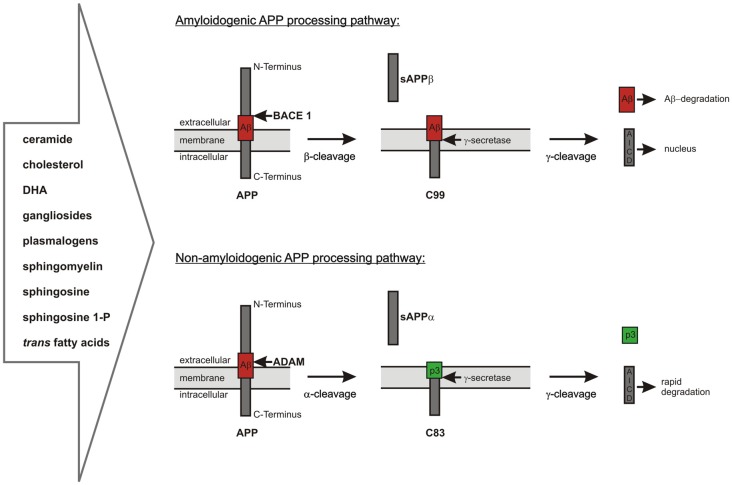
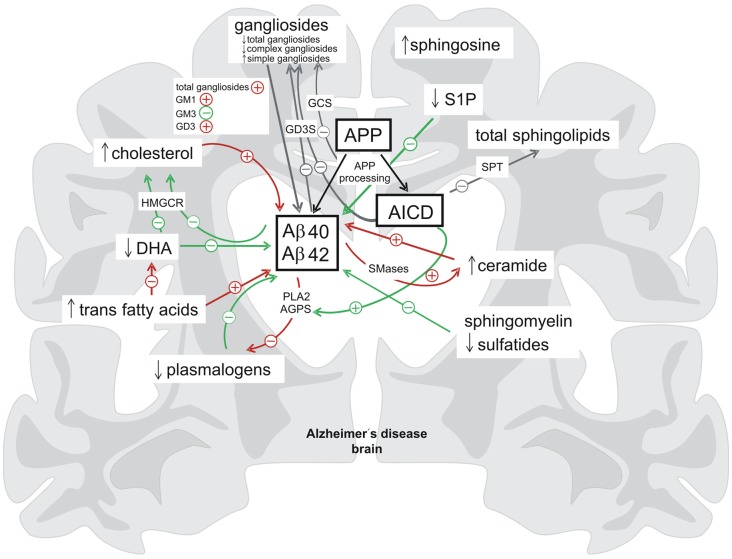
Extracellular neuritic plaques, composed of aggregated amyloid-β (Aβ) peptides, are one of the major histopathological hallmarks of Alzheimer’s disease (AD), a progressive, irreversible neurodegenerative disorder and the most common cause of dementia in the elderly. One of the most prominent risk factor for sporadic AD, carrying one or two aberrant copies of the apolipoprotein E (ApoE) ɛ4 alleles, closely links AD to lipids. Further, several lipid classes and fatty acids have been reported to be changed in the brain of AD-affected individuals. Interestingly, the observed lipid changes in the brain seem not only to be a consequence of the disease but also modulate Aβ generation. In line with these observations protective lipids being able to decrease Aβ generation and also potential negative lipids in respect to AD were identified. Mechanistically, Aβ peptides are generated by sequential proteolytic processing of the amyloid precursor protein (APP) by β- and γ-secretase. The α-secretase appears to compete with β-secretase for the initial cleavage of APP, preventing Aβ production. All APP-cleaving secretases as well as APP are transmembrane proteins, further illustrating the impact of lipids on Aβ generation. Beside the pathological impact of Aβ, accumulating evidence suggests that Aβ and the APP intracellular domain (AICD) play an important role in regulating lipid homeostasis, either by direct effects or by affecting gene expression or protein stability of enzymes involved in the de novo synthesis of different lipid classes. This review summarizes the current literature addressing the complex bidirectional link between lipids and AD and APP processing including lipid alterations found in AD post mortem brains, lipids that alter APP processing and the physiological functions of Aβ and AICD in the regulation of several lipid metabolism pathways.
Overview
The claims and statistics of this paper haven’t been checked yet.
Run the check — free, no account needed. It reads the open-access text and checks the sources it cites.
Integrity signals
Registry
Cites
Statistics
Figures
Verification
Claims the paper makes
The claims and statistics of this paper haven’t been checked yet.
Run the check — free, no account needed. It reads the open-access text and checks the sources it cites.
Claims other papers make about this one
Each is checked against this paper’s own text: does it say what the citing paper says it does?
In the citing paper
“Indeed, there is evidence that alternative APP-derived fragments as well as APP itself play important roles in the modulation of immune cell activation [160], protein clearance [161], and lipid homeostasis [162].”
From Genetic architecture of Alzheimer's disease (2020) · cites this paper as [162]
Self-check
Percentages, sums and reported differences re-computed from the paper’s own numbers.
The self-check needs the paper’s full text.
Citations
Cites
2 retracted
RETRACTED ARTICLE: A specific amyloid-β protein assembly in the brain impairs memory
Lesné, S., Koh, M. T., Kotilinek, L., Kayed, R., Glabe, C. G., Yang, A., Gallagher, M., & Ashe, K. H. (2006) · Nature · doi:10.1038/nature04533 · Cited by 2,769
RetractedPuglielli, L., Ellis, B. C., Saunders, A. J., & Kovacs, D. M. (2003) · Journal of Biological Chemistry · doi:10.1074/jbc.m300466200 · Cited by 265
RetractedThe Amyloid Hypothesis of Alzheimer’s Disease: Progress and Problems on the Road to Therapeutics
Hardy, J., & Selkoe, D. J. (2002) · Science · doi:10.1126/science.1072994 · Cited by 13,864
Amyloid oligomers exacerbate tau pathology in a mouse model of tauopathy
Selenica, M.-L. B., Brownlow, M., Jimenez, J. P., Lee, D. C., Pena, G., Dickey, C. A., Gordon, M. N., & Morgan, D. (2013) · Neurodegenerative Diseases · doi:10.1159/000337230 · Cited by 10,359
Corder, E. H., Saunders, A. M., Strittmatter, W. J., Schmechel, D. E., Gaskell, P. C., Small, G. W., Roses, A. D., Haines, J. L., & Pericak-Vance, M. A. (1993) · Science · doi:10.1126/science.8346443 · Cited by 9,429
Alzheimer's disease: the amyloid cascade hypothesis
Hardy, J. A., & Higgins, G. A. (1992) · Science · doi:10.1126/science.1566067 · Cited by 7,484
Glenner, G. G., & Wong, C. W. (1984) · Biochemical and Biophysical Research Communications · doi:10.1016/s0006-291x(84)80190-4 · Cited by 5,404
The precursor of Alzheimer's disease amyloid A4 protein resembles a cell-surface receptor
Kang, J., Lemaire, H.-G., Unterbeck, A., Salbaum, J. M., Masters, C. L., Grzeschik, K.-H., Multhaup, G., Beyreuther, K., & Müller-Hill, B. (1987) · Nature · doi:10.1038/325733a0 · Cited by 4,619
Amyloid plaque core protein in Alzheimer disease and Down syndrome.
Masters, C. L., Simms, G., Weinman, N. A., Multhaup, G., McDonald, B. L., & Beyreuther, K. (1985) · Proceedings of the National Academy of Sciences · doi:10.1073/pnas.82.12.4245 · Cited by 4,431
Lipid rafts as a membrane-organizing principle
Lingwood, D., & Simons, K. (2010) · Science · doi:10.1126/science.1174621 · Cited by 4,417
Research works printed but not linked: 1
- World Alzheimer Report, 2015, Alzheimer’s Disease International
Cited by
Sorted by citations
Surgery, neuroinflammation and cognitive impairment
Alam, A., Hana, Z., Jin, Z., Suen, K. C., & Ma, D. (2018) · EBioMedicine · doi:10.1016/j.ebiom.2018.10.021 · Cited by 495
Application of Metabolomics in Alzheimer’s Disease
Wilkins, J. M., & Trushina, E. (2018) · Frontiers in Neurology · doi:10.3389/fneur.2017.00719 · Cited by 268
Yang, J., Wang, Z., Cai, H.-Y., Li, Y., Hu, M.-M., Wu, M., & Qi, J. (2018) · Neuroscience Bulletin · doi:10.1007/s12264-018-0268-9 · Cited by 168
van Kruining, D., Luo, Q., van Echten‐Deckert, G., Mielke, M. M., Bowman, A. P., Ellis, S. R., Oliveira, T. G., & Martínez‐Martínez, P. (2020) · Advanced Drug Delivery Reviews · doi:10.1016/j.addr.2020.04.009 · Cited by 138
Akyol, S., Ugur, Z., Yılmaz, A., Ustun, I., Gorti, S. K. K., Oh, K., McGuinness, B., Passmore, P., Kehoe, P. G., Maddens, M. E., et al. (2021) · Cells · doi:10.3390/cells10102591 · Cited by 138
Metadata
- Authors
- Grimm, M. O. W., Mett, J., Grimm, H. S., & Hartmann, T.
- Affiliations
- Saarland University (DE)
- Corresponding author
- Grimm, Marcus O. W.
- Venue
- Frontiers in Molecular Neuroscience
- Publisher
- Frontiers Media SA
- Published
- 2017-03-10
- Volume
- 10
- Pages
- 63-63
- ISSN
- 1662-5099 (ISSN-L)
- PMC
- PMC5344993
- OpenAlex
- W2594288299
- Cited by
- 104
- References
- 265
- Citations by year
- 2026: 6 · 2025: 10 · 2024: 5 · 2023: 17 · 2022: 7 · 2021: 19 · 2020: 13 · 2019: 11 · 2018: 12 · 2017: 4
- FWCI
- 1.34
- Type
- journal article
- Language
- en
- Open access
- gold
- doi.org
- Licence
- cc-by
- Locations
- Frontiers in Molecular Neuroscience (publishedVersion, cc-by)
- PubMed Central (publishedVersion, cc-by)
- PubMed (publishedVersion)
- Funders
- EU Joint Programme – Neurodegenerative Disease Research
- Topics
- Life Sciences › Neuroscience › Cellular and Molecular Neuroscience › Alzheimer's disease research and treatments
- Health Sciences › Medicine › Psychiatry and Mental health › Dementia and Cognitive Impairment Research
- Life Sciences › Neuroscience › Neurology › Neuroinflammation and Neurodegeneration Mechanisms
- Keywords
- Alzheimer's disease, amyloid-beta, amyloid precursor protein, APOE ε4, lipid metabolism, beta-secretase, gamma-secretase, alpha-secretase, APP intracellular domain, lipid homeostasis, fatty acids, neuritic plaques, lipid dysregulation
About these checks
Registry, retraction, Cites and statistics results are computed, not judged, with one exception: a printed reference that no index lists is read once by a model before it counts as a citation error. Claims are extracted by a model and kept only when their quote appears verbatim in the text; each cited source is then checked, with a model’s help, for whether it says what the claim relies on. Those verdicts can be wrong — read the claim’s quote and the cited source before relying on one.
Statistics and arithmetic are recomputed, not judged.
Confidence bands are shown only for fields calibrated on our annotated test set. None is calibrated yet, so no band is shown.
What counts as a claim ›How we measure confidence ›How we check this ›
Are you an author, or do you see a problem with this page? Request a review
