

The DOI matches its Crossref record; 204 of the 205 references it cites were found in a registry or an index.
Intramuscular Delivery of Gene Therapy for Targeting the Nervous System
Open accessAbstract
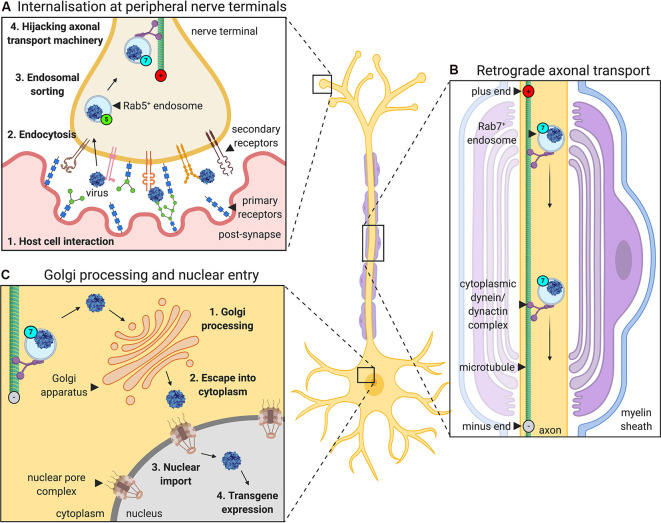
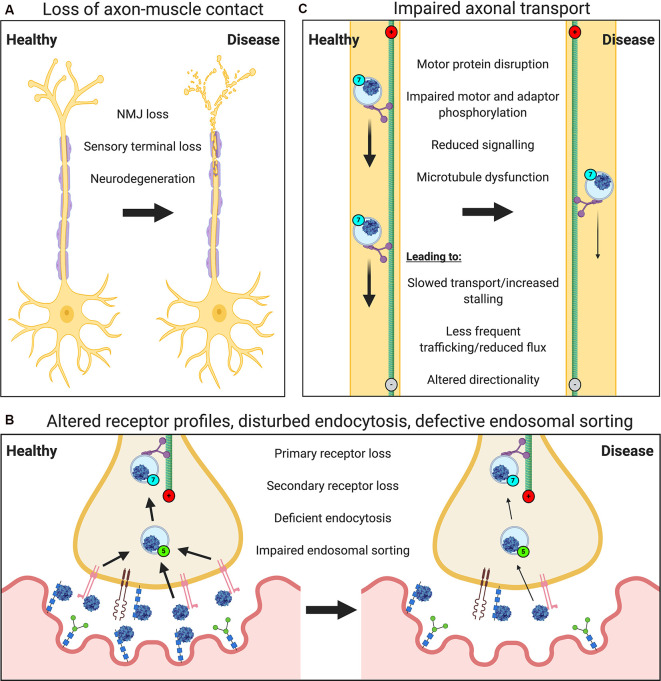
Virus-mediated gene therapy has the potential to deliver exogenous genetic material into specific cell types to promote survival and counteract disease. This is particularly enticing for neuronal conditions, as the nervous system is renowned for its intransigence to therapeutic targeting. Administration of gene therapy viruses into skeletal muscle, where distal terminals of motor and sensory neurons reside, has been shown to result in extensive transduction of cells within the spinal cord, brainstem, and sensory ganglia. This route is minimally invasive and therefore clinically relevant for gene therapy targeting to peripheral nerve soma. For successful transgene expression, viruses administered into muscle must undergo a series of processes, including host cell interaction and internalization, intracellular sorting, long-range retrograde axonal transport, endosomal liberation, and nuclear import. In this review article, we outline key characteristics of major gene therapy viruses-adenovirus, adeno-associated virus (AAV), and lentivirus-and summarize the mechanisms regulating important steps in the virus journey from binding at peripheral nerve terminals to nuclear delivery. Additionally, we describe how neuropathology can negatively influence these pathways, and conclude by discussing opportunities to optimize the intramuscular administration route to maximize gene delivery and thus therapeutic potential.
Overview
The claims and statistics of this paper haven’t been checked yet.
Run the check — free, no account needed. It reads the open-access text and checks the sources it cites.
Integrity signals
Registry
Cites
Statistics
Figures
Verification
Claims the paper makes
The claims and statistics of this paper haven’t been checked yet.
Run the check — free, no account needed. It reads the open-access text and checks the sources it cites.
Claims other papers make about this one
Each is checked against this paper’s own text: does it say what the citing paper says it does?
The cited source says what the claim attributes to it.
In the citing paper
“This strategy is particularly suited for mitigating motor neuron diseases (MNDs), such as spinal muscular atrophy (SMA) [99] and amyotrophic lateral sclerosis (ALS) [101].”
From Designing and optimizing AAV-mediated gene therapy for neurodegenerative diseases: from bench to bedside (2024) · cites this paper as [99]
The cited source says what the claim attributes to it.
In the citing paper
“AAV-mediated gene therapy using IM delivery is minimally invasive in local muscle tissue and undergoes a cascade intracellular event for retrograde axonal trafficking into neuronal soma [99, 100].”
From Designing and optimizing AAV-mediated gene therapy for neurodegenerative diseases: from bench to bedside (2024) · cites this paper as [99]
Self-check
Percentages, sums and reported differences re-computed from the paper’s own numbers.
The self-check needs the paper’s full text.
Citations
Cites
Isolation of a Common Receptor for Coxsackie B Viruses and Adenoviruses 2 and 5
Bergelson, J. M., Cunningham, J. A., Droguett, G., Kurt‐Jones, E. A., Krithivas, A., Hong, J. S., Horwitz, M. S., Crowell, R. L., & Finberg, R. W. (1997) · Science · doi:10.1126/science.275.5304.1320 · Cited by 3,102
Single-Dose Gene-Replacement Therapy for Spinal Muscular Atrophy
Mendell, J. R., Al-Zaidy, S., Shell, R., Arnold, W. D., Rodino-Klapac, L. R., Prior, T. W., Lowes, L., Alfano, L., Berry, K., Church, K., et al. (2017) · New England Journal of Medicine · doi:10.1056/nejmoa1706198 · Cited by 2,381
Integrins αvβ3 and αvβ5 promote adenovirus internalization but not virus attachment
Wickham, T. J., Mathias, P., Cheresh, D. A., & Nemerow, G. R. (1993) · Cell · doi:10.1016/0092-8674(93)90231-e · Cited by 2,199
Analysis of AAV Serotypes 1–9 Mediated Gene Expression and Tropism in Mice After Systemic Injection
Zincarelli, C., Soltys, S., Rengo, G., & Rabinowitz, J. E. (2008) · Molecular Therapy · doi:10.1038/mt.2008.76 · Cited by 1,490
Intravascular AAV9 preferentially targets neonatal neurons and adult astrocytes
Foust, K. D., Nurre, E., Montgomery, C. L., Hernandez, A., Chan, C. M., & Kaspar, B. K. (2009) · Nature Biotechnology · doi:10.1038/nbt.1515 · Cited by 1,456 · cited 2×
“Due to its ability to cross the BBB, AAV serotype 9 (AAV9) has become the principal serotype for CNS-targeting upon systemic administration (Foust et al., 2009; Bevan et al., 2011; Samaranch et al., 2012), although superior serotypes, such as AAVrh10, have also emerged (Tanguy et al., 2015).”
BackgroundA Designer AAV Variant Permits Efficient Retrograde Access to Projection Neurons
Tervo, D. G. R., Hwang, B., Viswanathan, S., Gaj, T., Lavzin, M., Ritola, K., Lindo, S. E., Michael, S. C., Кулешова, Е. П., Ojala, D. S., et al. (2016) · Neuron · doi:10.1016/j.neuron.2016.09.021 · Cited by 1,220
Cre-dependent selection yields AAV variants for widespread gene transfer to the adult brain
Deverman, B. E., Pravdo, P. L., Simpson, B. P., Kumar, S. R., Chan, K. Y., Banerjee, A., Wu, W.-L., Yang, B., Huber, N., Pasca, S. P., et al. (2016) · Nature Biotechnology · doi:10.1038/nbt.3440 · Cited by 1,061
Clinical use of lentiviral vectors
Milone, M. C., & O’Doherty, U. (2018) · Leukemia · doi:10.1038/s41375-018-0106-0 · Cited by 930
Emerging issues in AAV-mediated in vivo gene therapy
Colella, P., Ronzitti, G., & Mingozzi, F. (2018) · Molecular Therapy - Methods & Clinical Development · doi:10.1016/j.omtm.2017.11.007 · Cited by 881
Hinderer, C., Katz, N., Buza, E. L., Dyer, C., Goode, T., Bell, P., Richman, L. K., & Wilson, J. M. (2018) · Human Gene Therapy · doi:10.1089/hum.2018.015 · Cited by 814
Cited by
Sorted by citations
Drug delivery to the central nervous system
Nance, E. A., Pun, S. H., Saigal, R., & Sellers, D. L. (2021) · Nature Reviews Materials · doi:10.1038/s41578-021-00394-w · Cited by 442
Chowdhury, E. A., Meno‐Tetang, G. M. L., Chang, H. Y., Wu, S., Huang, H. W., Jamier, T., Chandran, J. S., & Shah, D. K. (2021) · Advanced Drug Delivery Reviews · doi:10.1016/j.addr.2021.01.017 · Cited by 80
Micro/nanosystems for controllable drug delivery to the brain
Tian, M., Ma, Z., & Yang, G. (2023) · The Innovation · doi:10.1016/j.xinn.2023.100548 · Cited by 64
Nanocarrier imaging at single-cell resolution across entire mouse bodies with deep learning
Luo, J., Molbay, M., Chen, Y., Horvath, I., Kadletz, K., Kick, B., Zhao, S., Al-Maskari, R., Singh, I., Ali, M., et al. (2025) · Nature Biotechnology · doi:10.1038/s41587-024-02528-1 · Cited by 53
Xu, L., Yao, S., Ding, Y. E., Xie, M., Feng, D., Sha, P., Tan, L., Bei, F., & Yao, Y. (2024) · Journal of Translational Medicine · doi:10.1186/s12967-024-05661-2 · Cited by 48
Metadata
- Authors
- Tosolini, A. P., & Sleigh, J. N.
- Affiliations
- UCL Queen Square Institute of Neurology (GB)
- UK Dementia Research Institute (GB)
- Corresponding author
- Tosolini, Andrew P.
- Sleigh, James N.
- Venue
- Frontiers in Molecular Neuroscience
- Publisher
- Frontiers Media SA
- Published
- 2020-07-17
- Volume
- 13
- Pages
- 129-129
- ISSN
- 1662-5099 (ISSN-L)
- PMC
- PMC7379875
- OpenAlex
- W3043715250
- Cited by
- 32
- References
- 205
- Citations by year
- 2026: 4 · 2025: 4 · 2024: 5 · 2023: 8 · 2022: 5 · 2021: 6
- FWCI
- 2.79
- Type
- journal article
- Language
- en
- Open access
- gold
- doi.org
- Licence
- Locations
- Frontiers in Molecular Neuroscience (publishedVersion, cc-by)
- PubMed Central (publishedVersion, cc-by)
- PubMed (publishedVersion)
- DOAJ (DOAJ: Directory of Open Access Journals) (submittedVersion, cc-by-sa)
- UCL Discovery (University College London) (submittedVersion)
- Funders
- Wellcome Trust (107116/Z/15/Z)
- Medical Research Council (MR/S006990/1)
- Topics
- Life Sciences › Biochemistry, Genetics and Molecular Biology › Genetics › Virus-based gene therapy research
- Life Sciences › Biochemistry, Genetics and Molecular Biology › Molecular Biology › RNA Interference and Gene Delivery
- Health Sciences › Medicine › Genetics (clinical) › Neurogenetic and Muscular Disorders Research
- Keywords
- intramuscular gene delivery, gene therapy vectors, retrograde axonal transport, peripheral nerve terminals, motor neurons, sensory neurons, adeno-associated virus, adenovirus, lentivirus, viral transduction, endosomal escape, nuclear import, neuropathology
About these checks
Registry, retraction, Cites and statistics results are computed, not judged, with one exception: a printed reference that no index lists is read once by a model before it counts as a citation error. Claims are extracted by a model and kept only when their quote appears verbatim in the text; each cited source is then checked, with a model’s help, for whether it says what the claim relies on. Those verdicts can be wrong — read the claim’s quote and the cited source before relying on one.
Statistics and arithmetic are recomputed, not judged.
Confidence bands are shown only for fields calibrated on our annotated test set. None is calibrated yet, so no band is shown.
What counts as a claim ›How we measure confidence ›How we check this ›
Are you an author, or do you see a problem with this page? Request a review
