

The DOI matches its Crossref record; 291 of the 291 references it cites were found in a registry or an index.
Hyperexcitability and homeostasis in fragile X Syndrome.
Open accessAbstract
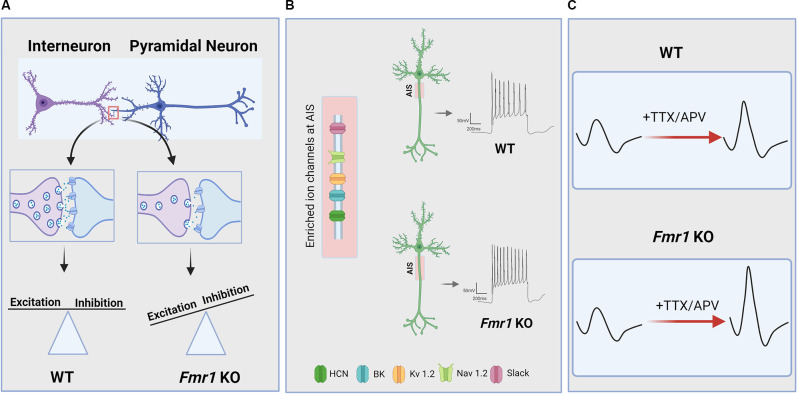
Fragile X Syndrome (FXS) is a leading inherited cause of autism and intellectual disability, resulting from a mutation in the FMR1 gene and subsequent loss of its protein product FMRP. Despite this simple genetic origin, FXS is a phenotypically complex disorder with a range of physical and neurocognitive disruptions. While numerous molecular and cellular pathways are affected by FMRP loss, there is growing evidence that circuit hyperexcitability may be a common convergence point that can account for many of the wide-ranging phenotypes seen in FXS. The mechanisms for hyperexcitability in FXS include alterations to excitatory synaptic function and connectivity, reduced inhibitory neuron activity, as well as changes to ion channel expression and conductance. However, understanding the impact of FMR1 mutation on circuit function is complicated by the inherent plasticity in neural circuits, which display an array of homeostatic mechanisms to maintain activity near set levels. FMRP is also an important regulator of activity-dependent plasticity in the brain, meaning that dysregulated plasticity can be both a cause and consequence of hyperexcitable networks in FXS. This makes it difficult to separate the direct effects of FMR1 mutation from the myriad and pleiotropic compensatory changes associated with it, both of which are likely to contribute to FXS pathophysiology. Here we will: (1) review evidence for hyperexcitability and homeostatic plasticity phenotypes in FXS models, focusing on similarities/differences across brain regions, cell-types, and developmental time points; (2) examine how excitability and plasticity disruptions interact with each other to ultimately contribute to circuit dysfunction in FXS; and (3) discuss how these synaptic and circuit deficits contribute to disease-relevant behavioral phenotypes like epilepsy and sensory hypersensitivity. Through this discussion of where the current field stands, we aim to introduce perspectives moving forward in FXS research.
Overview
The claims and statistics of this paper haven’t been checked yet.
Run the check — free, no account needed. It reads the open-access text and checks the sources it cites.
Integrity signals
Registry
Cites
Statistics
Figures
Verification
Claims the paper makes
The claims and statistics of this paper haven’t been checked yet.
Run the check — free, no account needed. It reads the open-access text and checks the sources it cites.
Claims other papers make about this one
Each is checked against this paper’s own text: does it say what the citing paper says it does?
The source backs part of the claim, not all of it — or backs it for a different population, condition or comparison.
In the citing paper
“Increased glutamatergic signaling and altered excitatory/inhibitory balance is recognized as a hallmark of FXS (Liu et al., 2022).”
From Astrocytes in fragile X syndrome (2024) · cites this paper as Liu et al., 2022
Experimental — accuracy not yet measured
Self-check
Percentages, sums and reported differences re-computed from the paper’s own numbers.
The self-check needs the paper’s full text.
Citations
Cites
Corticocortical inhibition in human motor cortex.
Kujirai, T., Caramia, M. D., Rothwell, J. C., Day, B. L., Thompson, P. D., Ferbert, A., Wroe, S. J., Asselman, P., & MARSDEN, C. D. (1993) · The Journal of Physiology · doi:10.1113/jphysiol.1993.sp019912 · Cited by 3,132
Parvalbumin neurons and gamma rhythms enhance cortical circuit performance
Sohal, V. S., Zhang, F., Yizhar, O., & Deisseroth, K. (2009) · Nature · doi:10.1038/nature07991 · Cited by 2,606
Driving fast-spiking cells induces gamma rhythm and controls sensory responses
Cardin, J. A., Carlén, M., Meletis, K., Knoblich, U., Zhang, F., Deisseroth, K., Tsai, L.-H., & Moore, C. I. (2009) · Nature · doi:10.1038/nature08002 · Cited by 2,603
Homeostatic plasticity in the developing nervous system
Turrigiano, G. G., & Nelson, S. B. (2004) · Nature Reviews Neuroscience · doi:10.1038/nrn1327 · Cited by 2,485
Neocortical excitation/inhibition balance in information processing and social dysfunction
Yizhar, O., Fenno, L. E., Prigge, M., Schneider, F., Davidson, T. J., O’Shea, D. J., Sohal, V. S., Goshen, I., Finkelstein, J., Paz, J. T., et al. (2011) · Nature · doi:10.1038/nature10360 · Cited by 2,454
Synaptic plasticity: taming the beast
Abbott, L. F., & Nelson, S. B. (2000) · Nature Neuroscience · doi:10.1038/81453 · Cited by 2,263 · cited 1×
“attenuate the hypo- or hyperexcitability owing to uncontrolled LTD or LTP, respectively, robust destabilizing forces in a circuit could pose devastating consequences on network activity (Abbott and Nelson, 2000).”
BackgroundActivity-dependent scaling of quantal amplitude in neocortical neurons
Turrigiano, G. G., Leslie, K. R., Desai, N. S., Rutherford, L. C., & Nelson, S. B. (1998) · Nature · doi:10.1038/36103 · Cited by 2,226
Variations on an inhibitory theme: phasic and tonic activation of GABAA receptors
Farrant, M., & Nusser, Z. (2005) · Nature Reviews Neuroscience · doi:10.1038/nrn1625 · Cited by 2,081
FMRP Stalls Ribosomal Translocation on mRNAs Linked to Synaptic Function and Autism
Darnell, J. C., Van Driesche, S. J., Zhang, C., Hung, K. Y. S., Mele, A., Fraser, C. E., Stone, E. F., Chen, C., Fak, J. J., Chi, S. W., et al. (2011) · Cell · doi:10.1016/j.cell.2011.06.013 · Cited by 2,072
Synaptic scaling mediated by glial TNF-α
Stellwagen, D., & Malenka, R. C. (2006) · Nature · doi:10.1038/nature04671 · Cited by 1,715
Research works printed but not linked: 1
- Zhang, 2021, FMRP regulates experience-dependent maturation of callosal synaptic connections and bilateral cortical synchrony, BioRxiv, 10.1101/2021.06.25.449490 · DOI
Cited by
Sorted by citations
Beyond controlling cell size: functional analyses of S6K in tumorigenesis
Wu, X., Xie, W., Xie, W., Wei, W., & Guo, J. (2022) · Cell Death and Disease · doi:10.1038/s41419-022-05081-4 · Cited by 96
Lipid-Based Molecules on Signaling Pathways in Autism Spectrum Disorder
Yui, K., Imataka, G., & Yoshihara, S. (2022) · International Journal of Molecular Sciences · doi:10.3390/ijms23179803 · Cited by 27
Early molecular layer interneuron hyperactivity triggers Purkinje neuron degeneration in SCA1
Pilotto, F., Douthwaite, C., Diab, R., Ye, X., qassab, Z. A., Tietje, C., Mounassir, M., Odriozola, A., Thapa, A., Buijsen, R. A. M., et al. (2023) · Neuron · doi:10.1016/j.neuron.2023.05.016 · Cited by 19
Montagner, P. S. S., Medeiros, W., da Silva, L. C. R., Borges, C. N., Brasil-Neto, J. P., Barbosa, V. D. D. S., Caixeta, F. V., & Malcher‐Lopes, R. (2023) · Frontiers in Psychiatry · doi:10.3389/fpsyt.2023.1210155 · Cited by 21
Shing, N., Walker, M. C., & Chang, P. (2022) · Neurobiology of Learning and Memory · doi:10.1016/j.nlm.2022.107683 · Cited by 19
Metadata
- Authors
- Liu, X., Kumar, V., Tsai, N.-P., & Auerbach, B. D.
- Affiliations
- University of Illinois Urbana-Champaign (US)
- Corresponding author
- Auerbach, Benjamin D.
- Venue
- Frontiers in Molecular Neuroscience
- Publisher
- Frontiers Media SA
- Published
- 2022-01-06
- Volume
- 14
- Pages
- 805929-805929
- ISSN
- 1662-5099 (ISSN-L)
- PMC
- PMC8770333
- OpenAlex
- W4205495648
- Cited by
- 53
- References
- 291
- Citations by year
- 2026: 9 · 2025: 13 · 2024: 10 · 2023: 11 · 2022: 8
- FWCI
- 6.33
- Type
- journal article
- Language
- en
- Open access
- gold
- doi.org
- Licence
- Locations
- Frontiers in Molecular Neuroscience (publishedVersion, cc-by)
- PubMed Central (publishedVersion, cc-by)
- PubMed (publishedVersion)
- DOAJ (DOAJ: Directory of Open Access Journals) (submittedVersion, cc-by-sa)
- Funders
- National Institute of Mental Health (R01MH124827)
- National Institute on Deafness and Other Communication Disorders (K01DC018310)
- Topics
- Life Sciences › Biochemistry, Genetics and Molecular Biology › Genetics › Genetics and Neurodevelopmental Disorders
- Life Sciences › Neuroscience › Cellular and Molecular Neuroscience › Neuroscience and Neuropharmacology Research
- Life Sciences › Neuroscience › Cognitive Neuroscience › Autism Spectrum Disorder Research
- Keywords
- fragile X syndrome, FMRP, neuronal hyperexcitability, neuronal homeostasis, homeostatic plasticity, inhibitory neurons, ion channels, activity-dependent plasticity, autism spectrum disorder, intellectual disability, epilepsy, sensory hypersensitivity, circuit dysfunction
About these checks
Registry, retraction, Cites and statistics results are computed, not judged, with one exception: a printed reference that no index lists is read once by a model before it counts as a citation error. Claims are extracted by a model and kept only when their quote appears verbatim in the text; each cited source is then checked, with a model’s help, for whether it says what the claim relies on. Those verdicts can be wrong — read the claim’s quote and the cited source before relying on one.
Statistics and arithmetic are recomputed, not judged.
Confidence bands are shown only for fields calibrated on our annotated test set. None is calibrated yet, so no band is shown.
What counts as a claim ›How we measure confidence ›How we check this ›
Are you an author, or do you see a problem with this page? Request a review
