

The DOI matches its Crossref record; the references it cites are not checked yet.
Comparative study of the most commonly used methods for total protein determination in milk of different species and their ultrafiltration products
Open accessAbstract
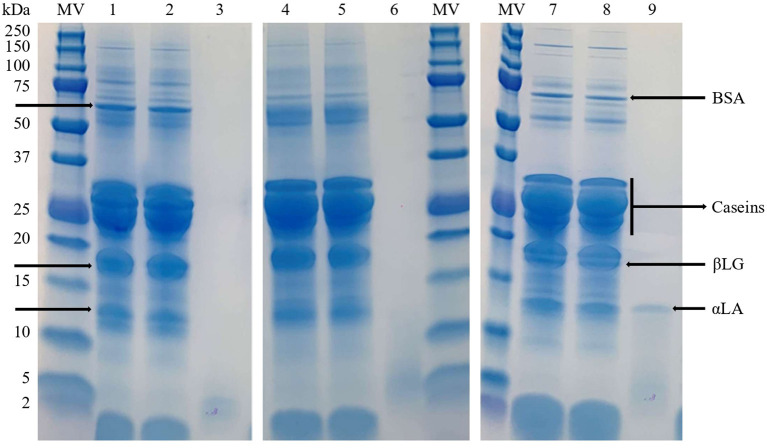
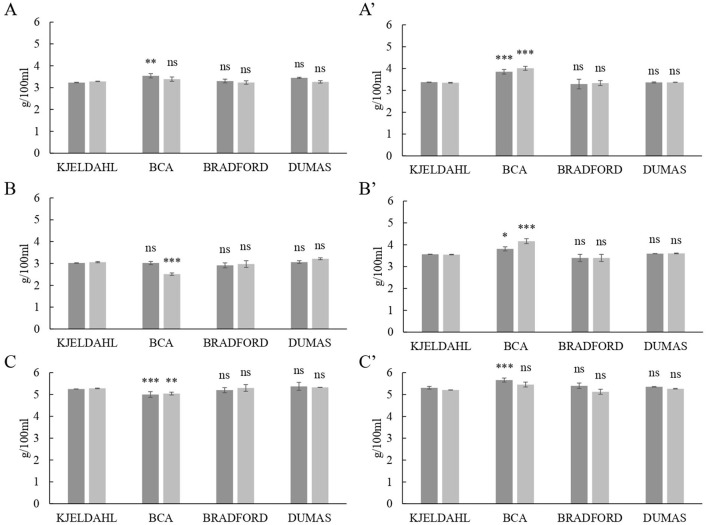
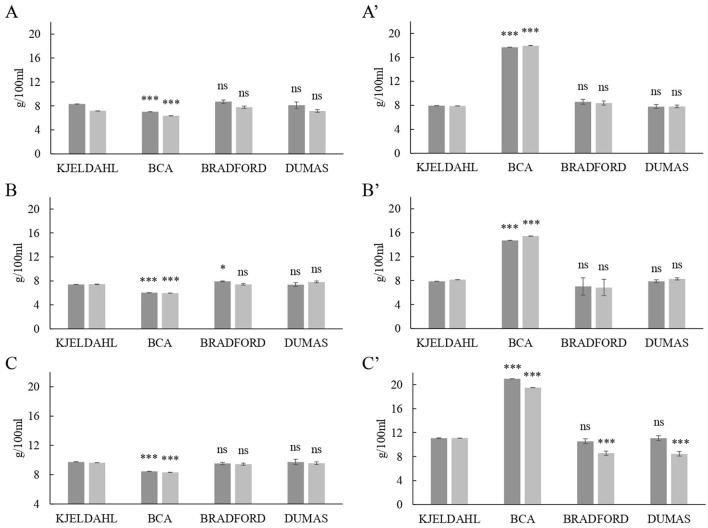
Milk ultrafiltration is a widely used membrane filtration process that allows the recuperation of whey proteins in a concentrate high in total solids, which can later be transformed in multiple healthy dairy products with great prospects for the food industry. Protein content is a decisive factor for the technological performance of milk concentrates and currently, the ISO standard method for its determination is Kjeldahl, which is time-consuming and requires specific instrumentation. For this reason, the use of rapid methods to quantify protein would greatly facilitate the monitoring of the milk ultrafiltration process. In this study, the bicinchoninic acid assay (BCA), the detergent compatible Bradford assay and the Dumas method were compared to Kjeldahl protein determination to select a quick and accurate methodology suitable for milk of different species and its ultrafiltration products (retentates and permeates). The protein content obtained from Bradford assay and Dumas method in origin milk and retentate samples was consistent with Kjeldahl values. In contrast, BCA protein levels were significantly different when compared to Kjeldahl and no method was proved to be suitable for protein determination in permeate samples. The use of sodium dodecyl sulfate was also examined to improve protein measurements without success. In comparison with the official method, Bradford assay quantitatively provided the best results, and it would be recommended for a quick, economic and easy determination of total protein content in milk and retentate samples.
Overview
The claims and statistics of this paper haven’t been checked yet.
Run the check — free, no account needed. It reads the open-access text and checks the sources it cites.
Integrity signals
Registry
Cites
Statistics
Figures
Verification
Claims the paper makes
The claims and statistics of this paper haven’t been checked yet.
Run the check — free, no account needed. It reads the open-access text and checks the sources it cites.
Claims other papers make about this one
Each is checked against this paper’s own text: does it say what the citing paper says it does?
The cited source says what the claim attributes to it.
In the citing paper
“nitrogenbased methods such as Dumas quantify total nitrogen, including non-protein fractions, and may therefore overestimate protein content [25]”
From Functional and Bioactive Characterization of Hemp Cake Proteins and Polyphenols from Non-Psychoactive Cannabis sativa (2025) · cites this paper as [25]
Self-check
Percentages, sums and reported differences re-computed from the paper’s own numbers.
The self-check needs the paper’s full text.
Citations
The citation lists haven’t been fetched yet
References 36 · Cited by 60
Research works printed but not linked: 36
- Fontecha, 2017, Recent advances in dairy ingredients and cardiovascular diseases with special reference to milk fat components.,, 251, 10.1016/B978-0-12-809868-4.00019-4 · DOI
- Thum, 2021, Variation in milk fat globule size and composition: A source of bioactives for human health, Crit Rev Food Sci Nutr., 30, 1, 10.1080/10408398.2021.1944049 · DOI
- Yadav, 2015, Cheese whey: a potential resource to transform into bioprotein, functional/nutritional proteins and bioactive peptides, Biotechnol Adv., 33, 756, 10.1016/j.biotechadv.2015.07.002 · DOI
- Pouliot, 2008, Membrane processes in dairy technology - from a simple idea to worldwide panacea, Int Dairy J., 18, 735, 10.1016/j.idairyj.2008.03.005 · DOI
- Soltani, 2022, Perspectives and recent innovations on white cheese produced by conventional methods or ultrafiltration technique, Int Dairy J., 125, 105232, 10.1016/j.idairyj.2021.105232 · DOI
- Banks, 2007, Ultrafiltration of cheesemilk.,, 30
- Moore, 2010, Total protein methods and their potential utility to reduce the risk of food protein adulteration, Compr Rev Food Sci Food Saf., 9, 330, 10.1111/j.1541-4337.2010.00114.x · DOI
- Sharma, 2010, The melamine adulteration scandal, Food Secur., 2, 97, 10.1007/s12571-009-0048-5 · DOI
- Kruger, 2009, The Bradford Method For Protein Quantitation.,, 17, 10.1007/978-1-59745-198-7_4 · DOI
- Walker, 2009, The Bicinchoninic Acid (BCA) Assay for Protein Quantitation.,, 11, 10.1007/978-1-59745-198-7_3 · DOI
- Brady, 2015, Evaluation of colorimetric assays for analyzing reductively methylated proteins: biases and mechanistic insights, Anal Biochem., 491, 43, 10.1016/j.ab.2015.08.027 · DOI
- Mæhre, 2018, Protein determination—method matters, Foods., 7, 5, 10.3390/foods7010005 · DOI
- Milton, 1992, The effect of reducing and non-reducing sugars on the bicinchoninic acid reaction for protein determination, Clin Chim Acta., 208, 141, 10.1016/0009-8981(92)90034-N · DOI
- Kessler, 1986, Interference by lipids in the determination of protein using bicinchoninic acid, Anal Biochem., 159, 138, 10.1016/0003-2697(86)90318-0 · DOI
- Lu, 2020, Performance of commercial colorimetric assays for quantitation of total soluble protein in thermally treated milk samples, Food Anal Methods., 13, 1337, 10.1007/s12161-020-01748-w · DOI
- Gazzola, 2015, Advantages of the KDS/BCA assay over the bradford assay for protein quantification in white wine and grape juice, Am J Enol Vitic., 66, 227, 10.5344/ajev.2014.14076 · DOI
- Compton, 1985, Mechanism of dye response and interference in the Bradford protein assay, Anal Biochem., 151, 369, 10.1016/0003-2697(85)90190-3 · DOI
- Jones, 1989, Measuring plant protein with the Bradford assay, J Chem Ecol., 15, 979, 10.1007/BF01015193 · DOI
- Duhamel, 1981, The addition of SDS to the Bradford dye-binding protein assay, a modification with increased sensitivity to collagen, J Biochem Biophys Methods., 5, 67, 10.1016/0165-022X(81)90007-5 · DOI
- Montes De Oca-Flores, 2019, Technological and physicochemical properties of milk and physicochemical aspects of traditional Oaxaca cheese, Rev Mex Cienc Pecu., 10, 368, 10.22319/rmcp.v10i2.4291 · DOI
- Villas-Boas, 2015, Epitopes resistance to the simulated gastrointestinal digestion of β-lactoglobulin submitted to two-step enzymatic modification, Food Res Int., 72, 191, 10.1016/j.foodres.2015.03.044 · DOI
- Lee, 1974, Electrophoresis of cottage cheese whey proteins and their polymers, J Dairy Sci., 58, 658, 10.3168/jds.S0022-0302(75)84624-8 · DOI
- Woo Park, 2015, Bioactive peptides in milk and dairy products: a review, Korean J Food Sci An., 35, 831, 10.5851/kosfa.2015.35.6.831 · DOI
- Smacchi, 2000, Bioactive peptides in dairy products: synthesis and interaction with proteolytic enzymes, Food Microbiol., 17, 129, 10.1006/fmic.1999.0302 · DOI
- Wiles, 1998, Routine analysis of proteins by kjeldahl and dumas methods: review and interlaboratory study using dairy products, J AOAC Int., 81, 620, 10.1093/jaoac/81.3.620 · DOI
- Kamizake, 2003, Determination of total proteins in cow milk powder samples: a comparative study between the Kjeldahl method and spectrophotometric methods, J Food Compos Anal., 16, 507, 10.1016/S0889-1575(03)00004-8 · DOI
- Keller, 1986, Determination of total protein in human milk: comparison of methods, Clin Chem., 32, 120, 10.1093/clinchem/32.1.120 · DOI
- Giuffrida, 2018, Comparison of macronutrient content in human milk measured by mid-infrared human milk analyzer and reference methods, J Perinatol., 393, 497, 10.1038/s41372-018-0291-8 · DOI
- Lonnerdal, 1987, Compartmentalization and quantitation of protein in human milk, J Nutr., 117, 1385, 10.1093/jn/117.8.1385 · DOI
- Bergqvist, 1989, Total protein determined in human breast milk by use of Coomassie Brilliant Blue and centrifugal analysis, Clin Chem., 35, 2127, 10.1093/clinchem/35.10.2127 · DOI
- Castro-Gómez, 2015, Relevance of dietary glycerophospholipids and sphingolipids to human health, Prostaglandins Leukot Essent Fat Acids., 101, 41, 10.1016/j.plefa.2015.07.004 · DOI
- Field, 2010, Melamine and cyanuric acid do not interfere with Bradford and Ninhydrin assays for protein determination, Food Chem., 121, 912, 10.1016/j.foodchem.2010.01.018 · DOI
- Hamada, 2000, Characterization and functional properties of rice bran proteins modified by commercial exoproteases and endoproteases, J Food Sci., 65, 305, 10.1111/j.1365-2621.2000.tb15998.x · DOI
- Jablonski, 2010, Determination of Protein Levels in Soy and Peanut Oils by Colorimetric Assay and ELISA, FOOD Compos Addit., 93, 213, 10.1093/jaoac/93.1.213 · DOI
- Hayes, 2020, Measuring Protein Content in Food: An Overview of Methods, Foods., 9, 1340, 10.3390/foods9101340 · DOI
- Morton, 1992, Modification of the bicinchoninic acid protein assay to eliminate lipid interference in determining lipoprotein protein content, Anal Biochem., 204, 332, 10.1016/0003-2697(92)90248-6 · DOI
Metadata
- Authors
- Hueso, D., Fontecha, J., & Gómez-Cortés, P.
- Affiliations
- Instituto de Investigación en Ciencias de la Alimentación (ES)
- Venue
- Frontiers in Nutrition
- Publisher
- Frontiers Media SA
- Published
- 2022-09-13
- Volume
- 9
- Pages
- 925565-925565
- ISSN
- 2296-861X (ISSN-L)
- PMC
- PMC9513457
- OpenAlex
- W4296588744
- Cited by
- 60
- References
- 36
- Citations by year
- 2026: 17 · 2025: 19 · 2024: 15 · 2023: 7 · 2022: 2
- FWCI
- 5.85
- Type
- journal article
- Language
- en
- Open access
- gold
- doi.org
- Licence
- Locations
- Frontiers in Nutrition (publishedVersion, cc-by)
- PubMed Central (publishedVersion, cc-by)
- PubMed (publishedVersion)
- DIGITAL.CSIC (Spanish National Research Council (CSIC)) (submittedVersion, cc-by)
- DOAJ (DOAJ: Directory of Open Access Journals) (submittedVersion, cc-by-sa)
- Funders
- Consejo Superior de Investigaciones Científicas
- Topics
- Life Sciences › Agricultural and Biological Sciences › Food Science › Food Nutrient Composition and Product Development
- Life Sciences › Agricultural and Biological Sciences › Animal Science and Zoology › Milk Quality and Mastitis in Dairy Cows
- Physical Sciences › Environmental Science › Water Science and Technology › Membrane Separation Technologies
- Keywords
- total protein determination, whey protein concentrate, permeate, Bradford assay, bicinchoninic acid assay, Dumas method, Kjeldahl method, sodium dodecyl sulfate
About these checks
Registry, retraction, Cites and statistics results are computed, not judged, with one exception: a printed reference that no index lists is read once by a model before it counts as a citation error. Claims are extracted by a model and kept only when their quote appears verbatim in the text; each cited source is then checked, with a model’s help, for whether it says what the claim relies on. Those verdicts can be wrong — read the claim’s quote and the cited source before relying on one.
Statistics and arithmetic are recomputed, not judged.
Confidence bands are shown only for fields calibrated on our annotated test set. None is calibrated yet, so no band is shown.
What counts as a claim ›How we measure confidence ›How we check this ›
Are you an author, or do you see a problem with this page? Request a review
How to cite
Cite CoChat for the checks on this page, and the paper for its own findings.
- This page
- CoChat. (2026). Citation check: Comparative study of the most commonly used methods for total protein determination in milk of different species and their ultrafiltration products. https://app.cochat.ai/papers/10.3389/fnut.2022.925565
- The paper
- Hueso, D., Fontecha, J., & Gómez-Cortés, P. (2022). Comparative study of the most commonly used methods for total protein determination in milk of different species and their ultrafiltration products. Frontiers in Nutrition. https://doi.org/10.3389/fnut.2022.925565
