

The DOI matches its Crossref record; 26 of the 26 references it cites were found in a registry or an index.
Liver injury during durvalumab-based immunotherapy is associated with poorer patient survival: A retrospective analysis
Abstract
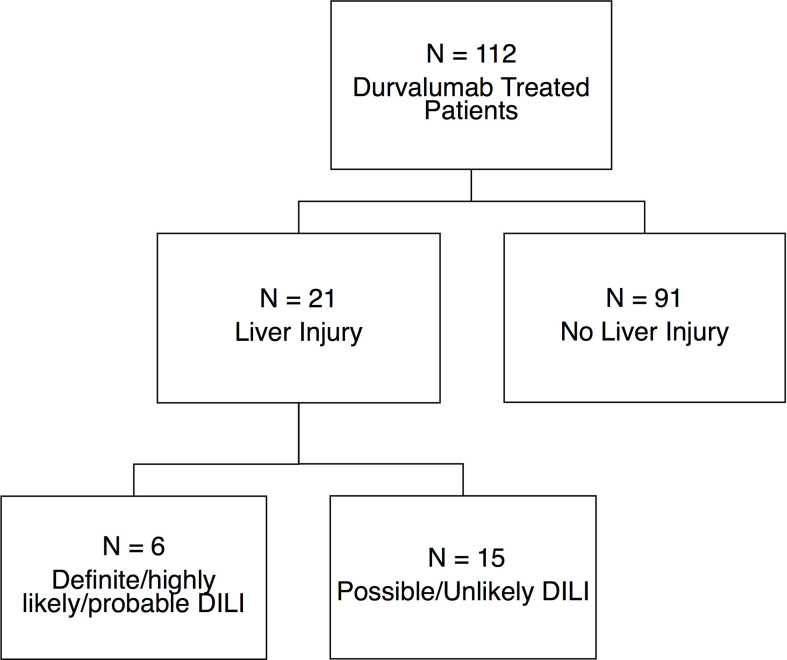
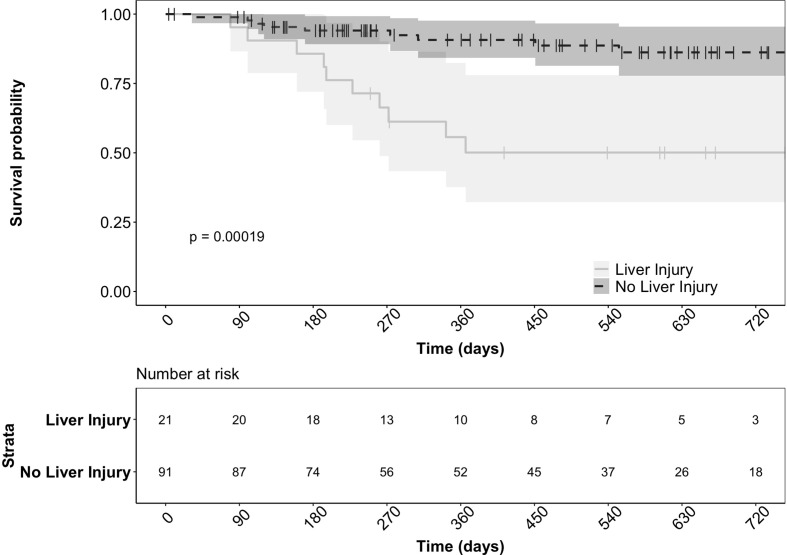
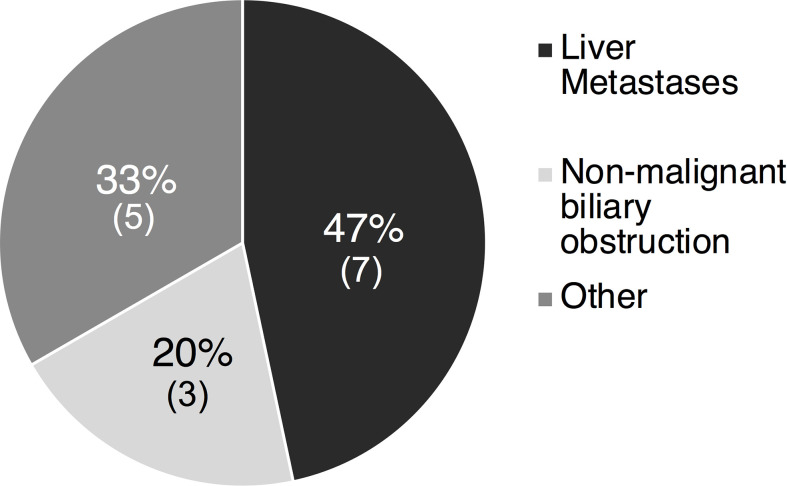
Background: Durvalumab is approved for the treatment of lung cancer, advanced biliary tract cancers, and is also being evaluated in many other solid organ tumors. The aim of our study is to define the incidence, etiology, and outcomes of liver injury in consecutive patients receiving durvalumab-based immunotherapy. Patients and methods: Durvalumab treated patients between 1/2016 – 7/2020 were identified from the electronic medical record. Liver injury was defined as serum AST or ALT ≥ 5x upper limit of normal (ULN), ALP ≥ 2x ULN, bilirubin ≥ 2.5 mg/dl, or INR ≥ 1.5. Potential drug induced liver injury (DILI) cases were adjudicated using expert opinion scoring and confirmed with Roussel Uclaf Causality Assessment Method (RUCAM). Results: Amongst 112 patients, 58 (52%) had non-small cell lung cancer, the median age was 65 years, and 60% were male. The 21 (19%) liver injury patients were significantly more likely to harbor hepatic metastases (52% vs 17%, p=<0.001), experience tumor progression (67% vs 32%, p=0.01) or die (48% vs 11%, p<0.001) during follow-up compared to the 91 without liver injury. Using multivariate regression analysis, the development of liver injury during treatment as well as baseline hepatic metastases were independently associated with mortality during follow-up. Six of the 21 (29%) liver injury cases were adjudicated as probable DILI with four attributed to durvalumab and two due to other drugs (paclitaxel, pembrolizumab). Durvalumab was permanently discontinued in two DILI patients, three received corticosteroids, and one was successfully rechallenged. Only one patient with DILI developed jaundice, and none required hospitalization. Liver biochemistries normalized in all 6 DILI cases, while they only normalized in 27% of the 15 non-DILI cases (p=0.002). The 6 DILI patients also had a trend towards improved survival compared to those with other causes of liver injury Conclusion: Liver injury was observed in 19% of durvalumab-treated patients and is associated with a greater likelihood of tumor progression and death during follow-up. The four durvalumab DILI cases were mild and self-limited, highlighting the importance of causality assessment to determine the cause of liver injury in oncology patients receiving immunotherapy.
Overview
The claims and statistics of this paper haven’t been checked yet.
Run the check — free, no account needed. It reads the open-access text and checks the sources it cites.
Integrity signals
Registry
Cites
Statistics
Figures
Verification
Claims the paper makes
The claims and statistics of this paper haven’t been checked yet.
Run the check — free, no account needed. It reads the open-access text and checks the sources it cites.
Claims other papers make about this one
Each is checked against this paper’s own text: does it say what the citing paper says it does?
In the citing paper
“A diagnosis of ILICI requires exclusion of alternative etiologies via serological testing along with contrast-enhanced cross-sectional imaging of the liver to exclude hepatic metastases and biliary obstruction.42,43”
From The contemporary epidemiology, causes, and management of drug-induced liver injury (2026) · cites this paper as [43]
In the citing paper
“Immune-mediated liver injury from checkpoint inhibitors (ILICIs) is an increasingly recognized cause of liver injury with an incidence of 5%–10%.41–43”
From The contemporary epidemiology, causes, and management of drug-induced liver injury (2026) · cites this paper as [43]
In the citing paper
“The pattern of liver injury with ILICI is hepatocellular in 40%–50% of patients, with older individuals more likely to present with a mixed or cholestatic profile, and typically occurs in the first 6 months of therapy.42,43,46”
From The contemporary epidemiology, causes, and management of drug-induced liver injury (2026) · cites this paper as [43]
Self-check
Percentages, sums and reported differences re-computed from the paper’s own numbers.
The self-check needs the paper’s full text.
Citations
Cites
Durvalumab after chemoradiotherapy in stage III non–small-cell lung cancer
Antonia, S. J., Villegas, A., Daniel, D., Vicente, D., Murakami, S., Hui, R., Yokoi, T., Chiappori, A., Lee, K. H., de Wit, M., et al. (2017) · New England Journal of Medicine · doi:10.1056/nejmoa1709937 · Cited by 4,593
Overall Survival with Durvalumab after Chemoradiotherapy in Stage III NSCLC
Antonia, S. J., Villegas, A., Daniel, D., Vicente, D., Murakami, S., Hui, R., Kurata, T., Chiappori, A., Lee, K. H., de Wit, M., et al. (2018) · New England Journal of Medicine · doi:10.1056/nejmoa1809697 · Cited by 2,798
Schneider, B. J., Naidoo, J., Santomasso, B. D., Lacchetti, C., Adkins, S., Anadkat, M., Atkins, M. B., Brassil, K. J., Caterino, J. M., Chau, I., et al. (2021) · Journal of Clinical Oncology · doi:10.1200/jco.21.01440 · Cited by 2,372
Self-citationPaz-Ares, L., Dvorkin, M., Chen, Y., Reinmuth, N., Hotta, K., Trukhin, D., Statsenko, G., Hochmair, M. J., Özgüroğlu, M., Ji, J. H., et al. (2019) · The Lancet · doi:10.1016/s0140-6736(19)32222-6 · Cited by 2,298
Haslam, A., & Prasad, V. (2019) · JAMA Network Open · doi:10.1001/jamanetworkopen.2019.2535 · Cited by 1,413
Durvalumab plus Gemcitabine and Cisplatin in Advanced Biliary Tract Cancer
Oh, D.-Y., Ruth He, A., Qin, S., Chen, L.-T., Okusaka, T., Vogel, A., Kim, J. W., Suksombooncharoen, T., Ah Lee, M., Kitano, M., et al. (2022) · NEJM Evidence · doi:10.1056/evidoa2200015 · Cited by 1,217
Liver metastasis restrains immunotherapy efficacy via macrophage-mediated T cell elimination
Yu, J., Green, M. D., Li, S., Sun, Y., Journey, S. N., Choi, J. E., Rizvi, S. M., Qin, A., Waninger, J. J., Lang, X., et al. (2021) · Nature Medicine · doi:10.1038/s41591-020-1131-x · Cited by 1,001
Powles, T., O'Donnell, P. H., Massard, C., Arkenau, H.-T., Friedlander, T. W., Hoimes, C. J., Lee, J. L., Ong, M., Sridhar, S. S., Vogelzang, N. J., et al. (2017) · JAMA Oncology · doi:10.1001/jamaoncol.2017.2411 · Cited by 869
RUCAM in Drug and Herb Induced Liver Injury: The Update
Danan, G., & Teschke, R. (2015) · International Journal of Molecular Sciences · doi:10.3390/ijms17010014 · Cited by 729
Goldman, J. W., Dvorkin, M., Chen, Y., Reinmuth, N., Hotta, K., Trukhin, D., Statsenko, G., Hochmair, M. J., Özgüroğlu, M., Ji, J. H., et al. (2021) · The Lancet Oncology · doi:10.1016/s1470-2045(20)30539-8 · Cited by 688
Research works printed but not linked: 2
- Kemp, 2022, Imfinzi plus chemotherapy approved in the US as the first immunotherapy regimen for patients with advanced biliary tract cancer
- 2021, IMFINZI, 1
Cited by
The contemporary epidemiology, causes, and management of drug-induced liver injury
Swanson, L., & Fontana, R. J. (2026) · Hepatology Communications · doi:10.1097/hc9.0000000000001011
Self-citation
Metadata
- Authors
- Swanson, L. A., Kassab, I., Tsung, I., Schneider, B. J., & Fontana, R. J.
- Venue
- Frontiers in Oncology
- Publisher
- Frontiers Media SA
- Published
- 2022-10-24
- Volume
- 12
- ISSN
- 2234-943X
- PMC
- PMC9637844
- Cited by
- 23
- References
- 26
About these checks
Registry, retraction, Cites and statistics results are computed, not judged, with one exception: a printed reference that no index lists is read once by a model before it counts as a citation error. Claims are extracted by a model and kept only when their quote appears verbatim in the text; each cited source is then checked, with a model’s help, for whether it says what the claim relies on. Those verdicts can be wrong — read the claim’s quote and the cited source before relying on one.
Statistics and arithmetic are recomputed, not judged.
Confidence bands are shown only for fields calibrated on our annotated test set. None is calibrated yet, so no band is shown.
What counts as a claim ›How we measure confidence ›How we check this ›
Are you an author, or do you see a problem with this page? Request a review
Data sources
Bibliographic data: Semantic Scholar, OpenAlex, Crossref.
Contains information from the Semantic Scholar Academic Graph Datasets, made available under the ODC Attribution License (ODC-BY 1.0).
Semantic Scholar’s data is described in: Kinney, R., et al. (2023). The Semantic Scholar Open Data Platform. arXiv:2301.10140.
