

Understanding the role of the gut microbiome in gastrointestinal cancer: A review
Open accessThe DOI matches its Crossref record; 218 of the 218 references it cites were found in a registry or an index.
Abstract
Gastrointestinal cancer represents one of the most diagnosed types of cancer. Cancer is a genetic and multifactorial disease, influenced by the host and environmental factors. It has been stated that 20% of cancer is caused by microorganisms such as Helicobacter pylori , hepatitis B and C virus, and human papillomavirus. In addition to these well-known microorganisms associated with cancer, it has been shown differences in the composition of the microbiota between healthy individuals and cancer patients. Some studies have suggested the existence of the selected microorganisms and their metabolites that can promote or inhibit tumorigenesis via some mechanisms. Recent findings have shown that gut microbiome and their metabolites can act as cancer promotors or inhibitors. It has been shown that gastrointestinal cancer can be caused by a dysregulation of the expression of non-coding RNA (ncRNA) through the gut microbiome. This review will summarize the latest reports regarding the relationship among gut microbiome, ncRNAs, and gastrointestinal cancer. The potential applications of diagnosing and cancer treatments will be discussed.
Overview
The claims and statistics of this paper haven’t been checked yet.
Free: it reads the open-access text and checks the first 5 claims that cite a source we can check. Create a free account to check every claim.
Integrity signals
Registry
Cites
Statistics
Figures
Verification
Claims the paper makes
The claims and statistics of this paper haven’t been checked yet.
Free: it reads the open-access text and checks the first 5 claims that cite a source we can check. Create a free account to check every claim.
Claims other papers make about this one
Each is checked against this paper’s own text: does it say what the citing paper says it does?
The cited source says what the claim attributes to it.
In the citing paper
“Paneth cell α-defensins shape intestinal microbiota composition, which influences multiple biomedical processes of the host, including behavior,39 autoimmune disease,40 and cancer.41”
From High-quality mouse reference genomes reveal the structural complexity of the murine protein-coding landscape (2026) · cites this paper as [41]
Self-check
Percentages, sums and reported differences re-computed from the paper’s own numbers.
The self-check needs the paper’s full text.
Citations
Cites
Items 201–218 of 218
Hoekstra, E., Das, A. M., Swets, M., Cao, W., van der Woude, C. J., Bruno, M. J., Peppelenbosch, M. P., Kuppen, P. J. K., ten Hagen, T. L. M., & Fuhler, G. M. (2016) · Oncotarget · doi:10.18632/oncotarget.7829 · Cited by 73 · cited 1×
“First, helicobacter pylori inject two cytotoxins, VacA and CagA into the host cell, which activates oncogenic signal transduction pathways (Fuhler et al., 2009; Queiroz et al., 2012; Hoekstra et al., 2016).”
BackgroundDelgado, S., Suárez, A., & Mayo, B. (2006) · Digestive Diseases and Sciences · doi:10.1007/s10620-006-3201-4 · Cited by 71 · cited 3×
“At the level of mouth and ileum, in which the digestion and absorption of monosaccharides, amino acids, and fatty acids take place, there are Enterococci and Lactobacilli, while in the ileum and the colon (at the level of which the bile acid is absorbed) there is a myriad of bacteria, including Ruminococcus, Staphyloc…”
BackgroundQueiroz, K. C. S., Milani, R., Ruela-de-Sousa, R. R., Fuhler, G. M., Justo, G. Z., Zambuzzi, W. F., Durán, N., Diks, S. H., Spek, C. A., Ferreira, C. V., et al. (2012) · PLoS ONE · doi:10.1371/journal.pone.0045362 · Cited by 54 · cited 1×
“First, helicobacter pylori inject two cytotoxins, VacA and CagA into the host cell, which activates oncogenic signal transduction pathways (Fuhler et al., 2009; Queiroz et al., 2012; Hoekstra et al., 2016).”
BackgroundThe gastrointestinal microbiota and its role in oncogenesis
Lam, S. Y., Yu, J. Q., Wong, S. H., Peppelenbosch, M. P., & Fuhler, G. M. (2017) · Best Practice & Research Clinical Gastroenterology · doi:10.1016/j.bpg.2017.09.010 · Cited by 52
Kiselyov, A., Bunimovich-Mendrazitsky, S., & Startsev, V. (2015) · BBA Clinical · doi:10.1016/j.bbacli.2015.06.002 · Cited by 47
Mediterranean diet adherence and risk of colorectal cancer: the prospective Netherlands Cohort Study
Schulpen, M., & van den Brandt, P. A. (2019) · European Journal of Epidemiology · doi:10.1007/s10654-019-00549-8 · Cited by 47
Distinct roles of the mTOR components Rictor and Raptor in MO7e megakaryocytic cells
Fuhler, G. M., Tyl, M. R., Olthof, S. G. M., Drayer, A. L., Blom, N. R., & Vellenga, E. (2009) · European Journal Of Haematology · doi:10.1111/j.1600-0609.2009.01263.x · Cited by 44 · cited 1×
“First, helicobacter pylori inject two cytotoxins, VacA and CagA into the host cell, which activates oncogenic signal transduction pathways (Fuhler et al., 2009; Queiroz et al., 2012; Hoekstra et al., 2016).”
BackgroundTsai, C., Chen, T., Tsai, K.-J., Lin, M., Hsu, C., Wu, D., Tsai, E., & Hsieh, T. (2020) · Biomedicine & Pharmacotherapy · doi:10.1016/j.biopha.2020.110869 · Cited by 44 · cited 3×
“(Tsai et al., 2020).”
BackgroundInfluentialHost–MicroRNA–Microbiota Interactions in Colorectal Cancer
Yuan, C., Steer, C. J., & Subramanian, S. (2019) · Genes · doi:10.3390/genes10040270 · Cited by 43 · cited 1×
“can regulate the growth and composition of the gut microbiota along with the change in the metabolism (Yuan et al., 2019).”
BackgroundBrexpiprazole: First Global Approval
Greig, S. L. (2015) · Drugs · doi:10.1007/s40265-015-0462-2 · Cited by 42 · cited 2×
“, 2015) or melanoma via Herpes virus (Greig, 2015), or pancreatic cancer with Listeria monocytogenes (Le et al.”
BackgroundThe Effects of Maturation on the Colonic Microflora in Infancy and Childhood
Enck, P., Zimmermann, K., Rusch, K., Schwiertz, A., Klosterhalfen, S., & Frick, J. S. (2009) · Gastroenterology Research and Practice · doi:10.1155/2009/752401 · Cited by 41 · cited 8×
“It was found that the ratios of Prevotella, Lactobacillus, and Bifidobacterium bacteria and fecal short-chain fatty acid (SCFA) levels were high in the microbiota of individuals with high adherence to the Mediterranean diet (MedDiet), and Clostridium species are seen to be lower (Del Chierico et al., 2014; De Filippis…”
BackgroundInfluentialTsigalou, C., Paraschaki, A., Karvelas, A., Kantartzi, K., Gagali, K., Tsairidis, D., & Bezirtzoglou, E. (2021) · Metabolism Open · doi:10.1016/j.metop.2021.100081 · Cited by 40 · cited 2×
“It has been reported that compliance with the MedDiet model positively affects the gut microbiome ecosystem and has positive roles in ensuring the immune system and metabolic balance of the human organism (Tsigalou et al., 2021).”
BackgroundResultRole of Bacterial Overgrowth in the Stomach as an Additional Risk Factor for Gastritis
Naylor, G., & Axon, A. T. R. (2003) · Canadian Journal of Gastroenterology and Hepatology · doi:10.1155/2003/350347 · Cited by 39 · cited 1×
“In addition to these, the microbiota is also populated with bacteria that reduce nitrates, it follows the formation of nitrites and carcinogenic N-nitroso compounds (Lundberg et al., 1994; Naylor and Axon, 2003; Jakszyn et al., 2006; Brawner et al., 2014).”
BackgroundTan, X., Mao, L., Huang, C., Yang, W., Guo, J., Chen, Z., & Chen, Z. (2021) · Bioengineered · doi:10.1080/21655979.2021.1940614 · Cited by 35 · cited 1×
“demonstrated that probiotics could inhibit the expression of the oncogenes hsa-mir-153 and hsa-mir-429 and increase the expression of the tumor suppressors hsa-mir-140 and hsa-mir-132, whereas pathobionts could increase the expression of the oncogenes hsa-mir-223, hsa-mir-96, and hsa-mir-106a (Tan et al., 2021).”
BackgroundA Crosstalk between Diet, Microbiome and microRNA in Epigenetic Regulation of Colorectal Cancer
Guz, M., Jeleniewicz, W., Malm, A., & Korona‐Głowniak, I. (2021) · Nutrients · doi:10.3390/nu13072428 · Cited by 34 · cited 1×
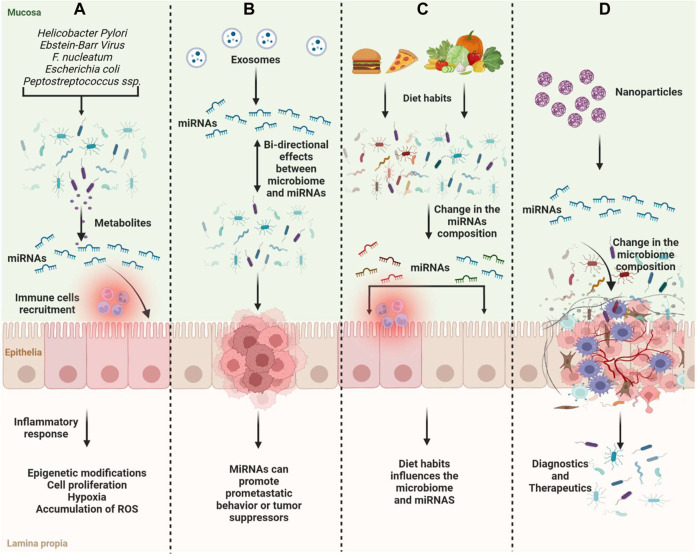
“Diet and dietary habits influence the microbiome, which is important in triggering the association between cancer and diet (Guz et al., 2021).”
BackgroundEnzymatic activities behind degradation of glucosinolates
Parchem, K., Piekarska, A., & Bartoszek, A. (2019) · Elsevier eBooks · doi:10.1016/b978-0-12-816493-8.00003-2 · Cited by 30
DNA methylation, colon cancer and Mediterranean diet: results from the EPIC-Italy cohort
Fasanelli, F., Giraudo, M. T., Vineis, P., Fiano, V., Fiorito, G., Grasso, C., Polidoro, S., Trevisan, M., Grioni, S., Krogh, V., et al. (2019) · Epigenetics · doi:10.1080/15592294.2019.1629230 · Cited by 26 · cited 1×
“Although the mechanisms associated with this are not clear, it has been reported that DNA methylation of cg20674490-RUNX3 may play a mediator role in this relationship (Fasanelli et al., 2019).”
BackgroundBi-direction effects between microbiome and MiRNAs in carcinogenesis
Wang, Q., Ding, H., Dong, G., Xu, L., Jiang, F., & Mao, Q. (2021) · Journal of Cancer Research and Clinical Oncology · doi:10.1007/s00432-021-03567-w · Cited by 11 · cited 1×
“In CRC, infection of Fusobacterium nucleatum increases the expression of miR-21 and down-modulation of miR-18a and miR-4802 (Wang et al., 2021).”
Background
Research works printed but not linked: 4
- Beslenme B. D. Z. Besinler F. (2017). Mikrobiyota. Tüba-mikrobiyota ve i?nsan sağlığı sempozyumu raporu. Ankara, Turkey: Türkiye Bilimler Akademisi.
- Guarner F. Malagelada J. R. (2003). Gut flora in health and disease. Lancet 361 (9356), 512– 519. 10.1016/S0140-6736(03)12489-0 12583961 · DOI · Paper page
- Tözün A. (2019). Bağırsak mikrobiyatası gastrointestinal kanserler. İSTANBUL: Acibadem Mehmet Ali Aydinlar University Research Information System.
- WHO (2020). Handbook on gut microbiome: A global perspective. Turkey: WHO.
Cited by
Targeting gut microbiota and metabolism as the major probiotic mechanism - An evidence-based review
Ma, T., Shen, X., Shi, X., Sakandar, H. A., Quan, K., Li, Y., Jin, H., Kwok, L.-Y., Zhang, H., & Sun, Z. (2023) · Trends in Food Science & Technology · doi:10.1016/j.tifs.2023.06.013 · Cited by 329
Cardiovascular disease and cancer: shared risk factors and mechanisms
Wilcox, N. S., Amit, U., Reibel, J. B., Berlin, E., Howell, K., & Ky, B. (2024) · Nature Reviews Cardiology · doi:10.1038/s41569-024-01017-x · Cited by 310
Han, D., Wu, Y., Lu, D., Pang, J., Hu, J., Zhang, X., Wang, Z., Zhang, G., & Wang, J. (2023) · Cell Death and Disease · doi:10.1038/s41419-023-06190-4 · Cited by 124
Modulation of gut‐microbiota through probiotics and dietary interventions to improve host health
Dasriya, V. L., Samtiya, M., Ranveer, S. A., Dhillon, H. S., Devi, N., Sharma, V., Nikam, P., Puniya, M., Chaudhary, P., Chaudhary, V., et al. (2024) · Journal of the Science of Food and Agriculture · doi:10.1002/jsfa.13370 · Cited by 93
Helicobacter pylori and immunotherapy for gastrointestinal cancer
Jia, K., Chen, Y., Xie, Y., Wang, X., Hu, Y., Sun, Y., Cao, Y., Zhang, L., Wang, Y., Wang, Z., et al. (2024) · The Innovation · doi:10.1016/j.xinn.2023.100561 · Cited by 74
Metadata
- Authors
- Ağagündüz, D., Cocozza, E., Cemali, Ö., Bayazıt, A. D., Nanì, M. F., Cerqua, I., Morgillo, F., Saygılı, S. K., Berni Canani, R., Amero, P., & Capasso, R.
- Affiliations
- Gazi University (TR)
- Merck Serono S.p.A. (Italy) (IT)
- University of Naples Federico II (IT)
- University of Campania "Luigi Vanvitelli" (IT)
- The University of Texas MD Anderson Cancer Center (US)
- Corresponding author
- Amero, Paola
- Capasso, Raffaele
- ORCID
- Venue
- Frontiers in Pharmacology
- Publisher
- Frontiers Media SA
- Published
- 2023-01-24
- Volume
- 14
- Pages
- 1130562-1130562
- ISSN
- 1663-9812 (ISSN-L)
- PMC
- PMC9903080
- OpenAlex
- W4317905978
- Semantic Scholar
- 5ab7309753a0e81bec0cf77d8caa5a3a994dc5f7
- Cited by
- 189
- References
- 218
- Citations by year
- 2026: 24 · 2025: 65 · 2024: 50 · 2023: 50
- FWCI
- 4.99
- Type
- journal article
- Language
- en
- Update notices
- corrigendum (2025-07-30)
- Open access
- gold
- doi.org
- Licence
- Locations
- Frontiers in Pharmacology (publishedVersion, cc-by)
- PubMed Central (publishedVersion, cc-by)
- PubMed (publishedVersion)
- DOAJ (DOAJ: Directory of Open Access Journals) (submittedVersion, cc-by-sa)
- Archivio Istituzionale della Ricerca - Università degli Studi della Campania "Luigi Vanvitelli" (submittedVersion)
- Funders
- European Commission (PE00000003, CUP D93C22000890001)
- NextGenerationEU
- Topics
- Life Sciences › Biochemistry, Genetics and Molecular Biology › Molecular Biology › Gut microbiota and health
- Life Sciences › Biochemistry, Genetics and Molecular Biology › Cancer Research › MicroRNA in disease regulation
- Health Sciences › Dentistry › Periodontics › Oral microbiology and periodontitis research
- Keywords
- gut microbiota, gastrointestinal cancer, non-coding RNA, dysbiosis, microbial metabolites, carcinogenesis, Helicobacter pylori, human papillomavirus, cancer diagnosis, cancer therapy
About these checks
Registry, retraction, Cites and statistics results are computed, not judged, with one exception: a printed reference that no index lists is read once by a model before it counts as a citation error. Claims are extracted by a model and kept only when their quote appears verbatim in the text; each cited source is then checked, with a model’s help, for whether it says what the claim relies on. Those verdicts can be wrong — read the claim’s quote and the cited source before relying on one.
Statistics and arithmetic are recomputed, not judged.
Confidence bands are shown only for fields calibrated on our annotated test set. None is calibrated yet, so no band is shown.
What counts as a claim ›How we measure confidence ›How we check this ›
Are you an author, or do you see a problem with this page? Request a review
Data sources
Bibliographic data: Semantic Scholar, OpenAlex, Crossref.
Contains information from the Semantic Scholar Academic Graph Datasets, made available under the ODC Attribution License (ODC-BY 1.0).
Semantic Scholar’s data is described in: Kinney, R., et al. (2023). The Semantic Scholar Open Data Platform. arXiv:2301.10140.
