

The DOI matches its Crossref record; 218 of the 218 references it cites were found in a registry or an index.
The critical roles of caveolin-1 in lung diseases
Open accessAbstract
Caveolin-1 (Cav-1), a structural and functional component in the caveolae, plays a critical role in transcytosis, endocytosis, and signal transduction. Cav-1 has been implicated in the mediation of cellular processes by interacting with a variety of signaling molecules. Cav-1 is widely expressed in the endothelial cells, smooth muscle cells, and fibroblasts in the various organs, including the lungs. The Cav-1-mediated internalization and regulation of signaling molecules participate in the physiological and pathological processes. Particularly, the MAPK, NF-κB, TGFβ/Smad, and eNOS/NO signaling pathways have been involved in the regulatory effects of Cav-1 in lung diseases. The important effects of Cav-1 on the lungs indicate that Cav-1 can be a potential target for the treatment of lung diseases. A Cav-1 scaffolding domain peptide CSP7 targeting Cav-1 has been developed. In this article, we mainly discuss the structure of Cav-1 and its critical roles in lung diseases, such as pneumonia, acute lung injury (ALI), asthma, chronic obstructive pulmonary disease (COPD), pulmonary hypertension, pulmonary fibrosis, and lung cancer.
Overview
The claims and statistics of this paper haven’t been checked yet.
Run the check — free, no account needed. It reads the open-access text and checks the sources it cites.
Integrity signals
Registry
Cites
Statistics
Figures
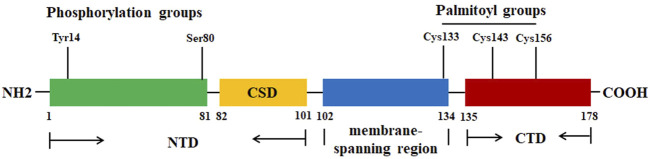
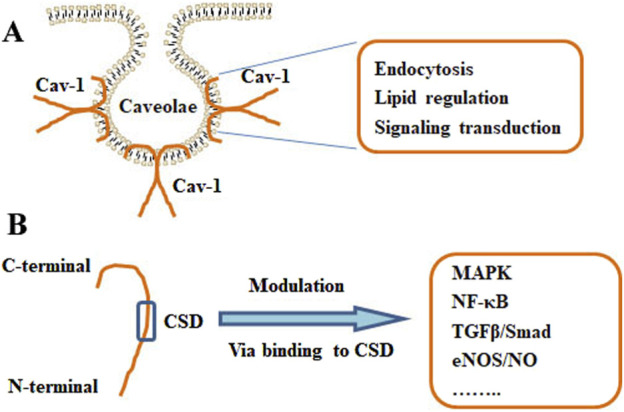
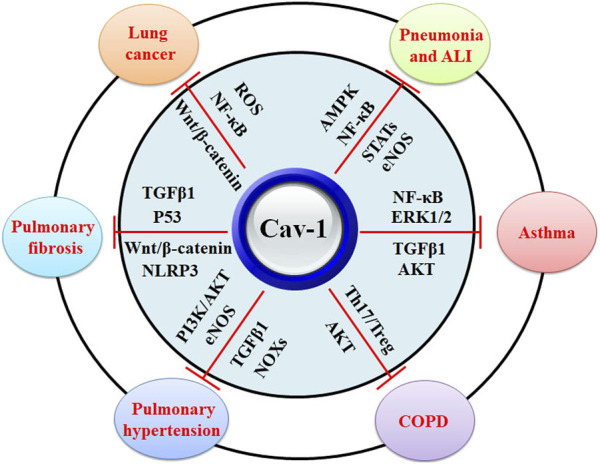
Verification
Claims the paper makes
The claims and statistics of this paper haven’t been checked yet.
Run the check — free, no account needed. It reads the open-access text and checks the sources it cites.
Claims other papers make about this one
Each is checked against this paper’s own text: does it say what the citing paper says it does?
The source backs part of the claim, not all of it — or backs it for a different population, condition or comparison.
In the citing paper
“Caveolin-1 protein (Cav-1) is a structural protein that plays a critical role in regulating lung repair and cellular movement by restoring pathways that both promote epithelial health and halt fibrosis in the lung7–9.”
From Inhaled LTI-03 for idiopathic pulmonary fibrosis: a randomized dose escalation study (2026) · cites this paper as [9]
Experimental — accuracy not yet measured
Self-check
Percentages, sums and reported differences re-computed from the paper’s own numbers.
The self-check needs the paper’s full text.
Citations
Cites
1 retracted
Xu, L., Cai, W., Ma, C., Shou, Q., Qian, J.-L., & Huseyin, T. S. (2018) · Evidence-based Complementary and Alternative Medicine · doi:10.1155/2018/2373609 · Cited by 7
RetractedThe role of pattern-recognition receptors in innate immunity: update on Toll-like receptors
Kawai, T., & Akira, S. (2010) · Nature Immunology · doi:10.1038/ni.1863 · Cited by 9,304
Soriano, J. B., Kendrick, P., Paulson, K. R., Gupta, V. K., Abrams, E. M., Adedoyin, R. A., Adhikari, T. B., Advani, S. M., Agrawal, A., Ahmadian, E., et al. (2020) · The Lancet Respiratory Medicine · doi:10.1016/s2213-2600(20)30105-3 · Cited by 2,450
Anderson, R. G. W. (1998) · Annual Review of Biochemistry · doi:10.1146/annurev.biochem.67.1.199 · Cited by 1,941
Caveolar endocytosis of simian virus 40 reveals a new two-step vesicular-transport pathway to the ER
Pelkmans, L., Kartenbeck, J., & Helenius, A. (2001) · Nature Cell Biology · doi:10.1038/35074539 · Cited by 1,236
Caveolae as plasma membrane sensors, protectors and organizers
Parton, R. G., & del Pozo, M. Á. (2013) · Nature Reviews Molecular Cell Biology · doi:10.1038/nrm3512 · Cited by 984
Progress and prospects of early detection in lung cancer
Knight, S., Crosbie, P. A. J., Balata, H., Chudziak, J., Hussell, T., & Dive, C. (2017) · Open Biology · doi:10.1098/rsob.170070 · Cited by 964
Identification of Peptide and Protein Ligands for the Caveolin-scaffolding Domain
Couët, J., Li, S. C., Okamoto, T., Ikezu, T., & Lisanti, M. P. (1997) · Journal of Biological Chemistry · doi:10.1074/jbc.272.10.6525 · Cited by 919
PTRF-Cavin, a conserved cytoplasmic protein required for caveola formation and function.
Hill, M., Bastiani, M., Luetterforst, R., Kirkham, M., Kirkham, A., Nixon, S. J., Walser, P., Abankwa, D., Oorschot, V., Martin, S., et al. (2008) · Cell · doi:10.1016/j.cell.2007.11.042 · Cited by 739
Potocytosis: Sequestration and Transport of Small Molecules by Caveolae
Anderson, R. G. W., Kamen, B. A., Rothberg, K. G., & Lacey, S. W. (1992) · Science · doi:10.1126/science.1310359 · Cited by 734
Cited by
Sorted by citations
Pulmonary Hypertension: Molecular Mechanisms and Clinical Studies
Adu‐Amankwaah, J., You, Q., Liu, X., Jiang, J., Yang, D., Liu, K., Yuan, J., Wang, Y., Hu, Q., & Tan, R. (2025) · MedComm · doi:10.1002/mco2.70134 · Cited by 24
Role of inflammation in endothelial responses in Pulmonary Hypertension
Wang, A., Qin, P., Zhang, J., Gong, S.-X., Zhang, F., Liang, N., Yang, Y., & Jiang, Z. (2025) · Biomedicine & Pharmacotherapy · doi:10.1016/j.biopha.2025.118206 · Cited by 9
Crosstalk of glutamine metabolism between cancer-associated fibroblasts and cancer cells
Chen, T., Xu, Y., Yang, F., Pan, Y., Ji, N., Li, J., Zeng, X. Y., Chen, Q., Jiang, L., & Shen, Y. (2025) · Cellular Signalling · doi:10.1016/j.cellsig.2025.111874 · Cited by 9
Elshal, M., Hamdi, A., Khalil, I. T., Arafa, E. A., Althobaiti, M. M., Arab, H. H., & Haikal, A. (2025) · Toxicology and Applied Pharmacology · doi:10.1016/j.taap.2025.117414 · Cited by 2
Todorović, P., Maglica, M., Kelam, N., Filipović, N., Rizikalo, A., Perutina, I., Mišković, J., Katsuyama, Y., & Vukojević, K. (2025) · Life · doi:10.3390/life15091395 · Cited by 2
Metadata
- Authors
- Fan, J., Zheng, S., Wang, M., & Yuan, X.
- Affiliations
- First Affiliated Hospital of Gannan Medical University (CN)
- Corresponding author
- Yuan, Xiaoliang
- Venue
- Frontiers in Pharmacology
- Publisher
- Frontiers Media SA
- Published
- 2024-09-24
- Volume
- 15
- Pages
- 1417834-1417834
- ISSN
- 1663-9812 (ISSN-L)
- PMC
- PMC11458383
- OpenAlex
- W4402753012
- Cited by
- 21
- References
- 218
- Citations by year
- 2026: 14 · 2025: 6 · 2024: 1
- FWCI
- 1.11
- Type
- journal article
- Language
- en
- Open access
- gold
- doi.org
- Licence
- Locations
- Frontiers in Pharmacology (publishedVersion, cc-by)
- PubMed Central (publishedVersion, cc-by)
- PubMed (publishedVersion)
- DOAJ (DOAJ: Directory of Open Access Journals) (submittedVersion, cc-by-sa)
- Topics
- Life Sciences › Biochemistry, Genetics and Molecular Biology › Cell Biology › Caveolin-1 and cellular processes
- Life Sciences › Biochemistry, Genetics and Molecular Biology › Molecular Biology › Angiogenesis and VEGF in Cancer
- Health Sciences › Medicine › Pharmacology (medical) › Flavonoids in Medical Research
- Keywords
- caveolin-1, caveolae, lung disease, MAPK signaling, NF-κB signaling, TGF-β/Smad signaling, pneumonia, acute lung injury, asthma, chronic obstructive pulmonary disease, pulmonary hypertension, pulmonary fibrosis, lung cancer
About these checks
Registry, retraction, Cites and statistics results are computed, not judged, with one exception: a printed reference that no index lists is read once by a model before it counts as a citation error. Claims are extracted by a model and kept only when their quote appears verbatim in the text; each cited source is then checked, with a model’s help, for whether it says what the claim relies on. Those verdicts can be wrong — read the claim’s quote and the cited source before relying on one.
Statistics and arithmetic are recomputed, not judged.
Confidence bands are shown only for fields calibrated on our annotated test set. None is calibrated yet, so no band is shown.
What counts as a claim ›How we measure confidence ›How we check this ›
Are you an author, or do you see a problem with this page? Request a review
