

The DOI matches its Crossref record; 260 of the 261 references it cites were found in a registry or an index.
Advances in “Omics” Approaches for Improving Toxic Metals/Metalloids Tolerance in Plants
Open accessAbstract
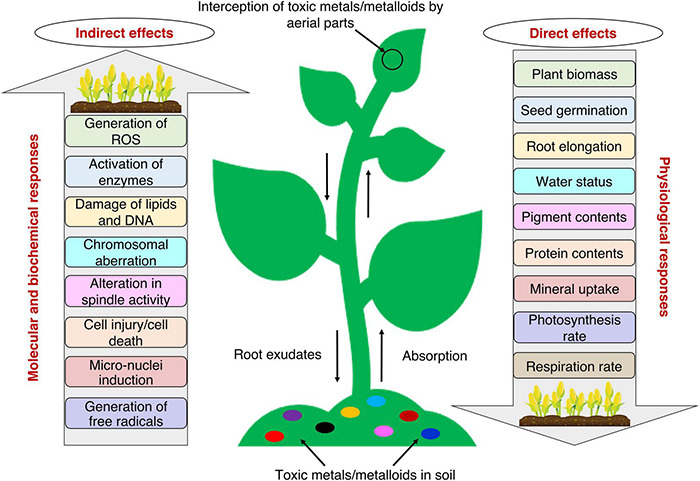
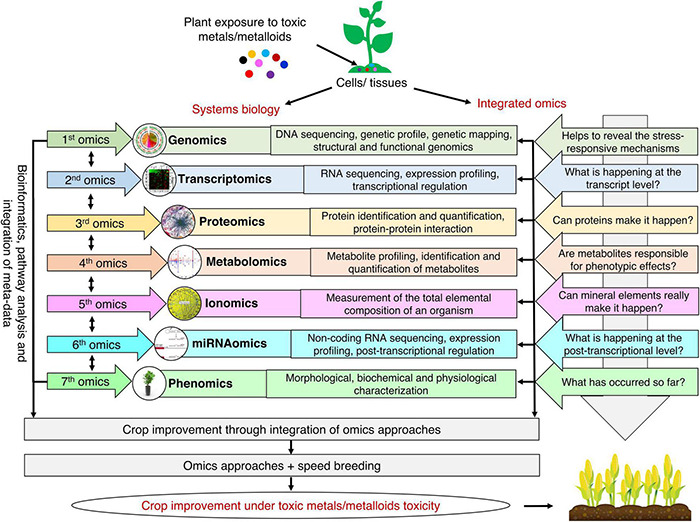
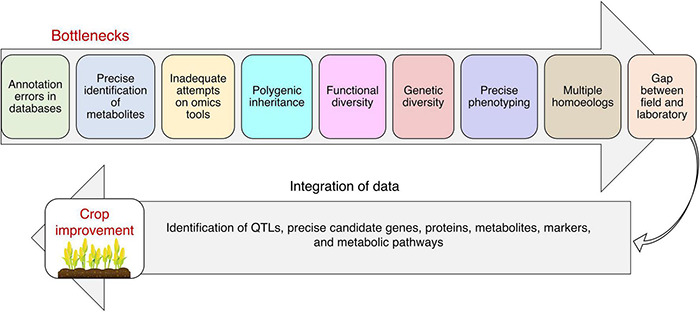
Food safety has emerged as a high-urgency matter for sustainable agricultural production. Toxic metal contamination of soil and water significantly affects agricultural productivity, which is further aggravated by extreme anthropogenic activities and modern agricultural practices, leaving food safety and human health at risk. In addition to reducing crop production, increased metals/metalloids toxicity also disturbs plants' demand and supply equilibrium. Counterbalancing toxic metals/metalloids toxicity demands a better understanding of the complex mechanisms at physiological, biochemical, molecular, cellular, and plant level that may result in increased crop productivity. Consequently, plants have established different internal defense mechanisms to cope with the adverse effects of toxic metals/metalloids. Nevertheless, these internal defense mechanisms are not adequate to overwhelm the metals/metalloids toxicity. Plants produce several secondary messengers to trigger cell signaling, activating the numerous transcriptional responses correlated with plant defense. Therefore, the recent advances in omics approaches such as genomics, transcriptomics, proteomics, metabolomics, ionomics, miRNAomics, and phenomics have enabled the characterization of molecular regulators associated with toxic metal tolerance, which can be deployed for developing toxic metal tolerant plants. This review highlights various response strategies adopted by plants to tolerate toxic metals/metalloids toxicity, including physiological, biochemical, and molecular responses. A seven-(omics)-based design is summarized with scientific clues to reveal the stress-responsive genes, proteins, metabolites, miRNAs, trace elements, stress-inducible phenotypes, and metabolic pathways that could potentially help plants to cope up with metals/metalloids toxicity in the face of fluctuating environmental conditions. Finally, some bottlenecks and future directions have also been highlighted, which could enable sustainable agricultural production.
Overview
The claims and statistics of this paper haven’t been checked yet.
Run the check — free, no account needed. It reads the open-access text and checks the sources it cites.
Integrity signals
Registry
Cites
Statistics
Figures
Verification
Claims the paper makes
The claims and statistics of this paper haven’t been checked yet.
Run the check — free, no account needed. It reads the open-access text and checks the sources it cites.
Claims other papers make about this one
Each is checked against this paper’s own text: does it say what the citing paper says it does?
The source backs part of the claim, not all of it — or backs it for a different population, condition or comparison.
In the citing paper
“While HMs are essential to plants, substantially, there are non-essential HMs like chromium (Cr), cadmium (Cd), lead (Pb), manganese (Mn), etc. induce devastating negative impacts on plant growth, culminating in poor crop production and toxicity to human health (Varma, 2021; Lone and Gaffar, 2021; Varma, 2021; Raza et al., 2022; Bhat et al., 2023).”
From Plant hyperaccumulators: a state-of-the-art review on mechanism of heavy metal transport and sequestration (2025) · cites this paper as Raza et al., 2022
Experimental — accuracy not yet measuredThe cited source says what the claim attributes to it.
In the citing paper
“Phytotoxic effects of HMs include damage to various physiological and metabolic networks at the cellular and molecular levels (Raza et al., 2022; Bhardwaj et al., 2023).”
From Plant hyperaccumulators: a state-of-the-art review on mechanism of heavy metal transport and sequestration (2025) · cites this paper as Raza et al., 2022
Self-check
Percentages, sums and reported differences re-computed from the paper’s own numbers.
The self-check needs the paper’s full text.
Citations
Cites
1 retracted
Alotaibi, M. O., Mohammed, A. E., Almutairi, T., & Elobeid, M. M. (2019) · Plants · doi:10.3390/plants8020043 · Cited by 17
RetractedmixOmics: An R package for ‘omics feature selection and multiple data integration
Rohart, F., Gautier, B., Singh, A., & Lê Cao, K.-A. (2017) · PLOS Computational Biology · doi:10.1371/journal.pcbi.1005752 · Cited by 4,056
MetaboAnalyst 4.0: towards more transparent and integrative metabolomics analysis
Chong, J., Soufan, O., Li, C., Caraus, I., Li, S., Bourque, G., Wishart, D. S., & Xia, J. (2018) · Nucleic Acids Research · doi:10.1093/nar/gky310 · Cited by 3,637
Caspi, R., Billington, R., Ferrer, L., Foerster, H., Fulcher, C. A., Keseler, I. M., Kothari, A., Krummenacker, M., Latendresse, M., Mueller, L. A., et al. (2016) · Nucleic Acids Research · doi:10.1093/nar/gkv1164 · Cited by 3,395
Hasanuzzaman, M., Bhuyan, M. H. M. B., Zulfiqar, F., Raza, A., Mohsin, S. M., Mahmud, J. A., Fujita, M., & Fotopoulos, V. (2020) · Antioxidants · doi:10.3390/antiox9080681 · Cited by 3,314
Self-citationHeavy metals in food crops: health risks, fate, mechanisms, and management
Rai, P. K., Lee, S. S., Zhang, M., Tsang, Y. F., & Kim, K.-H. (2019) · Environment International · doi:10.1016/j.envint.2019.01.067 · Cited by 1,895
New approach for understanding genome variations in KEGG
Kanehisa, M. I., Sato, Y., Furumichi, M., Morishima, K., & Tanabe, M. (2018) · Nucleic Acids Research · doi:10.1093/nar/gky962 · Cited by 1,845
Phytoremediation: A Promising Approach for Revegetation of Heavy Metal-Polluted Land
Yan, A., Wang, Y., Tan, S. N., Mohd Yusof, M. L., Ghosh, S., & Chen, Z. (2020) · Frontiers in Plant Science · doi:10.3389/fpls.2020.00359 · Cited by 1,644
Sarwar, N., Imran, M., Shaheen, M. R., Ishaque, W., Kamran, M., Matloob, A., Rehim, A., & Hussain, S. (2016) · Chemosphere · doi:10.1016/j.chemosphere.2016.12.116 · Cited by 1,442
Lowe, R. G. T., Shirley, N. J., Bleackley, M. R., Dolan, S., & Shafee, T. M. A. (2017) · PLoS Computational Biology · doi:10.1371/journal.pcbi.1005457 · Cited by 1,307
Research works printed but not linked: 6
- Bahmani, 2012, Effect of cadmium chloride on growth parameters of different bean genotypes (Phaseolus vulgaris L.)., ARPN J. Agric. Biol. Sci., 7, 35
- Kakeshpour, 2020, Tomato Class II Glutaredoxin Mutants Generated Via Multiplex CRISPR/Cas9 Genome Editing Technology are Susceptible to Multiple Abiotic Stresses.
- Lin, 2011, The detoxification effect of nitrogen on cadmium stress in Populus yunnanensis., Bot. Res. J., 4, 13
- Muntean, 2019, Heavy metals’ uptake from soil in potato tubers: an ionomic approach., ProEnvironment, 12, 159
- Parmar, 2013, Physiological, biochemical and molecular response of plants against heavy metals stress., Int. J. Curr. Res., 5, 80
- Shenton, 2019, Plant omics data center and CATchUP: web databases for effective gene mining utilizing public RNA-Seq-based transcriptome data, The Model Legume Medicago Truncatula, 1137
Cited by
Sorted by citations
Items 101–132 of 132
Cytokinins for boosting plant stress tolerance
Hameed, M., Qureshi, N., Fatima, N., Rafique, S., Zaffar, Z., Khan, Z., & Shah, T. (2026) · Elsevier eBooks · doi:10.1016/b978-0-443-45576-6.00015-7 · Cited by 1
Murtaza, G., Rizwan, M., Usman, M., Zaman, Q., Ahmed, Z., Iqbal, R., Tariq, A., & Deng, G. (2026) · Plant Biosystems - An International Journal Dealing with all Aspects of Plant Biology · doi:10.1007/s44473-025-00042-z · Cited by 1
IQRA, L., AIMEN, S., & ALI, Q. (2026) · Bulletin of Biological and Allied Sciences Research · doi:10.64013/bbasr.v2026i1.127 · Cited by 1
Akpınar, A., & Bakhshpour, M. (2026) · The Science of The Total Environment · doi:10.1016/j.scitotenv.2026.182009 · Cited by 1
Goswami, P., Krishna, S., Negar, Q., Patel, A. K., Kumar, R., & Kumar, D. (2026) · Reviews on Recent Clinical Trials · doi:10.2174/0115748871417707251206102016 · Cited by 1
Role of omics in understanding heavy metal responses and tolerance in plants
Dabral, S., Garg, E., Bhatt, D., Joshi, S., Joshi, R., & Nath, M. (2024) · Elsevier eBooks · doi:10.1016/b978-0-443-21625-1.00009-9 · Cited by 1
Copper Toxicity and Tolerance in Plants
Moreira, A., Moraes, L., Delfim, J., & Moreti, L. (2023) · Wiley eBooks · doi:10.1002/9781119906506.ch12 · Cited by 1
Designing crops for adaptation to polluted land
Pandey, V. C., Gajić, G., Lebrun, M., & Mahajan, P. (2023) · Elsevier eBooks · doi:10.1016/b978-0-323-95618-5.00007-5
Silicon absorption by plants in response to the environment
de Oliveira, S. P., Menezes, B. S., Araújo, F. S., Escobar, M. E. O., & de Oliveira, T. S. (2024) · Revista CERES · doi:10.1590/0034-737x2024710026
Bastos, A. D. S. M., Alves, A. C. B., Barros, L. T. C., Gomes, L. D. S., Nascimento, C. M., Ribeiro, D. M., Nogueira, G. A. D. S., & Neto, C. F. D. O. (2024) · Cuadernos de Educación y Desarrollo · doi:10.55905/cuadv16n6-038
Plants Response to Metalloid Signal: Insight into the Link Between Silicon and Plant Signalling
Lap, B., James, M., Longkumer, L., Sudhan, R. A., Kisku, A., Bhutia, N. D., Chaturvedi, R., Ahmad, M., & Bhutia, K. L. (2024) · Signaling and communication in plants · doi:10.1007/978-3-031-59024-5_3
Genomics Evolution of Ethnomedicinal Plants in a Changing Environment
dos Santos, T. B., Gazim, Z. C., Magalhães, H. M., & de Souza, S. G. H. (2024) · Springer eBooks · doi:10.1007/978-981-97-3405-4_12
CRISPR plants against heavy metal and metalloid stresses: Methods and applications
Sanjay, S., Banadka, A., Barwad, A., Mamtha, R. S., Ramakrishnan, R., Meghana, U., Kavyashree, A., Al-Khayri, J. M., & Nagella, P. (2025) · Elsevier eBooks · doi:10.1016/b978-0-443-24135-2.00014-1
Dissecting Stress-tolerant Traits of CRISPR-edited Crops by High-throughput Omics Technologies
Kumari, R., Pandey, E., Faizan, S., Bushra, S., Hussain, A., Verma, P., & Akhtar, M. S. (2025) · CABI biotechnology series. · doi:10.1079/9781800627307.0016
Exploring Genetic and Molecular Methods to Induce Crop Plant Tolerance Under Various Contamination
Kavidayal, H., Dabral, A., Dobriyal, M. J., Sarkar, B. C., & Singh, I. (2025) · Smart nanomaterials technology · doi:10.1007/978-981-96-6099-5_11
Das, A., Sajitha Lulu, S., Vaishnavi, J., Manam, M., Deepankumar, K., Samuel, J., & Osborne, J. W. (2025) · Archives of Microbiology · doi:10.1007/s00203-025-04554-2
Hydrophytes as a Source of Bioactives for Heavy Metals Remediation
Kaur, S., Kumar, A., & Raja, V. (2025) · IGI Global eBooks · doi:10.4018/979-8-3373-4037-1.ch004
The MicroRNA toolkit for crop improvement
Pandita, D. (2026) · Elsevier eBooks · doi:10.1016/b978-0-443-36457-0.00001-8
Aonti, A. J., Sohel, M. M. K., Shammy, S. A., & Ali, M. Y. (2026) · Sustainability Sciences in Asia and Africa · doi:10.1007/978-981-95-7746-0_4
Metal-Resilient Crops: Agronomic Innovations and Biotechnological Breakthroughs
Sameena, P. P., Anjitha, K. S., Raj, K. P. A., Veena, M., & Puthur, J. T. (2026) · Sustainability Sciences in Asia and Africa · doi:10.1007/978-981-95-7746-0_17
Berto, S. D. D. C., Bezerra, F. S., de Morais, J. E. F., Leal, L. Y. D. C., Paulino, M. K. S. S., Araújo, C. A. F., Schaffer, B. A., do Nascimento, C. W. A., & de Souza, E. R. (2026) · Plant and Soil · doi:10.1007/s11104-026-08796-x
Indigenous Knowledge in Contamination Assessment
Butnariu, M., & Roşca, M. (2026) · Springer eBooks · doi:10.1007/978-3-032-26858-7_12
Toxicodynamics of metals: Molecular and cellular mechanisms
Rawat, V., & Sawale, J. A. (2026) · Elsevier eBooks · doi:10.1016/b978-0-443-44299-5.00022-5
Rathore, S., Raja, V., Kaur, S., & Srivastava, V. (2026) · South African Journal of Botany · doi:10.1016/j.sajb.2026.08.010
Sevinc, C., Aasım, M., & Bakhsh, A. (2026) · Selcuk Journal of Agricultural and Food Sciences · doi:10.15316/selcukjafsci.1931829
Ren, C., Xiao, W., Zhang, Y., Wu, H., Zhang, J., Liu, B., Li, J., Li, Q., & Wang, X. (2026) · Frontiers in Plant Science · doi:10.3389/fpls.2026.1849237
Kassahun, T., Admas, H., Amsal, S., & Tazebew, E. (2026) · Journal of Plant Nutrition and Soil Science · doi:10.1002/jpln.70113
Сапахова, З., Дауров, Д., Даурова, А., Luo, X., Абилда, Ж., Toishimanov, M., Канат, Р., Isgandarov, I., Жамбакин, К., & Шамекова, М. (2026) · Plants · doi:10.3390/plants15192977
Xu, Y., Zhang, W., Lin, Y., Zhou, S., Zhang, M., Moyle, P. M., Ziora, Z. M., Septama, A. W., & Chen, H. (2026) · Food Bioscience · doi:10.1016/j.fbio.2026.110060
Self-citationAnjitha, K. S., Chaithanya, V. P., Joel, J. M., Sarath, N. G., Veena, M., Aswathi, K. P. R., Kumar, U., Puthur, J. T., & Dhankher, O. P. (2026) · Plant Physiology Reports · doi:10.1007/s40502-026-01018-7
Endophytes and Osmolytes Modulation of Organic Solutes Under Abiotic Stress
Khan, Z., Iftikhar, H., Hameed, M., Shahzadi, S., Imran, A., Saeed, F., Ali, B., Osama, M., Khalid, H. M., & Latef, A. A. H. A. (2026) · IGI Global eBooks · doi:10.4018/979-8-2600-0036-6.ch003
Integrating environmental stress tolerance with precision agriculture
Senthil‐Nathan, S., Vasantha‐Srinivasan, P., & Jogaiah, S. (2026) · Elsevier eBooks · doi:10.1016/b978-0-443-45109-6.00010-8
Metadata
- Authors
- Raza, A., Tabassum, J., Zahid, Z., Charagh, S., Bashir, S., Barmukh, R., Khan, R. S. A., Barbosa, F., Zhang, C., Chen, H., Zhuang, W., & Varshney, R. K.
- Affiliations
- Fujian Agriculture and Forestry University (CN)
- Chinese Academy of Agricultural Sciences (CN)
- National University of Sciences and Technology (PK)
- International Crops Research Institute for the Semi-Arid Tropics (IN)
- University of Agriculture Faisalabad (PK)
- Universidade de São Paulo (BR)
- Murdoch University (AU)
- Corresponding author
- Zhuang, Weijian
- Varshney, Rajeev K.
- ORCID
- Venue
- Frontiers in Plant Science
- Publisher
- Frontiers Media SA
- Published
- 2022-01-04
- Volume
- 12
- Pages
- 794373-794373
- ISSN
- 1664-462X (ISSN-L)
- PMC
- PMC8764127
- OpenAlex
- W4206241292
- Cited by
- 132
- References
- 261
- Citations by year
- 2026: 32 · 2025: 24 · 2024: 31 · 2023: 23 · 2022: 22
- FWCI
- 2.29
- Type
- journal article
- Language
- en
- Open access
- gold
- doi.org
- Licence
- Locations
- Frontiers in Plant Science (publishedVersion, cc-by)
- PubMed Central (publishedVersion, cc-by)
- PubMed (publishedVersion)
- Open Access Repository of ICRISAT (International Crops Research Institute for the Semi-Arid Tropics) (acceptedVersion)
- Murdoch University Research Portal (submittedVersion, cc-by)
- Murdoch University Research Portal (submittedVersion)
- DOAJ (DOAJ: Directory of Open Access Journals) (submittedVersion, cc-by-sa)
- Funders
- Bill and Melinda Gates Foundation (OPP1114827)
- Topics
- Life Sciences › Agricultural and Biological Sciences › Plant Science › Plant Stress Responses and Tolerance
- Life Sciences › Agricultural and Biological Sciences › Plant Science › Plant Micronutrient Interactions and Effects
- Physical Sciences › Environmental Science › Pollution › Heavy metals in environment
- Keywords
- metalloids, heavy metal toxicity, plant stress response, omics approaches, transcriptomics, proteomics, metabolomics, ionomics, phenomics, plant defense, stress-inducible genes, food safety, soil and water contamination
About these checks
Registry, retraction, Cites and statistics results are computed, not judged, with one exception: a printed reference that no index lists is read once by a model before it counts as a citation error. Claims are extracted by a model and kept only when their quote appears verbatim in the text; each cited source is then checked, with a model’s help, for whether it says what the claim relies on. Those verdicts can be wrong — read the claim’s quote and the cited source before relying on one.
Statistics and arithmetic are recomputed, not judged.
Confidence bands are shown only for fields calibrated on our annotated test set. None is calibrated yet, so no band is shown.
What counts as a claim ›How we measure confidence ›How we check this ›
Are you an author, or do you see a problem with this page? Request a review
