

Plant salt response: Perception, signaling, and tolerance
Open accessThe DOI matches its Crossref record; 234 of the 236 references it cites were found in a registry or an index, and 2 are not checked yet.
Abstract
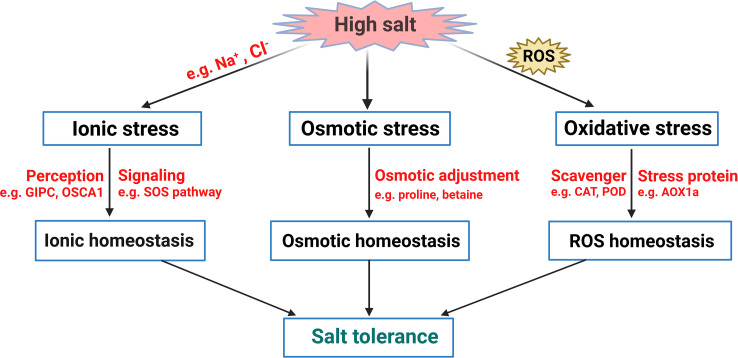
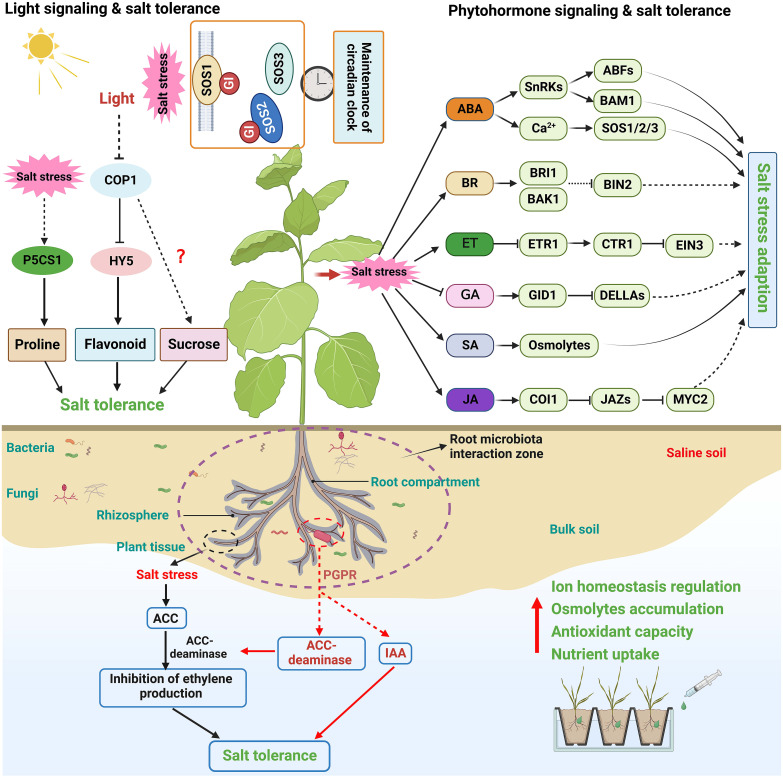
Salt stress is one of the significant environmental stressors that severely affects plant growth and development. Plant responses to salt stress involve a series of biological mechanisms, including osmoregulation, redox and ionic homeostasis regulation, as well as hormone or light signaling-mediated growth adjustment, which are regulated by different functional components. Unraveling these adaptive mechanisms and identifying the critical genes involved in salt response and adaption are crucial for developing salt-tolerant cultivars. This review summarizes the current research progress in the regulatory networks for plant salt tolerance, highlighting the mechanisms of salt stress perception, signaling, and tolerance response. Finally, we also discuss the possible contribution of microbiota and nanobiotechnology to plant salt tolerance.
Overview
The claims and statistics of this paper haven’t been checked yet.
Free: it reads the open-access text and checks the first 5 claims that cite a source we can check. Create a free account to check every claim.
Integrity signals
Registry
Cites
Statistics
Figures
Verification
Claims the paper makes
The claims and statistics of this paper haven’t been checked yet.
Free: it reads the open-access text and checks the first 5 claims that cite a source we can check. Create a free account to check every claim.
Self-check
Percentages, sums and reported differences re-computed from the paper’s own numbers.
The self-check needs the paper’s full text.
Citations
Cites
Mechanisms of Salinity Tolerance
Munns, R., & Tester, M. (2008) · Annual Review of Plant Biology · doi:10.1146/annurev.arplant.59.032607.092911 · Cited by 13,792 · cited 5×
“In addition to naturally occurring soil salinization, the situation is even exacerbated by excessive chemical fertilizers and soil amendments, improper irrigation practices, and the effect of seawater exposure (Munns and Tester, 2008; Sahab et al., 2021).”
BackgroundInfluentialReactive oxygen species: Metabolism, oxidative stress, and signal transduction
Apel, K., & Hirt, H. (2004) · Annual Review of Plant Biology · doi:10.1146/annurev.arplant.55.031903.141701 · Cited by 11,723 · cited 1×
“The toxic level of ROS seriously disrupts normal cellular metabolism through the oxidation of macromolecules like lipids, proteins, and nucleic acids, resulting in severe oxidative damage (Apel and Hirt, 2004; Miller et al., 2010).”
BackgroundReactive oxygen species and antioxidant machinery in abiotic stress tolerance in crop plants
Gill, S. S., & Tuteja, N. (2010) · Plant Physiology and Biochemistry · doi:10.1016/j.plaphy.2010.08.016 · Cited by 11,663 · cited 1×
“ROS in plant cells mainly includes oxygen radicals, like superoxide (*O2), hydroxyl radical (*OH), and some nonradicals, such as hydrogen peroxide (H2O2), singlet oxygen ((1)O2), and ozone (O3) (Gill and Tuteja, 2010).”
BackgroundAbiotic Stress Signaling and Responses in Plants
Zhu, J.-K. (2016) · Cell · doi:10.1016/j.cell.2016.08.029 · Cited by 5,701 · cited 1×
“Under abiotic stresses, including salinity and water Frontiers in Plant Science 06 deficit, endogenous ABA levels increase rapidly, and enhanced ABA signaling activates sucrose nonfermenting 1-related protein kinases (SnRK2s) (Zhu, 2016).”
BackgroundSharma, P., Jha, A. B., Dubey, R. S., & Pessarakli, M. (2012) · Journal of Botany · doi:10.1155/2012/217037 · Cited by 5,473 · cited 1×
“The generation sites of ROS in salt-stressed plants mainly include chloroplasts, mitochondria, apoplast, and peroxisomes (Sharma et al., 2012).”
BackgroundRoles of glycine betaine and proline in improving plant abiotic stress resistance
Ashraf, M., & Foolad, M. R. (2007) · Environmental and Experimental Botany · doi:10.1016/j.envexpbot.2005.12.006 · Cited by 4,776 · cited 1×
“Glycine betaine, a water-soluble amphoteric quaternary ammonium compound, is also an essential osmotic regulator in higher plants, playing a vital role in stress alleviation (Ashraf and Foolad, 2007).”
BackgroundReactive oxygen species homeostasis and signalling during drought and salinity stresses
MILLER, G., SUZUKI, N., CIFTCI‐YILMAZ, S., & MITTLER, R. (2010) · Plant, Cell & Environment · doi:10.1111/j.1365-3040.2009.02041.x · Cited by 3,945 · cited 1×
“The toxic level of ROS seriously disrupts normal cellular metabolism through the oxidation of macromolecules like lipids, proteins, and nucleic acids, resulting in severe oxidative damage (Apel and Hirt, 2004; Miller et al., 2010).”
BackgroundROS as signalling molecules: Mechanisms that generate specificity in ROS homeostasis
D'Autréaux, B., & Toledano, M. B. (2007) · Nature Reviews Molecular Cell Biology · doi:10.1038/nrm2256 · Cited by 3,642 · cited 1×
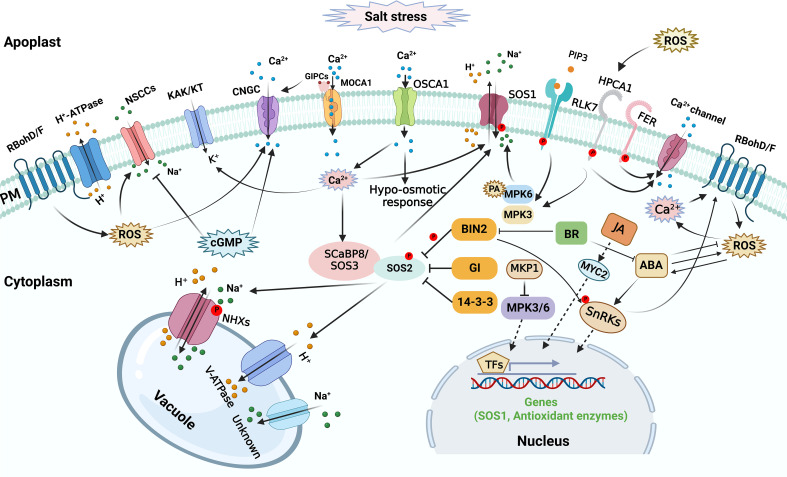
“ROS might damage cells at excess levels while act as crucial signaling molecules essential for stress signaling at lower concentrations (Figure 2) (D'Autréaux and Toledano, 2007; Sewelam et al., 2016).”
BackgroundImpact of Nanotechnology on Drug Delivery
Farokhzad, O. C., & Langer, R. (2009) · ACS Nano · doi:10.1021/nn900002m · Cited by 3,348 · cited 1×
“Nanotechnology is the application of small-sized materials with a basic structure of 1– 100 nm (Farokhzad and Langer, 2009).”
BackgroundNa+ Tolerance and Na+ Transport in Higher Plants
TESTER, M. (2003) · Annals of Botany · doi:10.1093/aob/mcg058 · Cited by 3,250
Research works printed but not linked: 1
- Kumar G. Kushwaha H. R. Purty R. S. Kumari S. Singla-Pareek S. L. Pareek A. (2012). Cloning, structural and expression analysis of OsSOS2 in contrasting cultivars of rice under salinity stress. Genes Genomes Genomics 6 (1), 34– 41.
Cited by
Insights into plant salt stress signaling and tolerance
Zhou, H., Shi, H., Yang, Y., Feng, X., Chen, X., Xiao, F., Lin, H., & Guo, Y. (2024) · Journal of Genetics and Genomics · doi:10.1016/j.jgg.2023.08.007 · Cited by 677
Self-citationJing, T., Li, J., He, Y., Shankar, A., Saxena, A., Tiwari, A., Maturi, K. C., Solanki, M. K., Singh, V., Eissa, M. A., et al. (2024) · Plant Physiology and Biochemistry · doi:10.1016/j.plaphy.2024.108602 · Cited by 161
Salt Stress—Regulation of Root Water Uptake in a Whole-Plant and Diurnal Context
Lu, Y., & Fricke, W. (2023) · International Journal of Molecular Sciences · doi:10.3390/ijms24098070 · Cited by 139
Abiotic Stress in Rice: Visiting the Physiological Response and Its Tolerance Mechanisms
Sarma, B., Kashtoh, H., Tamang, T. L., Bhattacharyya, P. N., Mohanta, Y. K., & Baek, K.-H. (2023) · Plants · doi:10.3390/plants12233948 · Cited by 152
“A significant amount of salt in the soil contributes to the first phase, characterized by reduced plant water intake and the subsequent induction of several cellular metabolic processes [285].”
BackgroundA comprehensive review on rice responses and tolerance to salt stress
Sackey, O. K., Feng, N., Mohammed, Y. Z., Dzou, C. F., Zheng, D., Zhao, L., & Shen, X. (2025) · Frontiers in Plant Science · doi:10.3389/fpls.2025.1561280 · Cited by 107
“Hormonal signaling serves as a conduit, merging environmental stimuli with growth and stress response pathways, allowing rice plants to acclimate to salinity stress via processes such as stomatal control, ionic homeostasis, and mitigation of oxidative damage (Xiao and Zhou, 2023).”
Metadata
- Authors
- Xiao, F., & Zhou, H.
- Affiliations
- Xinjiang University (CN)
- Sichuan University (CN)
- Corresponding author
- Zhou, Huapeng
- Venue
- Frontiers in Plant Science
- Publisher
- Frontiers Media SA
- Published
- 2023-01-06
- Volume
- 13
- Pages
- 1053699-1053699
- ISSN
- 1664-462X (ISSN-L)
- PMC
- PMC9854262
- OpenAlex
- W4313611758
- Cited by
- 286
- References
- 232
- Citations by year
- 2026: 87 · 2025: 98 · 2024: 83 · 2023: 18
- FWCI
- 7.09
- Type
- journal article
- Language
- en
- Open access
- gold
- doi.org
- Licence
- Locations
- Frontiers in Plant Science (publishedVersion, cc-by)
- PubMed Central (publishedVersion, cc-by)
- PubMed (publishedVersion)
- DOAJ (DOAJ: Directory of Open Access Journals) (submittedVersion, cc-by-sa)
- Funders
- National Natural Science Foundation of China (32260074, 32170295, 31870241)
- Topics
- Life Sciences › Agricultural and Biological Sciences › Plant Science › Plant Stress Responses and Tolerance
- Life Sciences › Agricultural and Biological Sciences › Plant Science › Plant-Microbe Interactions and Immunity
- Life Sciences › Agricultural and Biological Sciences › Plant Science › Plant nutrient uptake and metabolism
- Keywords
- salt stress, salt tolerance, osmoregulation, redox homeostasis, ion homeostasis, hormone signaling, light signaling, signaling networks, salt-tolerant cultivars, plant microbiome, nanobiotechnology
About these checks
Registry, retraction, Cites and statistics results are computed, not judged, with one exception: a printed reference that no index lists is read once by a model before it counts as a citation error. Claims are extracted by a model and kept only when their quote appears verbatim in the text; each cited source is then checked, with a model’s help, for whether it says what the claim relies on. Those verdicts can be wrong — read the claim’s quote and the cited source before relying on one.
Statistics and arithmetic are recomputed, not judged.
Confidence bands are shown only for fields calibrated on our annotated test set. None is calibrated yet, so no band is shown.
What counts as a claim ›How we measure confidence ›How we check this ›
Are you an author, or do you see a problem with this page? Request a review
Data sources
Bibliographic data: Semantic Scholar, OpenAlex, Crossref.
Contains information from the Semantic Scholar Academic Graph Datasets, made available under the ODC Attribution License (ODC-BY 1.0).
Semantic Scholar’s data is described in: Kinney, R., et al. (2023). The Semantic Scholar Open Data Platform. arXiv:2301.10140.
