

The DOI matches its Crossref record; 1 of the 1 references it cites were found in a registry or an index.
Drying temperatures affect the qualitative–quantitative variation of aromatic profiling in Anethum graveolens L. ecotypes as an industrial–medicinal–vegetable plant
Abstract
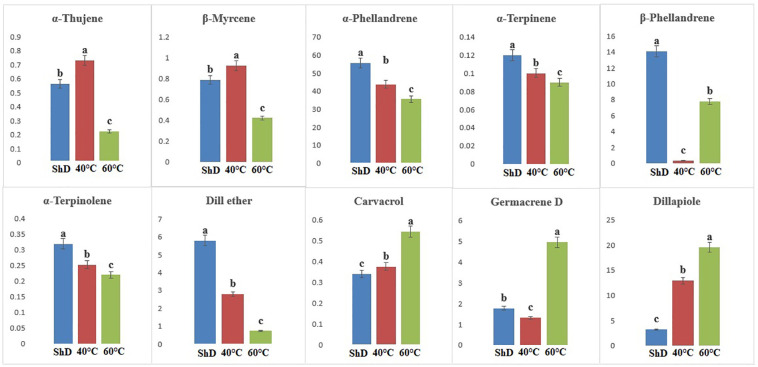
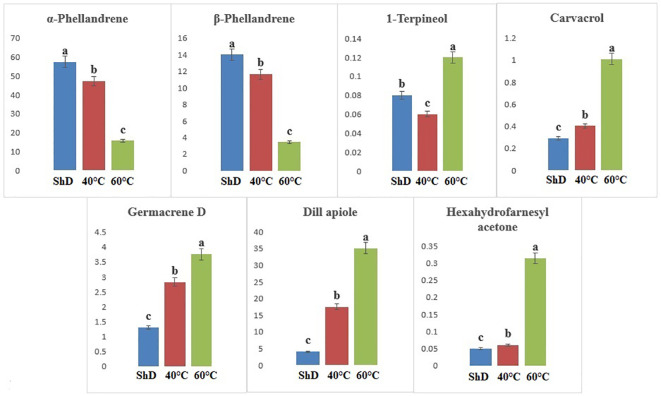
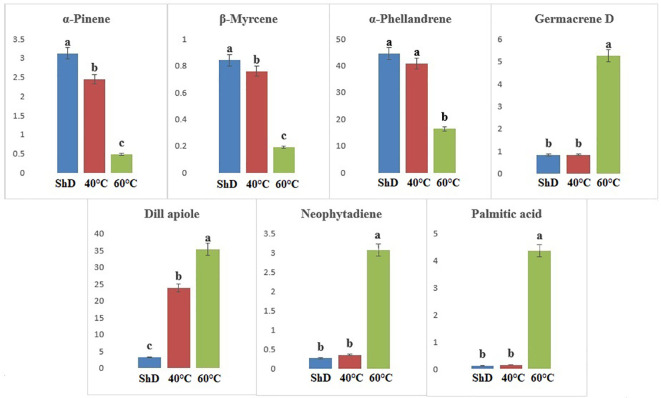
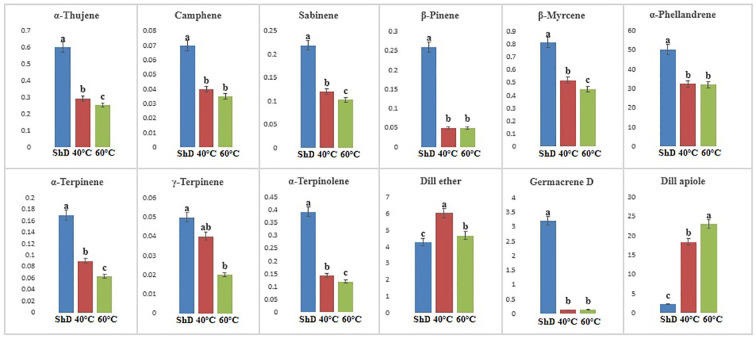
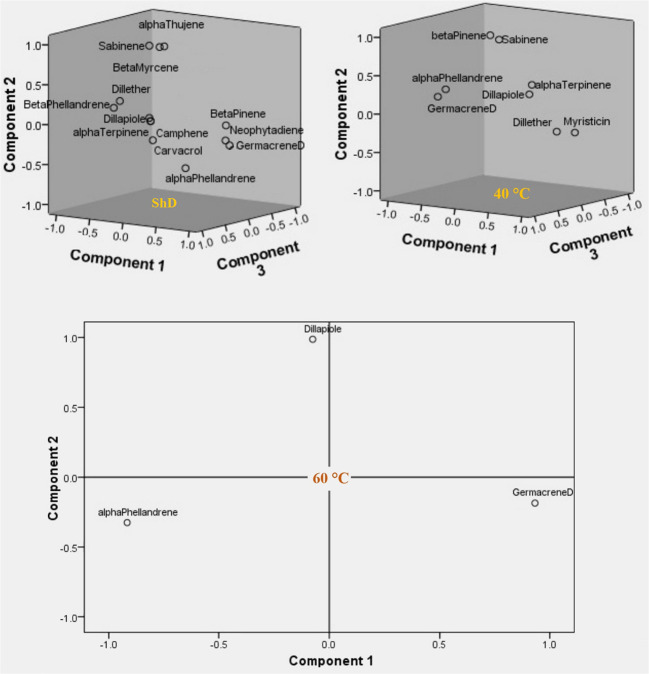
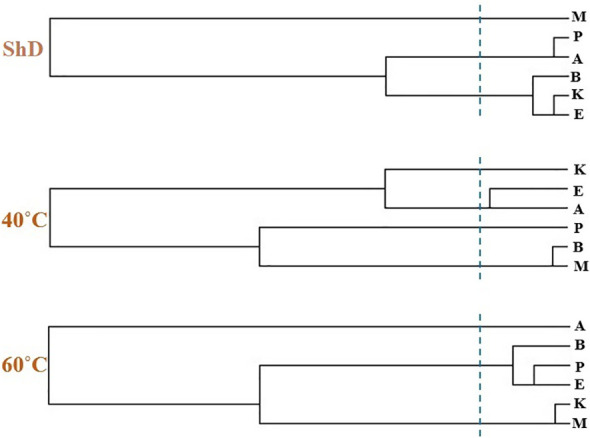
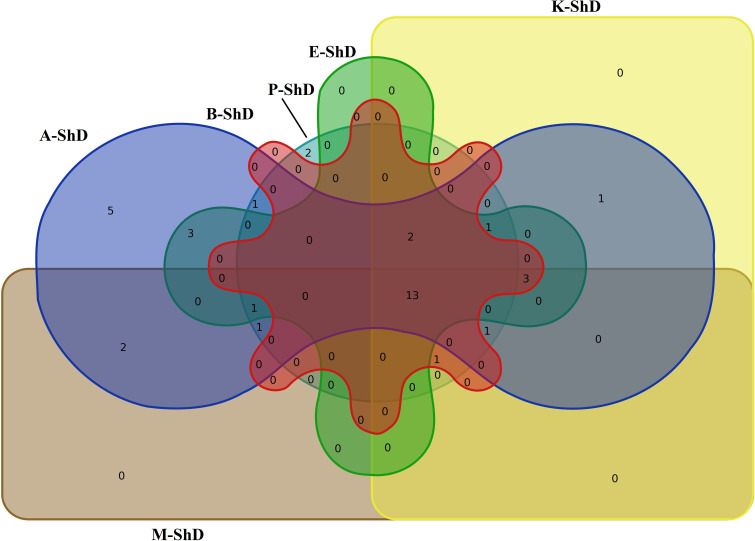
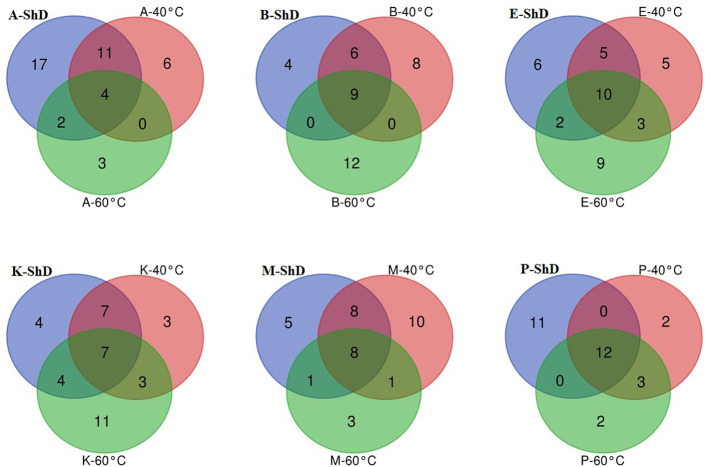
Introduction: There are several factors that affect the quality and quantity of active ingredients and essential oil (EO) content, including pre and postharvest practices such as drying conditions. One of the most important factors in drying is temperature and then selective drying temperature (DT). In general, DT has a direct effect on the aromatic properties of Anethum graveolens. Methods: On this basis, the present study was conducted to evaluate the effects of different DTs on the aroma profile of A. graveolens ecotypes. Results and discussion: The results showed that different DTs, ecotypes, and their interaction significantly affect EO content and composition. The highest EO yield was obtained from the Parsabad ecotype (1.86%) followed by the Ardabil ecotype (1.4%), both at 40° C. More than 60 EO compounds were identified, mainly monoterpenes and sesquiterpenes, highlighting α-Phellandrene, Germacrene D, and Dill apiole as major components in all treatments. Besides α-Phellandrene, the major EO compounds at shad drying (ShD) were β-Phellandrene and p-Cymene, while plant parts dried at 40° C showed l-Limonene and Limonene as the main constituents, and Dill apiole was detected in greater amounts in the samples dried at 60 °C. To determine the appropriate DT, simple and factorial based-ANOVA together multivariate analysis demonstrated significant differences in the compounds produced under different DTs. The results indicated that more EO compounds, mainly monoterpenes, were extracted at ShD than other DTs. On the other hand, the content and composition of sesquiterpenes increased significantly when DT was increased to 60 °C. From the genetic backgrounds point of view, the Parsabad ecotype (with 12 similar compounds) and Esfahan ecotype (with 10 similar compounds) were the most suitable ecotypes under all DTs in terms of EO compounds. Accordingly, the present study would help various industries to optimize specific DT(s) to obtain special EO compound(s) from different A. graveolens ecotypes based on commercial requirements.
Overview
The claims and statistics of this paper haven’t been checked yet.
Run the check — free, no account needed. It reads the open-access text and checks the sources it cites.
Integrity signals
Registry
Cites
Statistics
Figures
Verification
Claims the paper makes
The claims and statistics of this paper haven’t been checked yet.
Run the check — free, no account needed. It reads the open-access text and checks the sources it cites.
Claims other papers make about this one
Each is checked against this paper’s own text: does it say what the citing paper says it does?
In the citing paper
“It contains a variety of natural products, like EO, flavonoids, phenolic and fatty acids, cardiac glycosides, saponins and tannins [2,3,4].”
From Maceration, Soxhlet Extraction, and Steam Hydrodistillation of Anethum graveolens Seeds: Phytochemical Profiles and Cytotoxic Effects (2026) · cites this paper as [2]
Self-check
Percentages, sums and reported differences re-computed from the paper’s own numbers.
The self-check needs the paper’s full text.
Citations
Cites
Factors Affecting Chemical Variability of Essential Oils: A Review of Recent Developments
Barra, A. (2009) · Natural Product Communications · doi:10.1177/1934578x0900400827 · Cited by 312
Research works printed but not linked: 39
- Adams, 1995, Identification of essential oil components by gas chromatography/mass spectroscopy, allured publishing corp
- Ahmed, 2018, Effect of drying methods on yield, chemical composition and bioactivities of essential oil obtained from Moroccan Mentha pulegium l, Biocatal. Agric. Biotechnol., 16, 638, 10.1016/j.bcab.2018.10.016 · DOI
- Argyropoulos, 2014, Changes of essential oil content and composition during convective drying of lemon balm (Melissa officinalis l.), Ind. Crops Prod., 52, 118, 10.1016/j.indcrop.2013.10.020 · DOI
- Asekun, 2007, Effects of drying methods on the quality and quantity of the essential oil of mentha longifolia l. subsp. capensis, Food Chem., 101, 995, 10.1016/j.foodchem.2006.02.052 · DOI
- Azimzadeh, 2012, Genetic diversity of Iranian Bunium persicum germplasm by morphological markers and essential oil components, J. Med. Plants Res., 6, 1119, 10.5897/jmpr10.085 · DOI
- Behbahani, 2017, Use of Plantago major seed mucilage as a novel edible coating incorporated with Anethum graveolens essential oil on shelf life extension of beef in refrigerated storage, Int. J. Biol. Macromol., 94, 515, 10.1016/j.ijbiomac.2016.10.055 · DOI
- Blanco, 2000, Drying temperature effects in rosemary essential oil content and composition, 99
- Bowes, 2004, Influence of seeding date and harvest stage on yields and essential oil composition of three cultivars of dill (Anethum graveolens l.) grown in Nova Scotia, Can. J. Plant Sci., 84, 1155, 10.4141/P03-202 · DOI
- Callan, 2007, Herb and oil composition of dill (Anethum graveolens l.): effects of crop maturity and plant density, Ind. Crops Prod., 25, 282, 10.1016/j.indcrop.2006.12.007 · DOI
- Copolovici, 2018, Temperature dependencies of henry’s law constants for different plant sesquiterpenes, Chemosphere, 138, 751, 10.1016/j.chemosphere.2015.07.075 · DOI
- Dorneles, 2019, Effect of air temperature and velocity on drying kinetics and essential oil composition of Piper umbellatum l. leaves, Ind. Crops Prod., 142, 10.1016/j.indcrop.2019.111846 · DOI
- Ebadi, 2015, Influence of different drying methods on drying period, essential oil content and composition of Lippia citriodora kunth, J. Appl. Res. Med. Aromat. Plants, 2, 182, 10.1016/j.jarmap.2015.06.001 · DOI
- Figueiredo, 2008, Factors affecting secondary metabolite production in plants: volatile components and essential oils, Flavour Fragr. J., 23, 213, 10.1002/ffj.1875 · DOI
- Franz, 2009, Sources of essential oils, 39, 10.1201/9781420063165-c3 · DOI
- Gang, 2005, Evolution of flavors and scents, Annu. Rev. Plant Biol., 56, 301, 10.1146/annurev.arplant.56.032604.144128 · DOI
- Ghasemi Pirbalouti, 2017, Effect of drying methods on qualitative and quantitative properties of essential oil from the aerial parts of coriander, J. Appl. Res. Med. Aromat. Plants, 4, 35, 10.1016/j.jarmap.2016.07.006 · DOI
- Gholizadeh, 2021, Evaluation of genetic diversity of Anethum graveolens l. different ecotypes based on morphological traits and essential oil percentage of shoot, Iran. J. Hortic. Sci., 52, 581, 10.22059/ijhs.2020.294265.1751 · DOI
- Heamalatha, 2011, Pharmacognostical, pharmacological, investigation on Anethum graveolens Linn: a review, Res. J. Pharm. Biol. Chem. Sci., 2, 564
- Heberle, 2015, InteractiVenn: a web-based tool for the analysis of sets through Venn diagrams, BMC Bioinf., 16, 1, 10.1186/s12859-015-0611-3 · DOI
- Jianu, 2012, Chemical composition and antimicrobial activity of essential oils obtained from dill (Anethum graveolens l.) grown in Western Romania, Rev. Chim., 63, 641
- Jirovetz, 2003, Composition, quality control, and antimicrobial activity of the essential oil of long-time stored dill (Anethum graveolens l.) seeds from Bulgaria, J. Agric. Food Chem., 51, 3854, 10.1021/jf030004y · DOI · Paper page
- Kaur, 2010, Bioactive potential of Anethum graveolens, Foeniculum vulgare and Trachyspermum ammi belonging to the family umbelliferae-current status, J. Med. Plants Res., 4, 87, 10.5897/JMPR09.018 · DOI
- Khangholil, 2008, Effect of drying temperature on essential oil content and composition of sweet wormwood (Artemisia annua) growing wild in Iran, Pakistan J. Biol. Sci, 11, 10.3923/pjbs.2008.934.937 · DOI
- Mahayothee, 2020, Effect of drying temperature and drying method on drying rate and bioactive compounds in cassumunar ginger (Zingiber montanum), J. Appl. Res. Med. Aromat. Plants, 18, 10.1016/j.jarmap.2020.100262 · DOI
- Mahdieh, 2018, Infraspecific essential oil and anatomical variations of Salvia nemorosa l. (Labiatae) populations in Iran, Ind. Crops Prod., 123, 35, 10.1016/j.indcrop.2018.06.061 · DOI
- Mokhtarikhah, 2020, Qualitative changes of spearmint essential oil as affected by drying methods, Ind. Crops Prod., 153, 10.1016/j.indcrop.2020.112492 · DOI
- Naidu, 2016, Effect of drying methods on the quality characteristics of dill (Anethum graveolens) greens, Food Chem., 192, 849, 10.1016/j.foodchem.2015.07.076 · DOI
- Nikrouz-Gharamaleki, 2019, Multivariate and univariate analysis of genetic variation in Iranian summer savory (Satureja hortensis l.) accessions based on morphological traits, IJGPB, 8, 21, 10.30479/IJGPB.2020.12081.1256 · DOI
- Orhan, 2013, Phytochemical contents and enzyme inhibitory and antioxidant properties of Anethum graveolens l. (dill) samples cultivated under organic and conventional agricultural conditions, Food Chem. Toxicol., 59, 96, 10.1016/j.fct.2013.05.053 · DOI · Paper page
- Pino, 1995, Evaluation of flavor characteristic compounds in dill herb essential oil by sensory analysis and gas chromatography, J. Agric. Food Chem., 43, 1307, 10.1021/jf00053a034 · DOI
- Qin, 2021, Effects on volatile oil and volatile compounds of Amomum tsao-ko with different pre-drying and drying methods, Ind. Crops Prod., 174, 10.1016/j.indcrop.2021.114168 · DOI
- Rostaei, 2018, The effect of organic manure and chemical fertilizer on essential oil, chemical compositions and antioxidant activity of dill (Anethum graveolens) in sole and intercropped with soybean (Glycine max), J. Clean. Prod., 199, 18, 10.1016/j.jclepro.2018.07.141 · DOI
- Santos, 2002, Hairy root cultures of Anethum graveolens (dill): establishment, growth, time-course study of their essential oil and its comparison with parent plant oils, Biotechnol. Lett., 24, 1031, 10.1023/A:1015653701265 · DOI · Paper page
- Sellami, 2011, Qualitative and quantitative changes in the essential oil of Laurus nobilis l. leaves as affected by different drying methods, Food Chem., 126, 691, 10.1016/j.foodchem.2010.11.022 · DOI
- Talebi, 2021, Genetic structure and essential oil composition in wild populations of Salvia multicaulis vahl, Biochem. Syst. Ecol., 96, 10.1016/j.bse.2021.104269 · DOI
- Talebi, 2019, Morphological and essential oil variations among Iranian populations of Salvia chloroleuca (Lamiaceae), Biosyst. Divers., 27, 233, 10.15421/011932 · DOI
- Talebi, 2019, Effect of altitude on essential oil composition and on glandular trichome density in three Nepeta species (N. sessilifolia, N. heliotropifolia and N. fissa), Mediterr. Bot., 40, 81, 10.5209/MBOT.59730 · DOI
- Teles, 2013, Effect of geographical origin on the essential oil content and composition of fresh and dried Mentha×villosa Hudson leaves, Ind. Crops Prod., 46, 1, 10.1016/j.indcrop.2012.12.009 · DOI
- Zhang, 2018, Influence of drying methods on chemical compositions, antioxidant and antibacterial activity of essential oil from lemon peel, Nat. Prod. Res., 32, 1184, 10.1080/14786419.2017.1320791 · DOI
Cited by
Hadi, N., Drioiche, A., Bouchra, E. M., Baammi, S., Abdelaziz Shahat, A., Tagnaout, I., Radi, M., Remok, F., Bouzoubaa, A., & Zair, T. (2024) · Pharmaceuticals · doi:10.3390/ph17070862 · Cited by 30
Farmanpour Kalalagh, K., Mohebodini, M., Sabaghnia, N., Beyraghdar Kashkooli, A., & Esmaeili, H. (2025) · PLOS One · doi:10.1371/journal.pone.0327018 · Cited by 4
Self-citationGoldiș, C., Racoviceanu, R., Negrea-Ghiulai, R., Mioc, A., Prodea, A., Atyim, E., Maksimovic, T., Lukinich-Gruia, A. T., Pricop, M.-A., & Șoica, C. (2026) · Molecules · doi:10.3390/molecules31183337
Metadata
- Authors
- Farmanpour Kalalagh, K., Mohebodini, M., Fattahi, R., Beyraghdar Kashkooli, A., Davarpanah Dizaj, S., Salehifar, F., & Mokhtari, A. M.
- Venue
- Frontiers in Plant Science
- Publisher
- Frontiers Media SA
- Published
- 2023-05-12
- Volume
- 14
- ISSN
- 1664-462X
- PMC
- PMC10214840
- Cited by
- 9
- References
- 1
About these checks
Registry, retraction, Cites and statistics results are computed, not judged, with one exception: a printed reference that no index lists is read once by a model before it counts as a citation error. Claims are extracted by a model and kept only when their quote appears verbatim in the text; each cited source is then checked, with a model’s help, for whether it says what the claim relies on. Those verdicts can be wrong — read the claim’s quote and the cited source before relying on one.
Statistics and arithmetic are recomputed, not judged.
Confidence bands are shown only for fields calibrated on our annotated test set. None is calibrated yet, so no band is shown.
What counts as a claim ›How we measure confidence ›How we check this ›
Are you an author, or do you see a problem with this page? Request a review
How to cite
Cite CoChat for the checks on this page, and the paper for its own findings.
- This page
- CoChat. (2026). Citation check: Drying temperatures affect the qualitative–quantitative variation of aromatic profiling in Anethum graveolens L. ecotypes as an industrial–medicinal–vegetable plant. https://app.cochat.ai/papers/10.3389/fpls.2023.1137840
- The paper
- Farmanpour Kalalagh, K., Mohebodini, M., Fattahi, R., Beyraghdar Kashkooli, A., Davarpanah Dizaj, S., Salehifar, F., & Mokhtari, A. M. (2023). Drying temperatures affect the qualitative–quantitative variation of aromatic profiling in Anethum graveolens L. ecotypes as an industrial–medicinal–vegetable plant. Frontiers in Plant Science. https://doi.org/10.3389/fpls.2023.1137840
