

The DOI matches its Crossref record; its reference list is not available.
Teaching Careers: Exploring Links Between Well-Being, Burnout, Self-Efficacy and Praxis Shock
Open accessAbstract
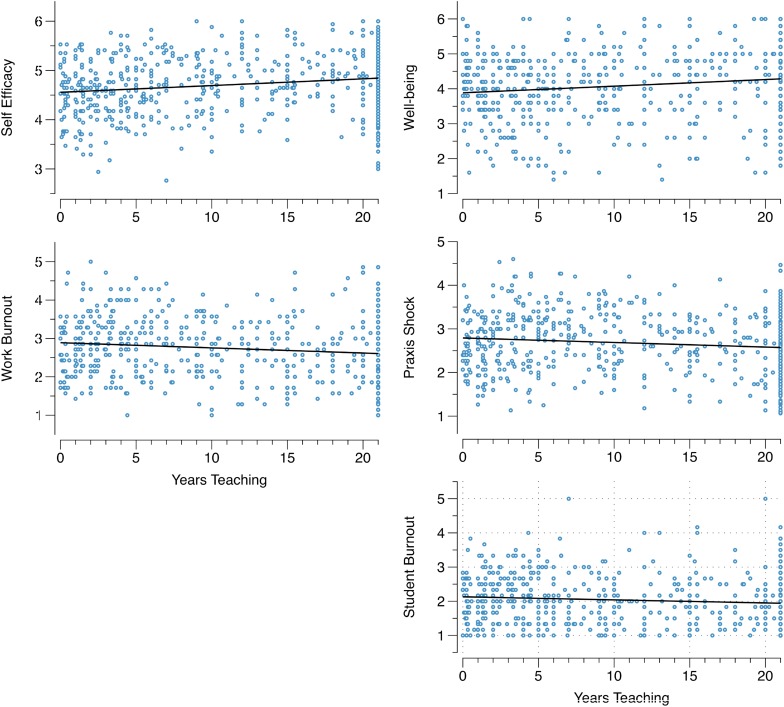
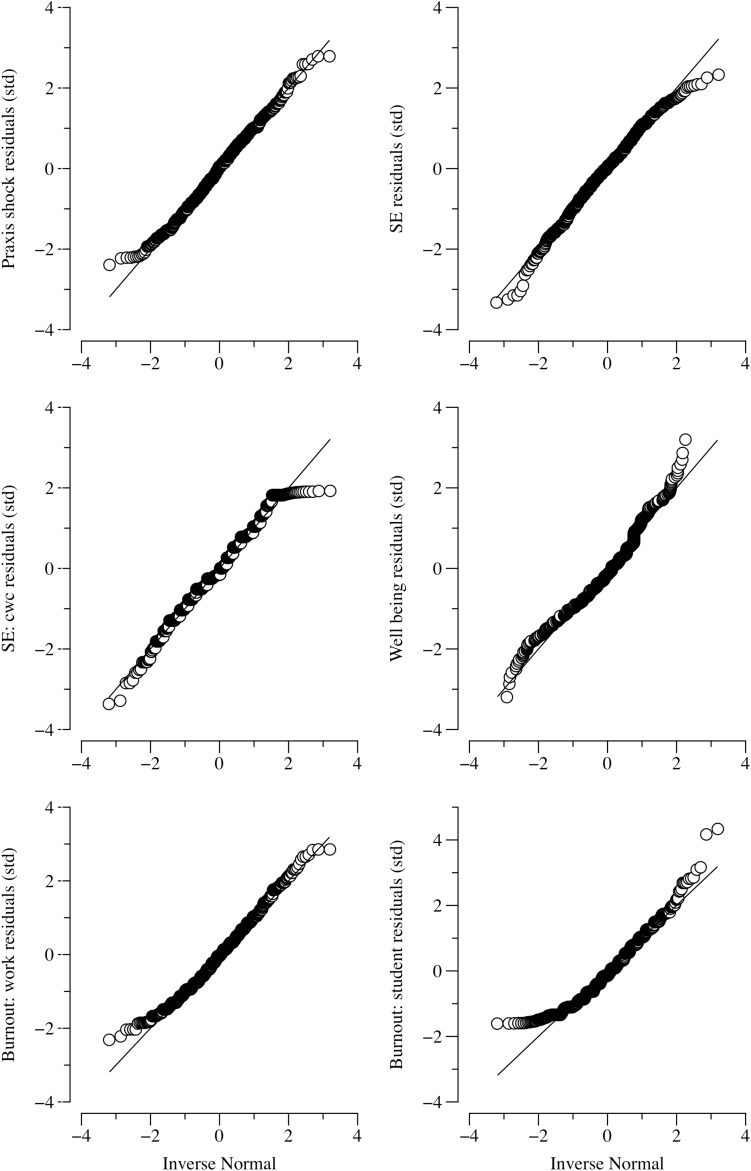
Burnout and attrition are issues facing many professions. In a bid to better understand this phenomenon and ways to address it, this paper explores experiences of praxis shock, well-being, burnout, and self-efficacy during teachers' careers. Regression and mediation analyses of 836 responses to a questionnaire reveal that praxis shock may occur at multiple points in a music teachers' career. Findings reveal that praxis shock predicts patterns of reported burnout, well-being and self-efficacy. This impacts on the development of productive professional identities, career satisfaction and success. Evidence is presented regarding praxis shock and its impact across a teaching career.
Overview
The claims and statistics of this paper haven’t been checked yet.
Run the check — free, no account needed. It reads the open-access text and checks the sources it cites.
Integrity signals
Registry
Cites
Statistics
Figures
Verification
Claims the paper makes
The claims and statistics of this paper haven’t been checked yet.
Run the check — free, no account needed. It reads the open-access text and checks the sources it cites.
Self-check
Percentages, sums and reported differences re-computed from the paper’s own numbers.
The self-check needs the paper’s full text.
Citations
No citation lists for this paper
No citation lists for this paper yet — checked again daily.
References 44 · Cited by 77
Research works printed but not linked: 40
- Ballantyne, 2005, Identities of music teachers: implications for teacher education, Proceedings of the Teacher Education: Local and Global: Australian Teacher Education Association Conference, 39
- Ballantyne, 2007, Documenting praxis shock in early-career australian music teachers: the impact of pre-service teacher education., Int. J. Music Educ., 25, 181, 10.1177/0255761407083573 · DOI
- Ballantyne, 2012, Exploring relationships between teacher identities and disciplinarity., Int. J. Music Educ., 30, 368, 10.1177/0255761412459165 · DOI
- Ballantyne, 2009, Bridging Gaps in Music Teacher Education: Developing Exemplary Practice Models Using Peer Collaboration.
- Ballantyne, 2012, Developing music teacher identities: an international multi-site study., Int. J. Music Educ., 30, 211, 10.1177/0255761411433720 · DOI
- Ballantyne, 2017, A good news story: early-career music teachers’ accounts of their “flourishing” professional identities., Teach. Teach. Educ., 68, 241, 10.1016/j.tate.2017.08.009 · DOI
- Bandura, 2006, Toward a psychology of human agency., Perspect. Psychol. Sci., 1, 164, 10.1111/j.1745-6916.2006.00011.x · DOI · Paper page
- Beauchamp, 2009, Understanding teacher identity: an overview of issues in the literature and implications for teacher education., Cambridge J. Educ., 39, 175, 10.1080/03057640902902252 · DOI · Paper page
- Beijaard, 2004, Reconsidering research on teachers’ professional identity., Teach. Teac. Educ., 20, 107, 10.1016/j.tate.2003.07.001 · DOI · Paper page
- Betoret, 2006, Stressors, self-efficacy, coping resources, and burnout among secondary school teachers in Spain., Educ. Psychol., 26, 519, 10.1080/01443410500342492 · DOI
- Buonomo, 2017, Teachers’ burnout profile: risk and protective factors., Open Psychol. J., 10, 190, 10.13075/ijomeh.1896.00238 · DOI
- Conway, 2012, Ten years later, experienced teacher reflections on “beginning music teacher perceptions of district-sponsored induction programs” (2001)., Bull. Council Res. Music Educ., 193, 63, 10.5406/bulcouresmusedu.193.0063 · DOI
- Day, 2007, Variations in the conditions for teachers’ professional learning and development: sustaining commitment and effectiveness over a career., Oxf. Rev. Educ., 33, 423, 10.1080/03054980701450746 · DOI
- Day, 2008, Identity, well-being and effectiveness: the emotional contexts of teaching., Pedagogy Cult. Soc., 16, 7, 10.1080/14681360701877743 · DOI
- Diez, 2007, Dispositions in Teacher Education.
- Fernet, 2012, Predicting intraindividual changes in teacher burnout: the role of perceived school environment and motivational factors., Teach. Teach. Educ., 28, 514, 10.1016/j.tate.2011.11.013 · DOI
- Fiorilli, 2017, At-risk teachers: the association between burnout levels and emotional appraisal processes., Open Psychol. J., 10, 129, 10.2174/1874350101710010127 · DOI
- Flores, 2006, Contexts which shape and reshape new teachers’ identities: a multi-perspective study., Teach. Teach. Educ., 22, 219, 10.1016/j.tate.2005.09.002 · DOI
- Gibbs, 2001, Explaining effective teaching: self-efficacy and thought control of action., J. Educ. Enquiry, 4, 1
- Gu, 2007, Teachers resilience: a necessary condition for effectiveness., Teach. Teach. Educ., 23, 1302, 10.1016/j.tate.2006.06.006 · DOI
- Hargreaves, 2007, Developing identities and attitudes in musicians and classroom music teachers., Br. J. Educ. Psychol., 77, 665, 10.1348/000709906x154676 · DOI
- Hong, 2010, Pre-service and beginning teachers’ professional identity and its relation to dropping out of the profession., Teach. Teach. Educ., 26, 1530, 10.1016/j.tate.2010.06.003 · DOI
- Hultell, 2013, Getting personal with teacher burnout: a longitudinal study on the development of burnout using a person-based approach., Teach. Teach. Educ., 32, 75, 10.1016/j.tate.2013.01.007 · DOI
- Kelchtermans, 2002, The micropolitics of teacher induction. A narrative-biographical study on teacher socialisation., Teach. Teach. Educ., 18, 105, 10.1016/s0742-051x(01)00053-1 · DOI
- Krueger, 2001, Reflections of beginning music teachers: the concerns of new teachers frequently overlap, and being aware of these issues may benefit veteran teachers who want to help., Music Educ. J., 88, 51, 10.2307/3399759 · DOI
- Legette, 2013, Perceptions of early-career school music teachers regarding their preservice preparation., Update, 32, 12, 10.1177/8755123313502342 · DOI
- Lindqvist, 2014, Teacher attrition the first five years – a multifaced image., Teach. Teach. Educ., 40, 94, 10.1016/j.tate.2014.02.005 · DOI
- Litano, 2016, Facilitating a whole-life approach to career development: the role of organizational leadership., J. Career Dev., 43, 52, 10.1177/0894845315569303 · DOI
- Mark, 1998, The music teachers’ dilemma – musician or teacher?, Int. J. Music Educ., 32, 3, 10.1177/025576149803200102 · DOI
- 2019, Parliament Learning From Teachers.
- Pillen, 2013, Profiles and change in beginning teachers’ professional identity tensions., Teach. Teach. Educ., 34, 86, 10.1016/j.tate.2013.04.003 · DOI
- Schaefer, 2013, Beginning teacher attrition: a question of identity making and identity shifting., Teach. Teach., 19, 260, 10.1080/13540602.2012.754159 · DOI
- Scheib, 2006, Policy implications for teacher retention: meeting the needs of the dual identities of arts educators., Arts Educ. Policy Rev., 107, 5, 10.3200/aepr.107.6.5-10 · DOI
- Shaw, 2016, Alleviating praxis shock: induction policy and programming for urban music educators., Arts Educ. Policy Rev., 119, 1, 10.1080/10632913.2016.1185655 · DOI
- Skaalvik, 2007, Dimensions of teacher self-efficacy and relations with strain factors, perceived collective teacher efficacy, and teacher burnout., J. Educ. Psychol., 99, 611, 10.1037/0022-0663.99.3.611 · DOI · Paper page
- Skaalvik, 2014, Teacher self-efficacy and perceived autonomy: relations with teacher engagement, job satisfaction, and emotional exhaustion., Psychol. Rep., 114, 68, 10.2466/14.02.pr0.114k14w0 · DOI · Paper page
- Smagorinsky, 2004, Tensions in learning to teach: accommodation and the development of a teaching identity., J. Teach. Educ., 55, 8, 10.1177/0022487103260067 · DOI
- Stokking, 2003, From student to teacher: reducing practice shock and early dropout in the teaching profession., Eur. J. Teach. Educ., 26, 329, 10.1080/0261976032000128175 · DOI
- 1998, World Health Organisation-Five Well-Being Index.
- Zee, 2016, Teacher self-efficacy and its effects on classroom processes, student academic adjustment, and teacher well-being: a synthesis of 40 years of research., Rev. Educ. Res., 84, 981, 10.3102/0034654315626801 · DOI · Paper page
Metadata
- Authors
- Ballantyne, J., & Retell, J.
- Affiliations
- The University of Queensland (AU)
- Corresponding author
- Ballantyne, Julie
- ORCID
- Ballantyne, Julie
- Venue
- Frontiers in Psychology
- Publisher
- Frontiers Media SA
- Published
- 2020-02-18
- Volume
- 10
- Pages
- 2255-2255
- ISSN
- 1664-1078 (ISSN-L)
- PMC
- PMC7040245
- OpenAlex
- W3007551365
- Cited by
- 77
- References
- 44
- Citations by year
- 2026: 14 · 2025: 15 · 2024: 14 · 2023: 15 · 2022: 10 · 2021: 5 · 2020: 4
- FWCI
- 92.89
- Type
- journal article
- Language
- en
- Open access
- gold
- doi.org
- Licence
- Locations
- Frontiers in Psychology (publishedVersion, cc-by)
- Europe PMC (PubMed Central) (publishedVersion, cc-by)
- PubMed Central (publishedVersion, cc-by)
- PubMed (publishedVersion)
- DOAJ (DOAJ: Directory of Open Access Journals) (submittedVersion, cc-by-sa)
- Funders
- University of Queensland
- Topics
- Social Sciences › Arts and Humanities › Music › Diverse Music Education Insights
- Social Sciences › Education › Teacher Professional Development and Motivation
- Social Sciences › Psychology › Social Psychology › Stress and Burnout Research
- Keywords
- teacher burnout, teacher well-being, teacher self-efficacy, music teachers, teacher attrition, teacher career development, professional identity, career satisfaction, teaching profession
About these checks
Registry, retraction, Cites and statistics results are computed, not judged, with one exception: a printed reference that no index lists is read once by a model before it counts as a citation error. Claims are extracted by a model and kept only when their quote appears verbatim in the text; each cited source is then checked, with a model’s help, for whether it says what the claim relies on. Those verdicts can be wrong — read the claim’s quote and the cited source before relying on one.
Statistics and arithmetic are recomputed, not judged.
Confidence bands are shown only for fields calibrated on our annotated test set. None is calibrated yet, so no band is shown.
What counts as a claim ›How we measure confidence ›How we check this ›
Are you an author, or do you see a problem with this page? Request a review
How to cite
Cite CoChat for the checks on this page, and the paper for its own findings.
- This page
- CoChat. (2026). Citation check: Teaching Careers: Exploring Links Between Well-Being, Burnout, Self-Efficacy and Praxis Shock. https://app.cochat.ai/papers/10.3389/fpsyg.2019.02255
- The paper
- Ballantyne, J., & Retell, J. (2020). Teaching Careers: Exploring Links Between Well-Being, Burnout, Self-Efficacy and Praxis Shock. Frontiers in Psychology. https://doi.org/10.3389/fpsyg.2019.02255
