

The DOI matches its Crossref record; 59 of the 60 references it cites were found in a registry or an index.
Moral contamination: Perceptions of good (but not bad) deeds depend on the ethical history of the actor
Open accessAbstract
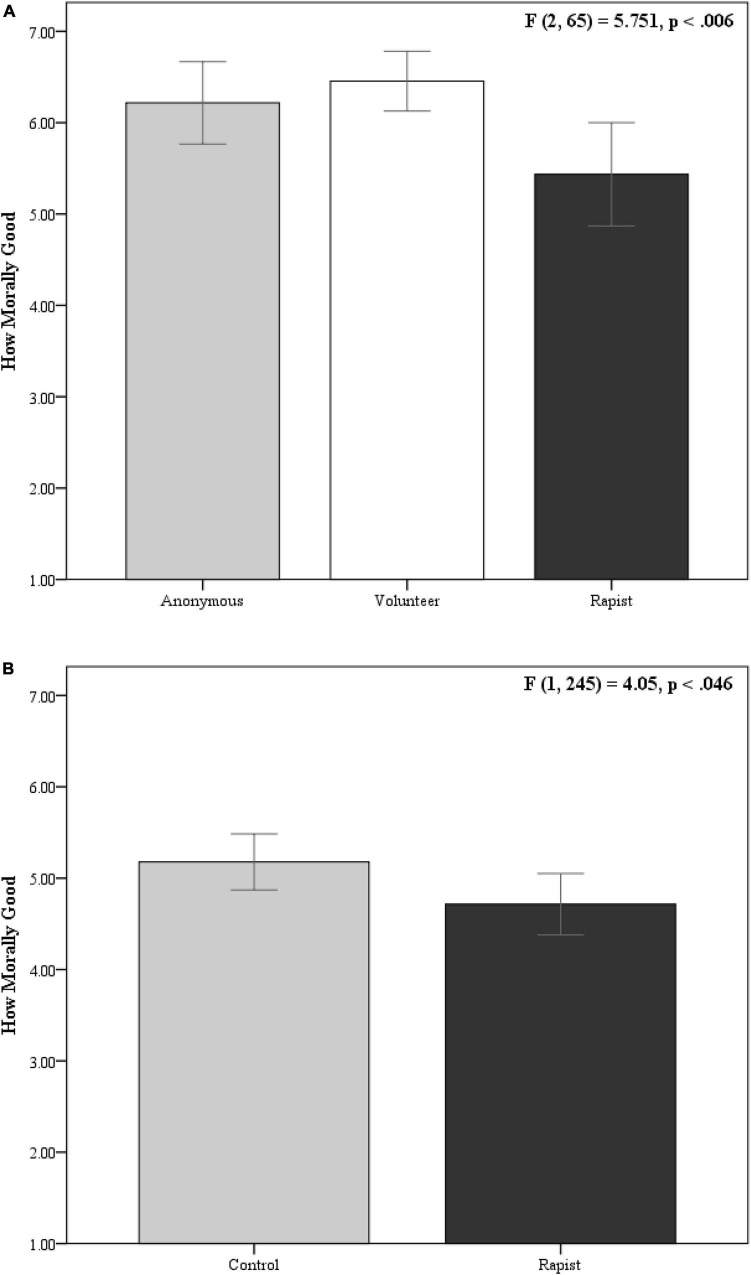
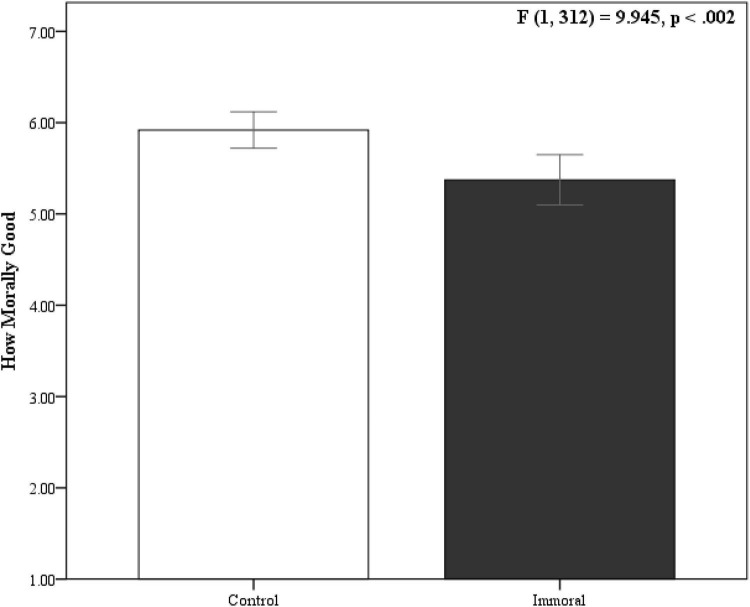
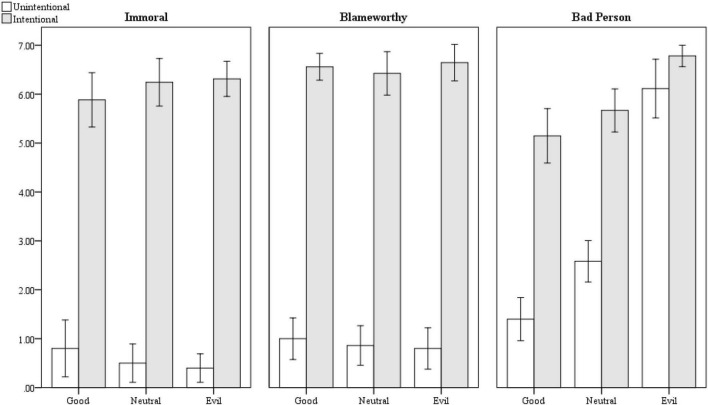
In the majority of moral decision-making research, we are asked to consider the action of someone we know little about—an anonymous actor. This is inconsistent with our everyday judgments of the actions of others. Here we test the novel prediction of whether actions are considered as comparably virtuous or malignant when performed by a good person, an immoral person, or the standard anonymous actor. Across four sets of experiments (nine studies in total), we show that the moral status of the actor contaminates peoples’ evaluations of the virtue of their actions. Even without ulterior motives, people do not judge good acts consistently across actors. We also discover a dose–response relationship where the more immoral the actor has been in the past—the less credit they are given for a good action in the present. This process does not occur for good people performing bad acts, however. Bad acts are bad regardless of who commits them. These results give new insights into the way people evaluate the behaviors of others.
Overview
The claims and statistics of this paper haven’t been checked yet.
Run the check — free, no account needed. It reads the open-access text and checks the sources it cites.
Integrity signals
Registry
Cites
Statistics
Figures
Verification
Claims the paper makes
The claims and statistics of this paper haven’t been checked yet.
Run the check — free, no account needed. It reads the open-access text and checks the sources it cites.
Self-check
Percentages, sums and reported differences re-computed from the paper’s own numbers.
The self-check needs the paper’s full text.
Citations
Cites
(2013) · Cited by 44,563
Lakens, D. (2013) · Frontiers in Psychology · doi:10.3389/fpsyg.2013.00863 · Cited by 10,303
Feeling and thinking: Preferences need no inferences.
Zajonc, R. B. (1980) · American Psychologist · doi:10.1037/0003-066x.35.2.151 · Cited by 8,094
The emotional dog and its rational tail: A social intuitionist approach to moral judgment.
Haidt, J. (2001) · Psychological Review · doi:10.1037/0033-295x.108.4.814 · Cited by 8,048
Baumeister, R. F., Bratslavsky, E., Finkenauer, C., & Vohs, K. D. (2001) · Review of General Psychology · doi:10.1037/1089-2680.5.4.323 · Cited by 7,678
On the psychology of prediction.
Kahneman, D., & Tversky, A. (1973) · Psychological Review · doi:10.1037/h0034747 · Cited by 6,202
Schuirmann, D. J. (1987) · Journal of Pharmacokinetics and Biopharmaceutics · doi:10.1007/bf01068419 · Cited by 2,696
The halo effect: Evidence for unconscious alteration of judgments.
Nisbett, R. E., & Wilson, T. D. (1977) · Journal of Personality and Social Psychology · doi:10.1037/0022-3514.35.4.250 · Cited by 2,021
Using Bayes to get the most out of non-significant results
Dienes, Z. (2014) · Frontiers in Psychology · doi:10.3389/fpsyg.2014.00781 · Cited by 1,998
Individual differences in intuitive-experiential and analytical-rational thinking styles.
Epstein, S. J., Pacini, R., Denes-Raj, V., & Heier, H. (1996) · Journal of Personality and Social Psychology · doi:10.1037//0022-3514.71.2.390 · Cited by 1,925
Research works printed but not linked: 3
- Gert, 2016, The definition of morality, The stanford encyclopedia of philosophy
- Glennie, 2011, Hugo chávez’s reverse-halo effect.
- Heighton, 2016, British army officer charged with sexual assault of Canadian soldier.
Cited by
Bad victims: Moral transgressions against immoral victims are judged less harshly
Inbar, Y., Mercier, B., Mondol, L., & White, C. (2026) · Cognition · doi:10.1016/j.cognition.2026.106448 · Cited by 2
비윤리성 지각, 경기력 지각, 성과정보 제시 시점이 운동선수 광고모델 공신력에 미치는 영향*
김, 민., 안, 진., & 김, 형. (2025) · 한국체육학회지 · doi:10.23949/kjpe.2025.9.64.5.49 · Cited by 1
Distorted Extension of the “Just Deserts”: Permitting Immoral Behavior Suffered by PerpetratorsPreprint
Xu, K., Wang, M., Lin, J., Chen, J., Yan, Z., Zuo, S., Shuyue, Z., & Xue, H. (2023) · SSRN Electronic Journal · doi:10.2139/ssrn.4656710
Chen, J., Luo, D., Wang, M., & Xu, K. (2026) · Current Psychology · doi:10.1007/s12144-026-09462-2
Metadata
- Authors
- Protzko, J., & Schooler, J. W.
- Affiliations
- Central Connecticut State University (US)
- University of California, Santa Barbara (US)
- Corresponding author
- Protzko, John
- Venue
- Frontiers in Psychology
- Publisher
- Frontiers Media SA
- Published
- 2023-01-19
- Volume
- 13
- Pages
- 1025214-1025214
- ISSN
- 1664-1078 (ISSN-L)
- PMC
- PMC9892465
- OpenAlex
- W4317387829
- Cited by
- 4
- References
- 60
- Citations by year
- 2026: 2 · 2025: 1 · 2023: 1
- FWCI
- 0.47
- Type
- journal article
- Language
- en
- Open access
- gold
- doi.org
- Licence
- Locations
- Frontiers in Psychology (publishedVersion, cc-by)
- PubMed Central (publishedVersion, cc-by)
- PubMed (publishedVersion)
- DOAJ (DOAJ: Directory of Open Access Journals) (submittedVersion, cc-by-sa)
- Funders
- John E. Fetzer Memorial Trust
- Topics
- Life Sciences › Neuroscience › Cognitive Neuroscience › Psychology of Moral and Emotional Judgment
- Social Sciences › Business, Management and Accounting › Organizational Behavior and Human Resource Management › Ethics in Business and Education
- Social Sciences › Arts and Humanities › Philosophy › Philosophical Ethics and Theory
- Keywords
- moral judgment, moral credit, moral blame, ethical decision-making, dose-response relationship
About these checks
Registry, retraction, Cites and statistics results are computed, not judged, with one exception: a printed reference that no index lists is read once by a model before it counts as a citation error. Claims are extracted by a model and kept only when their quote appears verbatim in the text; each cited source is then checked, with a model’s help, for whether it says what the claim relies on. Those verdicts can be wrong — read the claim’s quote and the cited source before relying on one.
Statistics and arithmetic are recomputed, not judged.
Confidence bands are shown only for fields calibrated on our annotated test set. None is calibrated yet, so no band is shown.
What counts as a claim ›How we measure confidence ›How we check this ›
Are you an author, or do you see a problem with this page? Request a review
Data sources
Bibliographic data: Semantic Scholar, OpenAlex, Crossref.
Contains information from the Semantic Scholar Academic Graph Datasets, made available under the ODC Attribution License (ODC-BY 1.0).
Semantic Scholar’s data is described in: Kinney, R., et al. (2023). The Semantic Scholar Open Data Platform. arXiv:2301.10140.
