

A meta-analysis of effects of blended learning on performance, attitude, achievement, and engagement across different countries
Open accessThe DOI matches its Crossref record; 57 of the 60 references it cites were found in a registry or an index; 5 of the 32 sources its claims cite were checked for support.
Abstract
While this special pandemic period has been seeing an increasing use of blended learning, few studies have meta-analytically reviewed the effectiveness of blended learning in different countries. This meta-analysis summarizes previous studies on blended learning effectiveness in different countries in terms of students' performance, students' attitudes toward blended learning, learning achievement, and student engagement in different countries. Through the meta-analysis via Stata/MP 14.0, it is concluded that blended learning can improve performance, attitude, and achievement in most countries. However, in both China and the USA, blended learning cannot significantly improve student engagement in academic activities. No significant differences were revealed in student performance in the USA between blended and non-blended learning. Future research can extend the research into blended learning to more countries and areas across the world.
Overview
CoChat Summary
TL;DR
This PRISMA meta-analysis of 29 included results found that blended learning generally improved student performance, attitude, and achievement across multiple countries, but did not significantly improve student engagement in China or the USA. It also found no significant performance difference between blended and non-blended learning in the USA.
Key findings
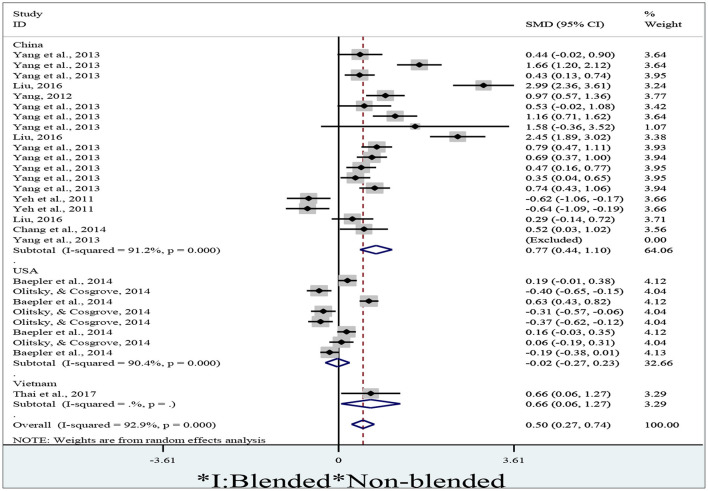
- Blended learning significantly improved overall student performance (d = 0.50, 95% CI = 0.27–0.74, p < 0.01), with significant effects in China (d = 0.77, 95% CI = 0.44–1.10, p < 0.01) and Vietnam (d = 0.66, 95% CI = 0.06–1.27, p = 0.032), but not in the USA (d = −0.02, 95% CI = −0.27–0.23, p = 0.853).
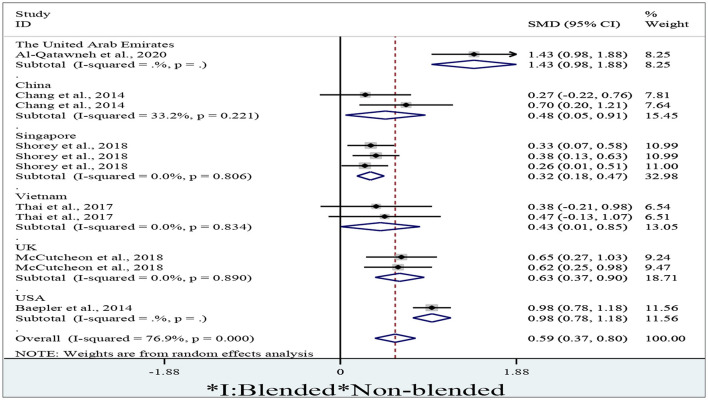
- Blended learning significantly improved overall student attitude (d = 0.59, 95% CI = 0.37–0.80, p < 0.01), with significant positive effects in the United Arab Emirates (d = 1.43), China (d = 0.48), Singapore (d = 0.32), Vietnam (d = 0.43), the UK (d = 0.63), and the USA (d = 0.98).
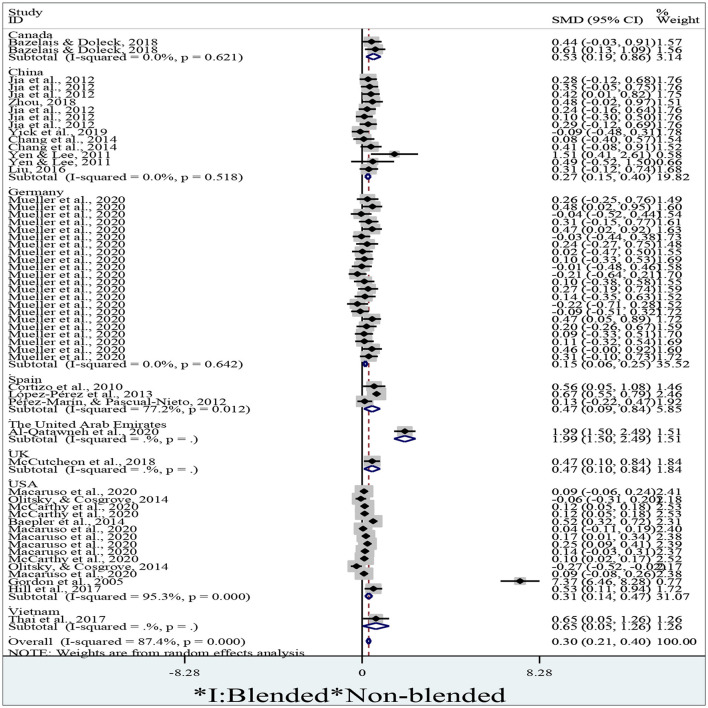
- Blended learning significantly improved overall learning achievement (d = 0.30, 95% CI = 0.21–0.40, p < 0.01), with significant effects in Canada (d = 0.53), China (d = 0.27), Germany (d = 0.15), Spain (d = 0.47), the United Arab Emirates (d = 1.99), the UK (d = 0.47), Vietnam (d = 0.65), and the USA (d = 0.31).
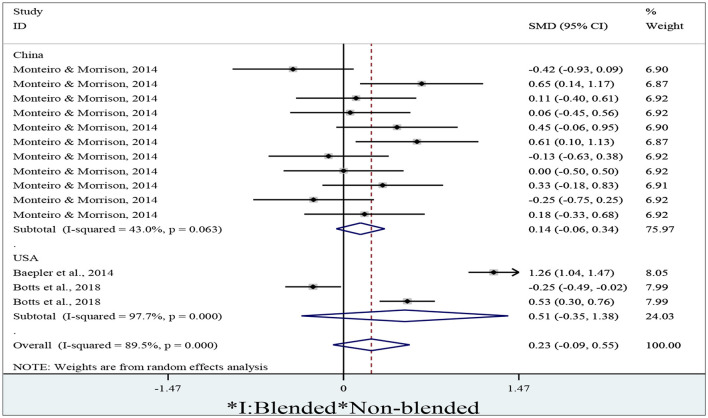
- Blended learning did not significantly improve student engagement overall (d = 0.23, 95% CI = −0.09–0.55, p = 0.156), in China (d = 0.14, 95% CI = −0.06–0.34, p = 0.169), or in the USA (d = 0.51, 95% CI = −0.35–1.38, p = 0.245).
Methods
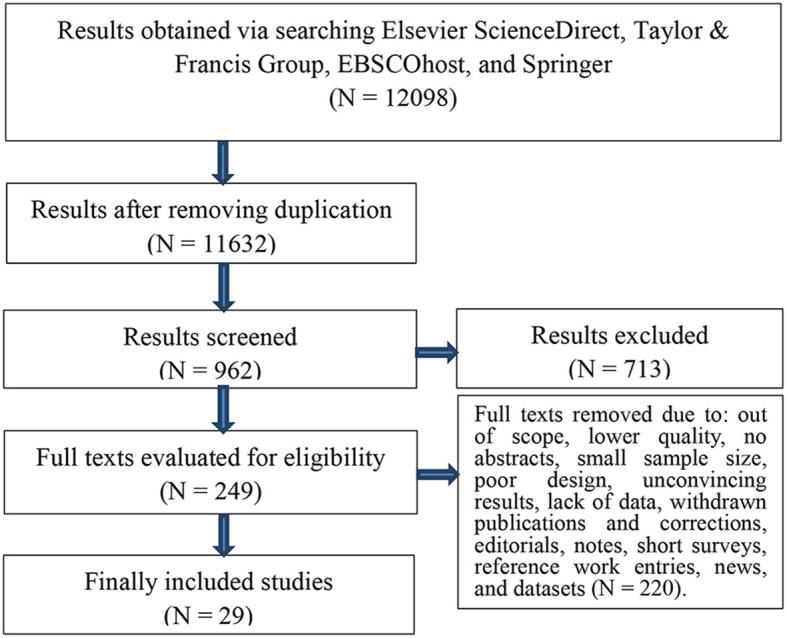
- The meta-analysis followed PRISMA and searched Elsevier ScienceDirect, Taylor and Francis Group, EBSCOhost, and Springer from inception until February 26, 2023, yielding 12,098 results; after screening, 29 results were included.
- Two researchers extracted means, standard deviations, and participant numbers for control and experimental groups, classified findings into performance, attitude, achievement, and engagement by country, and used Stata/MP 14.0 to calculate standardized mean differences (Cohen d) with 95% confidence intervals.
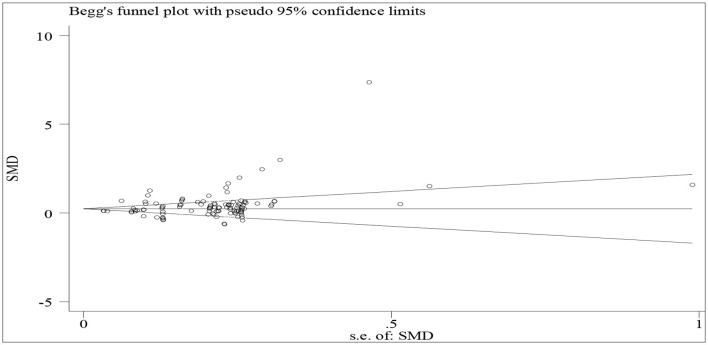
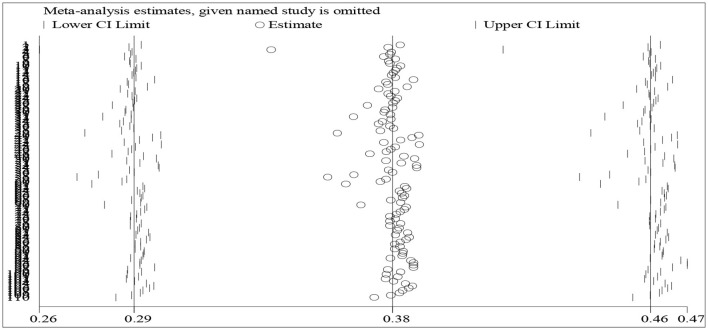
- Random-effect models were used because of high heterogeneity; Begg’s and Egger’s tests assessed publication bias, and a sensitivity analysis using “metan-based influence analysis” tested stability of effect sizes.
Limitations
- The paper states that the meta-analysis could not include all publications and non-published works due to limited library sources, that both Begg’s and Egger’s tests indicated publication bias, and that some identified research could not be completely retrieved.
- Evident from the text: heterogeneity was high across outcomes (e.g., I2 = 92.9% for performance, 76.9% for attitude, 87.4% for achievement, 89.5% for engagement), and several country-level results relied on single effect sizes, limiting generalizability.
Model-written summary. Check it against the paper before relying on it.
Integrity signals
Registry
Cites
Statistics
Figures
Verification
Claims the paper makes
5 Valid · 0 Not valid · 15 Not checked · 55 Own results and interpretations
The cited sources support only part of this claim — read each source’s verdict below.
In the paper
“Most studies positively reported blended learning performances.”
§ A meta-analysis of effects of blended learning on performance, attitude, achievement, and engagement across different countries > 1. Introduction > 1.2. Performance
What the sources say
- Partly supportedcites McCutcheon et al., 2018 matched to “Online learning versus blended learning of clinical supervisee skills with pre-registration nursing students: a randomised controlled trial” (2018) sourceExperimental — accuracy not yet measured
The Results and Conclusion report positive outcomes for blended learning compared with online-only learning in this nursing-student trial, although knowledge scores remained low. This single trial does not establish that most studies reported positive blended-learning performance; the Introduction notes a lack of evidence from systematic reviews. (LLM, conf=0.85)
- Not checked — no full text of the sourcecites Mueller et al., 2020 matched to “Do we always need a difference? Testing equivalence in a blended learning setting” (2020) source
- Not checked — no full text of the sourcecites Hill et al., 2017 matched to “Playing 'catch up' with blended learning: performance impacts of augmenting classroom instruction with online learning” (2016) source
plainstates an association- Asserted: passes — The authors put it forward as true.
- Checkable: passes — It can be checked against evidence.
- Load-bearing: unclear — It is unclear whether the paper’s conclusions depend on it.
- Based: passes — The paper gives a reason why it holds.
- Partly supported
The cited sources support only part of this claim — read each source’s verdict below.
In the paper
“The majority of learners positively assess the blended learning effectiveness.”
§ A meta-analysis of effects of blended learning on performance, attitude, achievement, and engagement across different countries > 1. Introduction > 1.3. Attitude
What the sources say
- Not checked — no full text of the sourcecites Jia et al., 2012 matched to “Effects of a vocabulary acquisition and assessment system on students' performance in a blended learning class for English subject” (2012) source
- Partly supportedcites Chang et al., 2014 matched to “Is blended e-learning as measured by an achievement test and self-assessment better than traditional classroom learning for vocational high school students?” (2014) sourceExperimental — accuracy not yet measured
The Discussion (p. 226) says students in the blended e-learning group had more positive perceptions of their cognition and skills than students in traditional learning. The Results also report higher overall self-assessment scores for the blended group. Neither passage establishes that a majority of learners positively assessed blended learning’s effectiveness. (LLM, conf=0.84)
- Not checked — no full text of the sourcecites Shorey et al., 2018 matched to “Blended learning pedagogy designed for communication module among undergraduate nursing students: a quasi-experimental study” (2018) source
plain- Asserted: passes — The authors put it forward as true.
- Checkable: passes — It can be checked against evidence.
- Load-bearing: unclear — It is unclear whether the paper’s conclusions depend on it.
- Based: passes — The paper gives a reason why it holds.
The cited sources support only part of this claim — read each source’s verdict below.
In the paper
“Although blended learning is a popular teaching method, there have been conflicting findings regarding its impact on academic achievement in different countries.”
§ A meta-analysis of effects of blended learning on performance, attitude, achievement, and engagement across different countries > 1. Introduction > 1.6. Contradictory findings
What the sources say
- Partly supportedcites Chang et al., 2014 matched to “Is blended e-learning as measured by an achievement test and self-assessment better than traditional classroom learning for vocational high school students?” (2014) sourceExperimental — accuracy not yet measured
The Introduction reports earlier studies finding improved learning performance, while this paper’s Results found no significant difference in achievement-test scores. That supports the general point that findings differ, but the paper does not establish that the differences concern academic achievement across countries. (LLM, conf=0.84)
- Not checked — no full text of the sourcecites Yick et al., 2019 matched to “Effectiveness of blended learning in the first year of fashion education” (2019) source
- Not checked — no full text of the sourcecites Olitsky and Cosgrove, 2014 matched to “The effect of blended courses on student learning: evidence from introductory economics courses” (2014) source
plain- Asserted: passes — The authors put it forward as true.
- Checkable: passes — It can be checked against evidence.
- Load-bearing: passes — The paper’s conclusions depend on it.
- Based: passes — The paper gives a reason why it holds.
- Partly supported
The cited sources support only part of this claim — read each source’s verdict below.
In the paper
“This conclusion is supported by the results of previous studies which mostly demonstrate the positive effects of blended learning on these outcomes (Yen and Lee, 2011; Chang et al., 2014).”
§ A meta-analysis of effects of blended learning on performance, attitude, achievement, and engagement across different countries > 4. Discussion
What the sources say
- Not checked — no full text of the sourcecites Yen and Lee, 2011 matched to “Exploring problem-solving patterns and their impact on learning achievement in a blended learning environment” (2011) source
- Partly supportedcites Chang et al., 2014 matched to “Is blended e-learning as measured by an achievement test and self-assessment better than traditional classroom learning for vocational high school students?” (2014) sourceExperimental — accuracy not yet measured
The Introduction reports that some previous studies found improved learning performance and positive effects of blended e-learning, including on attitudes; it does not establish that most studies found positive effects across all the named outcomes. In the Results and Discussion (page not specified), Chang et al. found higher self-assessment scores, but no significant improvement over traditional learning in achievement-test scores or attitude. (LLM, conf=0.87)
boostedstates a cause- Asserted: passes — The authors put it forward as true.
- Checkable: passes — It can be checked against evidence.
- Load-bearing: passes — The paper’s conclusions depend on it.
- Based: passes — The paper gives a reason why it holds.
A result the paper reports from its own data — it cites no other source for it, so there is none to check. The quote shows it is in the paper.
In the paper
“Through the meta-analysis via Stata/MP 14.0, it is concluded that blended learning can improve performance, attitude, and achievement in most countries.”
§ A meta-analysis of effects of blended learning on performance, attitude, achievement, and engagement across different countries > Abstract
plainstates a possible cause- Asserted: passes — The authors put it forward as true.
- Checkable: passes — It can be checked against evidence.
- Load-bearing: passes — The paper’s conclusions depend on it.
- Based: passes — The paper gives a reason why it holds.
48 more claims
Create a free account to see all 75 claims and to verify the 1 reference still open.
- Probably not a substantial claim. 15
- It may state two separate claims as one. 13
Statistics recomputed
Every reported test result, recomputed from its test statistic and degrees of freedom. A result shows as not adding up only once an independent check has confirmed it.
- Consistentz = 2.66reported p = .008 · recomputed p = .008
“z = 2.66, p = .008”
- Consistentz = 8.88reported p < .01 · recomputed p < .001
“z = 8.88, p < .01”
- Consistentz = 4.59reported p < .01 · recomputed p < .001
“z = 4.59, p < .01”
- Consistentz = 2.14reported p = .032 · recomputed p = .032
“z = 2.14, p = .032”
- Consistentz = 0.19reported p = .853 · recomputed p = .849
“z = 0.19, p = .853”
20 more recomputed tests
Create a free account to see every test the Stats check recomputed.
Self-check
Percentages, sums and reported differences re-computed from the paper’s own numbers.
Each contradiction between two passages listed here was confirmed by an independent check.
Rated minor: it would not touch a result — a value no result rests on, a p-value that stays on the same side of the significance level, or a conflict that is clerical, resolved elsewhere in the paper, or outside its own findings.
In the paper
§ A meta-analysis of effects of blended learning on performance, attitude, achievement, and engagement across different countries > 1. Introduction > 1.5. Engagement
“Undergraduates at Point Loma Nazarene University in the USA spent significantly more time learning in a blended instruction model than in the traditional instruction model (Botts et al., 2018).”
§ A meta-analysis of effects of blended learning on performance, attitude, achievement, and engagement across different countries > 1. Introduction > 1.6. Contradictory findings
“However, research conducted at Point Loma Nazarene University in the USA showed no significant differences between blended and traditional instruction for an upper-division quantitative literacy course, and students also spent less time learning in blended courses (Botts et al., 2018).”
Rated minor: it would not touch a result — a value no result rests on, a p-value that stays on the same side of the significance level, or a conflict that is clerical, resolved elsewhere in the paper, or outside its own findings.
In the paper
§ A meta-analysis of effects of blended learning on performance, attitude, achievement, and engagement across different countries > 3. Results > 3.6. Can blended learning positively influence student engagement in different countries?
“We thus conclude that there are significant differences in student engagement between blended and non-blended learning in both China (d = 0.14, 95% CI = −0.06~0.34, z = 1.38, p = 0.169), the USA (d = 0.51, 95% CI = −0.35~1.38, z = 1.16, p = 0.245), and the overall results (d = 0.23, 95% CI = −0.09~0.55, z = 1.42, p = 0.156).”
§ A meta-analysis of effects of blended learning on performance, attitude, achievement, and engagement across different countries > Abstract
“However, in both China and the USA, blended learning cannot significantly improve student engagement in academic activities.”
Citations
Cites
Preferred Reporting Items for Systematic Reviews and Meta-Analyses: the PRISMA statement
Moher, D., Liberati, A., Tetzlaff, J., Altman, D. G., & for the PRISMA Group (2009) · BMJ · doi:10.1136/bmj.b2535 · Cited by 83,823
Preferred Reporting Items for Systematic Reviews and Meta-Analyses: The PRISMA Statement
Moher, D., Liberati, A., Tetzlaff, J., Altman, D. G., & The PRISMA Group (2009) · PLoS Medicine · doi:10.1371/journal.pmed.1000097 · Cited by 64,042 · cited 7×
“PRISMA aims to improve the reporting quality and transparency of systematic reviews and meta-analyses by providing a standardized framework that facilitates the critical appraisal and synthesis of research evidence.”
InfluentialMeasuring inconsistency in meta-analyses
Higgins, J. P. T., Thompson, S. G., Deeks, J. J., & Altman, D. G. (2003) · BMJ · doi:10.1136/bmj.327.7414.557 · Cited by 63,139 · cited 1×
“The formula to calculate I2 is: I2 = [(Q-df)/Q] × 100%, where Q indicates the Chi-squared statistics and df means the degree of freedom (Higgins and Thompson, 2002; Higgins et al., 2003).”
BackgroundBias in meta-analysis detected by a simple, graphical test
Egger, M., Smith, G. D., Schneider, M., & Minder, C. (1997) · BMJ · doi:10.1136/bmj.315.7109.629 · Cited by 56,722
Quantifying heterogeneity in a meta‐analysis
Higgins, J. P. T., & Thompson, S. G. (2002) · Statistics in Medicine · doi:10.1002/sim.1186 · Cited by 36,763 · cited 1×
“The formula to calculate I2 is: I2 = [(Q-df)/Q] × 100%, where Q indicates the Chi-squared statistics and df means the degree of freedom (Higgins and Thompson, 2002; Higgins et al., 2003).”
BackgroundWang, G., Ma, R., Qiao, G., Wada, K., Aizawa, Y., & Satoh, T. (2015) · Integrative Medicine International · doi:10.1159/000368408 · Cited by 18,657
Operating characteristics of a rank correlation test for publication bias
Begg, C. B., & Mazumdar, M. (1994) · Biometrics · doi:10.2307/2533446 · Cited by 16,955
Borenstein, M., Hedges, L. V., Higgins, J. P. T., & Rothstein, H. R. (2009) · doi:10.1002/9780470743386 · Cited by 14,225 · cited 2×
“It is thus a must to identify whether there is any estimate located beyond the scope of 95% confidence intervals (Borenstein et al., 2009).”
BackgroundNew Effect Size Rules of Thumb
Sawilowsky, S. S. (2009) · Journal of Modern Applied Statistical Methods · doi:10.22237/jmasm/1257035100 · Cited by 3,254 · cited 1×
“The effect size will be deemed very small if d approximates 0.1, small if d approximates 0.2,medium if d approximates 0.5, large if d approximates 0.8, very large if d approximates 1.2, huge if d approximates 2.0 (Sawilowsky, 2009).”
InfluentialThe Handbook of Blended Learning: Global Perspectives, Local Designs
Bonk, C. J., Graham, C. R., Cross, J., & Moore, M. G. (2005) · Cited by 2,912
Research works printed but not linked: 3
- 9. Bonk C. J., Graham C. R. (2006). Handbook of Blended Learning: Global Perspectives, Local Designs. San Francisco, CA: Pfeiffer Publishing, 8–10.
- 13. Cohen J. (1988). Statistical Power Analysis for the Behavioral Sciences, 2nd Edn. Hillsdale, NJ: L. Erlbaum Associates.
- 33. Min W. H., Yu Z. G. (2023b). A Systematic Review of Critical Success Factors in Blended Learning. New York, NY: Education Sciences. · DOI
Cited by
E-learning platforms in higher education: A comparative review of the USA and Africa
Adeniyi, I. S., Hamad, N. M. A., Adewusi, O. E., Unachukwu, C. C., Osawaru, B., Chilson, O. U., Omolawal, S. A., Aliu, A. O., & David, I. O. (2024) · International Journal of Science and Research Archive · doi:10.30574/ijsra.2024.11.1.0283 · Cited by 90
“In the USA, blended learning combines in-person instruction with online resources, offering flexibility, catering to different learning styles, and enhancing student engagement and collaboration (Cao, 2023).”
BackgroundHybrid teaching after COVID-19: advantages, challenges and optimization strategies
Wang, X., Liu, J., Jia, S., Hou, C., Jiao, R., Yan, Y., Ma, T., Zhang, Y., Liu, Y., Wen, H., et al. (2024) · BMC Medical Education · doi:10.1186/s12909-024-05745-z · Cited by 47
“Moreover, researchers have found that hybrid teaching cannot significantly improve student engagement in academic activities in China and USA [7].”
BackgroundYu, Y., Tak, K. B. C., Bailey, R. P., Samsudin, N., & Ren, C. (2025) · Sustainability · doi:10.3390/su17020378 · Cited by 35
Bosch, C. (2024) · Journal of Education and e-Learning Research · doi:10.20448/jeelr.v11i2.5468 · Cited by 19
“Students who are intrinsically motivated in a blended learning environment are more likely to experience a heightened sense of well-being, which in turn contributes to their academic performance and overall success (Alsalhi, Al-Qatawneh, Eltahir, & Aqel, 2021; Cao, 2023) .”
BackgroundYu, Q., Yu, K., & Wang, J. (2025) · Behavioral Sciences · doi:10.3390/bs15091263 · Cited by 21
“Moreover, a meta-analysis also compares the effectiveness of BL across different countries (Cao, 2023).”
Alrasheedy, B. B., Gaballa, A. S. M., Alshammari, K. A., & Alrashdi, H. M. (2025) · Acta Psychologica · doi:10.1016/j.actpsy.2025.104955 · Cited by 17
Kok, X. K., Pua, C. Y., Puah, S., Devilly, O. Z., Wang, P. C., & Chua, E. C.-P. (2025) · British Educational Research Journal · doi:10.1002/berj.4123 · Cited by 25
Sukkamart, A., Chachiyo, W., Chachiyo, M., Pimdee, P., Moto, S., & Tansiri, P. (2024) · Cogent Education · doi:10.1080/2331186x.2024.2445951 · Cited by 28
“In Blended Learning, instruction is partially delivered online, with some control over the time, place, path, or pace of learning left to the student (Cao, 2023; Inal & Korkmaz, 2019).”
Wu, J., Tlili, A., Salha, S. H., Mizza, D., Saqr, M., López‐Pernas, S., & Huang, R. (2025) · Frontiers in Psychology · doi:10.3389/fpsyg.2025.1691414 · Cited by 23
“Cao's (2023) meta-analysis provided an additional perspective by evaluating BL effectiveness across different countries.”
Lai, R. P. (2023) · STEM Education Review · doi:10.54844/stemer.2023.0460 · Cited by 11
Bajaber, S. S. A. (2024) · International Journal of Educational Research Open · doi:10.1016/j.ijedro.2024.100377 · Cited by 7
Armstrong, E. J., Rogers, L., Lyon, M., & Selway, J. L. (2024) · Cureus · doi:10.7759/cureus.74178 · Cited by 9
“Challenges to the successful implementation of online and blended learning in medical education include access to technology, technological issues, faculty and student competence with new online technology and specific issues teaching practical skills [1,7].”
Suson, R. (2024) · International Journal of Learning Teaching and Educational Research · doi:10.26803/ijlter.23.7.11 · Cited by 23
“For instance, there is inconsistency on the impact of blended learning on student motivation, performance, and engagement (Cao, 2023).”
Leveraging lecturers’ intelligence for student engagement enrichment in blended learning courses
Huy, P. Q., & Phuc, V. K. (2024) · Cogent Education · doi:10.1080/2331186x.2024.2334930 · Cited by 10
“The majority of prior research has shown that blended learning has the potential to increase student engagement (Cao, 2023).”
InfluentialBošković, D., Husremović, D., Muslić, M., & Kapo, A. (2023) · Sustainability · doi:10.3390/su152416812 · Cited by 11
Li, Y.-D., & Wu, J.-H. (2025) · Research in Science & Technological Education · doi:10.1080/02635143.2025.2561977 · Cited by 11
“This finding is consistent with previous research emphasizing the advantages of blended learning (Cao 2023; Li and Wang 2022), though our effect size appears slightly higher, likely reflecting advancements in real-time feedback mechanisms and richer online resources in recent years.”
Use of Felder Silverman Learning Style Model in Technology Enhanced Learning
Faathima Fayaza, M. S., & Ahangama, S. (2024) · 2024 International Research Conference on Smart Computing and Systems Engineering (SCSE) · doi:10.1109/scse61872.2024.10550775 · Cited by 4
“The meta-analysis confirms BL outcomes, perceptions and achievements differ among the countries[29], for example in China and the USA BL fails to improve learner's engagement in academic activities[29].”
BackgroundCritical Success Factors Influencing English Learning Outcomes in Blended Learning Environments
Li, M., & Yu, Z. (2025) · SAGE Open · doi:10.1177/21582440251320052 · Cited by 13
“Studies have highlighted the significance of students’ attitudes, engagement, and motivation in achieving positive learning outcomes (Banihashem et al., 2023; Cao, 2023; Nugroho et al., 2023).”
Understanding physics teachers’ professional identity: an activity theory perspective
Şengül, Ö. (2024) · International Journal of Science Education · doi:10.1080/09500693.2024.2364369 · Cited by 5
“Research on physics education has underlined the signi fi cance of incorporating practical student-centered approaches (Cao, 2023; Pollard et al., 2020).”
Chain Mediation Effect of Learning Satisfaction on Achievement Perception in Adult Online Education
Pan, G., Xu, K., Nie, H., & Nie, Z. (2025) · Adult Education Quarterly · doi:10.1177/07417136251315141 · Cited by 3
“It signi fi es the extent of learners ’ active involvement in the online educational process, as manifested in their commitment to time, the effort they put forth, and their level of participation (Bati, 2023; Cao, 2023).”
InfluentialConditions: Online Professional Development in Early Childhood Education
Pölzl‐Stefanec, E., & Feierabend, S. (2025) · Journal of Social and Scientific Education · doi:10.58230/josse.v2i1.260 · Cited by 6
“The format should consider the needs of the learners and their learning environment to maximize the effectiveness of OPD (Cao, 2023).”
The impact of online teaching curricula on undergraduate basic surgical skills acquisition
Tandon, D., Gupta, A., Patel, R., Shukla, A., Gill, S. S., Patel, R. E., Krishnan, K., Yassa, B., Tandon, S., Rai, A. K., et al. (2025) · Surgery Open Science · doi:10.1016/j.sopen.2025.06.002 · Cited by 2
“In the post-COVID-19 era, our study provides clear evidence that online teaching of basic surgical skills could serve as an adjunct to the medical curriculum, a concept supported by studies such as Mao BP et al. [3,10,48 – 52].”
Li, X., & Ye, Y. (2025) · Scientific Reports · doi:10.1038/s41598-025-15947-0 · Cited by 12
Al-Obaydi, L. H., Pikhart, M., & Tawafak, R. M. (2025) · International Journal of Educational Research · doi:10.1016/j.ijer.2025.102762 · Cited by 7
Zhang, X. (2025) · Acta Psychologica · doi:10.1016/j.actpsy.2025.105876 · Cited by 6
Applying a Meta-synthesis Approach to Present a Blended Learning Model for Talent Development
Mirchi, S., Vedadi, A., & Gholamzadeh, D. (2024) · Journal of Medical Education · doi:10.5812/jme-142760 · Cited by 3
A 60 Years Analysis of Blended Learning: Path Towards Clarity or Obscurity in Distance Learning?
Tlili, A., Shehata, B., Salha, S. H., Bozkurt, A., Mishra, S., Panda, S., Huang, R., & Altınay, F. (2024) · Springer eBooks · doi:10.1007/978-981-97-9388-4_14 · Cited by 1
Yu, X., Yuan, D., & Qi, Y. (2024) · International Conference on Education Technology and Computer · doi:10.1145/3702163.3702446 · Cited by 1
“A literature review found that blended learning makes education a more effective and interactive activity [3], which in most cases improves learners’ performance, attitudes, and achievements [5], stimulates learners’ motivation [18], and gives them a positive affective experience of learning [19].”
Bakhtiari, A., Amiri, F. N., & Parvaneh, M. (2025) · Journal of Nursing and Midwifery Sciences · doi:10.5812/jnms-158881 · Cited by 1
“Therefore, it is vital to consider these aspects when designing BL programs (23).”
InfluentialAbdali, F. M. A., & Kew, S. N. (2024) · International Conference on Software Development and Technologies for Enhancing Accessibility and Fighting Info-exclusion (DSAI) · doi:10.1145/3696593.3696610 · Cited by 1
“The third subscale that received high mean (3,65) is direct attention subscale with the standard deviation of ,41.”
InfluentialOledan, A. M. B. (2025) · Salud Ciencia y Tecnología · doi:10.56294/saludcyt20252287 · Cited by 1
Rahman, S. M., Sarker, M. F. H., Gyeltshen, S., Sorna, U. S., Aafreen, S., Ahmed, S., Islam, M. K., Khan, N. A., & Islam, Y. M. (2026) · Social Sciences & Humanities Open · doi:10.1016/j.ssaho.2025.102419 · Cited by 2
Aprendizaje híbrido en la educación superior: impacto en la motivación y el desempeño académico
Arias, N. Z. P., Gutiérrez, M. J. L., Freire, L. N. V., Parra, K. A. P., Cobos, M. L. P., & Barberán, G. E. V. (2026) · South Florida Journal of Development · doi:10.46932/sfjdv7n1-007 · Cited by 2
Atinaf, W., Belachew, W., Abebe, A., & Melesse, S. (2026) · Chemistry Teacher International · doi:10.1515/cti-2025-0085 · Cited by 2
Breaking the case: Integrating a blended learning approach in a first-year forensic science module
Snasdell, A., Anyogu, A., & Ahmed-Ali, M. (2026) · Science & Justice · doi:10.1016/j.scijus.2026.101425 · Cited by 1
Nguyen, T.-D., & Nguyen, V.-H. (2026) · International Journal of Engineering Pedagogy (iJEP) · doi:10.3991/ijep.v16i1.59379 · Cited by 3
ПСИХОЛОГІЧНІ АСПЕКТИ ЦИФРОВІЗАЦІЇ ОСВІТИ: СВІТОВІ ТЕНДЕНЦІЇ ТА НАПРЯМИ НАУКОВИХ ДОСЛІДЖЕНЬ
Галузяк, В. (2025) · Modern Information Technologies and Innovation Methodologies of Education in Professional Training Methodology Theory Experience Problems · doi:10.31652/2412-1142-2025-78-418-430 · Cited by 3
The impact of blended learning on English language test scores
Karlinda, O., & Srivastava, R. A. (2025) · Journal of Research in English Language Teaching and Linguistics · doi:10.65431/jrell.v1i1.9 · Cited by 3
“Teng and Zeng (2022) and Cao (2023) similarly emphasize the role of self-efficacy, highlighting that when learners feel competent due to structured and familiar practice, their confidence and academic outcomes improve.”
Dang, D., Saleem, N. H., Nayani, W., & Erturk, E. (2026) · Education Sciences · doi:10.3390/educsci16060848 · Cited by 9
Romli, N., Mohamed, S., Darami, A. I., Haris, S., & Isa, M. A. M. (2023) · International Journal of Academic Research in Progressive Education and Development · doi:10.6007/ijarped/v12-i3/18614 · Cited by 1
Aprilia, N., Syahril, S., & Azhar, A. (2024) · Jurnal Paedagogy · doi:10.33394/jp.v11i1.9934 · Cited by 1
-, K. N., -, G. B., & -, S. B. (2024) · International Journal For Multidisciplinary Research · doi:10.36948/ijfmr.2024.v06i01.12769 · Cited by 1
Galarza, J. C. G., & Ruiz-Onofre, D. C. (2026) · Frontiers in Education · doi:10.3389/feduc.2026.1844465 · Cited by 3
Masdoki, M., & Din, R. (2023) · International Journal of Academic Research in Business and Social Sciences · doi:10.6007/ijarbss/v13-i12/20285
The Effects of Online Learning Platforms on Student Engagement and Academic Performance
Musa, M. K., & Hashim, M. Z. (2024) · Asian Journal of Research in Education and Social Sciences · doi:10.55057/ajress.2024.6.1.50
Мізюк, В., Дмитрієва, М., & Абросімов, Є. (2024) · Вісник науки та освіти · doi:10.52058/2786-6165-2024-5(23)-1181-1197 · Cited by 1
STEMvolution: Mastering English Language Confidence With Blended Learning in Education
Ghosh, S. S. (2024) · Advances in educational technologies and instructional design book series · doi:10.4018/979-8-3693-3041-8.ch009
Polat, M., & Yalçın, B. (2024) · Innoeduca International Journal of Technology and Educational Innovation · doi:10.24310/ijtei.102.2024.20132
“Positive attitudes are linked to enhanced learning experiences and outcomes, while negative attitudes can significantly hinder educational progress (Cao, 2023).”
InfluentialMa, G., & Shi, Y. (2024) · Social Education Research · doi:10.37256/ser.6120255882
“Studies have shown that EFL learners often require additional support to navigate these environments effectively, and their engagement levels are often closely tied to their comfort with the language and the digital platforms used (Cao, 2023).”
Sun, Y. (2024) · Applied Mathematics and Nonlinear Sciences · doi:10.2478/amns-2024-2654
WIP: Evolution of a Networking Course - Attitude Changes a Decade and a Pandemic Later
Seeling, P., & McGarry, M. P. (2024) · IEEE Frontiers in Education Conference (FIE) · doi:10.1109/fie61694.2024.10893429
“Blended learning [9] in higher education [10], [11], [12] has made global advances for all types of learners [13], [14].”
Zou, Q. (2025) · European Journal of Psychology of Education · doi:10.1007/s10212-025-00965-3
“Despite this, there are still some contradictory findings regarding blended learning outcomes (Cao, 2023).”
Systematic Literature Review on the Impact of Blended Learning to Learning Engagement and Motivation
Mulingtapang, L. G., Isubol, J. K., Lapidez, M. L., Papelleras, D. K., Juan, M., & Borja, J. M. A. D. (2025) · Jurnal Inovasi Pendidikan · doi:10.60132/jip.v3i1.462 · Cited by 5
RAYIMALIYEVA, Y. (2024) · UzMU xabarlari · doi:10.69617/nuuz.v1i1.6.3867
Bingölbalı, A., Aslan, A., Batdı, V., & Cinkara, E. (2025) · SAGE Open · doi:10.1177/21582440251336646 · Cited by 11
“Consequently, it is crucial for educators to meticulously assess the requirements of their students and the learning environment when determining whether to adopt a BL process (Cao, 2023).”
Mixed Methods Insights: Graduate Students’ Views and Experiences on Blended Learning
Legarde, M. A. A. (2025) · Psychology and Education A Multidisciplinary Journal · doi:10.70838/pemj.421003
Feedback Design: Learner and Faculty Perceptions in Blended Learning
Moni, A. (2025) · Springer proceedings in complexity · doi:10.1007/978-3-031-78623-5_20 · Cited by 1
Sujarwo, S., Santosa, T. A., Happy, N., Safira, I., Hiola, S. F., Manahor, A., & Rasyid, F. B. S. (2025) · IJORER International Journal of Recent Educational Research · doi:10.46245/ijorer.v6i4.871 · Cited by 5
“…students with an average effect size value of 1,062. blended learning which combines online and face-to-face learning, provides flexibility and access to a wide range of learning resources, and is able to improve student learning performance and attitudes (Cao, 2023); Sukkamart et al., 2025).”
Saroj, S., Sahney, S., & Sekar, S. (2025) · VINE Journal of Information and Knowledge Management Systems · doi:10.1108/vjikms-12-2024-0454 · Cited by 2
Hong, A. L. T., & Mahmud, L. (2025) · Advances in computational intelligence and robotics book series · doi:10.4018/979-8-3373-7508-3.ch011
A Gamified Learning Approach for a Better Educational Experience: A Case Study in the Middle East
Mattar, C., Oueida, S., Awad, P., Militaru, G., & Baalbaki, H. E. (2025) · International Journal of Game-Based Learning · doi:10.4018/ijgbl.391349 · Cited by 3
Leveraging Student Feedback to Enhance a Blended/Hybrid Model in Intermediate Accounting
Krivacek, G. J. (2025) · International Journal of Innovative Teaching and Learning in Higher Education · doi:10.4018/ijitlhe.393621
Jamshed, A., Jabeen, M., & Godil, D. I. (2025) · The Knowledge · doi:10.55737/tk/2k25d.44105
Exploring blended learning in micro mathematics education in the digital era
Syamsuddin, A., Rahim, A. R., Wahyuddin, Aswani, A., Rahmawati, & Nursalam (2025) · Multidisciplinary Science Journal · doi:10.31893/multiscience.2026372
“Sixth, students can more easily share files with lecturers and other students (Cao, 2023).”
How initiative plays a role in the learning process
Ardhyantama, V., Andriningrum, H., Wardani, R. P., Indrawati, D., Malik, M. S., Bali, S., & Hadi, M. S. (2025) · Multidisciplinary Science Journal · doi:10.31893/multiscience.2026382 · Cited by 2
“These findings align with evidence that students’ agency i n negotiating learning conditions contributes to increased satisfaction, autonomy, and engagement in higher education settings (Cao, 2023).”
Harnessing Educational Technology to Achieve SDG 4 in Malaysia: Insights from a Literature Review
Jamaludin, J. A., & Rahman, N. A. (2025) · ASEAN Journal of Open and Distance Learning · doi:10.64233/cuts1792
Implementasi model microteaching biologi berbasis PjBL dan blended learning
Sadikin, A., Siburian, J., Saudagar, F., & Pratama, R. (2026) · Jurnal Penelitian Pendidikan IPA · doi:10.29303/jppipa.v12i1.13069 · Cited by 1
Blended Learning in Intelligent Sports Engineering Education
Fan, Y., & Zhang, G. (2025) · International Conference on Educational Technology (ICET) · doi:10.1109/icet67421.2025.11380729
“Cao suggested that BL can be an effective educational approach across different cultural and educational contexts [41].”
Chiphambo, S. M. (2026) · Journal of Education and Learning Technology · doi:10.38159/jelt.2026719
Alignment of Blended Learning Adaptation with Learners Requirement
Choudhary, A., & Chatterjee, R. (2026) · Lecture notes in networks and systems · doi:10.1007/978-3-032-13555-1_32
TIan, H., Ye, Y., & Lai, L. (2026) · The EUrASEANs journal on global socio-economic dynamics · doi:10.35678/2539-5645.11.2.2026.289
Hasumin, Kobsirithiwara, P., & Koolsriroj, U. (2026) · rEFLections · doi:10.61508/refl.v33i1.288969
The pedagogical landscape of blended learning in higher education: a bibliometric analysis
ÇALIŞIR, E. Ç., Çobanoğlu, A. A., & Genç, G. (2026) · Journal of Applied Research in Higher Education · doi:10.1108/jarhe-12-2025-1176
Zhang, W., & Zhi, X. (2026) · Frontiers in Education · doi:10.3389/feduc.2026.1828159 · Cited by 1
Adnan, R., Anuwar, S. S., Man, S. N. E. C., Arman, S. A. D., Sulaiman, N., Ismail, H., Razalli, M., & Ismail, S. I. (2026) · ASEAN Journal of Open and Distance Learning · doi:10.64233/hilm2507
Perspectives and Readiness of Fijian Secondary School Teachers to Teach Using Blended Learning
Qabale, I. D., & Chand, S. P. (2026) · Educational Practice and Theory · doi:10.7459/ept/480104
Unveiling Trends in Digital Distance Learning Research
Vu, T. T. H., & Nguyen, D. M. (2026) · IGI Global eBooks · doi:10.4018/979-8-3373-1732-8.ch011
Floril, C. P., Floril, M. D. R. P., García, C. D. R., Sains, M. A. C., Fiallos, J. R. M., & Pomboza, S. A. R. (2026) · Frontiers in Education · doi:10.3389/feduc.2026.1847905 · Cited by 4
Le, H. T., Le, H. H., & Hai, P. T. T. (2026) · Data in Brief · doi:10.1016/j.dib.2026.112958
Viano, S. L., Moya, H., Robinson, E., Chen, J. C., & Conner, V. (2026) · Comput. Educ. · doi:10.1016/j.compedu.2026.105694
Improving critical thinking skills in mathematics: Implementation of the M6 learning model
Susandi, A. D., Sa’dijah, C., & Susiswo, S. (2026) · Pedagogical Research · doi:10.29333/pr/18773 · Cited by 1
“Several studies have developed learning models to improve critical thinking skills including Aba-Oli et al. (2025), Jaramillo Gómez et al. (2023), Tedla and Chen (2025), and Vo et al. (2023).”
Adjabeng, B. K., & Zerden, L. D. S. (2026) · Critical Public Health · doi:10.1080/09581596.2026.2690715
Dev, R. D. O. (2026) · Pertanika Journal of Physical Education and Sports · doi:10.47836/pjpes.1.1.08
Enhancing Graduate Engineering Course Outcomes Through Blended Synchronous Learning
Mwafy, A. M. (2026) · IEEE Global Engineering Education Conference (EDUCON) · doi:10.1109/educon67543.2026.11574454
“BL has emerged as it combines on-campus F2F instruction and an online learning experience through a tailored platform [3, 4].”
Nugraheni, A. S., Syaripudin, A., & Hasan, M. F. (2026) · Journal of Disability & Religion · doi:10.1080/23312521.2026.2695592 · Cited by 1
Cayabyab, M., & Josol, L. (2026) · Psychology and Education A Multidisciplinary Journal · doi:10.70838/pemj.590405
Educación superior híbrida y nuevos modelos de aprendizaje universitario.
Herrera-Sánchez, M. J., Casanova-Villalba, C. I., López-Pérez, P. J., & Santander-Salmon, E. S. (2025) · Revista de Investigación y Liderazgo · doi:10.63618/omd/revinvlid/v2/n1/29
“Por ello, los beneficios potenciales de la modalidad deben interpretarse con cautela y no como consecuencias automáticas de una mayor digitalización (Cao, 2023; Herrera et al., 2025; Sareen & Mandal, 2024; World Bank, 2024).”
Ouru, O. M., & Riany, K. G. (2026) · Research Square · doi:10.21203/rs.3.rs-10451093/v1
Runcharoon, K. (2026) · Journal of Microbiology and Biology Education · doi:10.1128/jmbe.00181-26
Keleş, M. K., & Özer, Ö. (2026) · Journal of Human Behavior in the Social Environment · doi:10.1080/10911359.2026.2729449
Nagakura, Y., Yamaki, F., Saimaru, H., Hiroya, K., & Ichinose, K. (2026) · Pharmacy · doi:10.3390/pharmacy14060135
“Previous reviews and meta-analyses have compared the educational effectiveness of face-to-face, online, and blended instruction; however, their conclusions have not been fully consistent [10–13].”
Metadata
- Authors
- Cao, W.
- Affiliations
- Qufu Normal University (CN)
- Corresponding author
- Cao, Wenwen
- ORCID
- Cao, Wenwen
- Venue
- Frontiers in Psychology
- Publisher
- Frontiers Media SA
- Published
- 2023-07-12
- Volume
- 14
- Pages
- 1212056-1212056
- ISSN
- 1664-1078 (ISSN-L)
- PMC
- PMC10369798
- OpenAlex
- W4384025286
- Semantic Scholar
- a5c5e22b4256155905a97be14da37319607d9828
- Cited by
- 94
- References
- 60
- Citations by year
- 2026: 31 · 2025: 33 · 2024: 26 · 2023: 4
- FWCI
- 5.81
- Type
- journal article
- Language
- en
- Open access
- gold
- doi.org
- Licence
- Locations
- Frontiers in Psychology (publishedVersion, cc-by)
- PubMed Central (publishedVersion, cc-by)
- PubMed (publishedVersion)
- DOAJ (DOAJ: Directory of Open Access Journals) (submittedVersion, cc-by-sa)
- Topics
- Social Sciences › Education › Online and Blended Learning
- Social Sciences › Education › English Language Learning and Teaching
- Physical Sciences › Computer Science › Information Systems › Educational Technology and E-Learning
- Keywords
- blended learning, student performance, student attitudes, academic performance, student engagement, cross-national comparison, COVID-19 pandemic, China
About these checks
Registry, retraction, Cites and statistics results are computed, not judged, with one exception: a printed reference that no index lists is read once by a model before it counts as a citation error. Claims are extracted by a model and kept only when their quote appears verbatim in the text; each cited source is then checked, with a model’s help, for whether it says what the claim relies on. Those verdicts can be wrong — read the claim’s quote and the cited source before relying on one.
The claim verdicts this report counts are experimental: their accuracy is not yet measured.
A language model drew the claims from the paper on 2026-09-30, under version 3 of the claim definition (model deepseek-v4.1-flash, prompt extract-v3).
A second model labelled each claim on 2026-09-30 (model jev-1.13-20260917, definition revision gold-guideline-v0.2).
Cited sources are checked with a language model’s help (gpt-6-sol).
Statistics and arithmetic are recomputed, not judged.
Confidence bands are shown only for fields calibrated on our annotated test set. None is calibrated yet, so no band is shown.
What counts as a claim ›How we measure confidence ›How we check this ›
Are you an author, or do you see a problem with this page? Request a review
Data sources
Bibliographic data: Semantic Scholar, OpenAlex, Crossref.
Contains information from the Semantic Scholar Academic Graph Datasets, made available under the ODC Attribution License (ODC-BY 1.0).
Semantic Scholar’s data is described in: Kinney, R., et al. (2023). The Semantic Scholar Open Data Platform. arXiv:2301.10140.
