

The DOI matches its Crossref record; 71 of the 77 references it cites were found in a registry or an index, and 6 are not checked yet.
The influence of generative artificial intelligence on creative cognition of design students: a chain mediation model of self-efficacy and anxiety
Open accessAbstract
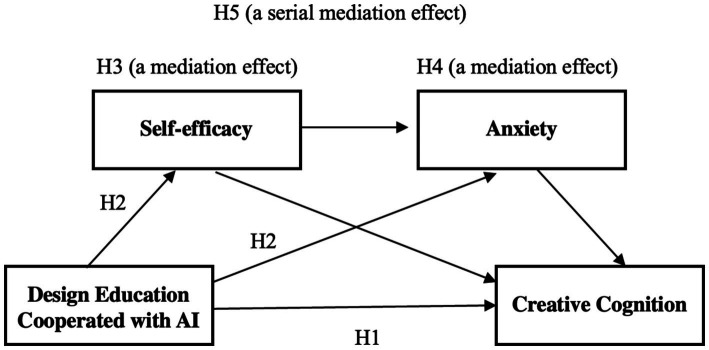
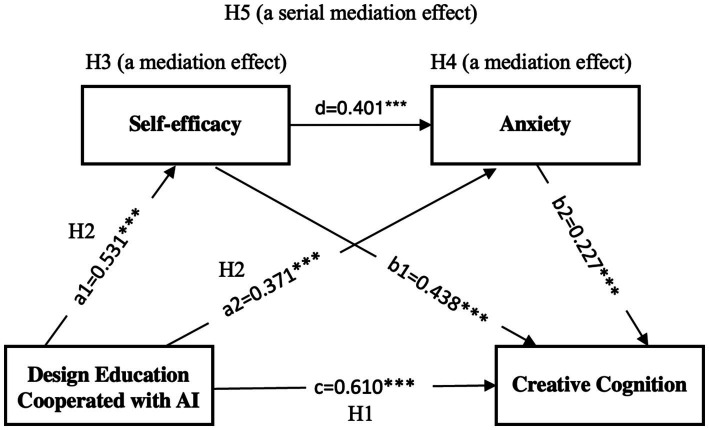
Introduction: This study investigated the role of generative Artificial Intelligence (AI) in enhancing the creative cognition of design students, examining the mediating effects of self-efficacy and anxiety reduction. Methods: A quantitative approach was employed, collecting data through online surveys from 121 design students at universities in southern China. The study utilized scales for AI knowledge and perception, self-efficacy, anxiety, and creative cognition, adapted from previous studies and evaluated on 5-point Likert scales. Data analysis was conducted using SPSS 24.0 for exploratory factor analysis and PROCESS v3.5 for mediation analysis. Results: The findings confirmed that AI positively impacted students’ innovative thinking (* β * = 0.610, * p * < 0.001). Self-efficacy (standardized * β * = 0.256, 95% CI [0.140, 0.418], * p * < 0.001) and anxiety reduction (standardized * β * = 0.093, 95% CI [0.018, 0.195], * p * < 0.05) positively mediated the relationship between generative AI and creative cognition. Additionally, a serial mediation effect through self-efficacy and anxiety reduction was observed (standardized * β * = 0.053, 95% CI [0.012, 0.114], * p * < 0.05). Discussion: Our empirical analysis demonstrates that AI positively affects design students’ innovative thinking, with self-efficacy and anxiety reduction serving as significant mediators. These findings provide valuable insights for educators and policymakers, suggesting that AI-integrated design curricula can significantly foster creative cognition, promote academic achievement, and enhance designer capabilities. Understanding AI’s impact on students’ creative processes is crucial for developing effective teaching strategies in today’s evolving educational landscape.
Overview
The claims and statistics of this paper haven’t been checked yet.
Run the check — free, no account needed. It reads the open-access text and checks the sources it cites.
Integrity signals
Registry
Cites
Statistics
Figures
Verification
Claims the paper makes
The claims and statistics of this paper haven’t been checked yet.
Run the check — free, no account needed. It reads the open-access text and checks the sources it cites.
Claims other papers make about this one
Each is checked against this paper’s own text: does it say what the citing paper says it does?
The source backs part of the claim, not all of it — or backs it for a different population, condition or comparison.
In the citing paper
“various prior studies report designers often perceive enhanced confidence and reduced anxiety and cognitive load when using AI tools [3, 42], particularly in early-stage, concept-development tasks [18].”
From Decoupling of Usefulness and Novelty: Evaluating the Impact of Generative AI on Design Outputs and Novice Designers' Creative Thinking (2026) · cites this paper as [42]
Experimental — accuracy not yet measured
Self-check
Percentages, sums and reported differences re-computed from the paper’s own numbers.
The self-check needs the paper’s full text.
Citations
Cites
1 retracted
Hanafy, N. O. (2023) · Journal of Building Engineering · doi:10.1016/j.jobe.2023.107999 · Cited by 111
RetractedBaron, R. M., & Kenny, D. A. (1986) · Journal of Personality and Social Psychology · doi:10.1037/0022-3514.51.6.1173 · Cited by 91,532
(2013) · Cited by 44,563
Self-efficacy: Toward a unifying theory of behavioral change
Bandura, A. (1977) · Psychological Review · doi:10.1037/0033-295x.84.2.191 · Cited by 43,925
Artificial intelligence: a modern approach
Kumar, D. A., Balasubramanian, S., Byeon, D. H., & Manerkar, P. G. V. (1995) · Choice Reviews Online · doi:10.5860/choice.33-1577 · Cited by 22,191
Becoming a Self-Regulated Learner: An Overview
Zimmerman, B. J. (2002) · Theory Into Practice · doi:10.1207/s15430421tip4102_2 · Cited by 10,197
The social psychology of creativity: A componential conceptualization.
Amabile, T. M. (1983) · Journal of Personality and Social Psychology · doi:10.1037/0022-3514.45.2.357 · Cited by 4,034
Handbook of Self-Regulation of Learning and Performance
Schunk, D. H. (2011) · Routledge eBooks · doi:10.4324/9780203839010 · Cited by 2,191
Divergent Thinking as an Indicator of Creative Potential
Runco, M. A., & Acar, S. (2012) · Creativity Research Journal · doi:10.1080/10400419.2012.652929 · Cited by 1,696
Sternberg, R. J., & Lubart, T. (1996) · American Psychologist · doi:10.1037/0003-066x.51.7.677 · Cited by 1,280
Research works printed but not linked: 3
- Kim, 2022, The artificial intelligence literacy scale for middle school students, J. Korea Soc. Comput. Inf., 27, 225, 10.9708/jksci.2022.27.03.225 · DOI
- Maddux, 2013, Self-efficacy, adaptation, and adjustment: Theory, research, and application
- Wang, 2021, Analysis and research on students' anxiety symptoms in art design teaching, Psychiatr. Danub., 33, 376
Cited by
Sorted by citations
Asamoah, M. K., & Amarteifio, J. (2025) · Discover Education · doi:10.1007/s44217-025-00593-5 · Cited by 18
Rong, W., Xiao, M., Zhao, L., & Zhou, X. (2025) · Information · doi:10.3390/info16121070 · Cited by 28
Farmanesh, P., Vehbi, A., & Dehkordi, N. S. (2025) · Sustainability · doi:10.3390/su17114763 · Cited by 25
Zhao, Y., & Huang, L. (2025) · Frontiers in Psychology · doi:10.3389/fpsyg.2025.1699174 · Cited by 32
Qian, P., & Xie, X.-Z. (2025) · International Journal of Human-Computer Interaction · doi:10.1080/10447318.2025.2526580 · Cited by 17
Zhou, Z., Guo, H., Ma, F., Yang, C., & Gao, Y. (2025) · Scientific Reports · doi:10.1038/s41598-025-21132-0 · Cited by 23
Lu, W., Shiyin, L., & Xiaomo, Q. (2025) · European Journal of Education · doi:10.1111/ejed.70245 · Cited by 16
Uprooting Technostress: Digital Leadership Empowering Employee Well-Being in the Era of Industry 4.0
Farmanesh, P., Vehbi, A., & Dehkordi, N. S. (2025) · Sustainability · doi:10.3390/su17198868 · Cited by 30
Zhang, B., Li, W., & Jou, M. (2025) · Interactive Learning Environments · doi:10.1080/10494820.2025.2570493 · Cited by 18
Zhuang, Z., & Li, X. (2026) · Frontiers in Psychology · doi:10.3389/fpsyg.2025.1709513 · Cited by 17
Wang, S., Tao, X., Ma, H., Li, F. F., & Wu, C. (2025) · Frontiers in Psychology · doi:10.3389/fpsyg.2025.1508383 · Cited by 15
Ansari, S. R., & Qamari, I. N. (2025) · Discover Education · doi:10.1007/s44217-025-00865-0 · Cited by 36
Bellibaş, M. Ş., Özgenel, M., & Bozkurt, A. (2025) · The Asia-Pacific Education Researcher · doi:10.1007/s40299-025-01059-w · Cited by 19
Teke, B. (2025) · Interactive Learning Environments · doi:10.1080/10494820.2025.2559930 · Cited by 12
Yang, Y., Li, Y., Alshuaibi, M. S. I., & Chethiyar, S. D. M. (2025) · Acta Psychologica · doi:10.1016/j.actpsy.2025.105869 · Cited by 8
Peng, C., Zhang, Z., Zhang, J., Zhang, J., Zhang, Z., Liu, Y., Jia, R., & Xu, X. (2026) · Frontiers in Psychology · doi:10.3389/fpsyg.2026.1719970 · Cited by 8
Shao, H., & Wang, R. (2026) · Frontiers in Psychology · doi:10.3389/fpsyg.2026.1779741 · Cited by 10
Wang, S.-J., & Huang, H. C. (2025) · Information Technology and People · doi:10.1108/itp-08-2024-0999 · Cited by 7
Kong, Y., Dong, T., Yang, Z., Fang, Y., & Chen, N. (2026) · Frontiers in Psychology · doi:10.3389/fpsyg.2026.1767454 · Cited by 8
Generative AI-Augmented Thematic Analysis
Jayawardene, V., & Ewing, M. T. (2025) · International Journal of Market Research · doi:10.1177/14707853251405043 · Cited by 4
Bao, Q., Wang, B., Liang, N., & Wang, J. (2026) · Education and Information Technologies · doi:10.1007/s10639-025-13872-3 · Cited by 5
Asio, J. M. R. (2026) · European Journal of Health and Biology Education · doi:10.29333/ejhbe/17850 · Cited by 5
Jiang, C., Hui, B., Sun, W., Li, J., Wang, X., & Wang, R. (2026) · Frontiers in Psychology · doi:10.3389/fpsyg.2026.1835335 · Cited by 4
Zhang, X., Xiao-hong, Z., & Xiao-kun, L. (2025) · Education and Information Technologies · doi:10.1007/s10639-025-13756-6 · Cited by 6
Song, X., Shen, J., & Yang, Z. (2025) · Journal of Business Ethics · doi:10.1007/s10551-025-06232-1 · Cited by 3
Wu, Y., Sun, Y., Zhou, D., Yuan, X., & Wei, Z. (2026) · International Journal of Human-Computer Interaction · doi:10.1080/10447318.2026.2622577 · Cited by 4
Self-citationCantaş, Ç., Celep, C., & BATUR, Ö. (2026) · Frontiers in Psychology · doi:10.3389/fpsyg.2026.1810689 · Cited by 4
Social Judgments of Generative AI Users
Meyers, S., Briker, R., & Bigman, Y. (2026) · Current Directions in Psychological Science · doi:10.1177/09637214261466635 · Cited by 3
Fu, Y., Zhou, T., Han, B., Wang, M., Chen, Y., Gomes Da Costa Lai, Z., Pang, R. Y., Reinecke, K., Wobbrock, J. O., & Hiniker, A. (2026) · Proceedings of the 2026 CHI Conference on Human Factors in Computing Systems · doi:10.1145/3772318.3791329 · Cited by 2
Liu, L., & Lv, Y. (2026) · Frontiers in Human Dynamics · doi:10.3389/fhumd.2026.1695355 · Cited by 4
Lee, J.-H. (2026) · Sustainability · doi:10.3390/su18083858 · Cited by 2
Liang, X., Diankun, J., Tadesse, E., & Hu, P. (2026) · European Journal of Education · doi:10.1111/ejed.70727 · Cited by 2
Jou, M., & Kao, C.-C. (2026) · Journal of Computing in Higher Education · doi:10.1007/s12528-026-09501-8 · Cited by 3
Elishar-Malka, V., Ariel, Y., & Saks, D. W. (2025) · Asian Journal of Communication · doi:10.1080/01292986.2025.2531498 · Cited by 2
Lu, J. (2025) · International Conference on Education, Knowledge and Information Management (ICEKIM) · doi:10.1145/3756580.3756630 · Cited by 1
Naing, M. T., Tun, S. S., Thu, S. P., Kyaw, S. Y. Y., & Jakkaew, P. (2025) · doi:10.1109/incit66780.2025.11276077 · Cited by 1
Xiao, Y., Jiang, H., Hurley, R. F., & Liu, S. (2026) · Computers and Education Artificial Intelligence · doi:10.1016/j.caeai.2026.100682 · Cited by 1
Xiao, W., & Lu, X. (2026) · Journal of Educational Computing Research · doi:10.1177/07356331261424733 · Cited by 1
Wu, X., Xie, Y., Hu, Y., Zeng, Y., Wu, L., Li, X., & Xiang, Y. (2026) · Frontiers in Psychology · doi:10.3389/fpsyg.2026.1787071 · Cited by 1
Generative AI and decision autonomy: a framework of psychological and structural empowerment
Mrayyan, N. E., Hani, I. B., & Alawadi, S. (2026) · Journal of Decision System · doi:10.1080/12460125.2026.2657495 · Cited by 1
INFLUENCE OF GENERATIVE AI TOOLS ON THE CREATIVE THINKING PROCESS OF DESIGN STUDENTS IN KERALA
Sreya, B., & D., H. (2026) · ShodhVichar Journal of Media and Mass Communication · doi:10.29121/shodhvichar.v2.i1.2026.94 · Cited by 1
Ma, L., Liu, T., Zhao, C., & Niu, T. (2026) · Frontiers in Psychology · doi:10.3389/fpsyg.2026.1844997 · Cited by 3
Al-Sharafi, M. A., Elgendy, I. A., Helal, M. Y., Alahmad, R., Chae, I., & Dwivedi, Y. K. (2026) · International Journal of Innovation Management · doi:10.1142/s1363919626500210 · Cited by 1
Liu, G., & Zhang, X. (2026) · Frontiers in Psychology · doi:10.3389/fpsyg.2026.1829753 · Cited by 1
Zhang, Q., Xiao, L., Wu, X., Chen, G., & Chiang, F. (2026) · Communications in computer and information science · doi:10.1007/978-3-032-29788-4_41 · Cited by 1
Cao, S., Liu, X., & Yu, X. (2026) · Frontiers in Psychology · doi:10.3389/fpsyg.2026.1797047 · Cited by 1
Elshaer, I. A., Kooli, C., Azazz, A. M. S., Alyahya, M. A., Fayyad, S., & Mohamed, G. A. (2026) · Societies · doi:10.3390/soc16080270 · Cited by 1
Zhang, Z., Lu, X., Zhang, Y., Zhang, H., & Zhang, M. (2026) · Frontiers in Psychology · doi:10.3389/fpsyg.2026.1934264 · Cited by 2
Söner, O. (2025) · Eğitim Bilimleri Dergisi · doi:10.15285/maruaebd.1665862 · Cited by 1
Navigating AI in Teacher Education
Kaur, B. (2025) · Advances in computational intelligence and robotics book series · doi:10.4018/979-8-3373-5092-9.ch010
Sari, N. A. R. M., Aziezy, E., Chen, H.-R., & Wu, T. (2025) · Lecture notes in computer science · doi:10.1007/978-3-031-98197-5_35
Li, Z., & Gu, D. (2025) · Research Square · doi:10.21203/rs.3.rs-6526907/v1
A Comparative Study on Creative Self-Concept among Millennials and Gen Z
Mabagos, N. L. R., Mallari, E. F., Manabat, I. R. Q., Maulas, Z. C., Mirando, M. B., Vergara, J. Q., & Cantilero, K. A. S. (2025) · International Journal of Multidisciplinary Applied Business and Education Research · doi:10.11594/ijmaber.06.08.07
Peddi, S., & Manoharan, G. (2025) · EthAIca · doi:10.56294/ai2025430
Integrating AI-Generated Content Into Lesson Planning
Rosmayanti, V., Sulolipu, A. A., Ram, S. W., Syawal, S., & Asrifan, A. (2026) · Advances in computational intelligence and robotics book series · doi:10.4018/979-8-3373-2721-1.ch005
Guo, J., Yi, D., Wang, C., Zhang, Z., & Guan, K. (2026) · Research Square · doi:10.21203/rs.3.rs-8651885/v1
Harnessing Artificial Intelligence in universities
Khalid, K., & Alsini, J. (2026) · IJERI International Journal of Educational Research and Innovation · doi:10.46661/ijeri.12533
Retrieval-Augmented AI Feedback to Support Metacognition and Accessible Feedback in STEM Education
Bhati, D., Le, T., Guercio, A., Auman, C., & Bandaru, D. S. (2026) · IEEE Conference on Artificial Intelligence (CAI) · doi:10.1109/cai68641.2026.11536256
Influencing Mechanism of GenAI on Creative Self-Efficacy from the Perspective of Smart Education
Wang, Z., Liang, B., & Zhang, B. (2026) · International Conference on Big Data and Informatization Education (ICBDIE) · doi:10.1145/3806980.3807026
Integrating generative AI in English education opportunities and challenges for EFL learners
Samsudin, & Allen, C. J. (2026) · Journal of Research in English Language Teaching and Linguistics · doi:10.65431/jrell.v2i1.32
Jaturat, N., Jaturat, N., & Kuntonbutr, C. (2026) · SSRN Electronic Journal · doi:10.2139/ssrn.7022816
wu, J., & xu, J. (2026) · SSRN Electronic Journal · doi:10.2139/ssrn.7048095
He, M., Hao, L., Li, Y. X., Chen, X. L., Jin, S., Wei, L., ZHANG, Q.-Q., & Xiong, W. H. (2026) · Communications in computer and information science · doi:10.1007/978-3-032-30836-8_3
Johann, V. E. (2026) · SSRN Electronic Journal · doi:10.2139/ssrn.7065620
Wang, N., & Li, J. (2026) · Frontiers in Psychology · doi:10.3389/fpsyg.2026.1798104
AI Usage and Employee Performance: The Dual Roles of AI Self-Efficacy and AI-Enabled HRM
Li, Y., & Geng, X. (2026) · Systems · doi:10.3390/systems14070786 · Cited by 2
Alhomaidi, M. J. A. (2026) · Creative Education · doi:10.4236/ce.2026.177072
AlMehrzi, A. A., Hussain, M. A., Tipu, S. A. A., & Sarker, A. E. (2026) · Journal of Open Innovation Technology Market and Complexity · doi:10.1016/j.joitmc.2026.100830
Chen, X., Yang, Q., Song, M. T., Zheng, Y., & Lei, C. (2026) · Frontiers in Psychology · doi:10.3389/fpsyg.2026.1884187 · Cited by 1
Rebuilding the Bridge: Overlooked Creativity Insights and Their Implications for Gifted Education
Puryear, J. S., Lamb, K. N., Acar, S., Dumas, D., Mammadov, S., & Rubenstein, L. D. (2026) · Gifted Child Quarterly · doi:10.1177/00169862261460090
Mim, M. K., Arju, M. T. J., Hasan, M., Sadia, F., & Banik, S. (2026) · European Journal of STEM Education · doi:10.20897/ejsteme/18303
Fang, X., Yang, Z., Niu, J., & Mazhar, B. (2026) · Education and Information Technologies · doi:10.1007/s10639-026-14113-x
Kashyap, K., & Shukla, A. (2026) · OPJU International Technology Conference on Smart Computing for Innovation and Advancement in Industry (OTCON) · doi:10.1109/otcon69332.2026.11629976
Growing Up Connected: Teaching Children and Youth Healthy Tech Habits
Lauer, D., Lauer, R., Lauer, R., & Tomar, D. (2026) · Springer eBooks · doi:10.1007/978-3-032-12201-8_19
Semantic Alignment is Not Enough: Evaluating Creativity in Iterative AI Image Generation
Schmidt, R. P. W., Conijn, R., Lin, P.-Y., Pauwels, P., & Hofmeyer, H. (2026) · Creativity Research Journal · doi:10.1080/10400419.2026.2720462 · Cited by 1
Luo, S., Li, A., Yang, G., Liu, B., & Liu, B. (2026) · International Conference on Computer Science and Technologies in Education (CSTE) · doi:10.1109/cste69562.2026.11649635
Hao, X., Li, J., Huang, H., & Hao, B. (2026) · Sustainability · doi:10.3390/su18179084 · Cited by 1
How AI anxiety and confidence shape student engagement in higher education
Moradi, S., & Evans, P. (2026) · Discover Education · doi:10.1007/s44217-026-02078-5
Li, W., Zhang, J., Zhou, Y., He, X., & Sun, J. (2026) · International Journal of Technology and Design Education · doi:10.1007/s10798-026-10117-3
Yang, X., Zhang, L., & Yuan, Y. (2026) · Creativity Research Journal · doi:10.1080/10400419.2026.2729228
Wang, Y., Wu, L., Jiang, Y., & Kong, S.-H. (2026) · Journal of Educational Computing Research · doi:10.1177/07356331261486315
Teng, J., & Cho, S. (2026) · International Journal of Technology and Design Education · doi:10.1007/s10798-026-10111-9
Guo, C. (2026) · Systems and Soft Computing · doi:10.1016/j.sasc.2026.200639
Impact of Self-Efficacy, Social Support, Medical Coping Modes and Resilience on Death Anxiety
Shah, S., Khan, N., & Yunus, S. (2026) · Journal of Innovative Research in Management Sciences · doi:10.62270/jirms.v7i2.168
Akyaman, S. (2026) · Lecture notes in computer science · doi:10.1007/978-3-032-37966-5_7
Yıldız, E. (2026) · Gümüşhane Üniversitesi İletişim Fakültesi Elektronik Dergisi · doi:10.19145/e-gifder.1857632
Tang, Y., & Wu, L. (2026) · Journal of Intelligence · doi:10.3390/jintelligence14100241
Zhang, J., & Xing, D. (2026) · Frontiers in Psychology · doi:10.3389/fpsyg.2026.1916135
Wu, W., & Zhang, H. (2026) · International Conference on Artificial Intelligence, Digital Media and Education · doi:10.1145/3839592.3839727
Chen, Y., Zhao, Y., Cheah, K. S. L., & Nasir, N. Y. M. (2026) · Frontiers in Psychology · doi:10.3389/fpsyg.2026.1962323
Xu, X.-P., Wang, C.-H., Fu, S.-Y., Tong, J.-W., & Jin, D. (2026) · Frontiers in Psychology · doi:10.3389/fpsyg.2026.1962146
Teng, J., & Cho, S. (2026) · Thinking Skills and Creativity · doi:10.1016/j.tsc.2026.102389
Wei, J., & Liu, L. (2026) · Frontiers in Psychology · doi:10.3389/fpsyg.2026.1921917
Li, Y., Yang, Y., & Bao, S. (2026) · Frontiers in Psychology · doi:10.3389/fpsyg.2026.1975841
Wang, X., Li, M., Du, J., Yao, Y., & Jiang, J. (2026) · PLoS ONE · doi:10.1371/journal.pone.0360722
Wang, K., Huang, Z., & Jiang, Q. (2026) · Applied Sciences · doi:10.3390/app162010320
Metadata
- Authors
- Hwang, Y., & Wu, Y.
- Affiliations
- Hunan University (CN)
- Hainan University (CN)
- Corresponding author
- Wu, Yi
- Venue
- Frontiers in Psychology
- Publisher
- Frontiers Media SA
- Published
- 2025-01-27
- Volume
- 15
- Pages
- 1455015-1455015
- ISSN
- 1664-1078 (ISSN-L)
- PMC
- PMC11808137
- OpenAlex
- W4406850244
- Cited by
- 104
- References
- 72
- Citations by year
- 2026: 77 · 2025: 27
- FWCI
- 108.93
- Type
- journal article
- Language
- en
- Open access
- gold
- doi.org
- Licence
- Locations
- Frontiers in Psychology (publishedVersion, cc-by)
- PubMed Central (publishedVersion, cc-by)
- PubMed (publishedVersion)
- DOAJ (DOAJ: Directory of Open Access Journals) (submittedVersion, cc-by-sa)
- Topics
- Social Sciences › Psychology › Experimental and Cognitive Psychology › Creativity in Education and Neuroscience
- Social Sciences › Education › Artificial Intelligence in Education
- Physical Sciences › Engineering › Mechanical Engineering › Design Education and Practice
- Keywords
- generative AI, creative cognition, design students, self-efficacy, anxiety, innovative thinking, serial mediation, design education
About these checks
Registry, retraction, Cites and statistics results are computed, not judged, with one exception: a printed reference that no index lists is read once by a model before it counts as a citation error. Claims are extracted by a model and kept only when their quote appears verbatim in the text; each cited source is then checked, with a model’s help, for whether it says what the claim relies on. Those verdicts can be wrong — read the claim’s quote and the cited source before relying on one.
Statistics and arithmetic are recomputed, not judged.
Confidence bands are shown only for fields calibrated on our annotated test set. None is calibrated yet, so no band is shown.
What counts as a claim ›How we measure confidence ›How we check this ›
Are you an author, or do you see a problem with this page? Request a review
