

The DOI matches its Crossref record; 71 of the 77 references it cites were found in a registry or an index, and 6 are not checked yet.
The influence of generative artificial intelligence on creative cognition of design students: a chain mediation model of self-efficacy and anxiety
Open accessAbstract
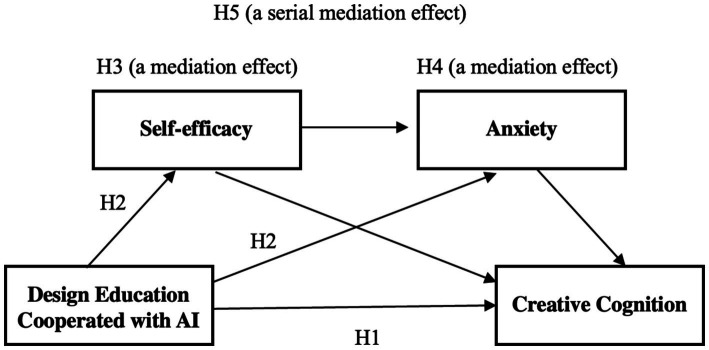
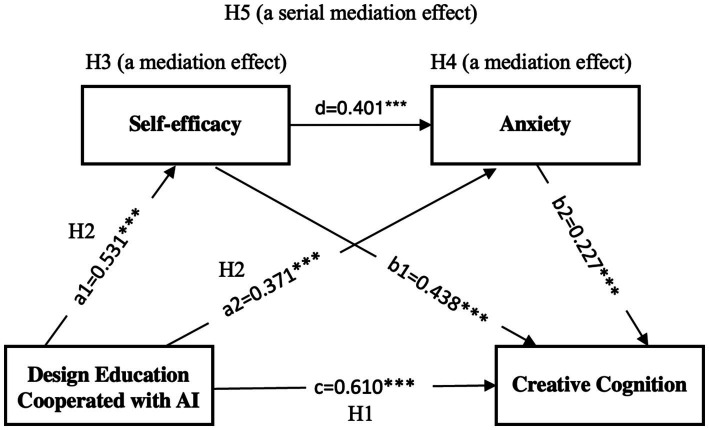
Introduction: This study investigated the role of generative Artificial Intelligence (AI) in enhancing the creative cognition of design students, examining the mediating effects of self-efficacy and anxiety reduction. Methods: A quantitative approach was employed, collecting data through online surveys from 121 design students at universities in southern China. The study utilized scales for AI knowledge and perception, self-efficacy, anxiety, and creative cognition, adapted from previous studies and evaluated on 5-point Likert scales. Data analysis was conducted using SPSS 24.0 for exploratory factor analysis and PROCESS v3.5 for mediation analysis. Results: The findings confirmed that AI positively impacted students’ innovative thinking (* β * = 0.610, * p * < 0.001). Self-efficacy (standardized * β * = 0.256, 95% CI [0.140, 0.418], * p * < 0.001) and anxiety reduction (standardized * β * = 0.093, 95% CI [0.018, 0.195], * p * < 0.05) positively mediated the relationship between generative AI and creative cognition. Additionally, a serial mediation effect through self-efficacy and anxiety reduction was observed (standardized * β * = 0.053, 95% CI [0.012, 0.114], * p * < 0.05). Discussion: Our empirical analysis demonstrates that AI positively affects design students’ innovative thinking, with self-efficacy and anxiety reduction serving as significant mediators. These findings provide valuable insights for educators and policymakers, suggesting that AI-integrated design curricula can significantly foster creative cognition, promote academic achievement, and enhance designer capabilities. Understanding AI’s impact on students’ creative processes is crucial for developing effective teaching strategies in today’s evolving educational landscape.
Overview
The claims and statistics of this paper haven’t been checked yet.
Run the check — free, no account needed. It reads the open-access text and checks the sources it cites.
Integrity signals
Registry
Cites
Statistics
Figures
Verification
Claims the paper makes
The claims and statistics of this paper haven’t been checked yet.
Run the check — free, no account needed. It reads the open-access text and checks the sources it cites.
Claims other papers make about this one
Each is checked against this paper’s own text: does it say what the citing paper says it does?
The source backs part of the claim, not all of it — or backs it for a different population, condition or comparison.
In the citing paper
“various prior studies report designers often perceive enhanced confidence and reduced anxiety and cognitive load when using AI tools [3, 42], particularly in early-stage, concept-development tasks [18].”
From Decoupling of Usefulness and Novelty: Evaluating the Impact of Generative AI on Design Outputs and Novice Designers' Creative Thinking (2026) · cites this paper as [42]
Experimental — accuracy not yet measured
Self-check
Percentages, sums and reported differences re-computed from the paper’s own numbers.
The self-check needs the paper’s full text.
Citations
Cites
1 retracted
Hanafy, N. O. (2023) · Journal of Building Engineering · doi:10.1016/j.jobe.2023.107999 · Cited by 111
RetractedBaron, R. M., & Kenny, D. A. (1986) · Journal of Personality and Social Psychology · doi:10.1037/0022-3514.51.6.1173 · Cited by 91,532
(2013) · Cited by 44,563
Self-efficacy: Toward a unifying theory of behavioral change
Bandura, A. (1977) · Psychological Review · doi:10.1037/0033-295x.84.2.191 · Cited by 43,925
Artificial intelligence: a modern approach
Kumar, D. A., Balasubramanian, S., Byeon, D. H., & Manerkar, P. G. V. (1995) · Choice Reviews Online · doi:10.5860/choice.33-1577 · Cited by 22,191
Becoming a Self-Regulated Learner: An Overview
Zimmerman, B. J. (2002) · Theory Into Practice · doi:10.1207/s15430421tip4102_2 · Cited by 10,197
The social psychology of creativity: A componential conceptualization.
Amabile, T. M. (1983) · Journal of Personality and Social Psychology · doi:10.1037/0022-3514.45.2.357 · Cited by 4,034
Handbook of Self-Regulation of Learning and Performance
Schunk, D. H. (2011) · Routledge eBooks · doi:10.4324/9780203839010 · Cited by 2,191
Divergent Thinking as an Indicator of Creative Potential
Runco, M. A., & Acar, S. (2012) · Creativity Research Journal · doi:10.1080/10400419.2012.652929 · Cited by 1,696
Sternberg, R. J., & Lubart, T. (1996) · American Psychologist · doi:10.1037/0003-066x.51.7.677 · Cited by 1,280
Research works printed but not linked: 3
- Kim, 2022, The artificial intelligence literacy scale for middle school students, J. Korea Soc. Comput. Inf., 27, 225, 10.9708/jksci.2022.27.03.225 · DOI
- Maddux, 2013, Self-efficacy, adaptation, and adjustment: Theory, research, and application
- Wang, 2021, Analysis and research on students' anxiety symptoms in art design teaching, Psychiatr. Danub., 33, 376
Cited by
Sorted by citations
Items 101–104 of 104
Christopoulos, A., Mystakidis, S., Perikos, I., Bourazeri, A., Michael, A., & Laakso, M. (2026) · Applied Cognitive Psychology · doi:10.1002/acp.70298
Wang, X., Hou, J., Tingyun, L. U. O., Du, J., & Yuan, Z. (2026) · Frontiers in Psychology · doi:10.3389/fpsyg.2026.1883577
Zhang, Q., & Li, S. (2026) · International Conference on Intelligent Education and Computer Technology (IECT) · doi:10.1145/3845354.3845556
Han, L., & Zhongqin, C. (2026) · Frontiers in Psychology · doi:10.3389/fpsyg.2026.1957097
Metadata
- Authors
- Hwang, Y., & Wu, Y.
- Affiliations
- Hunan University (CN)
- Hainan University (CN)
- Corresponding author
- Wu, Yi
- Venue
- Frontiers in Psychology
- Publisher
- Frontiers Media SA
- Published
- 2025-01-27
- Volume
- 15
- Pages
- 1455015-1455015
- ISSN
- 1664-1078 (ISSN-L)
- PMC
- PMC11808137
- OpenAlex
- W4406850244
- Cited by
- 104
- References
- 72
- Citations by year
- 2026: 77 · 2025: 27
- FWCI
- 108.93
- Type
- journal article
- Language
- en
- Open access
- gold
- doi.org
- Licence
- Locations
- Frontiers in Psychology (publishedVersion, cc-by)
- PubMed Central (publishedVersion, cc-by)
- PubMed (publishedVersion)
- DOAJ (DOAJ: Directory of Open Access Journals) (submittedVersion, cc-by-sa)
- Topics
- Social Sciences › Psychology › Experimental and Cognitive Psychology › Creativity in Education and Neuroscience
- Social Sciences › Education › Artificial Intelligence in Education
- Physical Sciences › Engineering › Mechanical Engineering › Design Education and Practice
- Keywords
- generative AI, creative cognition, design students, self-efficacy, anxiety, innovative thinking, serial mediation, design education
About these checks
Registry, retraction, Cites and statistics results are computed, not judged, with one exception: a printed reference that no index lists is read once by a model before it counts as a citation error. Claims are extracted by a model and kept only when their quote appears verbatim in the text; each cited source is then checked, with a model’s help, for whether it says what the claim relies on. Those verdicts can be wrong — read the claim’s quote and the cited source before relying on one.
Statistics and arithmetic are recomputed, not judged.
Confidence bands are shown only for fields calibrated on our annotated test set. None is calibrated yet, so no band is shown.
What counts as a claim ›How we measure confidence ›How we check this ›
Are you an author, or do you see a problem with this page? Request a review
