

The DOI matches its Crossref record; 10 of the 10 references it cites were found in a registry or an index.
Understanding identity development in context: comparing reflective and situated approaches to identity
Abstract
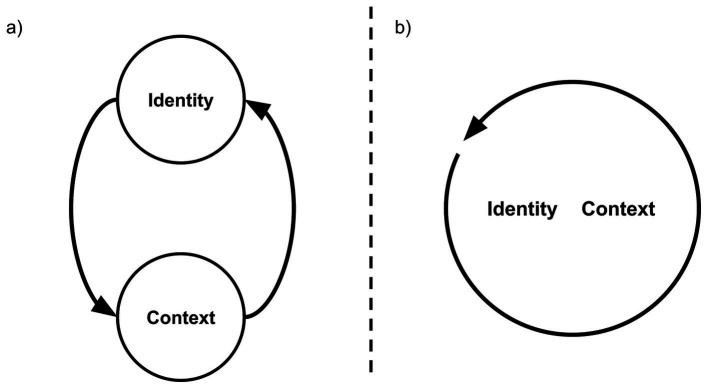
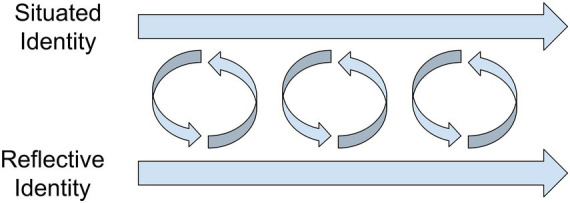
Many recent approaches to identity share a foundational similarity with ecological psychology, namely, to place identity in its context. That is, they explicitly place identity in its physical and social environments. Yet, we can distinguish at least two different approaches that diverge fundamentally with regards to the role that this “context” has in identity. We refer to these approaches as “reflective identity” and “situated identity” approaches. While the reflective-identity approach views context and individual as separate entities with a bi-directional relationship, the situated-identity approach views context and individual as inherently intertwined and inseparable. While these approaches have emerged as independent from each other, we see potential for these two approaches to become comprehensively coordinated. To set the stage for such a coordination in future research, we provide a short overview of these different approaches to identity and describe where they align and diverge with regards to viewing identity as contextualized. After providing an overview of the key differences and similarities, we outline a possibility for integration and offer ideas for future lines of research that we see as fruitful for developing a comprehensive and coordinated approach to identity that takes context seriously.
Overview
The claims and statistics of this paper haven’t been checked yet.
Run the check — free, no account needed. It reads the open-access text and checks the sources it cites.
Integrity signals
Registry
Cites
Statistics
Figures
Verification
Claims the paper makes
The claims and statistics of this paper haven’t been checked yet.
Run the check — free, no account needed. It reads the open-access text and checks the sources it cites.
Claims other papers make about this one
Each is checked against this paper’s own text: does it say what the citing paper says it does?
In the citing paper
“This issue is not unique to discursive micro-analyses of identity, but indeed represents a fundamental issue in developmental (identity) research; we know little about how (and if) situated and reflective identity concepts are related (De Ruiter & Gmelin, 2021;Klimstra & Schwab, 2021;Van Der Gaag et al., 2025).”
From Studying Identity Development in Everyday Conversations: A Practical Guide to Developmental Discursive Micro-Analysis (DDMA) (2026) · cites this paper as Van Der Gaag et al., 2025
In the citing paper
“Due to their focus on reflective processes, developmental approaches to identity risk reducing contexts to sources of identity-relevant information, rather than treating them as sites of development (Korobov, 2010;Van Der Gaag et al., 2025).”
From Studying Identity Development in Everyday Conversations: A Practical Guide to Developmental Discursive Micro-Analysis (DDMA) (2026) · cites this paper as Van Der Gaag et al., 2025
Self-check
Percentages, sums and reported differences re-computed from the paper’s own numbers.
The self-check needs the paper’s full text.
Citations
Cites
Development and validation of ego-identity status.
Marcia, J. E. (1966) · Journal of Personality and Social Psychology · doi:10.1037/h0023281 · Cited by 5,172 · cited 3×
“If a strong commitment is formed through active exploration, the individual is considered to have an achieved identity status (Marcia, 1966), which is the most optimal of four identity statuses for one’s general psycho-emotional development (Kroger and Marcia, 2011).”
The Psychology of Life Stories
McAdams, D. P. (2001) · Review of General Psychology · doi:10.1037/1089-2680.5.2.100 · Cited by 2,808 · cited 1×
“For example, McAdams (2001) shows that culture transmits notions of which experiences are in fact meaningful for identity.”
McAdams, D. P., & McLean, K. C. (2013) · Current Directions in Psychological Science · doi:10.1177/0963721413475622 · Cited by 1,497
The Dialogical Self: Toward a Theory of Personal and Cultural Positioning
Hermans, H. J. M. (2001) · Culture & Psychology · doi:10.1177/1354067x0173001 · Cited by 1,488
Determinants and mechanisms in ego identity development: a review and synthesis
Bosma, H. A., & Kunnen, E. S. (2001) · Developmental Review · doi:10.1006/drev.2000.0514 · Cited by 516 · cited 1×
“Drawing from these theorists, Bosma and Kunnen (2001) advanced theory on identity development, by conceptualizing identity as a dynamic process of continuous interaction between individual and context.”
An integrated developmental model for studying identity content in context
Galliher, R. V., McLean, K. C., & Syed, M. (2017) · Developmental Psychology · doi:10.1037/dev0000299 · Cited by 277
Time and identity: a framework for research and theory formation
Lichtwarck-Aschoff, A., van Geert, P., Bosma, H., & Kunnen, S. (2008) · Developmental Review · doi:10.1016/j.dr.2008.04.001 · Cited by 200
Crocetti, E., Branje, S., Rubini, M., Koot, H. M., & Meeus, W. (2017) · Child Development · doi:10.1111/cdev.12547 · Cited by 103
van der Gaag, M. A. E., Albers, C. J., & Kunnen, E. S. (2017) · Developmental Psychology · doi:10.1037/dev0000336 · Cited by 37
van der Gaag, M. A. E., de Ruiter, N. M. P., & Kunnen, E. S. (2016) · Journal of Adolescence · doi:10.1016/j.adolescence.2015.11.007 · Cited by 26
Research works printed but not linked: 41
- Anderson, 2009, Applying positioning theory to the analysis of classroom interactions: mediating micro-identities, macro-kinds, and ideologies of knowing, Linguist. Educ., 20, 291, 10.1016/j.linged.2009.08.001 · DOI
- Antaki, 2012, Conversation analysis and identity in interaction, 10.1002/9781405198431.wbeal0201 · DOI
- Antaki, 1996, Social identities in talk: speakers’ own orientations, Br. J. Soc. Psychol., 35, 473, 10.1111/j.2044-8309.1996.tb01109.x · DOI
- Antaki, 2008, Identities in talk, 10.4135/9781446216958 · DOI · Paper page
- Bamberg, 1997, Positioning between structure and performance, J. Narrat. Life Hist., 7, 335, 10.1075/jnlh.7.42pos · DOI
- Becht, 2017, Identity uncertainty and commitment making across adolescence: five-year within-person associations using daily identity reports, Dev. Psychol., 53, 2103, 10.1037/dev0000374 · DOI · Paper page
- Berzonsky, 1992, Identity style and coping strategies, J. Pers., 60, 771, 10.1111/j.1467-6494.1992.tb00273.x · DOI
- Beyers, 2008, Dynamics of perceived parenting and identity formation in late adolescence, J. Adolesc., 31, 165, 10.1016/j.adolescence.2007.04.003 · DOI
- Branje, 2021, Dynamics of identity development in adolescence: a decade in review, J. Res. Adolesc., 31, 908, 10.1111/jora.12678 · DOI · Paper page
- Breakwell, 1986, Coping with threatened identities
- Breakwell, 1988, A simple model of identity, Rev.Int. Psychol. Soc., 1, 191
- Carpendale, 2018, Self constructed in culture, 25
- Cipolletta, 2022, Intersubjectivity, joint action and sociality, J. Constr. Psychol., 35, 904, 10.1080/10720537.2020.1805066 · DOI
- De Jaegher, 2007, Participatory sense-making: an enactive approach to social cognition, Phenomenol. Cogn. Sci., 6, 485, 10.1007/s11097-007-9076-9 · DOI · Paper page
- De Ruiter, 2023, Practices in state self-esteem research: an analysis of enacted ontologies, Identity, 23, 67, 10.1080/15283488.2022.2130323 · DOI
- De Ruiter, 2021, What is real about “real time” anyway? A proposal for a pluralistic approach to studying identity processes across different timescales, Identity, 21, 289, 10.1080/15283488.2021.1969937 · DOI · Paper page
- De Ruiter, 2019, Introduction to a dynamic systems approach to psychosocial development in adolescence, 1, 10.4324/9781315165844-1 · DOI
- Edwards, 1992, Discursive psychology
- Erikson, 1956, The problem of Ego identity, J. Am. Psychoanal. Assoc., 4, 56, 10.1177/000306515600400104 · DOI
- Fogel, 1993, Developing through relationships: Origins of communication, self, and culture
- Gmelin, 2021, Iterative Micro-identity content analysis: studying identity development within and across real-time interactions, Identity, 21, 324, 10.1080/15283488.2021.1973474 · DOI
- Grotevant, 1987, Toward a process model of identity formation, J. Adolesc. Res., 2, 203, 10.1177/074355488723003 · DOI
- Hollway, 2008, The importance of relational thinking in the practice of psycho-social research: ontology, epistemology, methodology and ethics
- Kaplan, 2017, A complex dynamic systems perspective on identity and its development: the dynamic systems model of role identity, Dev. Psychol., 53, 2036, 10.1037/dev0000339 · DOI
- Kaplan, 1993, From mistrust to trust: through a stage vertically, 153
- Kerpelman, 1997, Toward a microprocess perspective on adolescent identity development: an identity control theory approach, J. Adolesc. Res., 12, 325, 10.1177/0743554897123002 · DOI
- Klimstra, 2016, Daily dynamics of adolescent mood and identity, J. Res. Adolesc., 26, 459, 10.1111/jora.12205 · DOI
- Klimstra, 2010, Short-term fluctuations in identity: introducing a micro-level approach to identity formation, J. Pers. Soc. Psychol., 99, 191, 10.1037/a0019584 · DOI
- Korobov, 2010, A discursive psychological approach to positioning, Qual. Res. Psychol., 7, 263, 10.1080/14780880902822321 · DOI · Paper page
- Kroger, 1993, Identity and context. How the identity statuses choose their match, 130
- Kroger, 2011, The identity statuses: origins, meanings, and interpretations, 31, 10.1007/978-1-4419-7988-9_2 · DOI
- Mascolo, 2020, Steps to an integrative conception of psychological development, 466, 10.4324/9781003018599-19 · DOI
- McAdams, 1993, The stories we live by: Personal myths and the making of the self
- McLean, 2016, The role of domain content in understanding identity development processes, J. Res. Adolesc., 26, psyh, 10.1111/jora.12169 · DOI
- Overton, 2014, Fundamental concepts and methods in developmental science: a relational perspective, Res. Hum. Dev., 11, 63, 10.1080/15427609.2014.881086 · DOI
- Stokoe, 2010, Gender, conversation analysis, and the anatomy of membership categorization practices, Soc. Personal. Psychol. Compass, 4, 428, 10.1111/j.1751-9004.2010.00261.x · DOI
- Stokoe, 2012, Moving forward with membership categorization analysis: methods for systematic analysis, Discourse Stud., 14, 277, 10.1177/1461445612441534 · DOI
- Van der Gaag, 2020, The landscape of identity model: an integration of qualitative and quantitative aspects of identity development, Identity, 20, 272, 10.1080/15283488.2020.1821154 · DOI
- Van Geert, 2022, Toward a process approach in psychology: Stepping into Heraclitus’ river, 10.1017/9781108859189 · DOI
- Waterman, 2015, What does it mean to engage in identity exploration and to hold identity commitments? A methodological critique of multidimensional measures for the study of identity processes, Identity, 15, 309, 10.1080/15283488.2015.1089403 · DOI · Paper page
- Wetherell, 2007, A step too far: discursive psychology, linguistic ethnography and questions of identity, J. Socioling., 11, 661, 10.1111/j.1467-9841.2007.00345.x · DOI
Cited by
Sorted by citations
Gmelin, J.-O. H. (2026) · Identity · doi:10.1080/15283488.2026.2708720
Self-citation
Metadata
- Authors
- Van Der Gaag, M. A. E., Gmelin, J. O. H., & De Ruiter, N. M. P.
- Venue
- Frontiers in Psychology
- Publisher
- Frontiers Media SA
- Published
- 2025-01-08
- Volume
- 15
- ISSN
- 1664-1078
- PMC
- PMC11750864
- Cited by
- 20
- References
- 10
About these checks
Registry, retraction, Cites and statistics results are computed, not judged, with one exception: a printed reference that no index lists is read once by a model before it counts as a citation error. Claims are extracted by a model and kept only when their quote appears verbatim in the text; each cited source is then checked, with a model’s help, for whether it says what the claim relies on. Those verdicts can be wrong — read the claim’s quote and the cited source before relying on one.
Statistics and arithmetic are recomputed, not judged.
Confidence bands are shown only for fields calibrated on our annotated test set. None is calibrated yet, so no band is shown.
What counts as a claim ›How we measure confidence ›How we check this ›
Are you an author, or do you see a problem with this page? Request a review
