

Adult Disorganized Attachment scale (ADA): Persian adaptation, validity, and reliability study
Open accessThe DOI matches its Crossref record; 48 of the 53 references it cites were found in a registry or an index, and 1 are not checked yet; none of the 15 sources its claims cite is checked for support yet.
Abstract
Objective: The aim of the current study was to adapt the Adult Disorganized Attachment Scale (ADA) to Persian and to examine its psychometric properties. Method: The study was conducted with 202 participants, including 124 female (61.4%), who were students at Kermanshah University of Medical Sciences, aged 17–36 years. The Experience in Close Relationships measure was used to assess convergent validity, while the Sadism Scale and Shutdown Dissociation Scale were used to evaluate criterion validity. The reliability using Cronbach’s alpha coefficient, convergent validity, and construct validity using confirmatory factor analysis were examined. The collected data were analyzed in SPSS v.25 and LISREL 8.8 applications. Results: The scale demonstrated strong reliability ( α = 0.82) and good convergent validity, with positive correlations to Shutdown Dissociation, Anxious and Avoidant Attachment, and Sadism ( p < 0.05). Confirmatory Factor Analysis supported its structural validity with excellent fit indexes (χ 2 /df = 1.44, RMSEA = 0.047, CFI = 0.98, GFI = 0.96). Conclusion: This Persian version of the ADA can be considered a valid and reliable scale, which is a short and practical tool that can be used in clinical and research settings in Iran.
Checked 2026-11-24 · 1 reference not checked yet
Overview
CoChat Summary
TL;DR
This study adapted the 9-item Adult Disorganized Attachment (ADA) scale into Persian and evaluated its psychometric properties in 202 Iranian university students. It reports strong internal consistency, a good-fitting single-factor structure, and significant correlations with dissociation, anxious and avoidant attachment, and sadism.
Key findings
- Internal consistency was strong: Cronbach’s α = 0.82; corrected item-total correlations ranged from 0.48 to 0.76 (mean = 0.65).
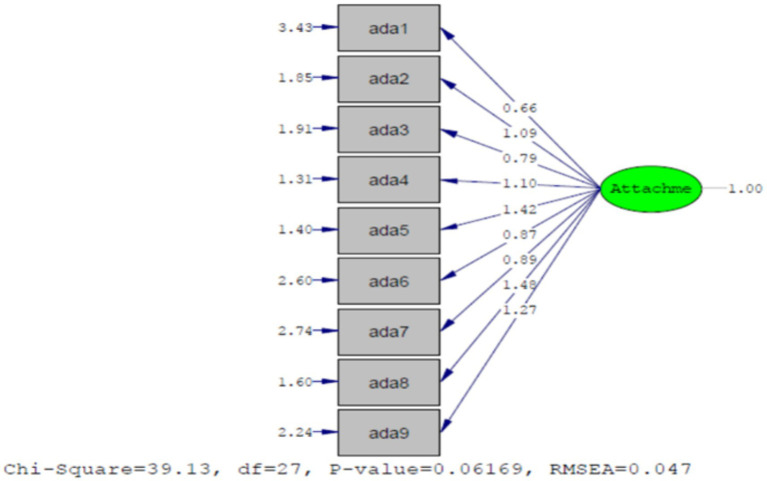
- Confirmatory factor analysis supported a single-factor structure with excellent fit: χ²/df = 1.44, RMSEA = 0.047, CFI = 0.98, GFI = 0.96, SRMR = 0.04.
- Convergent and criterion validity were supported by significant positive correlations with Shutdown Dissociation (r = 0.15, p < 0.05), Anxious Attachment (r = 0.46, p < 0.01), Avoidant Attachment (r = 0.47, p < 0.01), and Sadism (r = 0.38, p < 0.01).
- A multiple regression predicting disorganized attachment from attachment anxiety and avoidance was significant, F(2, 199) = 61.95, p < 0.001, accounting for 38.4% of the variance (R² = 0.384); anxiety (β = 0.403, p < 0.001) and avoidance (β = 0.412, p < 0.001) were both significant predictors.
Methods
- Design: Persian translation, cultural adaptation, and psychometric validation of the Adult Disorganized Attachment scale.
- Sample: 202 students at Kermanshah University of Medical Sciences (124 female, 61.4%; 38.6% male), mean age = 22.91 years, SD = 3.77, range 17–36; inclusion required enrollment and at least one close romantic relationship, with no exclusion criteria applied.
- Measures and analysis: ADA, Shutdown Dissociation Scale, Experiences in Close Relationships–Revised, and Sadism scale; analyses included Cronbach’s alpha, confirmatory factor analysis, correlations, independent t-test, and multiple regression using SPSS v.25 and LISREL 8.8.
Limitations
- Stated: the sample included only university students, which may limit generalizability to the general population.
- Stated: the study did not assess test–retest reliability, so consistency over time remains untested.
- Evident from the text: the study used convenience sampling and self-report measures, and it did not include clinical or more diverse community samples; these features further constrain generalizability and method-variance interpretations.
Model-written summary. Check it against the paper before relying on it.
Integrity signals
Registry
Cites
Statistics
Figures
Verification
Claims the paper makes
0 Valid · 0 Not valid · 10 Not checked · 25 Own results and interpretations
A result the paper reports from its own data — it cites no other source for it, so there is none to check. The quote shows it is in the paper.
In the paper
“Notably, the scale showed moderate and highly significant correlations with both Anxious Attachment (r = 0.46, p < 0.01) and Avoidant Attachment (r = 0.47, p < 0.01), indicating that disorganized attachment encompasses aspects of both anxiety and avoidance in attachment behaviors.”
- Also stated in: § Validity · boosted
“As shown in Table 3, the Disorganized Attachment Scale has a significant positive correlation (p < 0.05) with Shutdown Dissociation, Anxious Attachment Style, Avoidant Attachment Style and Sadism, demonstrating good convergent validity for the scale.”
§ Adult Disorganized Attachment scale (ADA): Persian adaptation, validity, and reliability study > Discussion
boostedstates an association- Asserted: passes — The authors put it forward as true.
- Checkable: passes — It can be checked against evidence.
- Load-bearing: passes — The paper’s conclusions depend on it.
- Based: passes — The paper gives a reason why it holds.
- Also stated in: § Validity · boosted
A result the paper reports from its own data — it cites no other source for it, so there is none to check. The quote shows it is in the paper.
In the paper
“Both attachment anxiety (β = 0.403, p < 0.001) and avoidance (β = 0.412, p < 0.001) were significant predictors.”
§ Adult Disorganized Attachment scale (ADA): Persian adaptation, validity, and reliability study > Result > Validity
plainstates a cause- Asserted: passes — The authors put it forward as true.
- Checkable: passes — It can be checked against evidence.
- Load-bearing: passes — The paper’s conclusions depend on it.
- Based: passes — The paper gives a reason why it holds.
A result the paper reports from its own data — it cites no other source for it, so there is none to check. The quote shows it is in the paper.
In the paper
“There was a modest but significant correlation with Shutdown Dissociation (r = 0.15, p < 0.05), supporting theoretical expectations that disorganized attachment involves dissociative symptoms.”
- Also stated in: § Validity · boosted
“As shown in Table 3, the Disorganized Attachment Scale has a significant positive correlation (p < 0.05) with Shutdown Dissociation, Anxious Attachment Style, Avoidant Attachment Style and Sadism, demonstrating good convergent validity for the scale.”
§ Adult Disorganized Attachment scale (ADA): Persian adaptation, validity, and reliability study > Discussion
boostedstates an association- Asserted: passes — The authors put it forward as true.
- Checkable: passes — It can be checked against evidence.
- Load-bearing: passes — The paper’s conclusions depend on it.
- Based: passes — The paper gives a reason why it holds.
- Also stated in: § Validity · boosted
A result the paper reports from its own data — it cites no other source for it, so there is none to check. The quote shows it is in the paper.
In the paper
“The scale demonstrated strong reliability (α = 0.82) and good convergent validity, with positive correlations to Shutdown Dissociation, Anxious and Avoidant Attachment, and Sadism (p < 0.05).”
- Also stated in: § Validity · boosted
“The Disorganized Attachment Scale showed strong internal consistency, with a Cronbach’s alpha of 0.82.”
- Also stated in: § Discussion · hedged
“The reliability analysis of the scale resulted in a Cronbach’s alpha coefficient of 0.82, indicating strong internal consistency among its items.”
§ Adult Disorganized Attachment scale (ADA): Persian adaptation, validity, and reliability study > Abstract > Results
boosted- Asserted: passes — The authors put it forward as true.
- Checkable: passes — It can be checked against evidence.
- Load-bearing: passes — The paper’s conclusions depend on it.
- Based: passes — The paper gives a reason why it holds.
- Also stated in: § Validity · boosted
A result the paper reports from its own data — it cites no other source for it, so there is none to check. The quote shows it is in the paper.
In the paper
“Notably, the scale showed moderate and highly significant correlations with both Anxious Attachment (r = 0.46, p < 0.01) and Avoidant Attachment (r = 0.47, p < 0.01), indicating that disorganized attachment encompasses aspects of both anxiety and avoidance in attachment behaviors.”
- Also stated in: § Validity · boosted
“As shown in Table 3, the Disorganized Attachment Scale has a significant positive correlation (p < 0.05) with Shutdown Dissociation, Anxious Attachment Style, Avoidant Attachment Style and Sadism, demonstrating good convergent validity for the scale.”
§ Adult Disorganized Attachment scale (ADA): Persian adaptation, validity, and reliability study > Discussion
boostedstates an association- Asserted: passes — The authors put it forward as true.
- Checkable: passes — It can be checked against evidence.
- Load-bearing: passes — The paper’s conclusions depend on it.
- Based: passes — The paper gives a reason why it holds.
- Also stated in: § Validity · boosted
14 more claims
Create a free account to see all 35 claims and to verify the 12 references still open.
- It may state two separate claims as one. 9
- Probably not a substantial claim. 7
- The quote only partly states this claim. 1
Statistics recomputed
Every reported test result, recomputed from its test statistic and degrees of freedom. A result shows as not adding up only once an independent check has confirmed it.
- ConsistentF(2, 199) = 61.95reported p < .001 · recomputed p < .001
“F(2, 199) = 61.95, p < .001”
- ConsistentF(2, 496) = 267.74reported p < .001 · recomputed p < .001
“F(2, 496) = 267.74, p < .001”
Self-check
Percentages, sums and reported differences re-computed from the paper’s own numbers.
Each contradiction between two passages listed here was confirmed by an independent check.
Rated minor: it would not touch a result — a value no result rests on, a p-value that stays on the same side of the significance level, or a conflict that is clerical, resolved elsewhere in the paper, or outside its own findings.
In the paper
§ Adult Disorganized Attachment scale (ADA): Persian adaptation, validity, and reliability study > Discussion
“The RMSEA is also 0.04, supporting the model’s adequacy.”
§ Adult Disorganized Attachment scale (ADA): Persian adaptation, validity, and reliability study > Result > Confirmatory factor analysis (CFA)
“| One-factor | 39/13 | 27 | 1.44 | 0.04 | 0.96 | 0.94 | 0/98 | 0.98 | 0.93 | 0.98 | 0.96 | 0.047 |”
Rated minor: it would not touch a result — a value no result rests on, a p-value that stays on the same side of the significance level, or a conflict that is clerical, resolved elsewhere in the paper, or outside its own findings.
In the paper
§ Adult Disorganized Attachment scale (ADA): Persian adaptation, validity, and reliability study > Result > Validity
“| 2-Shutdown dissociation (criterion validity) | 7.60 (5.46) | | 1 | 0.20* | 0.12** | 0.28** |”
§ Adult Disorganized Attachment scale (ADA): Persian adaptation, validity, and reliability study > Result > Validity
“Note: Correlations represent Pearson correlation coefficients. *p < 0.05, **p < 0.01.”
Citations
Cites
Principles and Practice of Structural Equation Modeling
Tabri, N., & Elliott, C. M. (2012) · Canadian Graduate Journal of Sociology and Criminology · doi:10.15353/cgjsc-rcessc.v1i1.25 · Cited by 38,891
(1969) · Cited by 18,340
Attachment in adulthood: structure, dynamics, and change
(2008) · Choice Reviews Online · doi:10.5860/choice.45-2903 · Cited by 4,315
(1998) · Cited by 3,968
An Item-Response Theory Analysis of Self-Report Measures of Adult Attachment
Fraley, R. C., Waller, N. G., & Brennan, K. A. (2000) · Journal of Personality and Social Psychology · doi:10.1037/0022-3514.78.2.350 · Cited by 3,385
A Secure Base: Clinical Applications of Attachment Theory
Bowlby, J. (1998) · Medical Entomology and Zoology · Cited by 3,379
Main, M., & Solomon, J. (2026) · Routledge eBooks · doi:10.4324/9781003569978-2 · Cited by 1,987
Kyriazos, T. A. (2018) · Psychology · doi:10.4236/psych.2018.98126 · Cited by 1,882 · cited 2×
“Tinsley and Tinsley (1987) suggest having 5 to 10 participants per item for psychometric studies (Kyriazos, 2018), meaning 45–90 participants are needed for a 9-item measure.”
Attachment Across the Life Cycle
Stevenson-Hinde, J., & Marris, P. (1991) · Taylor & Francis eBooks · doi:10.4324/9780203317914 · Cited by 1,637
Psychoanalytic Studies of the Personality
H., R., & Fairbairn, W. R. D. (1953) · The British Journal of Sociology · doi:10.2307/587202 · Cited by 1,583
Uses of factor analysis in counseling psychology research.
Tinsley, H. E. A., & Tinsley, D. J. (1987) · Journal of Counseling Psychology · doi:10.1037//0022-0167.34.4.414 · Cited by 1,324
Bowlby, J. (1980) · Medical Entomology and Zoology · Cited by 1,303
Attachment-related psychodynamics
Shaver, P. R., & Mikulincer, M. (2002) · Attachment & Human Development · doi:10.1080/14616730210154171 · Cited by 1,294
Affective development in infancy
Brazelton, T. B., & Yogman, M. W. (1986) · Medical Entomology and Zoology · Cited by 1,145
Attachment Theory and Close Relationships
Chazan, S. (1999) · American Journal of Psychotherapy · doi:10.1176/appi.psychotherapy.1999.53.2.269 · Cited by 892
Handbook of Mentalizing in Mental Health Practice
LAZAR, S. G. (2013) · Journal of Psychiatric Practice · doi:10.1097/01.pra.0000426331.79890.cf · Cited by 876
Discovery of an insecure-disorganized/disoriented attachment pattern.
Main, M., & Solomon, J. (1986) · Cited by 610
Moshagen, M., Hilbig, B. E., & Zettler, I. (2018) · Psychological Review · doi:10.1037/rev0000111 · Cited by 519 · cited 1×
“This makes the scale a reliable and valid measure for assessing sadism within the context of dark personality traits (Moshagen et al., 2018; Ebrahimi Ghavam, 2020).”
Spiegel, R. (1981) · American Journal of Psychotherapy · doi:10.1176/appi.psychotherapy.1981.35.4.598a · Cited by 472
Disorganized/disoriented attachment in the etiology of the dissociative disorders.
Liotti, G. (1992) · Cited by 338
Developmental origins of attachment styles
Belsky, J. (2002) · Attachment & Human Development · doi:10.1080/14616730210157510 · Cited by 209
A Model of dissociation based on attachment theory and research
Liotti, G. (2006) · Journal of Trauma & Dissociation · doi:10.1300/j229v07n04_04 · Cited by 190 · cited 1×
“They also demonstrated that these infants develop multiple, fragmented internal working models (IWMs) of themselves and their primary caregivers (Main and Solomon, 1986; Liotti, 2006).”
Confusion of Tongues between Adults and the Child: The Language of Tenderness and of Passion
Ferenczi, S. (1988) · Contemporary Psychoanalysis · doi:10.1080/00107530.1988.10746234 · Cited by 159
Understanding the dissociative processes: The contribution of attachment theory
Liotti, G. (1999) · Psychoanalytic Inquiry · doi:10.1080/07351699909534275 · Cited by 126
Paetzold, R. L., Rholes, W. S., & Kohn, J. L. (2015) · Review of General Psychology · doi:10.1037/gpr0000042 · Cited by 125 · cited 6×
“The scale demonstrated high internal consistency (Cronbach’s α = 0.91) (Paetzold et al., 2015).”
InfluentialMeyer, B., & Pilkonis, P. A. (2001) · Psychotherapy · doi:10.1037/0033-3204.38.4.466 · Cited by 120
Simpson, J. A., & Rholes, W. S. (2002) · Attachment & Human Development · doi:10.1080/14616730210154207 · Cited by 117
14. The Development of Infant-Mother Attachment
Ainsworth, M. D. S. (1982) · Columbia University Press eBooks · doi:10.7312/bels91552-016 · Cited by 115
Russell, T. D., & King, A. R. (2016) · Personality and Individual Differences · doi:10.1016/j.paid.2016.05.029 · Cited by 97
The Shutdown Dissociation Scale (Shut-D)
Schalinski, I., Schauer, M., & Elbert, T. (2015) · European Journal of Psychotraumatology · doi:10.3402/ejpt.v6.25652 · Cited by 62
Huprich, S. K. (2022) · American Psychological Association eBooks · doi:10.1037/0000310-000 · Cited by 57
The revised Psychosis Attachment Measure: Measuring disorganized attachment
Pollard, C., Bucci, S., MacBeth, A. M., & Berry, K. (2020) · British Journal of Clinical Psychology · doi:10.1111/bjc.12249 · Cited by 52
Nickisch, A., Palazova, M., & Ziegler, M. D. (2020) · Personality and Individual Differences · doi:10.1016/j.paid.2020.110227 · Cited by 49
Blizard, R. A. (2001) · Journal of Trauma & Dissociation · doi:10.1300/j229v02n04_03 · Cited by 46
Disorganized and unresolved states in adulthood
Jacobvitz, D. B., & Reisz, S. (2018) · Current Opinion in Psychology · doi:10.1016/j.copsyc.2018.06.006 · Cited by 34
Pollak, E., Wiegand‐Grefe, S., & Höger, D. (2008) · Psychotherapy Research · doi:10.1080/10503300701376365 · Cited by 25
Briere, J., Runtz, M., Eadie, E. M., Bigras, N., & Godbout, N. (2019) · Psychological Trauma Theory Research Practice and Policy · doi:10.1037/tra0000396 · Cited by 19
Developmental and attachment-based perspectives on dissociation: beyond the effects of maltreatment
Guérin-Marion, C., Sezlik, S., & Bureau, J.-F. (2020) · European Journal of Psychotraumatology · doi:10.1080/20008198.2020.1802908 · Cited by 16
A systematic review of measures of adult disorganized attachment
Pollard, C., Bucci, S., & Berry, K. (2023) · British Journal of Clinical Psychology · doi:10.1111/bjc.12411 · Cited by 16
Burback, L., Forner, C., Winkler, O., Al-Shamali, H., Ayoub, Y., Paquet, J., & Verghese, M. (2024) · Psychology Research and Behavior Management · doi:10.2147/prbm.s402456 · Cited by 14
KLYKYLO, W. M. (2001) · American Journal of Psychiatry · doi:10.1176/appi.ajp.158.6.978 · Cited by 14
Meier, M., & Bureau, J. (2018) · Journal of Child and Family Studies · doi:10.1007/s10826-018-1028-1 · Cited by 11
Hoffman, P. M. (2006) · Cited by 5
Preliminary findings on psychometric properties of the adolescent story stem profile
Zhang, Y., Hillman, S., Pereira, M. R., Anderson, K., & Cross, R. M. (2025) · Frontiers in Psychology · doi:10.3389/fpsyg.2025.1478372 · Cited by 2
Adult Disorganized Attachment Scale (ADA): Turkish adaptation, validity, and reliability study
Ertürk, İ. Ş. (2021) · Dusunen Adam The Journal of Psychiatry and Neurological Sciences · doi:10.14744/dajpns.2021.00145 · Cited by 2
Molisa, M. (2015) · uO Research (University of Ottawa) · doi:10.20381/ruor-4075 · Cited by 1
Attachment in adulthood structure, dynamics, and change
Mikulincer, M., & Shaver, P. R. (2007)
(2020)
Mentalization-based treatment.
Bateman, A. W. (2022) · Personality disorders and pathology: Integrating clinical assessment and practice in the DSM-5 and ICD-11 era. · doi:10.1037/0000310-011
Research works printed but not linked: 5
- Blizard R. A. (1997). The origins of dissociative identity disorder from an object relations and attachment theory perspective. Dissociation 10, 223– 229.
- Bowlby J. (1969/1982). Attachment and loss. New York: Basic Books.
- Bowlby J. (1973). Attachment and loss, vol. 2. London, UK: Separation: Hogarth Press and the Institute of Psycho-Analysis.
- Main M. (1981). Avoidance in the service of attachment: a working paper. Behav. Dev., 651– 693.
- Thompson R. A. Simpson J. A. Berlin L. J. (2021). Attachment: The fundamental questions. New York, NY, USA: Guilford Publications.
Cited by
Ercengiz, M., Aka, P., & Şata, M. (2026) · Current Psychology · doi:10.1007/s12144-026-09292-2 · Cited by 1
Metadata
- Authors
- Pahlavan, M., Mohammadian, Y., Jaberghaderi, N., & Mahaki, B.
- Affiliations
- Kermanshah University of Medical Sciences (IR)
- Corresponding author
- Mohammadian, Youkhabeh
- Venue
- Frontiers in Psychology
- Publisher
- Frontiers Media SA
- Published
- 2025-05-22
- Volume
- 16
- Pages
- 1471538-1471538
- ISSN
- 1664-1078 (ISSN-L)
- PMC
- PMC12137351
- OpenAlex
- W4410607500
- Cited by
- 1
- References
- 53
- Citations by year
- 2026: 1
- FWCI
- 0.49
- Type
- journal article
- Language
- en
- Update notices
- correction (2025-12-15)
- Open access
- gold
- doi.org
- Licence
- Locations
- Frontiers in Psychology (publishedVersion, cc-by)
- PubMed Central (publishedVersion, cc-by)
- PubMed (publishedVersion)
- DOAJ (DOAJ: Directory of Open Access Journals) (submittedVersion)
- Topics
- Social Sciences › Psychology › Social Psychology › Attachment and Relationship Dynamics
- Social Sciences › Psychology › Clinical Psychology › Psychoanalysis and Psychopathology Research
- Social Sciences › Psychology › Experimental and Cognitive Psychology › Anxiety, Depression, Psychometrics, Treatment, Cognitive Processes
- Keywords
- disorganized attachment, Persian adaptation, psychometric validation, scale reliability, convergent validity, construct validity, sadism, attachment anxiety, attachment avoidance, close relationships
About these checks
Registry, retraction, Cites and statistics results are computed, not judged, with one exception: a printed reference that no index lists is read once by a model before it counts as a citation error. Claims are extracted by a model and kept only when their quote appears verbatim in the text; each cited source is then checked, with a model’s help, for whether it says what the claim relies on. Those verdicts can be wrong — read the claim’s quote and the cited source before relying on one.
A language model drew the claims from the paper on 2026-11-24, under version 3 of the claim definition (model deepseek-v4.1-flash, prompt extract-v3).
A second model labelled each claim on 2026-11-24 (model jev-1.13-20260917, definition revision gold-guideline-v0.2).
Statistics and arithmetic are recomputed, not judged.
Confidence bands are shown only for fields calibrated on our annotated test set. None is calibrated yet, so no band is shown.
What counts as a claim ›How we measure confidence ›How we check this ›
Are you an author, or do you see a problem with this page? Request a review
Data sources
Bibliographic data: Semantic Scholar, OpenAlex, Crossref.
Contains information from the Semantic Scholar Academic Graph Datasets, made available under the ODC Attribution License (ODC-BY 1.0).
Semantic Scholar’s data is described in: Kinney, R., et al. (2023). The Semantic Scholar Open Data Platform. arXiv:2301.10140.
