

From enhancement to over-reliance: a mixed-method study of generative AI and sustainable learning performance
Open accessThe DOI matches its Crossref record; 82 of the 82 references it cites were found in a registry or an index; 3 of the 50 sources its claims cite were checked for support.
Abstract
The rapid integration of generative artificial intelligence (AI) in education has raised important questions regarding its impact on student learning outcomes. While prior research has primarily focused on AI adoption, limited attention has been given to its influence on sustainable learning performance and the potential risks associated with its use. Addressing this gap, this study develops a comprehensive model to examine both the positive and negative effects of AI use on learning by integrating AI literacy, self-regulated learning, cognitive offloading, and individual differences. A mixed-method approach was employed, combining time-lagged survey data collected in three waves from 623 university students in China with qualitative interviews conducted with educators. The quantitative data were analyzed using PLS-SEM, while qualitative data were examined through thematic analysis to provide deeper insights into the observed relationships. The findings reveal that AI literacy significantly enhances critical AI evaluation, which, along with self-regulated learning, promotes effective AI use. Effective AI use positively influences sustainable learning performance but also increases AI over-reliance, which negatively affects learning outcomes. Furthermore, polychronicity moderates key relationships, indicating that multitasking tendencies shape both AI dependency and learning effectiveness. The qualitative findings support and explain these results, highlighting the behavioral mechanisms underlying AI-supported learning. Overall, the study demonstrates that the impact of AI on learning is dual in nature and depends on how students engage with the technology, offering important implications for theory and educational practice.
Overview
CoChat Summary
TL;DR
This mixed-method study models both benefits and risks of generative AI for learning, finding that AI literacy and self-regulated learning support effective AI use, which improves sustainable learning performance but also increases AI over-reliance. Polychronicity moderates both pathways, strengthening the link from effective AI use to over-reliance and weakening its link to sustainable learning performance.
Key findings
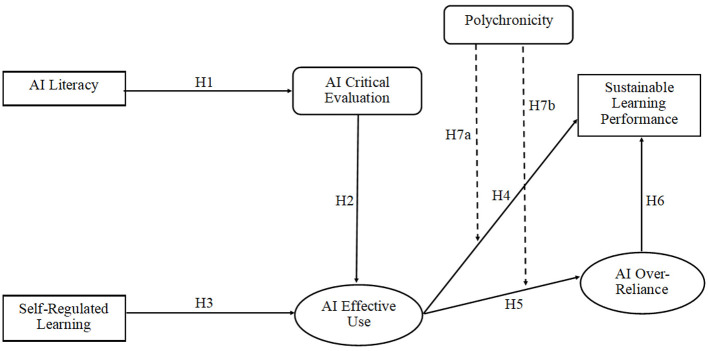
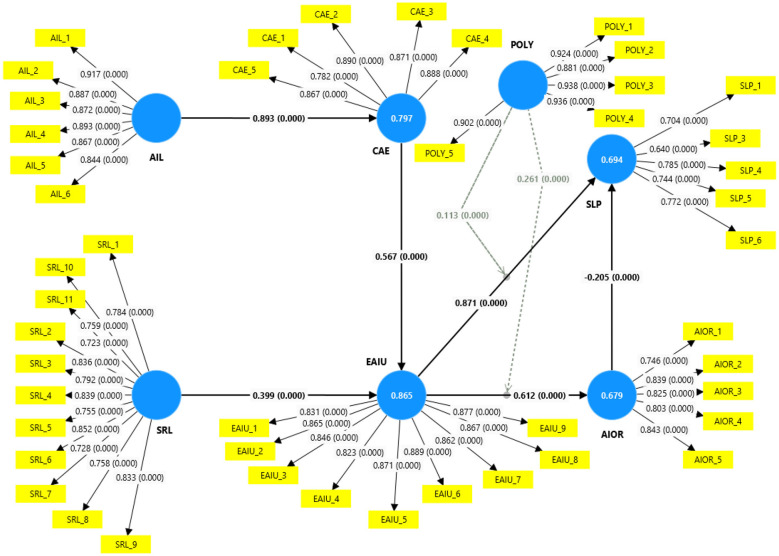
- AI literacy strongly predicted critical AI evaluation (β = 0.893, t = 111.167, p < 0.001, f² = 3.916), and critical AI evaluation plus self-regulated learning predicted effective AI use (β = 0.567 and β = 0.399, respectively, both p < 0.001).
- Effective AI use positively predicted sustainable learning performance (β = 0.871, t = 30.115, p < 0.001, f² = 1.139) but also positively predicted AI over-reliance (β = 0.612, t = 25.574, p < 0.001, f² = 1.160); AI over-reliance negatively predicted sustainable learning performance (β = −0.205, t = 5.291, p < 0.001, f² = 0.044).
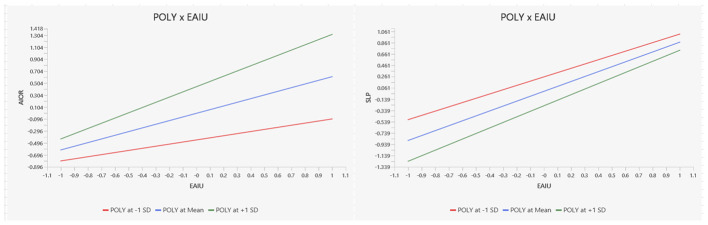
- Polychronicity moderated effective AI use → AI over-reliance (β = 0.261, t = 10.422, p < 0.001, f² = 0.227) and effective AI use → sustainable learning performance (β = 0.113, t = 4.452, p < 0.001, f² = 0.036).
- Model explanatory power: R² = 0.797 for critical AI evaluation, 0.865 for effective AI use, 0.679 for AI over-reliance, and 0.694 for sustainable learning performance; Q² values ranged from 0.360 to 0.626.
Methods
- Explanatory sequential mixed-method design: quantitative phase first, followed by qualitative educator interviews to explain and contextualize findings.
- Quantitative sample: three-wave time-lagged survey of Chinese university students; 1,000 questionnaires distributed in Wave 1, 771 valid responses, 693 in Wave 2, and 623 matched responses in Wave 3 (overall retention approximately 62.3%).
- Analysis: PLS-SEM using SmartPLS 4 with 5,000 bootstraps for direct and moderation paths; qualitative data from 15 educators were analyzed using Braun and Clarke’s six-phase thematic analysis, then integrated via triangulation, joint display analysis, and meta-inference.
Limitations
- The paper states that participants were drawn only from Chinese universities, limiting cross-cultural and cross-system generalizability.
- The paper states that the design was ultimately cross-sectional and non-experimental despite the time-lagged waves, so causality cannot be firmly established.
- The paper states that sustainable learning performance was measured only by student self-report, with no objective measures such as GPA, standardized retention assessments, or observable behavior; it also notes possible common method bias despite Harman’s test and full collinearity VIF diagnostics.
- The text makes evident additional measurement concerns: the HTMT for effective AI use and sustainable learning performance was 0.859, close to the conservative 0.85 threshold, and sustainable learning performance had a relatively low AVE of 0.534.
Model-written summary. Check it against the paper before relying on it.
Integrity signals
Registry
Cites
Statistics
Figures
Verification
Claims the paper makes
3 Valid · 8 Not valid · 44 Not checked · 156 Own results and interpretations
The cited sources support only part of this claim — read each source’s verdict below.
In the paper
“there is some evidence that students with a high degree of literacy in using AI are still vulnerable to becoming excessively dependent on AI due to the ease with which it can be used to perform cognitive tasks that require high levels of cognitive effort, thus creating a paradoxical situation in which productive use of AI may inadvertently result in an over-reliance (Zhai et al., 2024).”
§ From enhancement to over-reliance: a mixed-method study of generative AI and sustainable learning performance > Hypotheses development > Effective AI use and AI over-reliance
What the sources say
- Partly supportedcites Zhai et al., 2024 matched to “The effects of over-reliance on AI dialogue systems on students’ cognitive abilities: A systematic review” (2024) sourceExperimental — accuracy not yet measured
The nearest statement in our copy is the Discussion synthesis of over-reliance, which reports that 'individuals using AI dialogue systems, irrespective of their expertise level in the subject matter, are at risk of becoming overly reliant on them' (crediting Li & Little, 2023) — this supports the general 'skilled users are still vulnerable' point, but the source's qualifier is subject-matter expertise, not a high degree of AI literacy (the paper's only treatment of AI literacy is a Recommendation for literacy programmes, not a finding about literate users). The ease/convenience element is partly there: the Introduction and Discussion report that 'the ease of access to AI tools can lead to complacency' (Duhaylungsod & Chavez, 2023) and that 'the convenience offered by AI tools in providing quick answers might deter students from engaging in thorough research' (Abd-Alrazaq et al., 2023), and the Introduction notes AI 'inadvertently weaken[s] users' cognitive abilities by fostering an environment of dependency'. What our copy does not state is the specific mechanism the claim attributes — AI easing tasks 'that require high levels of cognitive effort' — nor an explicit 'paradoxical situation' in which productive use causes over-reliance; the paper only describes a 'dual impact' (benefits alongside risks) in the Question 1 findings. So the literacy framing and the cognitive-effort mechanism are the unsupported parts. (LLM, conf=0.72)
hedgedstates a possible cause- Asserted: passes — The authors put it forward as true.
- Checkable: passes — It can be checked against evidence.
- Load-bearing: passes — The paper’s conclusions depend on it.
- Based: passes — The paper gives a reason why it holds.
- Partly supported
The cited sources support only part of this claim — read each source’s verdict below.
In the paper
“Even those who are proficient in using AI tools and monitor their usage may be prone to becoming overly dependent on them because of the ability for AI to reduce the complexity of tasks and reduce the effort required for cognitive engagement (Zhai et al., 2024).”
§ From enhancement to over-reliance: a mixed-method study of generative AI and sustainable learning performance > Hypotheses development > AI over-reliance and sustainable learning performance
What the sources say
- Partly supportedcites Zhai et al., 2024 matched to “The effects of over-reliance on AI dialogue systems on students’ cognitive abilities: A systematic review” (2024) sourceExperimental — accuracy not yet measured
The Discussion (Li and Little 2023 passage) supports the 'even proficient users' element: individuals using AI dialogue systems 'irrespective of their expertise level' are at risk of becoming overly reliant. The reduced-effort element is supported only loosely by the Discussion heuristics passage (users opt for 'efficient cognitive shortcuts' and 'perceive benefits and time savings', which may diminish cognitive capabilities) and by the passage on AI streamlining research/writing tasks — but our copy nowhere states that AI reduces the complexity of tasks, and it contains no reference to users who monitor or regulate their own AI usage (searches for 'monitor their usage', 'task complexity', 'cognitive load' returned nothing on that point). The causal link joining the two halves is therefore assembled from separate statements and one qualifier ('who monitor their usage') is absent from the source. (LLM, conf=0.72)
hedgedstates a possible cause- Asserted: passes — The authors put it forward as true.
- Checkable: passes — It can be checked against evidence.
- Load-bearing: passes — The paper’s conclusions depend on it.
- Based: passes — The paper gives a reason why it holds.
- Partly supported
The cited sources support only part of this claim — read each source’s verdict below.
In the paper
“proving how AI literacy can impact evaluative actions performed toward specific outputs created by the use of the generative, probabilistic LLMs -a uniquely different challenge which cannot be fully covered by generic digital literacy approaches”
§ From enhancement to over-reliance: a mixed-method study of generative AI and sustainable learning performance > . Results and discussion > Discussion
What the sources say
- Partly supportedcites Oates and Johnson, 2025 matched to “ChatGPT in the classroom: evaluating its role in fostering critical evaluation skills” (2025) sourceExperimental — accuracy not yet measured
The Conclusion (n.p.) supports the first half of the attribution: 'The interaction between ChatGPT and the user emerges as a significant variable influencing the tool efficacy, pointing to the necessity embedding the developing AI literacy amongst learners within the curriculum... contingent on the user's ability to ask the right questions... it necessitates a level of proficiency in interacting with AI tools', reinforced by Student Opinions/Discussion passages on user engagement shaping how learners critically evaluate AI-generated output. However, no passage in our copy draws the contrast the claim's second half attributes to this source — that generative, probabilistic LLMs pose a 'uniquely different challenge which cannot be fully covered by generic digital literacy approaches'; the paper never discusses digital literacy as a comparator (searched: 'AI literacy digital literacy', 'generic digital competence', 'evaluative actions toward outputs'), mentioning only the digital age, digital divide (references) and participants' prior technological exposure. The framing is also softer in the source: it argues for embedding AI literacy in the curriculum rather than demonstrating its impact on evaluative actions. (LLM, conf=0.72)
boostedstates a cause- Asserted: passes — The authors put it forward as true.
- Checkable: passes — It can be checked against evidence.
- Load-bearing: passes — The paper’s conclusions depend on it.
- Based: passes — The paper gives a reason why it holds.
- Partly supported
A result the paper reports from its own data — it cites no other source for it, so there is none to check. The quote shows it is in the paper.
In the paper
“which, along with self-regulated learning, promotes effective AI use”
§ From enhancement to over-reliance: a mixed-method study of generative AI and sustainable learning performance > Abstract
plainstates a cause- Asserted: passes — The authors put it forward as true.
- Checkable: passes — It can be checked against evidence.
- Load-bearing: passes — The paper’s conclusions depend on it.
- Based: passes — The paper gives a reason why it holds.
A result the paper states — it cites no source for it, so there is none to check. The quote shows it is in the paper.
In the paper
“which, along with self-regulated learning, promotes effective AI use”
§ From enhancement to over-reliance: a mixed-method study of generative AI and sustainable learning performance > Abstract
plainstates a cause- Asserted: passes — The authors put it forward as true.
- Checkable: passes — It can be checked against evidence.
- Load-bearing: passes — The paper’s conclusions depend on it.
- Based: passes — The paper gives a reason why it holds.
67 more claims
Create a free account to see all 211 claims and to verify the 44 references still open.
- The quote only partly states this claim. 5
- It may state two separate claims as one. 74
- Probably not a substantial claim. 88
Self-check
Percentages, sums and reported differences re-computed from the paper’s own numbers.
Each contradiction between two passages listed here was confirmed by an independent check.
Rated major: it would touch a result — a value a result rests on, reported and recomputed p-values on opposite sides of the significance level, two passages that conflict with no sign which is right, or a cited work retracted before this paper was published.
In the paper
§ From enhancement to over-reliance: a mixed-method study of generative AI and sustainable learning performance > . Results and discussion > Hypotheses testing
“| POLY × EAIU → SLP | 0.113 | 0.025 | 4.452 | 0.000 | 0.036 |”
§ From enhancement to over-reliance: a mixed-method study of generative AI and sustainable learning performance > . Results and discussion > Hypotheses testing
“The slope is steepest at low polychronicity (−1 SD), then becomes flatter as polychronicity increases (+1 SD).”
Rated minor: it would not touch a result — a value no result rests on, a p-value that stays on the same side of the significance level, or a conflict that is clerical, resolved elsewhere in the paper, or outside its own findings.
In the paper
§ From enhancement to over-reliance: a mixed-method study of generative AI and sustainable learning performance > . Results and discussion > Measurement model assessment
“The construct of Self-Regulated Learning (SRL) had strong internal consistency with a Cronbach's Alpha (α) of 0.942, a Composite Reliability (CR) of 0.954, an FL of 0.723–0.852, and an Average Variance Extracted (AVE) of 0.622.”
§ From enhancement to over-reliance: a mixed-method study of generative AI and sustainable learning performance > . Results and discussion > Measurement model assessment
“| Self-regulated learning | SRL_1 | 0.784 | 0.939 | 0.947 | 0.622 |”
Rated minor: it would not touch a result — a value no result rests on, a p-value that stays on the same side of the significance level, or a conflict that is clerical, resolved elsewhere in the paper, or outside its own findings.
In the paper
§ From enhancement to over-reliance: a mixed-method study of generative AI and sustainable learning performance > . Results and discussion > Integration of quantitative and qualitative findings
“| H8: Moderation (POLY → SLP) | Significant | Reduced focus | Multitasking weakens deep learning |”
§ From enhancement to over-reliance: a mixed-method study of generative AI and sustainable learning performance > Hypotheses development > Moderating role of polychronicity
“- H7a: Polychronicity moderates the relationship between Effective AI Use and Sustainable Learning Performance, such that the relationship is weaker for students with higher polychronicity”
Rated minor: it would not touch a result — a value no result rests on, a p-value that stays on the same side of the significance level, or a conflict that is clerical, resolved elsewhere in the paper, or outside its own findings.
In the paper
§ From enhancement to over-reliance: a mixed-method study of generative AI and sustainable learning performance > . Results and discussion > Measurement model assessment
“the obtained HTMT value of 0.859 is above 0.90 but not equal to it”
§ From enhancement to over-reliance: a mixed-method study of generative AI and sustainable learning performance > . Results and discussion > Measurement model assessment
“HTMT = 0.859), which, while approaching the conservative 0.85 threshold, remains below the widely accepted 0.90 cutoff”
Rated minor: it would not touch a result — a value no result rests on, a p-value that stays on the same side of the significance level, or a conflict that is clerical, resolved elsewhere in the paper, or outside its own findings.
In the paper
“The total matched sample of 623 participants resulted in an overall retention of approximately 62.3% across all three waves of data collection.”
§ From enhancement to over-reliance: a mixed-method study of generative AI and sustainable learning performance > Methodology > Data collection process
Reported 62.3 · recomputed 80.80415
1 more finding
Create a free account to see every finding of this check.
Citations
Cites
Using thematic analysis in psychology
Braun, V., & Clarke, V. (2006) · Qualitative Research in Psychology · doi:10.1191/1478088706qp063oa · Cited by 194,414
Podsakoff, P. M., MacKenzie, S. B., Lee, J.-Y., & Podsakoff, N. P. (2003) · Journal of Applied Psychology · doi:10.1037/0021-9010.88.5.879 · Cited by 82,194
A new criterion for assessing discriminant validity in variance-based structural equation modeling
Henseler, J., Ringle, C. M., & Sarstedt, M. (2015) · Journal of the Academy of Marketing Science · doi:10.1007/s11747-014-0403-8 · Cited by 38,459
When to Use and How to Report the Results of PLS-SEM
Hair, J. F., Risher, J. J., Sarstedt, M., & Ringle, C. M. (2019) · European Business Review · doi:10.1108/ebr-11-2018-0203 · Cited by 27,541
Palinkas, L. A., Horwitz, S. M., Green, C. A., Wisdom, J. P., Duan, N., & Hoagwood, K. (2015) · Administration and Policy in Mental Health and Mental Health Services Research · doi:10.1007/s10488-013-0528-y · Cited by 12,038
Partial Least Squares Structural Equation Modeling (PLS-SEM) Using R: A Workbook
Hair, J. F., Hult, G. T. M., Ringle, C. M., Sarstedt, M., Danks, N. P., & Ray, S. (2021) · Classroom Companion: Business · doi:10.1007/978-3-030-80519-7 · Cited by 10,343
Common Method Bias in PLS-SEM: A Full Collinearity Assessment Approach
Kock, N. (2015) · International Journal of e-Collaboration · doi:10.4018/ijec.2015100101 · Cited by 10,215
Internet, Phone, Mail, and Mixed‐Mode Surveys: The Tailored Design Method
Dillman, D. A., Smyth, J. D., & Christian, L. M. (2014) · Wiley eBooks · doi:10.1002/9781394260645 · Cited by 4,460
Bias in cross-sectional analyses of longitudinal mediation
Maxwell, S. E., & Cole, D. A. (2007) · Psychological Methods · doi:10.1037/1082-989x.12.1.23 · Cited by 3,401
What is AI Literacy? Competencies and Design Considerations
Long, D., & Magerko, B. (2020) · Proceedings of the 2020 CHI Conference on Human Factors in Computing Systems · doi:10.1145/3313831.3376727 · Cited by 3,241
Research works printed but not linked: 1
- Kline R. B. (2023). Principles and Practice of Structural Equation Modeling, 5th edn. New York, NY: The Guilford Press.
Cited by
Li, S., 张国平, & Yang, Z. (2026) · Frontiers in Psychology · doi:10.3389/fpsyg.2026.2011342
Metadata
- Authors
- Gao, L., Sun, Y., & Khan, S. U.
- Affiliations
- Student Aid Management Center, Jiangxi Institute of Technology
- Weifang University (CN)
- Shenzhen University (CN)
- Corresponding author
- Sun, Yanli
- Venue
- Frontiers in Psychology
- Publisher
- Frontiers Media SA
- Published
- 2026-06-29
- Volume
- 17
- Pages
- 1847369-1847369
- ISSN
- 1664-1078 (ISSN-L)
- PMC
- PMC13359038
- OpenAlex
- W7166520030
- Semantic Scholar
- 8287067bc1053111ca8b56296044a6196006dae9
- Cited by
- 1
- References
- 80
- Citations by year
- 2026: 1
- FWCI
- 3.61
- Type
- journal article
- Language
- en
- Open access
- gold
- doi.org
- Licence
- Locations
- Frontiers in Psychology (publishedVersion, cc-by)
- PubMed (publishedVersion)
- PubMed Central (publishedVersion, cc-by)
- DOAJ (DOAJ: Directory of Open Access Journals) (submittedVersion)
- Topics
- Social Sciences › Education › Artificial Intelligence in Education
- Health Sciences › Medicine › Health Informatics › Artificial Intelligence in Healthcare and Education
- Physical Sciences › Computer Science › Artificial Intelligence › Intelligent Tutoring Systems and Adaptive Learning
- Keywords
- generative AI in education, overreliance on AI, AI literacy, student self-regulation, cognitive offloading, individual differences, polychronicity, multitasking, university students, AI-assisted learning
About these checks
Registry, retraction, Cites and statistics results are computed, not judged, with one exception: a printed reference that no index lists is read once by a model before it counts as a citation error. Claims are extracted by a model and kept only when their quote appears verbatim in the text; each cited source is then checked, with a model’s help, for whether it says what the claim relies on. Those verdicts can be wrong — read the claim’s quote and the cited source before relying on one.
The claim verdicts this report counts are experimental: their accuracy is not yet measured.
A language model drew the claims from the paper on 2026-11-18, under version 3 of the claim definition (model deepseek-v4.1-flash, prompt extract-v3).
A second model labelled each claim on 2026-11-18 (model jev-1.13-20260917, definition revision gold-guideline-v0.2).
Cited sources are checked with a language model’s help (qwen3.8-omni-flash).
Statistics and arithmetic are recomputed, not judged.
Confidence bands are shown only for fields calibrated on our annotated test set. None is calibrated yet, so no band is shown.
What counts as a claim ›How we measure confidence ›How we check this ›
Are you an author, or do you see a problem with this page? Request a review
Data sources
Bibliographic data: Semantic Scholar, OpenAlex, Crossref.
Contains information from the Semantic Scholar Academic Graph Datasets, made available under the ODC Attribution License (ODC-BY 1.0).
Semantic Scholar’s data is described in: Kinney, R., et al. (2023). The Semantic Scholar Open Data Platform. arXiv:2301.10140.
