

The DOI matches its Crossref record; 66 of the 66 references it cites were found in a registry or an index.
Therapeutic and Preventive Use of Video Games in Child and Adolescent Psychiatry: A Systematic Review
Open accessAbstract
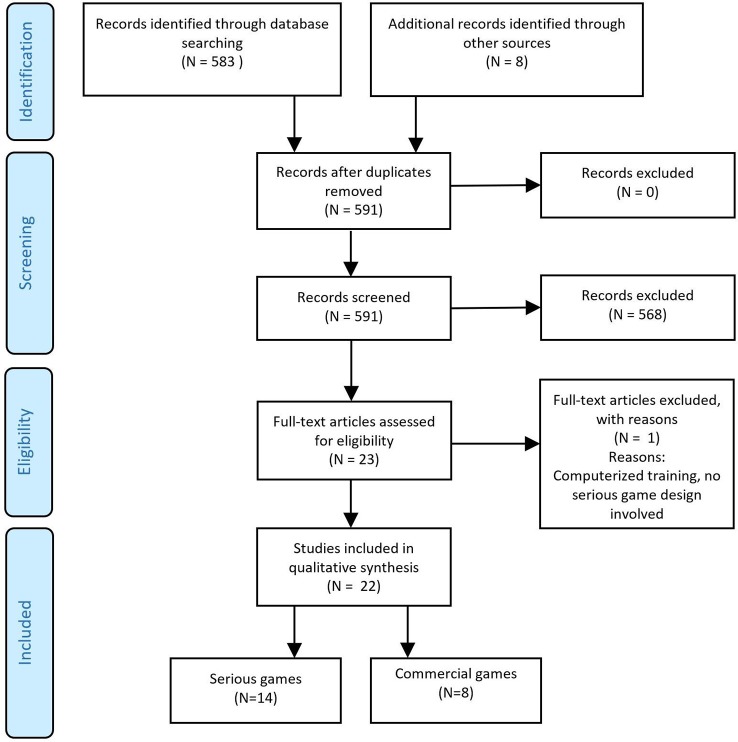
BACKGROUND: Over the past decade, the use of commercial video games and serious games has developed in child and adolescent psychiatry. These games may become relevant alternatives or adjuncts to traditional psychotherapy, providing that their effectiveness is properly established. The purpose of this literature review was to evaluate the effectiveness of serious games and commercial video games in the treatment or prevention of psychiatric disorders in children and adolescents. METHODS: Medline's database was used to search articles published between January 2012 and July 2019. The following keywords were used for this search: "Video games" OR "Active video game" OR "serious gaming" OR "Serious game" OR "Exergame" AND "Child mental disorder" OR "Adolescent" OR "Child" AND "Therapy" OR "Prevention". Only comparative studies which targeted interventions on children and adolescents suffering from psychiatric disorders were included. RESULTS: Twenty-two studies, focusing on a wide range of psychiatric conditions, met our inclusion criteria's: 14 evaluated serious games and 8 commercial games. All studies were randomized controlled trials but only two studies compared the intervention game to psychotherapeutic gold standard; other studies used a no-intervention control group or an alternative game as the control group. Eighteen studies reported significant improvements on the symptoms and test scores targeted. CONCLUSION: Serious games and commercially available video games can be an effective trajectory for psychotherapy in child and adolescent psychiatry. However, there is a lack of longitudinal studies which assess the sustained effects of these games, and standards for proper evaluation of their effectiveness are missing.
Overview
The claims and statistics of this paper haven’t been checked yet.
Run the check — free, no account needed. It reads the open-access text and checks the sources it cites.
Integrity signals
Registry
Cites
Statistics
Figures
Verification
Claims the paper makes
The claims and statistics of this paper haven’t been checked yet.
Run the check — free, no account needed. It reads the open-access text and checks the sources it cites.
Claims other papers make about this one
Each is checked against this paper’s own text: does it say what the citing paper says it does?
The cited source says what the claim attributes to it.
In the citing paper
“Another issue with many of these studies is that they often lack appropriate and rigorous methodology such as longitudinal follow-up,29 and a mixed-methodological approach that can assess the feasibility and acceptability of such interventions.”
From A novel ACT-based video game to support mental health through embedded learning: A mixed-methods feasibility study protocol (2020) · cites this paper as [29]
Self-check
Percentages, sums and reported differences re-computed from the paper’s own numbers.
The self-check needs the paper’s full text.
Citations
Cites
Preferred Reporting Items for Systematic Reviews and Meta-Analyses: the PRISMA statement
Moher, D., Liberati, A., Tetzlaff, J., Altman, D. G., & for the PRISMA Group (2009) · BMJ · doi:10.1136/bmj.b2535 · Cited by 83,823
Preferred reporting items for systematic reviews and meta-analyses: the PRISMA Statement.
(2009) · PubMed Central · Cited by 44,859
Lecture Notes in Computer Science 1205
(1999) · Industrial Robot the international journal of robotics research and application · doi:10.1108/ir.1999.04926fae.001 · Cited by 39,228
Reciprocal Teaching of Comprehension-Fostering and Comprehension-Monitoring Activities
Palinscar, A. S., & Brown, A. L. (1984) · Cognition and Instruction · doi:10.1207/s1532690xci0102_1 · Cited by 5,186
A systematic literature review of empirical evidence on computer games and serious games
Connolly, T. M., Boyle, E. A., MacArthur, E., Hainey, T., & Boyle, J. M. (2012) · Computers & Education · doi:10.1016/j.compedu.2012.03.004 · Cited by 2,890
From visual simulation to virtual reality to games
Zyda, M. (2005) · Computer · doi:10.1109/mc.2005.297 · Cited by 2,077
Is working memory training effective? A meta-analytic review
Melby-Lervåg, M., & Hulme, C. (2013) · Developmental Psychology · doi:10.1037/a0028228 · Cited by 1,782
Unmet Need for Mental Health Care Among U.S. Children: Variation by Ethnicity and Insurance Status
Kataoka, S. H., Zhang, L., & Wells, K. B. (2002) · American Journal of Psychiatry · doi:10.1176/appi.ajp.159.9.1548 · Cited by 1,566
Baranowski, T., Buday, R., Thompson, D. I., & Baranowski, J. (2008) · American Journal of Preventive Medicine · doi:10.1016/j.amepre.2007.09.027 · Cited by 998
Meta-analysis of action video game impact on perceptual, attentional, and cognitive skills.
Bediou, B., Adams, D. M., Mayer, R. E., Tipton, E., Green, C. S., & Bavelier, D. (2018) · Psychological Bulletin · doi:10.1037/bul0000130 · Cited by 807
Research works printed but not linked: 4
- Oh, 2010, Defining exergames & exergaming
- Schoneveld, 2018, Preventing childhood anxiety disorders: is an applied game as effective as a cognitive behavioral therapy-based program?, Prev Sci Off J Soc Prev Res, 19, 10.1007/s11121-017-0843-8 · DOI · Paper page
- Franceschini, 2013, Action video games make dyslexic children read better, Curr Biol CB, 23, 10.1016/j.cub.2013.01.044 · DOI
- Perry, 2017, preventing depression in final year secondary students: school-based randomized controlled trial, J Med Internet Res, 19, e369, 10.2196/jmir.8241 · DOI · Paper page
Cited by
Sorted by citations
Items 101–124 of 124
Positive and Negative Aspects of Digital Games from the Perspective of Adolescents
KESKİN, A. D., & Aral, N. (2022) · Türk Psikolojik Danışma ve Rehberlik Dergisi · doi:10.17066/tpdrd.1224117
Avoiding Artifacts in a Self-Assessed Electroencephalogram Dataset for Emotion PerceptionPreprint
Almanza-Conejo, O., Avina‐Cervantes, J. G., García-Pérez, A., & Ibarra-Manzano, M.-A. (2023) · SSRN Electronic Journal · doi:10.2139/ssrn.4467225
Design and Validation of a Mobile Depression Application for Young Adults through Expert Review
Yusof, N., Harun, H., & Aziz, N. (2023) · Journal of Advanced Research in Applied Sciences and Engineering Technology · doi:10.37934/araset.32.2.277288 · Cited by 2
Leroux, Y. (2023) · Contraste · doi:10.3917/cont.057.0221
Gaming, eSports, and Spanish Consumer Behavior
Batalla, D. D. M., López-Tenorio, P. J., & Carlos, M. P. S. D. (2024) · Advances in marketing, customer relationship management, and e-services book series · doi:10.4018/979-8-3693-1231-5.ch015
Carbon emission reduction of the memory game with game prototype method for golden age
Praditasari, W. A. A., Tambunan, A. C., Songklainita, A., Bangun, A. F., Dewa, R. T., Puspitasari, S. D., & Kholis, I. (2024) · AIP conference proceedings · doi:10.1063/5.0242305
Psychotherapy: Home vs. Digital Games or Home&Digital Games&AI
Hudíková, Z. (2024) · Media & Marketing Identity · doi:10.34135/mmidentity-2024-77
Mafela, L., & Sekgobela, T. (2025) · International Journal of Research in Business and Social Science (2147-4478) · doi:10.20525/ijrbs.v14i1.3717
Rooij, D. S. T., Kuipers, D. A., Prins, J., & Pierie, J.-P. E. N. (2025) · doi:10.2196/preprints.77173
Ike, T. C., Yi, N. K. H., & Shaker, V. (2025) · Lecture notes in networks and systems · doi:10.1007/978-981-96-5214-3_35
Cho, M., Hwang, S., Kim, Y. J., & Lee, D. (2025) · SAGE Open · doi:10.1177/21582440251370833
Murugan, K., Das, K., Shrinivasan, V., Aravind, P., Suresh, I., & Saravanan, P. (2025) · doi:10.38124/ijisrt/25sep577 · Cited by 1
Rezayi, S., Tehrani‐Doost, M., & Shahmoradi, L. (2024) · Figshare · doi:10.6084/m9.figshare.26558921
Atención, memoria y funciones ejecutivas, en niños y niñas que utilizan videojuegos
Barrera, D. C. C., Lozano-Plazas, J. E., & Muñoz, J. D. C. (2025) · Revista Lasallista de Investigación · doi:10.22507/rli.v22n2a3876
Gaming‑Based Community Intervention for Loneliness in Adult Gamers: Longitudinal Observational Study
Neu, C., Hull, T. D., & Malgaroli, M. (2026) · JMIR Formative Research · doi:10.2196/82428
Rebollo, C., Castellar, R. G., Remolar, I., & Rossano, V. (2026) · Entertainment Computing · doi:10.1016/j.entcom.2026.101093 · Cited by 2
Exploring the field of exergaming: a bibliometric and content analysis
Lu, X., Shi, Z., Wang, Y., Gong, D., & Zhang, X. (2026) · Entertainment Computing · doi:10.1016/j.entcom.2026.101113
Revet, A. (2021) · theses.fr (ABES) · doi:10.70675/89a70176z3a60z462bz811dz3f3939e5e591
Self-citationAydın, T., İnci, F., Kilic, M., Yiğit, N., Kahve, Y., & Ceyhan, E. (2026) · Journal of Children s Orthopaedics · doi:10.1177/18632521261466900
Shin, S., Chandra, S., Rajan, A., Shah, S., & Dautenhahn, K. (2026) · Advanced Robotics · doi:10.1080/01691864.2026.2700312
Reading Interventions in the Modern Era: Reconceptualizing the Utility of Video Games
Mehmedovic, S. (2025) · Digital Commons - DU (University of Denver) · doi:10.56902/etdcrp.2025.143
Digital Technologies in Social Work with Children and Youth: The Experiences of Social Workers
Sadauskas, J., & Jesa, B. I. (2026) · European social work education and practice · doi:10.1007/978-3-032-18544-0_7
The Association Between Video Gaming and Adolescent Identity: A Systematic Review
van Nierop, B., Wijsbroek, S. A. M., Kleinjan, M., Maes, M., Cup, V. H., & Peeters, M. (2026) · Adolescent Research Review · doi:10.1007/s40894-026-00295-5
Hayden‐Evans, M., Inkster, T., Fimmano, I., Smith, Z., Leamon, J., Girdler, S. J., & Milbourn, B. T. (2026) · Australian Occupational Therapy Journal · doi:10.1111/1440-1630.70132
Metadata
- Authors
- Zayeni, D., Raynaud, J.-P., & Revet, A.
- Affiliations
- Centre Hospitalier Universitaire de Toulouse (FR)
- Université Toulouse III - Paul Sabatier (FR)
- Corresponding author
- Zayeni, Darius
- Venue
- Frontiers in Psychiatry
- Publisher
- Frontiers Media SA
- Published
- 2020-02-06
- Volume
- 11
- Issue
- 36
- Pages
- 36-36
- ISSN
- 1664-0640 (ISSN-L)
- PMC
- PMC7016332
- OpenAlex
- W3004678209
- Cited by
- 124
- References
- 66
- Citations by year
- 2026: 9 · 2025: 23 · 2024: 24 · 2023: 21 · 2022: 22 · 2021: 18 · 2020: 7
- FWCI
- 3.57
- Type
- journal article
- Language
- en
- Open access
- gold
- doi.org
- Licence
- Locations
- Frontiers in Psychiatry (publishedVersion, cc-by)
- PubMed Central (publishedVersion, cc-by)
- PubMed (publishedVersion)
- HAL (submittedVersion, other-oa)
- DOAJ (DOAJ: Directory of Open Access Journals) (submittedVersion, cc-by-sa)
- Topics
- Social Sciences › Psychology › Developmental and Educational Psychology › Educational Games and Gamification
- Social Sciences › Psychology › Applied Psychology › Digital Mental Health Interventions
- Social Sciences › Psychology › Clinical Psychology › Child Therapy and Development
- Keywords
- serious games, video games, exergames, child and adolescent psychiatry, mental illness, prevention, psychotherapy adjunct, game-based intervention
About these checks
Registry, retraction, Cites and statistics results are computed, not judged, with one exception: a printed reference that no index lists is read once by a model before it counts as a citation error. Claims are extracted by a model and kept only when their quote appears verbatim in the text; each cited source is then checked, with a model’s help, for whether it says what the claim relies on. Those verdicts can be wrong — read the claim’s quote and the cited source before relying on one.
Statistics and arithmetic are recomputed, not judged.
Confidence bands are shown only for fields calibrated on our annotated test set. None is calibrated yet, so no band is shown.
What counts as a claim ›How we measure confidence ›How we check this ›
Are you an author, or do you see a problem with this page? Request a review
