

The DOI matches its Crossref record; 56 of the 59 references it cites were found in a registry or an index.
Post-COVID-19 fatigue: A systematic review
Open accessAbstract
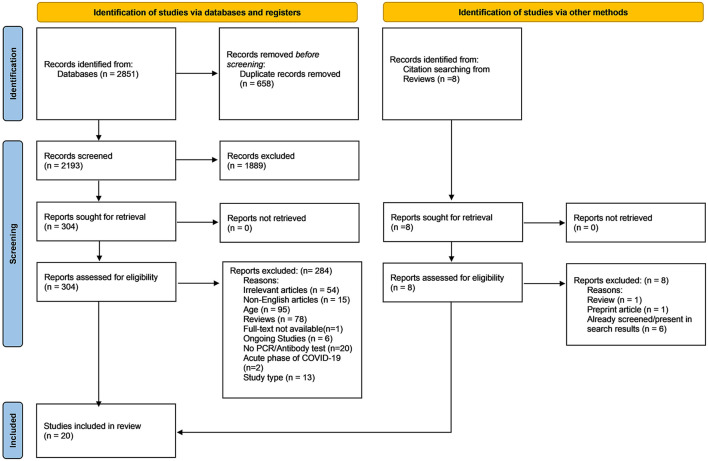
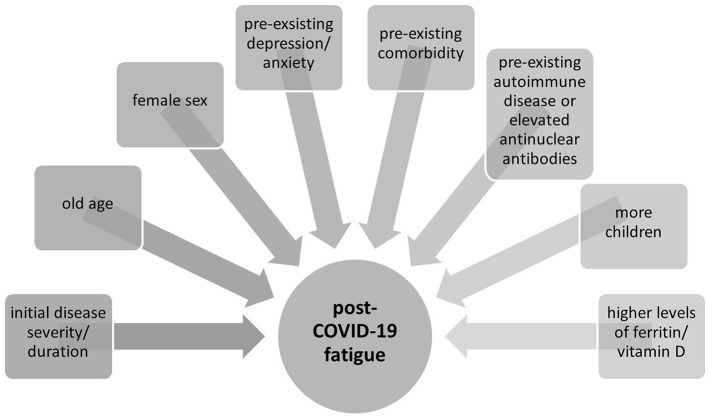
Fatigue is recognized as one of the most commonly presented long-term complaints in individuals previously infected with SARS-CoV-2. This systematic review was performed to describe symptoms, etiology, possible risk factors related to post-COVID-19 fatigue and the therapeutic approaches used for the treatment of post-COVID-19 fatigue. For the systematic literature search the databases PubMed, Web of Science, Cochrane Library, and PsycInfo were used. All articles that met the inclusion criteria were analyzed for demographics, clinical data and treatment. Included were studies which focused on an adult population (18–65 years old); elderly patients and patients with chronic somatic diseases which can also cause fatigue were excluded. We identified 2,851, screened 2,193 and finally included 20 studies with moderate to high methodological quality, encompassing 5,629 participants. Potential risk factors for post-COVID-19 fatigue were old age, female sex, severe clinical status in the acute phase of infection, a high number of comorbidities, and a prediagnosis of depression/anxiety. Lastly, a possible autoimmune etiology was suspected. Several treatment approaches have been tested mostly in small and uncontrolled studies so far: a Chinese herbal formulation improved breathlessness and fatigue. Moreover, molecular hydrogen (H2) inhalation had beneficial health effects in terms of improved physical (6-min walking test) and respiratory function in patients with post-COVID-19. Patients also noticed improvement in fatigue after undergoing hyperbaric oxygen therapy (HBOT) and enhanced external counterpulsation (EECP). Lastly. muscle strength and physical function were improved after undergoing an 8-weeks biweekly physical therapy course including aerobic training, strengthening exercises, diaphragmatic breathing techniques, and mindfulness training. However, larger and controlled studies e.g., investigating the effect of physical and / or psychotherapy for patients with post-COVID-19 fatigue are urgently warranted. Systematic Review Registration Unique Identifier: CRD42022320676, https://www.crd.york.ac.uk/PROSPERO/ .
Overview
The claims and statistics of this paper haven’t been checked yet.
Run the check — free, no account needed. It reads the open-access text and checks the sources it cites.
Integrity signals
Registry
Cites
Statistics
Figures
Verification
Claims the paper makes
The claims and statistics of this paper haven’t been checked yet.
Run the check — free, no account needed. It reads the open-access text and checks the sources it cites.
Claims other papers make about this one
Each is checked against this paper’s own text: does it say what the citing paper says it does?
The cited source says what the claim attributes to it.
In the citing paper
“Second, specific symptom-based interventions are usually provided (Chennapragada et al., 2022), which makes it difficult to address comorbid EDs, for instance, anxiety and depressive symptoms that are simultaneously present in COVID-19 patients (Joli et al., 2022).”
From Unified Protocol for the transdiagnostic treatment of emotional disorders in people with post COVID-19 condition: study protocol for a multiple baseline n-of-1 trial (2023) · cites this paper as Joli et al., 2022
Self-check
Percentages, sums and reported differences re-computed from the paper’s own numbers.
The self-check needs the paper’s full text.
Citations
Cites
ROBINS-I: a tool for assessing risk of bias in non-randomised studies of interventions
Sterne, J. A., Hernán, M. A., Reeves, B. C., Savović, J., Berkman, N. D., Viswanathan, M., Henry, D., Altman, D. G., Ansari, M. T., Boutron, I., et al. (2016) · BMJ · doi:10.1136/bmj.i4919 · Cited by 20,329
Psychophysical bases of perceived exertion
BORG, G. A. V. (1982) · Medicine & Science in Sports & Exercise · doi:10.1249/00005768-198205000-00012 · Cited by 16,580
Page, M. J., Moher, D., Bossuyt, P. M., Boutron, I., Hoffmann, T. C., Mulrow, C. D., Shamseer, L., Tetzlaff, J. M., Akl, E. A., Brennan, S. E., et al. (2021) · BMJ · doi:10.1136/bmj.n160 · Cited by 13,262
Development of a fatigue scale
Chalder, T., Berelowitz, G., Pawlikowska, T., Watts, L., Wessely, S., Wright, D., & Wallace, E. P. (1993) · Journal of Psychosomatic Research · doi:10.1016/0022-3999(93)90081-p · Cited by 3,032 · cited 5×
“%) female gender has a higher risk of fatigue El Sayed, 2021 (14) Saudi Arabia Cross-sectional observational study with longitudinal component patients with COVID-19 after 2 consecutive negative PCR tests who attended the pulmonology clinic for follow up and psychiatric department for assessment n= 200 mean age: 36.6…”
MethodInfluentialMore than 50 long-term effects of COVID-19: a systematic review and meta-analysis
Lopez-Leon, S., Wegman-Ostrosky, T., Perelman, C., Sepulveda, R., Rebolledo, P. A., Cuapio, A., & Villapol, S. (2021) · Scientific Reports · doi:10.1038/s41598-021-95565-8 · Cited by 2,757
Püntmann, V. O., Carerj, M. L., Wieters, I., Fahim, M., Arendt, C. T., Hoffmann, J., Shchendrygina, A., Escher, F., Vasa‐Nicotera, M., Zeiher, A. M., et al. (2020) · JAMA Cardiology · doi:10.1001/jamacardio.2020.3557 · Cited by 2,228
The Value of Cardiovascular Autonomic Function Tests: 10 Years Experience in Diabetes
Ewing, D. J., Martyn, C., Young, R. J., & Clarke, B. F. (1985) · Diabetes Care · doi:10.2337/diacare.8.5.491 · Cited by 1,436
Pathogenic T-cells and inflammatory monocytes incite inflammatory storms in severe COVID-19 patients
Zhou, Y., Fu, B., Zheng, X., Wang, D., Zhao, C., Qi, Y., Sun, R., Tian, Z., Xu, X., & Wei, H. (2020) · National Science Review · doi:10.1093/nsr/nwaa041 · Cited by 1,295
Weisman, I. M., & Zeballos, R. J. (1976) · American Heart Journal · doi:10.1016/s0002-8703(76)80065-8 · Cited by 1,217
Townsend, L., Dyer, A. H., Jones, K., Dunne, J., Mooney, A., Gaffney, F., O'Connor, L., Leavy, D., O'Brien, K., Dowds, J., et al. (2020) · PLOS ONE · doi:10.1371/journal.pone.0240784 · Cited by 911
NIH Toolbox for Assessment of Neurological and Behavioral Function
Gershon, R. C., Wagster, M. V., Hendrie, H. C., Fox, N. A., Cook, K. F., & Nowinski, C. J. (2013) · Neurology · doi:10.1212/wnl.0b013e3182872e5f · Cited by 895
Psychometric qualities of a brief self-rated fatigue measure
Michielsen, H. J., De Vries, J., & Van Heck, G. L. (2003) · Journal of Psychosomatic Research · doi:10.1016/s0022-3999(02)00392-6 · Cited by 860
Augustin, M., Schommers, P., Stecher, M., Dewald, F., Gieselmann, L., Gruell, H., Horn, C., Vanshylla, K., Cristanziano, V. D., Osebold, L., et al. (2021) · The Lancet Regional Health - Europe · doi:10.1016/j.lanepe.2021.100122 · Cited by 715
Persistent neurologic symptoms and cognitive dysfunction in non-hospitalized COVID-19 “long haulers”
Graham, E. L., Clark, J. R., Orban, Z. S., Lim, P. H., Szymanski, A. L., Taylor, C., DiBiase, R. M., Jia, D. T., Balabanov, R., Ho, S. U., et al. (2021) · Annals of Clinical and Translational Neurology · doi:10.1002/acn3.51350 · Cited by 693
Malik, P., Patel, K., Pinto, C., Jaiswal, R., Tirupathi, R., Pillai, S., & Patel, U. K. (2021) · Journal of Medical Virology · doi:10.1002/jmv.27309 · Cited by 670
Buccheri, G., Ferrigno, D., & Tamburini, M. (1996) · European Journal of Cancer · doi:10.1016/0959-8049(95)00664-8 · Cited by 627
More than 50 Long-term effects of COVID-19: a systematic review and meta-analysisPreprint
López‐León, S., Wegman-Ostrosky, T., Perelman, C., et al. (2021) · medRxiv · doi:10.1101/2021.01.27.21250617 · Cited by 613
Assessment and characterisation of post‐COVID‐19 manifestations
Kamal, M., Abo Omirah, M., Hussein, A., & Saeed, H. (2021) · International Journal of Clinical Practice · doi:10.1111/ijcp.13746 · Cited by 603
Lai, J., Cella, D. F., Choi, S. W., Junghaenel, D. U., Christodoulou, C., Gershon, R. C., & Stone, A. A. (2011) · Archives of Physical Medicine and Rehabilitation · doi:10.1016/j.apmr.2010.08.033 · Cited by 377
Frequency, signs and symptoms, and criteria adopted for long COVID‐19: A systematic review
Martimbianco, A. L. C., Pacheco, R. L., Bagattini, Â. M., & Riera, R. (2021) · International Journal of Clinical Practice · doi:10.1111/ijcp.14357 · Cited by 370
Townsend, L., Dowds, J., O’Brien, K., Sheill, G., Dyer, A. H., O’Kelly, B., Hynes, J. P., Mooney, A., Dunne, J., Cheallaigh, C. N., et al. (2021) · Annals of the American Thoracic Society · doi:10.1513/annalsats.202009-1175oc · Cited by 296
Cognitive behaviour therapy in chronic fatigue syndrome.
Butler, S., Chalder, T., Ron, M. A., & Wessely, S. C. (1991) · Journal of Neurology Neurosurgery & Psychiatry · doi:10.1136/jnnp.54.2.153 · Cited by 277
Ichihara, M., Sobue, S., Ito, M., Ito, M., Hirayama, M., & Ohno, K. (2015) · Medical Gas Research · doi:10.1186/s13618-015-0035-1 · Cited by 275
Post-COVID-19 Fatigue: Potential Contributing Factors
Rudroff, T., Fietsam, A. C., Deters, J. R., Bryant, A., & Kamholz, J. A. (2020) · Brain Sciences · doi:10.3390/brainsci10121012 · Cited by 259
Heckenberg, R. A., Eddy, P. J., Kent, S., & Wright, B. J. (2018) · Journal of Psychosomatic Research · doi:10.1016/j.jpsychores.2018.09.010 · Cited by 249
Sivan, M., & Taylor, S. (2020) · BMJ · doi:10.1136/bmj.m4938 · Cited by 244
Vanichkachorn, G., Newcomb, R. A., Cowl, C. T., Murad, M. H., Breeher, L. E., Miller, S., Trenary, M., Neveau, D., & Higgins, S. (2021) · Mayo Clinic Proceedings · doi:10.1016/j.mayocp.2021.04.024 · Cited by 243
An index for breathlessness and leg fatigue
Borg, E., Borg, G., Larsson, K., Letzter, M., & Sundblad, B. (2010) · Scandinavian Journal of Medicine and Science in Sports · doi:10.1111/j.1600-0838.2009.00985.x · Cited by 235
Traditional Chinese medicine in COVID-19
Lyu, M., Fan, G., Xiao, G., Wang, T., Xu, D. W., Gao, J., Ge, S., Li, Q., Ma, Y., Zhang, H., et al. (2021) · Acta Pharmaceutica Sinica B · doi:10.1016/j.apsb.2021.09.008 · Cited by 227
Chronic fatigue syndrome, the immune system and viral infection
Bansal, A. S., Bradley, A. S., Bishop, K. N., Kiani‐Alikhan, S., & Ford, B. (2011) · Brain Behavior and Immunity · doi:10.1016/j.bbi.2011.06.016 · Cited by 220
Infectious Diseases Society of America Guidelines on the Diagnosis of COVID-19 (June 2020)
Hanson, K. E., Caliendo, A. M., Arias, C. A. D., Englund, J. A., Lee, M. J., Loeb, M. B., Patel, R., Alayli, A. E., Kalot, M. A., Falck-Ytter, Y. T., et al. (2020) · Clinical Infectious Diseases · doi:10.1093/cid/ciaa760 · Cited by 213
Hanson, K. E., Caliendo, A. M., Arias, C. A. D., Hayden, M. K., Englund, J. A., Lee, M. J., Loeb, M. B., Patel, R., Alayli, A. E., Altayar, O., et al. (2021) · Clinical Infectious Diseases · doi:10.1093/cid/ciab048 · Cited by 184
The anti-inflammatory mechanism of antidepressants – SSRIs, SNRIs
Gałecki, P., Mossakowska-Wójcik, J., & Talarowska, M. E. (2017) · Progress in Neuro-Psychopharmacology and Biological Psychiatry · doi:10.1016/j.pnpbp.2017.03.016 · Cited by 180
Nehme, M., Braillard, O., Chappuis, F., Courvoisier, D. S., Guessous, I., & CoviCare Study Team (2021) · Annals of Internal Medicine · doi:10.7326/m21-0878 · Cited by 151
Ameringer, S., Elswick, R. K., Menzies, V. S., Robins, J. L. W., Starkweather, A. R., Walter, J. M., Gentry, A. E., & Jallo, N. (2016) · Nursing Research · doi:10.1097/nnr.0000000000000162 · Cited by 126
Sayed, S. E., Shokry, D., & Gomaa, S. (2020) · Neuropsychopharmacology Reports · doi:10.1002/npr2.12154 · Cited by 116
Fatigue following COVID-19 infection is not associated with autonomic dysfunction
Townsend, L., Moloney, D. J., Finucane, C., McCarthy, K., Bergin, C. J., Bannan, C., & Kenny, R. A. (2021) · PLoS ONE · doi:10.1371/journal.pone.0247280 · Cited by 98
Vink, M., & Vink-Niese, A. (2020) · Healthcare · doi:10.3390/healthcare8040552 · Cited by 86
Prevalence of Post-COVID-19 Cough One Year After SARS-CoV-2 Infection: A Multicenter Study
Fernández‐de‐las‐Peñas, C., Guijarro, C., Canteli, S. P., Hernández‐Barrera, V., & Torres‐Macho, J. (2021) · Lung · doi:10.1007/s00408-021-00450-w · Cited by 83
Physical Therapy Management of an Individual With Post-COVID Syndrome: A Case Report
Mayer, K. P., Steele, A. K., Soper, M. K., Branton, J. D., Lusby, M. L., Kalema, A. G., Dupont‐Versteegden, E. E., & Montgomery-Yates, A. A. (2021) · Physical Therapy · doi:10.1093/ptj/pzab098 · Cited by 70
Enhanced External Counterpulsation Therapy
Raza, A., Steinberg, K., Tartaglia, J., Frishman, W. H., & Gupta, T. (2016) · Cardiology in Review · doi:10.1097/crd.0000000000000122 · Cited by 61
Botek, M., Krejčí, J., Valenta, M., McKune, A. J., Sládečková, B., Konečný, P., Klimešová, I., & Pastucha, D. (2022) · International Journal of Environmental Research and Public Health · doi:10.3390/ijerph19041992 · Cited by 59
Margalit, I., Yelin, D., Sagi, M., Rahat, M. M., Sheena, L., Mizrahi, N., Gordin, Y., Agmon, H., Karny-Epstein, N., Atamna, A., et al. (2022) · Clinical Infectious Diseases · doi:10.1093/cid/ciac283 · Cited by 55
PROMIS Scales for Assessment of Persistent Post-COVID Symptoms: A Cross Sectional Study
Ganesh, R., Ghosh, A. K., Nyman, M., Croghan, I. T., Grach, S. L., Anstine, C. V., Salonen, B. R., & Hurt, R. T. (2021) · Journal of Primary Care & Community Health · doi:10.1177/21501327211030413 · Cited by 50
Ara, J., Fadriquela, A., Ahmed, M. F., Bajgai, J., Sajo, M. E. J., Lee, S. P., Kim, T. S., Jung, J. Y., Kim, C.-S., Kim, S., et al. (2018) · BioMed Research International · doi:10.1155/2018/2571269 · Cited by 46
Townsend, L., Dyer, A. H., McCluskey, P., O’Brien, K., Dowds, J., Laird, E. J., Bannan, C., Bourke, N. M., Cheallaigh, C. N., Byrne, D., et al. (2021) · Nutrients · doi:10.3390/nu13072430 · Cited by 44
Hyperbaric oxygen treatment for long coronavirus disease-19: a case report
Bhaiyat, A. M., Sasson, E., Wang, Z., Khairy, S., Ginzarly, M., Qureshi, U., Fikree, M., & Efrati, S. (2022) · Journal of Medical Case Reports · doi:10.1186/s13256-022-03287-w · Cited by 37
Qingjin Yiqi granules for post‐COVID‐19 condition: A randomized clinical trial
Pang, W., Yang, F., Zhao, Y., Dai, E., Feng, J., Huang, Y., Guo, Y., Zhou, S., Huang, M. X., Zheng, W., et al. (2022) · Journal of Evidence-Based Medicine · doi:10.1111/jebm.12465 · Cited by 35
Long Haulers—What Is the Evidence for Post-COVID Fatigue?
Stengel, A., Malek, N. P., Zipfel, S., & Goepel, S. (2021) · Frontiers in Psychiatry · doi:10.3389/fpsyt.2021.677934 · Cited by 32
Self-citationTranscranial Doppler Ultrasound Evidence of Active Cerebral Embolization in COVID-19
Batra, A., Clark, J. R., LaHaye, K., Shlobin, N. A., Hoffman, S. C., Orban, Z. S., Colton, K., Dematte, J. E., Sorond, F. A., Koralnik, I. J., et al. (2020) · Journal of Stroke and Cerebrovascular Diseases · doi:10.1016/j.jstrokecerebrovasdis.2020.105542 · Cited by 29
Molecular hydrogen alleviates lung injury after traumatic brain injury: Pyroptosis and apoptosis
Li, T., Sun, T., Wang, Y.-Z., Wan, Q., Li, W., & Yang, W. (2021) · European Journal of Pharmacology · doi:10.1016/j.ejphar.2021.174664 · Cited by 27
Weisman, I., & Zeballos, R. (2001) · Clinics in Chest Medicine · doi:10.1016/s0272-5231(05)70060-5 · Cited by 22
Cardiorespiratory physiology, exertional symptoms, and psychological burden in post-COVID-19 fatigue
Schaeffer, M. R., Cowan, J., Milne, K. M., Puyat, J. H., Voduc, N., Corrales‐Medina, V., Lavoie, K., Mulloy, A. J., Chirinos, J. A., Abdallah, S. J., et al. (2022) · Respiratory Physiology & Neurobiology · doi:10.1016/j.resp.2022.103898 · Cited by 21
Physical and Mental Fatigue in Subjects Recovered from COVID-19 Infection: A Case–Control Study
Elanwar, R., Hussein, M., Magdy, R., Eid, R. A., Yassien, A., Abdelsattar, A. S., Alsharaway, L. A., Fathy, W., Hassan, A., & Kamal, Y. S. (2021) · Neuropsychiatric Disease and Treatment · doi:10.2147/ndt.s317027 · Cited by 18
Enhanced External Counterpulsation as a Novel Treatment for Post-acute COVID-19 Sequelae
Dayrit, J. K., Verduzco‐Gutierrez, M., Teal, A., & Shah, S. A. (2021) · Cureus · doi:10.7759/cureus.14358 · Cited by 16
Weingärtner, A.-L., & Stengel, A. (2021) · PPmP - Psychotherapie · Psychosomatik · Medizinische Psychologie · doi:10.1055/a-1544-8349 · Cited by 9
Self-citation
Research works printed but not linked: 3
- Julian, 2021, Cochrane Handbook for Systematic Reviews of Interventions Version 60
- Beyond Myalgic Encephalomyelitis/Chronic Fatigue Syndrome: Redefining an Illness, Committee on the Diagnostic Criteria for Myalgic Encephalomyelitis/Chronic Fatigue Syndrome
- Zhen, 2021, Health Commission of Hebei Province
Cited by
Sorted by citations
Epidemiology, clinical presentation, pathophysiology, and management of long COVID: an update
Su, S., Zhao, Y., Zeng, N., Liu, X., Zheng, Y., Sun, J., Zhong, Y., Wu, S., Ni, S., Gong, Y.-M., et al. (2023) · Molecular Psychiatry · doi:10.1038/s41380-023-02171-3 · Cited by 107
Psychological factors associated with Long COVID: a systematic review and meta-analysis
Engelmann, P., Reinke, M., Stein, C., Salzmann, S., Löwe, B., Toussaint, A. C., & Mora, M. C. S. (2024) · EClinicalMedicine · doi:10.1016/j.eclinm.2024.102756 · Cited by 97
Long COVID: Clinical characteristics, proposed pathogenesis and potential therapeutic targets
Kenny, G., Townsend, L., Savinelli, S., & Mallon, P. W. G. (2023) · Frontiers in Molecular Biosciences · doi:10.3389/fmolb.2023.1157651 · Cited by 72
Campos, M. C., Nery, T., Starke, A. C., Alves, A. C. D. B., Speck, A. E., & Aguiar, A. S. (2022) · Neuroscience & Biobehavioral Reviews · doi:10.1016/j.neubiorev.2022.104902 · Cited by 71
Oliveira, M. R., Hoffman, M., Jones, A. W., Holland, A. E., & Borghi‐Silva, A. (2024) · Archives of Physical Medicine and Rehabilitation · doi:10.1016/j.apmr.2024.01.007 · Cited by 58
Metadata
- Authors
- Joli, J., Buck, P., Zipfel, S., & Stengel, A.
- Affiliations
- Universitätsklinikum Tübingen (DE)
- Humboldt-Universität zu Berlin (DE)
- Corresponding author
- Stengel, Andreas
- Venue
- Frontiers in Psychiatry
- Publisher
- Frontiers Media SA
- Published
- 2022-08-11
- Volume
- 13
- Pages
- 947973-947973
- ISSN
- 1664-0640 (ISSN-L)
- PMC
- PMC9403611
- OpenAlex
- W4291015998
- Cited by
- 155
- References
- 59
- Citations by year
- 2026: 20 · 2025: 32 · 2024: 50 · 2023: 48 · 2022: 5
- FWCI
- 4.87
- Type
- journal article
- Language
- en
- Open access
- gold
- doi.org
- Licence
- Locations
- Frontiers in Psychiatry (publishedVersion, cc-by)
- PubMed Central (publishedVersion, cc-by)
- PubMed (publishedVersion)
- DOAJ (DOAJ: Directory of Open Access Journals) (submittedVersion, cc-by-sa)
- Funders
- Deutsche Forschungsgemeinschaft
- Topics
- Health Sciences › Medicine › Clinical Neurology › Long-Term Effects of COVID-19
- Health Sciences › Medicine › Infectious Diseases › COVID-19 Clinical Research Studies
- Social Sciences › Psychology › Clinical Psychology › COVID-19 and Mental Health
- Keywords
- post-COVID-19 fatigue, long COVID, COVID-19 pandemic, risk factors, autoimmune etiology, Chinese herbal medicine, hyperbaric oxygen therapy, enhanced external counterpulsation, physiotherapy, aerobic exercise, mindfulness training, diaphragmatic breathing, anxiety and depression, comorbidities
About these checks
Registry, retraction, Cites and statistics results are computed, not judged, with one exception: a printed reference that no index lists is read once by a model before it counts as a citation error. Claims are extracted by a model and kept only when their quote appears verbatim in the text; each cited source is then checked, with a model’s help, for whether it says what the claim relies on. Those verdicts can be wrong — read the claim’s quote and the cited source before relying on one.
Statistics and arithmetic are recomputed, not judged.
Confidence bands are shown only for fields calibrated on our annotated test set. None is calibrated yet, so no band is shown.
What counts as a claim ›How we measure confidence ›How we check this ›
Are you an author, or do you see a problem with this page? Request a review
