

Safety, tolerability, and clinical and neural effects of single-dose psilocybin in obsessive-compulsive disorder: Protocol for a randomized, double-blind, placebo-controlled, non-crossover trial
Open accessThe DOI matches its Crossref record; 87 of the 88 references it cites were found in a registry or an index.
Abstract
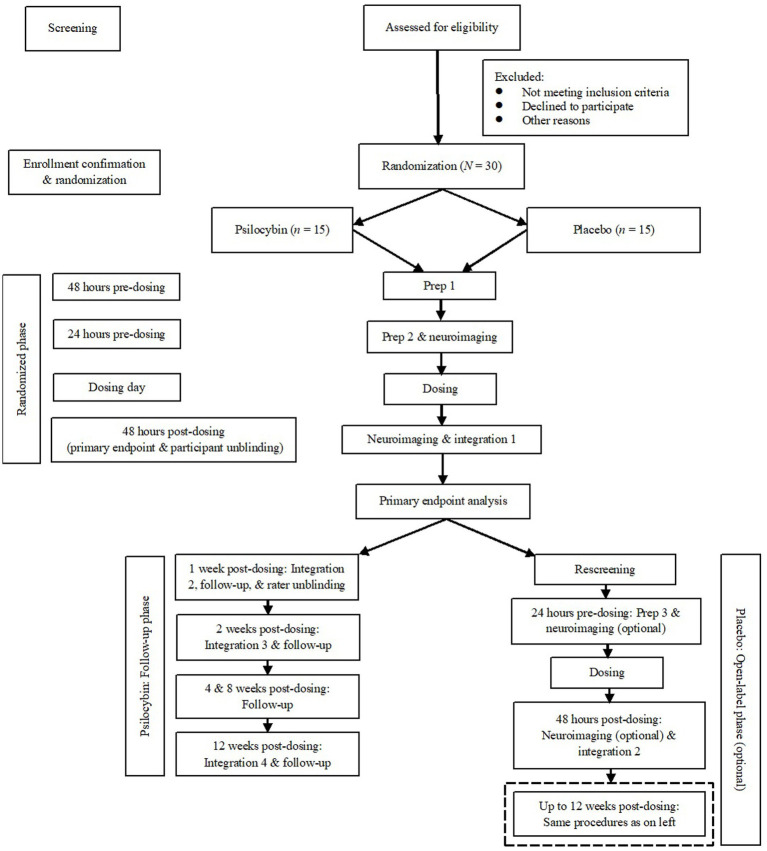
Background: Psilocybin may help treat obsessive-compulsive disorder (OCD). To date, only one open-label study of psilocybin for OCD exists, necessitating further investigation with a randomized controlled design. The neural correlates of psilocybin's effects on OCD have also not been studied. Objectives: This first-of-its-kind trial aims to evaluate the feasibility, safety, and tolerability of psilocybin in the treatment of OCD, provide preliminary evidence on the effects of psilocybin on OCD symptoms, and elucidate neural mechanisms that may mediate psilocybin's effects on OCD. Design: We use a randomized (1:1), double-blind, placebo-controlled, non-crossover design to examine the clinical and neural effects of either a single dose of oral psilocybin (0.25 mg/kg) or active placebo-control agent (250 mg of niacin) on OCD symptoms. Methods and analysis: We are enrolling 30 adult participants at a single site in Connecticut, USA who have failed at least one trial of standard care treatment (medication/psychotherapy) for OCD. All participants will also receive unstructured, non-directive psychological support during visits. Aside from safety, primary outcomes include OCD symptoms over the past 24 h, assessed by the Acute Yale-Brown Obsessive-Compulsive Scale and Visual Analog Scale ratings. These are collected by blinded, independent raters at baseline and the primary endpoint of 48 h post-dosing. Total follow-up is 12 weeks post-dosing. Resting state neuroimaging data will be collected at baseline and primary endpoint. Participants randomized to placebo will be offered the chance to return for an open-label dose of 0.25 mg/kg. Ethics statement: All participants will be required to provide written informed consent. The trial (protocol v. 5.2) was approved by the institutional review board (HIC #2000020355) and registered with ClinicalTrials.gov (NCT03356483). Discussion: This study may represent an advance in our ability to treat refractory OCD, and pave the way for future studies of neurobiological mechanisms of OCD that may respond to psilocybin.
Overview
The claims and statistics of this paper haven’t been checked yet.
Free: it reads the open-access text and checks the first 5 claims that cite a source we can check. Create a free account to check every claim.
Integrity signals
Registry
Cites
Statistics
Figures
Verification
Claims the paper makes
The claims and statistics of this paper haven’t been checked yet.
Free: it reads the open-access text and checks the first 5 claims that cite a source we can check. Create a free account to check every claim.
Claims other papers make about this one
Each is checked against this paper’s own text: does it say what the citing paper says it does?
The cited source says what the claim attributes to it.
In the citing paper
“In this study, we conducted a qualitative analysis of post-dosing interview data from 12 completers in the first, randomized, double-blind, single-dose, placebo-controlled trial of psilocybin for OCD (31, 33).”
Self-check
Percentages, sums and reported differences re-computed from the paper’s own numbers.
The self-check needs the paper’s full text.
Citations
Cites
The Pittsburgh Sleep Quality Index: a new instrument for psychiatric practice and research
Buysse, D. J., Reynolds, C. F., Monk, T. H., Berman, S. R., & Kupfer, D. J. (1989) · Psychiatry Research · doi:10.1016/0165-1781(89)90047-4 · Cited by 35,234
(1970) · Cited by 24,983
(1998) · The Journal of Clinical Psychiatry · Cited by 19,139
A new depression scale designed to be sensitive to change
Montgomery, S. A., & Åsberg, M. (1979) · British Journal of Psychiatry · doi:10.1192/bjp.134.4.382 · Cited by 13,962 · cited 1×
“Montgomery-Åsberg Depression Scale (MADRS) (59) 6.”
(1998) · PubMed · Cited by 10,216
(1976) · Medical Entomology and Zoology · Cited by 8,899
The Yale-Brown Obsessive Compulsive Scale: I. Development, Use, and Reliability
Goodman, W. K. (1989) · Archives of General Psychiatry · doi:10.1001/archpsyc.1989.01810110048007 · Cited by 7,712 · cited 10×
“A Y-BOCS score of 19 indicates moderate OCD symptom severity; with the criteria for a persisting diagnosis of OCD and the failure of at least one trial of standard care treatment (see Section 2.3.2), this cutoff score allows us to characterize our intended sample as treatmentrefractory.”
BackgroundMethodInfluentialScheier, M. F., Carver, C. S., & Bridges, M. W. (1994) · Journal of Personality and Social Psychology · doi:10.1037//0022-3514.67.6.1063 · Cited by 7,456
(2001) · Cited by 5,455
Inclusion of Other in the Self Scale and the structure of interpersonal closeness.
Aron, A., Aron, E. N., & Smollan, D. (1992) · Journal of Personality and Social Psychology · doi:10.1037/0022-3514.63.4.596 · Cited by 5,157 · cited 1×
“Inclusion of Other in the Self Scale (IOS) (82) 27.”
Research works printed but not linked: 9
- Williams MT Ching THW. Obsessive-compulsive disorder in ethnoracial minorities: symptoms, barriers to, and considerations for treatment In: Pittenger C, editor. Obsessive-compulsive disorder: Phenomenology, pathophysiology, and treatment. New York: Oxford University Press (2017). 703– 14.
- First MB Gibbon M Spitzer RL Williams JBW Benjamin LS. SCID-II personality questionnaire. Washington, DC: American Psychiatric Press (1997).
- Saunders JB Aasland OG. WHO collaborative project on the identification and treatment of persons with harmful alcohol consumption: Report on phase I, the development of a screening instrument. Geneva, Switzerland: World Health Organization (1987).
- Multidisciplinary Association for Psychedelic Science (MAPS). Self-reported nicotine use (SRNU). Santa Cruz, CA: MAPS (2017).
- DeYoung CG Quilty LC Peterson JB. Big five aspects scale (BFAS). Washington, DC: APA (2007).
- Dittrich A Lamparter D Maurer M. A short introduction. Zurich, Switzerland: PSIN PLUS (2010).
- Newman E Kaloupek D. Reactions to research participation questionnaire. Unpublished instrument. Tulsa, OK: University of Tulsa (1996).
- Multidisciplinary Association for Psychedelic Science (MAPS). Utilization of facility and emergent care (UFEC). Santa Cruz, CA: MAPS (2017).
- Smith JA Flowers P Larkin M. Interpretative phenomenological analysis: theory, research, practice. London, UK: SAGE (2009).
Cited by
Bhatt, K. V., & Weissman, C. R. (2024) · npj Mental Health Research · doi:10.1038/s44184-023-00053-8 · Cited by 34
Psilocybin for the treatment of Alzheimer’s disease
Zheng, S., Ma, R., Yang, Y., & Li, G. (2024) · Frontiers in Neuroscience · doi:10.3389/fnins.2024.1420601 · Cited by 28
Adverse psychiatric effects of psychedelic drugs: a systematic review of case reports
Yildirim, B., Sahin, S. S., Gee, A., Jauhar, S., Rucker, J., Salgado‐Pineda, P., Pomarol‐Clotet, E., & McKenna, P. J. (2024) · Psychological Medicine · doi:10.1017/s0033291724002496 · Cited by 32
“Two double-blind placebo-controlled trials of psilocybin for obsessive-compulsive disorder are currently underway (Ching et al., 2023a, 2023b).”
Psychedelics for the Treatment of Obsessive–Compulsive Disorder: Efficacy and Proposed Mechanisms
Collins, H. M. (2024) · The International Journal of Neuropsychopharmacology · doi:10.1093/ijnp/pyae057 · Cited by 29
Pellegrini, L., Fineberg, N. A., O'Connor, S., de Souza, A. M. F. L. P., Godfrey, K., Reed, S., Peill, J. M., Healy, M. P., Rohani-Shukla, C., Lee, H., et al. (2025) · Comprehensive Psychiatry · doi:10.1016/j.comppsych.2025.152619 · Cited by 33
Metadata
- Authors
- Ching, T. H. W., Grazioplene, R., Bohner, C., Kichuk, S. A., DePalmer, G., D’Amico, E., Eilbott, J., Jankovsky, A., Burke, M., Hokanson, J., Martins, B., Witherow, C., Patel, P., Amoroso, L., Schaer, H., Pittenger, C., & Kelmendi, B.
- Affiliations
- Yale University (US)
- Corresponding author
- Ching, Terence H. W.
- ORCID
- Venue
- Frontiers in Psychiatry
- Publisher
- Frontiers Media SA
- Published
- 2023-04-25
- Volume
- 14
- Pages
- 1178529-1178529
- ISSN
- 1664-0640 (ISSN-L)
- PMC
- PMC10166878
- OpenAlex
- W4366989647
- Cited by
- 29
- References
- 88
- Citations by year
- 2026: 5 · 2025: 9 · 2024: 14 · 2023: 1
- FWCI
- 8.43
- Type
- journal article
- Language
- en
- Open access
- gold
- doi.org
- Licence
- Locations
- Frontiers in Psychiatry (publishedVersion, cc-by)
- PubMed Central (publishedVersion, cc-by)
- PubMed (publishedVersion)
- DOAJ (DOAJ: Directory of Open Access Journals) (submittedVersion, cc-by-sa)
- Funders
- Yale University
- National Institute of Mental Health (K23MH122777)
- Yale Center for Clinical Investigation, Yale School of Medicine
- Topics
- Social Sciences › Psychology › Clinical Psychology › Psychedelics and Drug Studies
- Social Sciences › Psychology › Clinical Psychology › Obsessive-Compulsive Spectrum Disorders
- Health Sciences › Medicine › Psychiatry and Mental health › Schizophrenia research and treatment
- Keywords
- psilocybin, obsessive-compulsive disorder, treatment-resistant OCD, treatment-resistant depression, psychedelic therapy
About these checks
Registry, retraction, Cites and statistics results are computed, not judged, with one exception: a printed reference that no index lists is read once by a model before it counts as a citation error. Claims are extracted by a model and kept only when their quote appears verbatim in the text; each cited source is then checked, with a model’s help, for whether it says what the claim relies on. Those verdicts can be wrong — read the claim’s quote and the cited source before relying on one.
Statistics and arithmetic are recomputed, not judged.
Confidence bands are shown only for fields calibrated on our annotated test set. None is calibrated yet, so no band is shown.
What counts as a claim ›How we measure confidence ›How we check this ›
Are you an author, or do you see a problem with this page? Request a review
How to cite
Cite CoChat for the checks on this page, and the paper for its own findings.
- This page
- CoChat. (2026). Citation check: Safety, tolerability, and clinical and neural effects of single-dose psilocybin in obsessive-compulsive disorder: Protocol for a randomized, double-blind, placebo-controlled, non-crossover trial. https://app.cochat.ai/papers/10.3389/fpsyt.2023.1178529
- The paper
- Ching, T. H. W., Grazioplene, R., Bohner, C., Kichuk, S. A., DePalmer, G., D’Amico, E., Eilbott, J., Jankovsky, A., Burke, M., Hokanson, J., Martins, B., Witherow, C., Patel, P., Amoroso, L., Schaer, H., Pittenger, C., & Kelmendi, B. (2023). Safety, tolerability, and clinical and neural effects of single-dose psilocybin in obsessive-compulsive disorder: Protocol for a randomized, double-blind, placebo-controlled, non-crossover trial. Frontiers in Psychiatry. https://doi.org/10.3389/fpsyt.2023.1178529
Data sources
Bibliographic data: Semantic Scholar, OpenAlex, Crossref.
Contains information from the Semantic Scholar Academic Graph Datasets, made available under the ODC Attribution License (ODC-BY 1.0).
Semantic Scholar’s data is described in: Kinney, R., et al. (2023). The Semantic Scholar Open Data Platform. arXiv:2301.10140.
