

Effectiveness and mechanisms of Intensive Short-Term Dynamic Psychotherapy for treatment-resistant depression: a reanalysis of a randomized controlled trial
Open accessThe DOI matches its Crossref record; 45 of the 51 references it cites were found in a registry or an index; none of the 77 sources its claims cite is checked for support yet.
Abstract
Introduction: Intensive Short-Term Dynamic Psychotherapy has shown promising effects for treatment-resistant depression, but it remains unclear whether its hypothesized mechanisms — reducing emotional repression, negative affect, and psychological distress — actually mediate treatment outcomes. Methods: We reanalyzed publicly available data from a randomized controlled trial ( N = 86) comparing 20 sessions of Intensive Short-Term Dynamic Psychotherapy to waitlist control for treatment-resistant depression. Depression and process measures were assessed at baseline, post-treatment, and 3-month follow-up. Linear mixed-effects models analyzed trajectories; bootstrap mediation and cross-lagged panel analyses provided an exploratory examination of proposed process variables. Results: Treatment produced large effects on depression at post-treatment (Cohen’s d = 1.68) that continued to increase through 3-month follow-up ( d = 2.50, 95% CI [1.88, 3.11]). All proposed process measures also showed very large effects ( d = 1.96–2.95). However, neither emotional repression nor negative affect significantly mediated depression improvement. Distress showed apparent mediation, but a sensitivity analysis removing the overlapping depression subscale eliminated this effect entirely, confirming it reflected construct overlap rather than a genuine indirect effect. Cross-lagged analyses revealed no temporal precedence for any process measure, indicating concurrent rather than sequential change. Discussion: These findings confirm that this psychotherapy produces large, durable effects on treatment-resistant depression. However, the theorized sequential process — whereby reducing defensive functioning leads to improved affect regulation, which in turn alleviates depression — was not supported in the present data. Instead, the treatment appears to produce broad, simultaneous therapeutic change across multiple psychological domains. These exploratory findings suggest that understanding how psychotherapy works may require finer temporal measurement and observational methods that capture in-session processes.
Overview
CoChat Summary
TL;DR
This exploratory reanalysis of a randomized controlled trial (N = 86) confirms that 20 sessions of Intensive Short-Term Dynamic Psychotherapy produce very large, durable reductions in treatment-resistant depression relative to waitlist control, but finds no support for the theory's proposed sequential mechanisms. Neither emotional repression nor negative affect mediated depression improvement, and cross-lagged analyses showed concurrent rather than sequential change.
Key findings
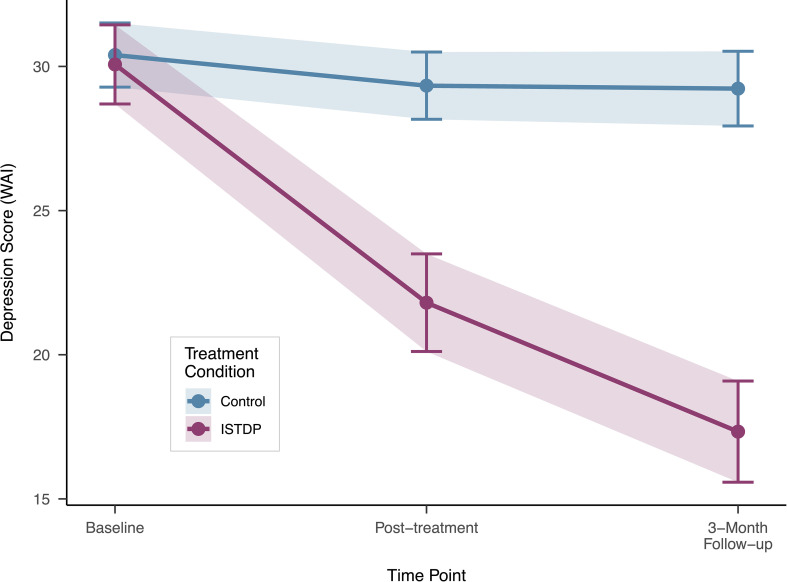
- Between-group depression effects were large at post-treatment (Cohen's d = 1.68, 95% CI [1.15, 2.22]) and increased at 3-month follow-up (d = 2.50, 95% CI [1.88, 3.11]); ISTDP participants continued improving between post-treatment and follow-up (Mdiff = 4.47, SE = 0.63, p < .001), while waitlist controls showed minimal change (all ps > .10).
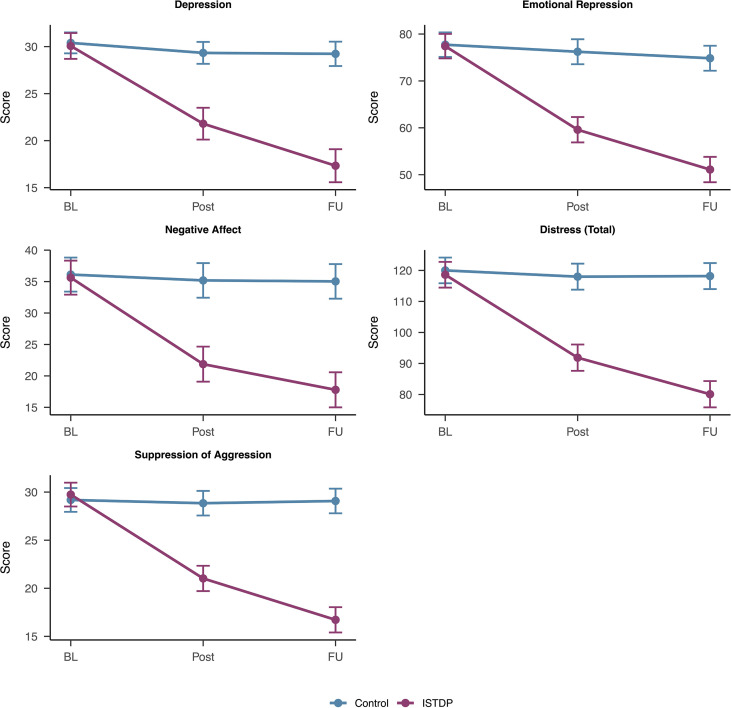
- All proposed process measures showed very large effects at follow-up: emotional repression d = 2.76, negative affect d = 1.96, distress d = 2.95, suppression of aggression d = 2.75.
- Mediation was null for the conceptually distinct process measures: emotional repression indirect effect = -1.84, 95% CI [-5.41, 1.00], p = .246; negative affect indirect effect = 1.51, 95% CI [-0.52, 3.87], p = .149 (direction counter to prediction). Distress appeared to mediate (indirect effect = -6.34, 95% CI [-11.07, -3.08], 53.9% of total effect), but a sensitivity analysis removing the overlapping Depression subscale eliminated it (ACME = 0.55, 95% CI [-1.98, 3.27], p = .702).
- Cross-lagged analyses found no temporal precedence in either direction for any process measure (e.g., emotional repression → depression β = -0.11, 95% CI [-0.25, 0.02], p = .098), suggesting broad concurrent change.
Methods
- Secondary reanalysis of publicly available data (Open Science Framework) from a two-arm RCT of 86 Iranian adults (ages 18–60) with treatment-resistant depression, randomized 1:1 to 20 ISTDP sessions over 10 weeks or waitlist control, with assessments at baseline, post-treatment, and 3-month follow-up.
- Depression was measured with the WAI Depression subscale; process measures were the WAI Repressive/Restraint Composite, PANAS Negative Affect, WAI Distress, and WAI Suppression of Aggression.
- Linear mixed-effects models (REML, random intercepts) for trajectories; bootstrap mediation (5,000 resamples, BCa CIs) and cross-lagged OLS regressions for exploratory process analyses; intent-to-treat for trajectory models, listwise deletion (n = 37–40) for mediation and cross-lagged analyses.
Limitations
- Stated by the paper: as a secondary analysis, the authors were constrained by the original design, including measure selection and only three measurement occasions, which limits temporal resolution for detecting session-level mechanisms; exclusive reliance on self-report cannot capture unconscious processes; the Distress composite included the depression outcome, making its mediation finding uninterpretable; the waitlist control precludes separating ISTDP-specific from general psychotherapy factors; the Iranian sample and treatment-resistant focus limit generalizability; N = 86 gave limited power for small-to-moderate indirect effects and inadequate power for moderation; ~13% dropout; only two therapists; and mediation rests on the untestable sequential ignorability assumption.
- Evident from the text: the original trial's assessment personnel were not blinded to allocation, and sessions were not recorded for adherence rating, so treatment fidelity was maintained only through weekly supervision rather than independently verified.
Model-written summary. Check it against the paper before relying on it.
Integrity signals
Registry
Cites
Statistics
Figures
Verification
Claims the paper makes
0 Valid · 2 Not valid · 49 Not checked · 141 Own results and interpretations
A result the paper reports from its own data — it cites no other source for it, so there is none to check. The quote shows it is in the paper.
In the paper
“and follow-up, β^=−11.66, 95% CI [−13.34,−9.98], t(153.73) = −13.61, p<.001.”
§ Effectiveness and mechanisms of Intensive Short-Term Dynamic Psychotherapy for treatment-resistant depression: a reanalysis of a randomized controlled trial > Results > Primary outcome: depression trajectories
plainstates an association- Asserted: passes — The authors put it forward as true.
- Checkable: passes — It can be checked against evidence.
- Load-bearing: passes — The paper’s conclusions depend on it.
- Based: passes — The paper gives a reason why it holds.
A result the paper reports from its own data — it cites no other source for it, so there is none to check. The quote shows it is in the paper.
In the paper
“This between-group difference increased further at 3-month follow-up, t(146.7) = 12.03, p<.001, Cohen’s d = 2.50, 95% CI [1.88, 3.11], representing a very large effect.”
§ Effectiveness and mechanisms of Intensive Short-Term Dynamic Psychotherapy for treatment-resistant depression: a reanalysis of a randomized controlled trial > Results > Primary outcome: depression trajectories
plainstates a cause- Asserted: passes — The authors put it forward as true.
- Checkable: passes — It can be checked against evidence.
- Load-bearing: passes — The paper’s conclusions depend on it.
- Based: passes — The paper gives a reason why it holds.
A result the paper reports from its own data — it cites no other source for it, so there is none to check. The quote shows it is in the paper.
In the paper
“Second, ISTDP produced comparable large effects on all proposed process measures (emotional repression d = 2.76; negative affect d = 1.96; distress d = 2.95).”
§ Effectiveness and mechanisms of Intensive Short-Term Dynamic Psychotherapy for treatment-resistant depression: a reanalysis of a randomized controlled trial > Discussion
plainstates a causen = 86- Asserted: passes — The authors put it forward as true.
- Checkable: passes — It can be checked against evidence.
- Load-bearing: passes — The paper’s conclusions depend on it.
- Based: passes — The paper gives a reason why it holds.
A result the paper reports from its own data — it cites no other source for it, so there is none to check. The quote shows it is in the paper.
In the paper
“Cross-lagged analyses revealed no temporal precedence for any process measure, indicating concurrent rather than sequential change.”
§ Effectiveness and mechanisms of Intensive Short-Term Dynamic Psychotherapy for treatment-resistant depression: a reanalysis of a randomized controlled trial > Abstract > Results
plain- Asserted: passes — The authors put it forward as true.
- Checkable: passes — It can be checked against evidence.
- Load-bearing: passes — The paper’s conclusions depend on it.
- Based: passes — The paper gives a reason why it holds.
A result the paper reports from its own data — it cites no other source for it, so there is none to check. The quote shows it is in the paper.
In the paper
“ISTDP participants experienced an average reduction of 12.87 points on the 7–35 point WAI Depression subscale from baseline to follow-up, representing a 45% reduction in depression scores (baseline M = 28.81 to follow-up M = 15.94).”
§ Effectiveness and mechanisms of Intensive Short-Term Dynamic Psychotherapy for treatment-resistant depression: a reanalysis of a randomized controlled trial > Discussion > Large and durable treatment effects on depression
plainstates a cause- Asserted: passes — The authors put it forward as true.
- Checkable: passes — It can be checked against evidence.
- Load-bearing: passes — The paper’s conclusions depend on it.
- Based: passes — The paper gives a reason why it holds.
80 more claims
Create a free account to see all 192 claims and to verify the 77 references still open.
- It may state two separate claims as one. 78
- Probably not a substantial claim. 55
Statistics recomputed
Every reported test result, recomputed from its test statistic and degrees of freedom. A result shows as not adding up only once an independent check has confirmed it.
- Consistentχ²(45) = 72.34reported p = .006 · recomputed p = .006
“χ2(45) = 72.34, p = .006”
- ConsistentF(2, 151.9) = 94.85reported p < .001 · recomputed p < .001
“F(2, 151.9) = 94.85, p < .001”
- Consistentt(153.73) = -13.61reported p < .001 · recomputed p < .001
“t(153.73) = −13.61, p < .001”
- Consistentt(133) = 0.34reported p = .734 · recomputed p = .734
“t(133.0) = 0.34, p = .734”
- Consistentt(146.7) = 7.65reported p < .001 · recomputed p < .001
“t(146.7) = 7.65, p < .001”
2 more recomputed tests
Create a free account to see every test the Stats check recomputed.
Self-check
Percentages, sums and reported differences re-computed from the paper’s own numbers.
Each contradiction between two passages listed here was confirmed by an independent check.
Rated major: it would touch a result — a value a result rests on, reported and recomputed p-values on opposite sides of the significance level, two passages that conflict with no sign which is right, or a cited work retracted before this paper was published.
In the paper
§ Effectiveness and mechanisms of Intensive Short-Term Dynamic Psychotherapy for treatment-resistant depression: a reanalysis of a randomized controlled trial > Materials and methods > Study design and participants
“At post-treatment and follow-up, data were available from 36 ISTDP participants and 39 waitlist participants.”
§ Effectiveness and mechanisms of Intensive Short-Term Dynamic Psychotherapy for treatment-resistant depression: a reanalysis of a randomized controlled trial > Materials and methods > Data analysis
“Mediation and cross-lagged analyses used listwise deletion due to software limitations, resulting in sample sizes of n = 37–40 for ISTDP participants with complete data.”
Rated minor: it would not touch a result — a value no result rests on, a p-value that stays on the same side of the significance level, or a conflict that is clerical, resolved elsewhere in the paper, or outside its own findings.
In the paper
§ Effectiveness and mechanisms of Intensive Short-Term Dynamic Psychotherapy for treatment-resistant depression: a reanalysis of a randomized controlled trial > Results > Missing data
“All analyses used the full intent-to-treat sample with REML estimation.”
§ Effectiveness and mechanisms of Intensive Short-Term Dynamic Psychotherapy for treatment-resistant depression: a reanalysis of a randomized controlled trial > Materials and methods > Data analysis
“Mediation and cross-lagged analyses used listwise deletion due to software limitations, resulting in sample sizes of n = 37–40 for ISTDP participants with complete data.”
Rated minor: it would not touch a result — a value no result rests on, a p-value that stays on the same side of the significance level, or a conflict that is clerical, resolved elsewhere in the paper, or outside its own findings.
In the paper
§ Effectiveness and mechanisms of Intensive Short-Term Dynamic Psychotherapy for treatment-resistant depression: a reanalysis of a randomized controlled trial > Materials and methods > Data analysis
“These correlations were computed within the ISTDP group only (n = 43), as changes in the waitlist group were minimal.”
§ Effectiveness and mechanisms of Intensive Short-Term Dynamic Psychotherapy for treatment-resistant depression: a reanalysis of a randomized controlled trial > Materials and methods > Study design and participants
“At post-treatment and follow-up, data were available from 36 ISTDP participants and 39 waitlist participants.”
Citations
Cites
Fitting Linear Mixed-Effects Models Using lme4
Bates, D., Mächler, M., Bolker, B., & Walker, S. (2015) · Journal of Statistical Software · doi:10.18637/jss.v067.i01 · Cited by 86,835
Development and validation of brief measures of positive and negative affect: The PANAS scales.
Watson, D., Clark, L. A., & Tellegen, A. (1988) · Journal of Personality and Social Psychology · doi:10.1037/0022-3514.54.6.1063 · Cited by 32,433
lmerTest Package: Tests in Linear Mixed Effects Models
Kuznetsova, A., Brockhoff, P. B., & Christensen, R. H. B. (2017) · Journal of Statistical Software · doi:10.18637/jss.v082.i13 · Cited by 24,346
Rush, A. J., Trivedi, M. H., Wisniewski, S. R., Nierenberg, A. A., Stewart, J. W., Warden, D., Niederehe, G., Thase, M. E., Lavori, P. W., Lebowitz, B. D., et al. (2006) · American Journal of Psychiatry · doi:10.1176/ajp.2006.163.11.1905 · Cited by 5,643 · cited 2×
“While evidence-based treatments such as antidepressant medication and psychotherapy produce meaningful improvements for many patients, a substantial proportion — approximately 30% to 40% — do not achieve remission with fi rst line interventions (2, 3).”
mediation:R Package for Causal Mediation Analysis
Tingley, D., Yamamoto, T., Hirose, K., Keele, L., & Imai, K. (2014) · Journal of Statistical Software · doi:10.18637/jss.v059.i05 · Cited by 4,155
Promoting an open research culture
Nosek, B. A., Alter, G., Banks, G. C., Borsboom, D., Bowman, S. D., Breckler, S. J., Buck, S., Chambers, C. D., Chin, G., Christensen, G., et al. (2015) · Science · doi:10.1126/science.aab2374 · Cited by 2,708
Mediators and Moderators of Treatment Effects in Randomized Clinical Trials
Kraemer, H. C., Wilson, G. T., Fairburn, C. G., & Agras, W. S. (2002) · Archives of General Psychiatry · doi:10.1001/archpsyc.59.10.877 · Cited by 2,562
Mediators and Mechanisms of Change in Psychotherapy Research
Kazdin, A. E. (2007) · Annual Review of Clinical Psychology · doi:10.1146/annurev.clinpsy.3.022806.091432 · Cited by 2,504 · cited 4×
“…conducted, they have typically examined change scores calculated across the same time period for both mediator and outcome, leaving open the question of whether process changes actually precede and cause symptom changes, or whether both simply change together in response to some other factor (25).”
InfluentialThe Great Psychotherapy Debate: The Evidence for What Makes Psychotherapy Work
Wampold, B. E. (2015) · doi:10.4324/9780203582015 · Cited by 1,773
Lack of group-to-individual generalizability is a threat to human subjects research
Fisher, A. J., Medaglia, J. D., & Jeronimus, B. F. (2018) · Proceedings of the National Academy of Sciences · doi:10.1073/pnas.1711978115 · Cited by 1,099
DEFINITION AND EPIDEMIOLOGY OF TREATMENT-RESISTANT DEPRESSION
Fava, M., & Davidson, K. G. (1996) · Psychiatric Clinics of North America · doi:10.1016/s0193-953x(05)70283-5 · Cited by 797
The Role of Common Factors in Psychotherapy Outcomes
Cuijpers, P., Reijnders, M., & Huibers, M. J. H. (2019) · Annual Review of Clinical Psychology · doi:10.1146/annurev-clinpsy-050718-095424 · Cited by 748
Prevention of Relapse following cognitive therapy vs medications in moderate to severe depression.
Hollon, S. D., DeRubeis, R. J., Shelton, R. C., Amsterdam, J. D., Salomon, R. M., O’Reardon, J. P., Lovett, M. L., Young, P. R., Haman, K. L., Freeman, B. B., et al. (2005) · Archives of General Psychiatry · doi:10.1001/archpsyc.62.4.417 · Cited by 735
Sudden gains and critical sessions in cognitive-behavioral therapy for depression.
Tang, T. Z., & DeRubeis, R. J. (1999) · Journal of Consulting and Clinical Psychology · doi:10.1037/0022-006x.67.6.894 · Cited by 684 · cited 1×
“Moreover, research on sudden gains in psychotherapy suggests that therapeutic improvement often occurs in discrete, non-linear breakthroughs rather than through gradual, continuous change (47).”
A Review of the Clinical, Economic, and Societal Burden of Treatment-Resistant Depression: 1996–2013
Mrazek, D. A., Hornberger, J. C., Altar, C. A., & Degtiar, I. (2014) · Psychiatric Services · doi:10.1176/appi.ps.201300059 · Cited by 580 · cited 1×
“The burden of TRD is considerable, not only for affected individuals who experience prolonged suffering and functional impairment, but also for healthcare systems facing increased service utilization and costs (5).”
Psychotherapeutic benefits of compassion-focused therapy: an early systematic review
Leaviss, J., & Uttley, L. (2015) · Psychological Medicine · doi:10.1017/s0033291714002141 · Cited by 546
DeRubeis, R. J., Cohen, Z. D., Forand, N. R., Fournier, J. C., Gelfand, L. A., & Lorenzo-Luaces, L. (2014) · PLoS ONE · doi:10.1371/journal.pone.0083875 · Cited by 509 · cited 1×
“Modern precision medicine approaches in psychotherapy emphasize such moderation effects (53, 54), recognizing that “ one size fi ts all ” models fail to capture the complexity of therapeutic change.”
Defining treatment‐resistant depression
Gaynes, B. N., Lux, L., Gartlehner, G., Asher, G., Forman‐Hoffman, V., Green, J., Boland, E., Weber, R. P., Randolph, C., Bann, C., et al. (2020) · Depression and Anxiety · doi:10.1002/da.22968 · Cited by 447
Treatment selection in depression.
Cohen, Z. D., & DeRubeis, R. J. (2018) · Annual Review of Clinical Psychology · doi:10.1146/annurev-clinpsy-050817-084746 · Cited by 435 · cited 1×
“Modern precision medicine approaches in psychotherapy emphasize such moderation effects (53, 54), recognizing that “ one size fi ts all ” models fail to capture the complexity of therapeutic change.”
The efficacy of short-term psychodynamic psychotherapy for depression: A meta-analysis update
Driessen, E., Hegelmaier, L. M., Abbass, A. A., Barber, J. P., Dekker, J. J. M., Van, H. L., Jansma, E. P., & Cuijpers, P. (2015) · Clinical Psychology Review · doi:10.1016/j.cpr.2015.07.004 · Cited by 409
Sroufe, L. A., Egeland, B. R., & Kreutzer, T. (1990) · Child Development · doi:10.1111/j.1467-8624.1990.tb02867.x · Cited by 409
Wiles, N., Thomas, L., Abel, A., Ridgway, N., Turner, N., Campbell, J., Garland, A., Hollinghurst, S., Jerrom, B., Kessler, D., et al. (2013) · The Lancet · doi:10.1016/s0140-6736(12)61552-9 · Cited by 340 · cited 3×
“Extended follow-up assessments at 6, 12, and 24 months would establish long-term durability and identify factors predicting maintenance versus relapse.”
InfluentialShort-term psychodynamic psychotherapies for common mental disorders
Abbass, A. A., Kisely, S. R., Town, J. M., Leichsenring, F., Driessen, E., De Maat, S., Gerber, A., Dekker, J., Rabung, S., Rusalovska, S., et al. (2014) · Cochrane Database of Systematic Reviews · doi:10.1002/14651858.cd004687.pub4 · Cited by 329
The effects of fifteen evidence-supported therapies for adult depression: A meta-analytic review
Cuijpers, P., Karyotaki, E., de Wit, L., & Ebert, D. D. (2020) · Psychotherapy Research · doi:10.1080/10503307.2019.1649732 · Cited by 276
Sroufe, L. A., Egeland, B., & Kreutzer, T. (1990) · Child Development · doi:10.2307/1130748 · Cited by 261
Some methodological and statistical issues in the study of change processes in psychotherapy
Laurenceau, J.-P., Hayes, A. M., & Feldman, G. C. (2007) · Clinical Psychology Review · doi:10.1016/j.cpr.2007.01.007 · Cited by 225
Enhancing the Personalization of Psychotherapy With Dynamic Assessment and Modeling
Fisher, A. J., & Boswell, J. F. (2016) · Assessment · doi:10.1177/1073191116638735 · Cited by 204
Short-term psychodynamic psychotherapies for common mental disorders
Abbass, A. A., Hancock, J. T., Henderson, J., & Kisely, S. R. (2006) · Cochrane Database of Systematic Reviews · doi:10.1002/14651858.cd004687.pub3 · Cited by 140
Co-Creating Change: Effective Dynamic Therapy Techniques
Frederickson, J. J. (2013) · Cited by 139
Tang, T. Z., Luborsky, L., & Andrusyna, T. (2002) · Journal of Consulting and Clinical Psychology · doi:10.1037//0022-006x.70.2.444 · Cited by 126
Preadolescents' Social-Emotional Adjustment and Selective Attrition in Family Research
Weinberger, D. A., Tublin, S. K., Ford, M. E., & Feldman, S. S. (1990) · Child Development · doi:10.1111/j.1467-8624.1990.tb02868.x · Cited by 123
Abbass, A., Town, J., & Driessen, E. (2012) · Harvard Review of Psychiatry · doi:10.3109/10673229.2012.677347 · Cited by 106
Intensive Short-Term Dynamic Psychotherapy of treatment-resistant depression: a pilot study
Abbass, A. A. (2006) · Depression and Anxiety · doi:10.1002/da.20203 · Cited by 72
The Mechanisms of Sudden Gains in Supportive–Expressive Therapy for Depression
Andrusyna, T. P., Luborsky, L., Pham, T., & Tang, T. Z. (2006) · Psychotherapy Research · doi:10.1080/10503300600591379 · Cited by 66
Town, J. M., Abbass, A., Stride, C., & Bernier, D. (2017) · Journal of Affective Disorders · doi:10.1016/j.jad.2017.02.035 · Cited by 65
Johansson, R., Town, J. M., & Abbass, A. (2014) · PeerJ · doi:10.7717/peerj.548 · Cited by 43
Self-citationTown, J. M., Abbass, A., & Bernier, D. (2013) · American Journal of Psychotherapy · doi:10.1176/appi.psychotherapy.2013.67.1.89 · Cited by 34
Town, J. M., Falkenström, F., Abbass, A., & Stride, C. (2022) · Journal of Counseling Psychology · doi:10.1037/cou0000581 · Cited by 29
Town, J. M., Abbass, A., Stride, C., Nunes, A., Bernier, D., & Berrigan, P. (2020) · Journal of Affective Disorders · doi:10.1016/j.jad.2020.04.035 · Cited by 27
Ajilchi, B., Nejati, V., Town, J. M., Wilson, R., & Abbass, A. (2016) · Journal of Nervous & Mental Disease · doi:10.1097/nmd.0000000000000518 · Cited by 26
Angerer, F., Mennel, V., Grund, S., Mayer, A., Büscher, R., Sander, L., Cuijpers, P. J., Terhorst, Y., Baumeister, H., & Domhardt, M. (2024) · Journal of Affective Disorders · doi:10.1016/j.jad.2024.09.055 · Cited by 21
The efficacy of experiential dynamic therapies: A 10-year systematic review and meta-analysis update
Lilliengren, P., Mechler, J., Lindqvist, K., Maroti, D., & Johansson, R. (2025) · Clinical Psychology & Psychotherapy · doi:10.1002/cpp.70086 · Cited by 17
Self-citationSolbakken, O. A., & Abbass, A. (2015) · Journal of Affective Disorders · doi:10.1016/j.jad.2015.04.003 · Cited by 16
Intensive short-term dynamic psychotherapy: A treatment overview and empirical basis
Abbass, A., Town, J. M., & Driessen, E. (2013) · Research in Psychotherapy: Psychopathology, Process and Outcome · doi:10.4081/ripppo.2013.84 · Cited by 11
Angerer (2025) · doi:10.1016/j.jad.2024.09.126 · Cited by 10
Berggraf, L., Ulvenes, P. G., Wampold, B. E., Hoffart, A., & McCullough, L. (2012) · Psychotherapy Research · doi:10.1080/10503307.2011.653997 · Cited by 10
Heshmati, R., Wienicke, F. J., & Driessen, E. (2023) · Psychotherapy · doi:10.1037/pst0000500 · Cited by 8
Patients’ affective processes within initial Experiential Dynamic Therapy sessions
Aafjes-van Doorn, K., Lilliengren, P., Cooper, A., Macdonald, J., & Falkenström, F. (2017) · Psychotherapy · doi:10.1037/pst0000072 · Cited by 7
Self-citationHeshmati, R., Javadpour, S., HajiSaghati, R., & Haollahzadeh, S. (2021) · Journal of Research in Psychopathology · doi:10.22098/jrp.2022.10218.1057 · Cited by 5
Heshmati, R., Wienicke, F. J., & Driessen, E. (2025) · Data in Brief · doi:10.1016/j.dib.2025.112126 · Cited by 1
Johansson, R., Eriksson, K., Åberg, K., Town, J., & Abbass, A. (2024) · Journal of Contemporary ISTDP · doi:10.70839/bv43rz18 · Cited by 1
Self-citation
Research works printed but not linked: 7
- Davanloo H. Intensive Short-Term Dynamic Psychotherapy. New York, NY: Wiley (2000).
- Abbass A. Reaching through resistance: Advanced psychotherapy techniques. 1st edn. Kansas City, MO: Seven Leaves Press (2015).
- Della Selva PC. Intensive short-term dynamic psychotherapy: Theory and technique. London, UK: Karnac Books (2004).
- R Core Team. R: A Language and Environment for Statistical Computing. Vienna, Austria: R Foundation for Statistical Computing (2024).
- Lenth RV. emmeans: Estimated Marginal Means, aka Least-Squares Means. (2024), R package version 1.10.0.
- Torchiano M. effsize: Efficient Effect Size Computation. (2020), R package version 0.8.1.
- Aust F Barth M. papaja: Prepare APA Journal Articles with R Markdown. (2023), R package version 0.1.2.
Cited by
Zabihifard, M., Ranjbaripour, T., & Touranposhti, M. G. (2026) · International journal of body, mind and culture · doi:10.61838/ijbmc.v13i9.1225
Metadata
- Authors
- Johansson, R., & Lilliengren, P.
- Affiliations
- Stockholm University (SE)
- Venue
- Frontiers in Psychiatry
- Publisher
- Frontiers Media SA
- Published
- 2026-04-22
- Volume
- 17
- Pages
- 1815946-1815946
- ISSN
- 1664-0640 (ISSN-L)
- PMC
- PMC13143956
- OpenAlex
- W7155154194
- Semantic Scholar
- ef6189836795df181f8898c52b52553067e3bd8c
- Cited by
- 1
- References
- 49
- Citations by year
- 2026: 1
- FWCI
- 3.60
- Type
- journal article
- Language
- en
- Open access
- gold
- doi.org
- Licence
- Locations
- Frontiers in Psychiatry (publishedVersion, cc-by)
- PsyArXiv (OSF Preprints) (submittedVersion, cc-by)
- PubMed Central (publishedVersion, cc-by)
- PubMed (publishedVersion)
- DOAJ (DOAJ: Directory of Open Access Journals) (submittedVersion)
- Topics
- Social Sciences › Psychology › Clinical Psychology › Psychotherapy Techniques and Applications
- Social Sciences › Psychology › Clinical Psychology › Psychoanalysis and Psychopathology Research
- Social Sciences › Psychology › Experimental and Cognitive Psychology › Anxiety, Depression, Psychometrics, Treatment, Cognitive Processes
- Keywords
- intensive short-term dynamic psychotherapy, treatment-resistant depression, mediation analysis, emotional repression, defensive functioning, negative affect, psychological distress, emotion regulation, psychotherapy mechanisms, construct overlap, process indicators
About these checks
Registry, retraction, Cites and statistics results are computed, not judged, with one exception: a printed reference that no index lists is read once by a model before it counts as a citation error. Claims are extracted by a model and kept only when their quote appears verbatim in the text; each cited source is then checked, with a model’s help, for whether it says what the claim relies on. Those verdicts can be wrong — read the claim’s quote and the cited source before relying on one.
A language model drew the claims from the paper on 2026-11-28, under version 3 of the claim definition (model deepseek-v4.1-flash, prompt extract-v3).
A second model labelled each claim on 2026-11-28 (model jev-1.13-20260917, definition revision gold-guideline-v0.2).
Statistics and arithmetic are recomputed, not judged.
Confidence bands are shown only for fields calibrated on our annotated test set. None is calibrated yet, so no band is shown.
What counts as a claim ›How we measure confidence ›How we check this ›
Are you an author, or do you see a problem with this page? Request a review
Data sources
Bibliographic data: Semantic Scholar, OpenAlex, Crossref.
Contains information from the Semantic Scholar Academic Graph Datasets, made available under the ODC Attribution License (ODC-BY 1.0).
Semantic Scholar’s data is described in: Kinney, R., et al. (2023). The Semantic Scholar Open Data Platform. arXiv:2301.10140.
