

The DOI matches its Crossref record; 26 of the 26 references it cites were found in a registry or an index.
Behavioral Change Towards Reduced Intensity Physical Activity Is Disproportionately Prevalent Among Adults With Serious Health Issues or Self-Perception of High Risk During the UK COVID-19 Lockdown
Open accessPublished version of a preprint
Abstract
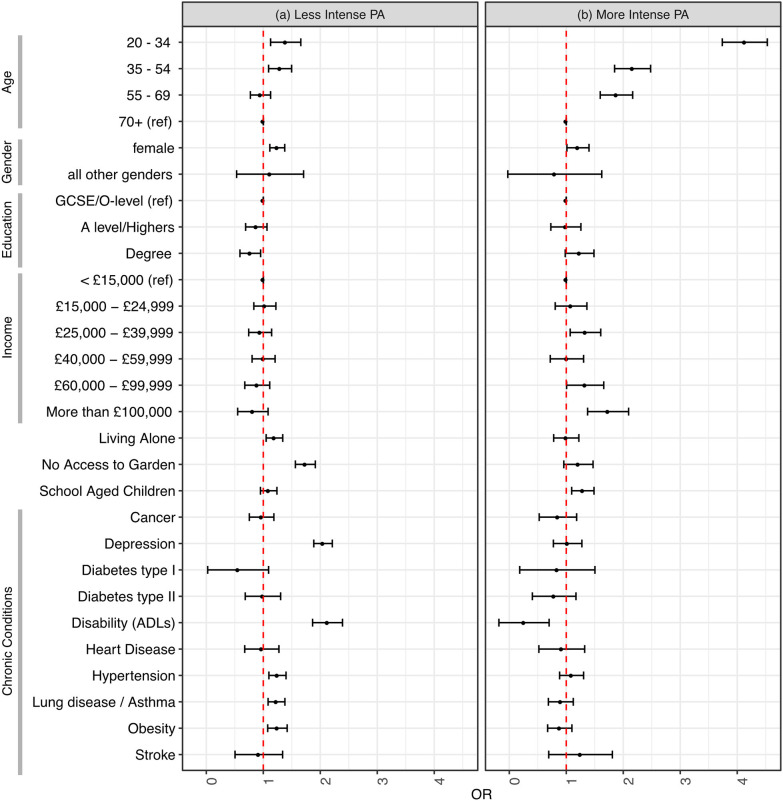
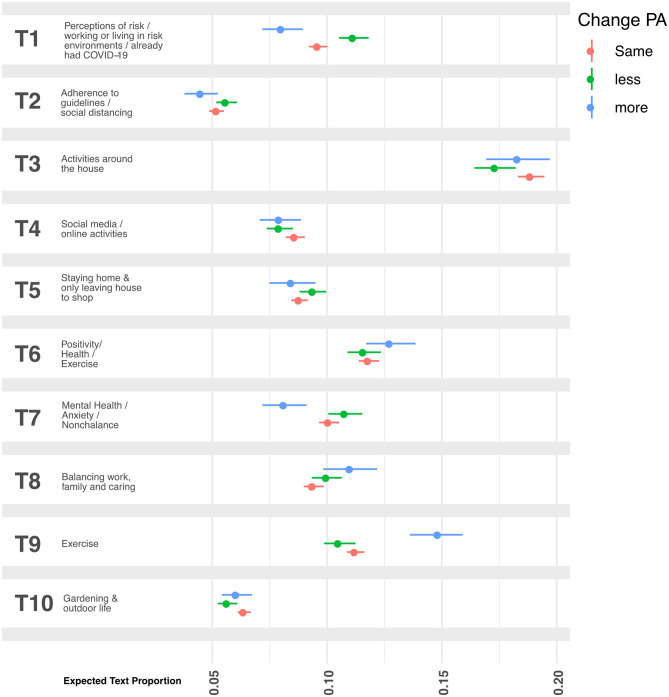
Abstract Importance There are growing concerns that the UK COVID-19 lockdown has reduced opportunities to maintain health through physical activity, placing individuals at higher risk of chronic disease and leaving them more vulnerable to severe sequelae of COVID-19. Objective To examine whether the UK’s lockdown measures have had disproportionate impacts on intensity of physical activity in groups who are, or who perceive themselves to be, at heightened risk from COVID-19. Designs, Setting, Participants UK-wide survey of adults aged over 20, data collected between 2020-04-06 and 2020-04-22. Exposures Self-reported doctor-diagnosed obesity, hypertension, type I/II diabetes, lung disease, cancer, stroke, heart disease. Self-reported disabilities and depression. Sex, gender, educational qualifications, household income, caring for school-age children. Narrative data on coping strategies. Main Outcomes and Measures Change in physical activity intensity after implementation of UK COVID-19 lockdown (self-reported). Results Most (60%) participants achieved the same level of intensity of physical activity during the lockdown as before the epidemic. Doing less intensive physical activity during the lockdown was associated with obesity (OR 1.21, 95% CI 1.02-1.41), hypertension (OR 1.52, 1.33-1.71), lung disease (OR 1.31,1.13-1.49), depression (OR 2.02, 1.82-2.22) and disability (OR 2.34, 1.99-2.69). Participants who reduced their physical activity intensity also had higher odds of being female, living alone or having no garden, and more commonly expressed sentiments about personal or household risks in narratives on coping. Conclusions and relevance Groups who reduced physical activity intensity included disproportionate numbers of people with either heightened objective clinical risks or greater tendency to express subjective perceptions of risk. Policy on exercise for health during lockdowns should include strategies to facilitate health promoting levels of physical activity in vulnerable groups, including those with both objective and subjective risks.
Overview
The claims and statistics of this paper haven’t been checked yet.
Run the check — free, no account needed. It reads the open-access text and checks the sources it cites.
Integrity signals
Registry
Cites
Statistics
Figures
Verification
Claims the paper makes
The claims and statistics of this paper haven’t been checked yet.
Run the check — free, no account needed. It reads the open-access text and checks the sources it cites.
Claims other papers make about this one
Each is checked against this paper’s own text: does it say what the citing paper says it does?
In the citing paper
“Although data on PA during the COVID-19 pandemic are scarce, a study from the UK found adults with chronic conditions were most likely to report reducing their PA due to the COVID-19 lockdown. 20”
From Physical inactivity is associated with a higher risk for severe COVID-19 outcomes: a study in 48 440 adult patients (2021) · cites this paper as [20]
Self-check
Percentages, sums and reported differences re-computed from the paper’s own numbers.
The self-check needs the paper’s full text.
Citations
Cites
Modern Applied Statistics with S
Venables, W. N., & Ripley, B. D. (2002) · Statisctics and computing/Statistics and computing · doi:10.1007/978-0-387-21706-2 · Cited by 25,941
A novel coronavirus outbreak of global health concern
Wang, C., Horby, P. W., Hayden, F. G., & Gao, G. F. (2020) · The Lancet · doi:10.1016/s0140-6736(20)30185-9 · Cited by 7,700
Collaborative, T. O., Williamson, E., Walker, A. J., Bhaskaran, K., Bacon, S., Bates, C., Morton, C. E., Curtis, H. J., Mehrkar, A., Evans, D., et al. (2020) · doi:10.1101/2020.05.06.20092999 · Cited by 6,674
Factors associated with COVID-19-related death using OpenSAFELY
Williamson, E. J., Walker, A. J., Bhaskaran, K., Bacon, S., Bates, C., Morton, C. E., Curtis, H. J., Mehrkar, A., Evans, D., Inglesby, P., et al. (2020) · Nature · doi:10.1038/s41586-020-2521-4 · Cited by 6,674
Exercise as medicine - evidence for prescribing exercise as therapy in 26 different chronic diseases
Pedersen, B. K., & Saltin, B. (2015) · Scandinavian Journal of Medicine & Science in Sports · doi:10.1111/sms.12581 · Cited by 3,514
Structural Topic Models for Open‐Ended Survey Responses
Roberts, M. E., Stewart, B., Tingley, D. H., Lucas, C., Leder-Luis, J., Gadarian, S. K., Albertson, B. L., & Rand, D. G. (2014) · American Journal of Political Science · doi:10.1111/ajps.12103 · Cited by 2,103
Ammar, A., Brach, M., Trabelsi, K., Chtourou, H., Boukhris, O., Masmoudi, L., Bouaziz, B., Bentlage, E., How, D., Ahmed, M., et al. (2020) · Nutrients · doi:10.3390/nu12061583 · Cited by 2,073
stm : An R Package for Structural Topic Models
Roberts, M. E., Stewart, B. M., & Tingley, D. (2019) · Journal of Statistical Software · doi:10.18637/jss.v091.i02 · Cited by 1,714
Lear, S. A., Hu, W., Rangarajan, S., Gasevic, D., Leong, D., Iqbal, R., Casanova, A., Swaminathan, S., Anjana, R. M., Kumar, R., et al. (2017) · The Lancet · doi:10.1016/s0140-6736(17)31634-3 · Cited by 1,331
Chekroud, S. R., Gueorguieva, R., Zheutlin, A. B., Paulus, M., Krumholz, H. M., Krystal, J. H., & Chekroud, A. M. (2018) · The Lancet Psychiatry · doi:10.1016/s2215-0366(18)30227-x · Cited by 1,172
Fu, L., Wang, B., Yuan, T., Chen, X., Ao, Y., Fitzpatrick, T., Li, P., Zhou, Y., Lin, Y., Duan, Q., et al. (2020) · Journal of Infection · doi:10.1016/j.jinf.2020.03.041 · Cited by 1,141
Hamer, M., Mika Kivimaki, B., Galé, C. R., & Batty, G. D. (2020) · Brain Behavior and Immunity · doi:10.1016/j.bbi.2020.05.059 · Cited by 589
Hammami, A., Harrabi, B., Mohr, M., & Krustrup, P. (2020) · Managing Sport and Leisure · doi:10.1080/23750472.2020.1757494 · Cited by 541
Evidence mounts on the disproportionate effect of COVID-19 on ethnic minorities
Kirby, T. (2020) · The Lancet Respiratory Medicine · doi:10.1016/s2213-2600(20)30228-9 · Cited by 521
Physical inactivity and cardiovascular disease at the time of coronavirus disease 2019 (COVID-19)
Lippi, G., Henry, B. M., & Sanchis‐Gomar, F. (2020) · European Journal of Preventive Cardiology · doi:10.1177/2047487320916823 · Cited by 390
Tak, E., Kuiper, R., Chorus, A., & Hopman-Rock, M. (2013) · Ageing Research Reviews · doi:10.1016/j.arr.2012.10.001 · Cited by 372
Metabolic Responses to Reduced Daily Steps in Healthy Nonexercising Men
(2008) · JAMA · doi:10.1001/jama.299.11.1259 · Cited by 313
Kivimäki, M., Singh-Manoux, A., Pentti, J., Sabia, S., Nyberg, S. T., Alfredsson, L., Goldberg, M., Knutsson, A., Koskenvuo, M., Koskinen, A., et al. (2019) · BMJ · doi:10.1136/bmj.l1495 · Cited by 313
Reduced physical activity in young and older adults: Metabolic and musculoskeletal implications
Bowden Davies, K. A., Pickles, S., Sprung, V. S., Kemp, G. J., Alam, U., Moore, D. R., Tahrani, A. A., & Cuthbertson, D. J. (2019) · Therapeutic Advances in Endocrinology and Metabolism · doi:10.1177/2042018819888824 · Cited by 278
Cheng, W., Zhang, Z., Cheng, W., Yang, C., Diao, L., & Liu, W. (2018) · European Journal of Preventive Cardiology · doi:10.1177/2047487318795194 · Cited by 221
Ethnic inequalities in limiting health and self-reported health in later life revisited
Evandrou, M., Falkingham, J., Feng, Z., & Vlachantoni, A. (2016) · Journal of Epidemiology & Community Health · doi:10.1136/jech-2015-206074 · Cited by 153
Holm, L., Jespersen, A. P., Nielsen, D. S., Frøst, M. B., Reitelseder, S., Jensen, T., Engelsen, S. B., Kjær, M., & Damsholt, T. (2015) · Scandinavian Journal of Medicine and Science in Sports · doi:10.1111/sms.12415 · Cited by 133
Hamer, M., Kivimäki, M., Galé, C. R., et al. (2020) · medRxiv · doi:10.1101/2020.05.09.20096438 · Cited by 59
Wealth and Disability in Later Life: The English Longitudinal Study of Ageing (ELSA)
Torres, J. L., Lima‐Costa, M. F., Marmot, M. G., & de Oliveira, C. M. (2016) · PLoS ONE · doi:10.1371/journal.pone.0166825 · Cited by 49
Rogers, N. T., Waterlow, N., Brindle, H. E., et al. (2020) · medRxiv · doi:10.1101/2020.05.12.20098921 · Cited by 26
Self-citationAmmar, A., Brach, M., Trabelsi, K., et al. (2020) · doi:10.1101/2020.05.04.20072447
Cited by
Sorted by citations
Stockwell, S., Trott, M., Tully, M. A., Shin, J. I., Barnett, Y., Butler, L. T., McDermott, D. T., Schuch, F. B., & Smith, L. (2021) · BMJ Open Sport & Exercise Medicine · doi:10.1136/bmjsem-2020-000960 · Cited by 1,587
Sallis, R., Young, D. R., Tartof, S. Y., Sallis, J. F., Sall, J., Li, Q., Smith, G. N., & Cohen, D. A. (2021) · British Journal of Sports Medicine · doi:10.1136/bjsports-2021-104080 · Cited by 789
Non-pharmaceutical interventions during the COVID-19 pandemic: A review
Perra, N. (2021) · Physics Reports · doi:10.1016/j.physrep.2021.02.001 · Cited by 540
Deschasaux, M., Druesne‐Pecollo, N., Esseddik, Y., de Edelenyi, F. S., Allès, B., Andreeva, V. A., Baudry, J., Charreire, H., Deschamps, V., Egnell, M., et al. (2020) · American Journal of Clinical Nutrition · doi:10.1093/ajcn/nqaa336 · Cited by 473
Impact of the COVID-19 Pandemic on Older Adults: Rapid Review
Lebrasseur, A., Fortin-Bédard, N., Lettre, J., Raymond, É., Bussières, È.-L., Lapierre, N., Faieta, J. M., Vincent, C., Duchesne, L., Ouellet, M., et al. (2021) · JMIR Aging · doi:10.2196/26474 · Cited by 445
Metadata
- Authors
- Rogers, N. T., Waterlow, N. R., Brindle, H., Enria, L., Eggo, R. M., Lees, S., & Roberts, C. H.
- Affiliations
- University College London (GB)
- London School of Hygiene & Tropical Medicine (GB)
- University of Bath (GB)
- Corresponding author
- Rogers, Nina Trivedy
- ORCID
- Venue
- Frontiers in Public Health
- Publisher
- Frontiers Media SA
- Published
- 2020-09-30
- Volume
- 8
- Pages
- 575091-575091
- ISSN
- 2296-2565 (ISSN-L)
- PMC
- PMC7554527
- OpenAlex
- W3091129928
- Cited by
- 140
- References
- 23
- Citations by year
- 2026: 3 · 2025: 1 · 2024: 13 · 2023: 22 · 2022: 40 · 2021: 48 · 2020: 13
- FWCI
- 18.43
- Type
- journal article
- Language
- en
- Open access
- gold
- doi.org
- Licence
- Locations
- Frontiers in Public Health (publishedVersion, cc-by)
- medRxiv (acceptedVersion, cc-by)
- PubMed Central (publishedVersion, cc-by)
- PubMed (publishedVersion)
- LSHTM Research Online (London School of Hygiene and Tropical Medicine) (acceptedVersion)
- DOAJ (DOAJ: Directory of Open Access Journals) (submittedVersion, cc-by-sa)
- UCL Discovery (University College London) (submittedVersion)
- Funders
- Medical Research Council (MR/S003975/1)
- Topics
- Health Sciences › Medicine › Public Health, Environmental and Occupational Health › Physical Activity and Health
- Social Sciences › Psychology › Clinical Psychology › COVID-19 and Mental Health
- Social Sciences › Sociology and Political Science › COVID-19 Prevention and Impact
- Keywords
- physical activity intensity, COVID-19 lockdown, behavior change, self-perceived risk, chronic disease, obesity, hypertension, lung disease, depression, disability, coping strategies, green space access, vulnerable populations, income, living alone, gender differences, age differences, exercise during pandemic, physical activity policy, UK adults, structural topic modeling, social determinants of health
- MeSH terms
- COVID-19, SARS-CoV-2, Aged, Child, Communicable Disease Control, Female, United Kingdom, Humans, Self Concept, Exercise
About these checks
Registry, retraction, Cites and statistics results are computed, not judged, with one exception: a printed reference that no index lists is read once by a model before it counts as a citation error. Claims are extracted by a model and kept only when their quote appears verbatim in the text; each cited source is then checked, with a model’s help, for whether it says what the claim relies on. Those verdicts can be wrong — read the claim’s quote and the cited source before relying on one.
Statistics and arithmetic are recomputed, not judged.
Confidence bands are shown only for fields calibrated on our annotated test set. None is calibrated yet, so no band is shown.
What counts as a claim ›How we measure confidence ›How we check this ›
Are you an author, or do you see a problem with this page? Request a review
