

Peer pressure and adolescent mobile social media addiction: Moderation analysis of self-esteem and self-concept clarity
Open accessThe DOI matches its Crossref record; 49 of the 49 references it cites were found in a registry or an index.
Abstract
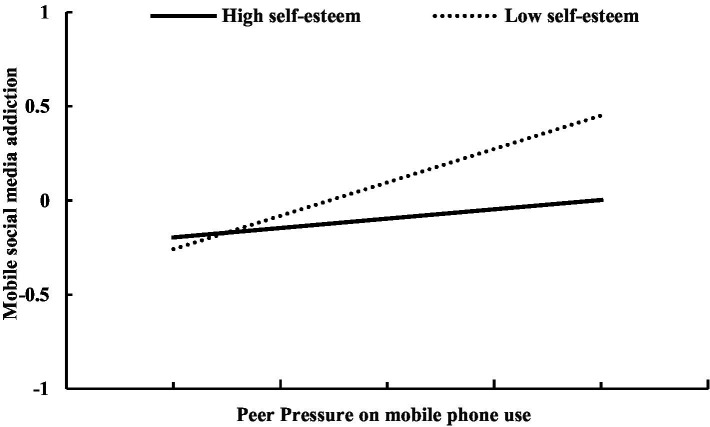
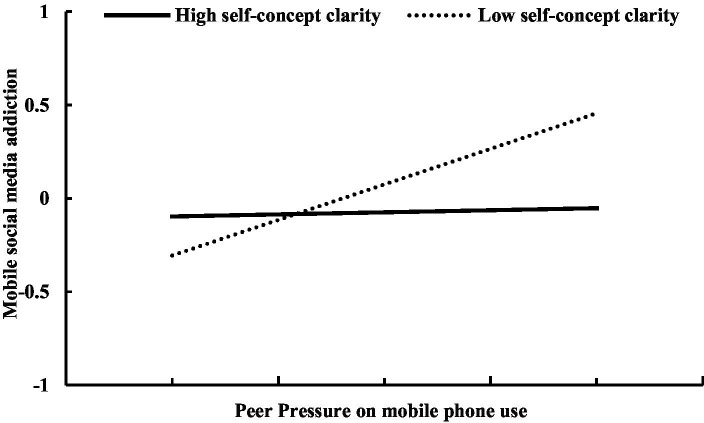
Background: Social media addiction has increasingly been a critical social problem. We explored the association between peer pressure on mobile phone use and adolescent mobile social media addiction and tested whether self-esteem and self-concept clarity could buffer the effect of peer pressure. Methods: 830 adolescents ( M age = 14.480, SD age = 1.789) participated in our anonymous cross-sectional questionnaire study. Results: The results showed that peer pressure significantly predicted adolescent mobile social media addiction. Self-esteem moderated the effect of peer pressure on mobile social media addiction in that peer pressure had a weaker effect for adolescents with higher self-esteem. Self-concept clarity moderated the effect of peer pressure on mobile social media addiction in that peer pressure had a weaker effect for adolescents with higher self-esteem. The two moderators also interact in that the moderation of self-esteem was stronger for adolescents with higher self-concept clarity and the moderation of self-concept clarity for adolescents with higher self-esteem. Conclusion: The results highlight the critical role of self-esteem and self-concept clarity in buffering the impact of peer pressure on mobile social media addiction. The findings promote a better understanding of how to buffer the undesirable effect of peer pressure and reduce the risk of mobile social media addiction among adolescents.
Overview
The claims and statistics of this paper haven’t been checked yet.
Free: it reads the open-access text and checks the first 5 claims that cite a source we can check. Create a free account to check every claim.
Integrity signals
Registry
Cites
Statistics
Figures
Verification
Claims the paper makes
The claims and statistics of this paper haven’t been checked yet.
Free: it reads the open-access text and checks the first 5 claims that cite a source we can check. Create a free account to check every claim.
Claims other papers make about this one
Each is checked against this paper’s own text: does it say what the citing paper says it does?
The cited source says what the claim attributes to it.
In the citing paper
“Another study revealed that teenage addiction to mobile social media is highly predictable by peer pressure and that this association is especially strong in young people who have low self-esteem [90].”
From Correlations between social media addiction and anxiety, depression, FoMO, loneliness and self-esteem among students: A systematic review and meta-analysis (2025) · cites this paper as [90]
Self-check
Percentages, sums and reported differences re-computed from the paper’s own numbers.
The self-check needs the paper’s full text.
Citations
Cites
(2013) · Cited by 44,563
Self-esteem as an interpersonal monitor: The sociometer hypothesis
Leary, M. R., Tambor, E. S., Terdal, S. K., & Downs, D. L. (1995) · Journal of Personality and Social Psychology · doi:10.1037/0022-3514.68.3.518 · Cited by 2,519
Andreassen, C. S., Pallesen, S., & Griffiths, M. D. (2017) · Addictive Behaviors · doi:10.1016/j.addbeh.2016.03.006 · Cited by 1,504
The uses and abuses of Facebook: A review of Facebook addiction
Ryan, T., Chester, A., Reece, J., & Xenos, S. (2014) · Journal of Behavioral Addictions · doi:10.1556/jba.3.2014.016 · Cited by 714
Understanding peer influence in children and adolescents
(2008) · Choice Reviews Online · doi:10.5860/choice.46-1775 · Cited by 621
Cheng, C., Lau, Y.-C., Chan, L., & Luk, J. W. (2021) · Addictive Behaviors · doi:10.1016/j.addbeh.2021.106845 · Cited by 571
The structure of the self-concept and its relation to psychological adjustment
Campbell, J. D., Assanand, S., & Paula, A. D. (2003) · Journal of Personality · doi:10.1111/1467-6494.t01-1-00002 · Cited by 457 · cited 1×
“Self-esteem reflects whether an individual has a positive self-concept (15), and selfconcept clarity reflects whether an individual has a clear self-concept (16).”
BackgroundThe multidimensionality of peer pressure in adolescence
Clasen, D. R., & Brown, B. B. (1985) · Journal of Youth and Adolescence · doi:10.1007/bf02139520 · Cited by 309 · cited 1×
“Peer pressure refers to the pressure that individuals feel when they are directly or indirectly asked to think and act according to the rules or requirements of their peers (6, 7).”
BackgroundMobile phone dependency and its impacts on adolescents’ social and academic behaviors
Seo, D. G., Park, Y., Kim, M. K., & Park, J. (2016) · Computers in Human Behavior · doi:10.1016/j.chb.2016.05.026 · Cited by 270 · cited 1×
“Academic performance was closely associated with self-esteem and mobile phone addiction (17, 52).”
BackgroundPerceived stress and mobile phone addiction in Chinese adolescents: A moderated mediation model
Liu, Q.-Q., Zhang, D.-J., Yang, X.-J., Zhang, C.-Y., Fan, C.-Y., & Zhou, Z.-K. (2018) · Computers in Human Behavior · doi:10.1016/j.chb.2018.06.006 · Cited by 201
Self-citation
Research works printed but not linked: 4
- Rankin P. S. (2019). Bridging the theory to evidence gap: a systematic review and analysis of individual × environment models of child development. Doctoral dissertation. St Lucia QLD, Australia: The University of Queensland.
- Findley D. (2013). Self-concept clarity and self-esteem in adolescence: Associations with psychological, behavioral, and academic adjustment. Graduate dissertation. Tampa, FL: University of South Florida.
- Wang X. D. Wang X. L. Ma H. Handbook of mental health assessment; Chinese Mental Health Journal Press, Beijing, China. (1999): 633– 637.
- Zunic D. (2017). The effects of social media and self-esteem on the fear of missing out (FoMO) and delinquent behavior. Doctoral dissertation. Lakeland, FL: Florida Southern College.
Cited by
Adolescent Social Media Use and Emotional Intelligence: A Systematic Review
Piccerillo, L., & Digennaro, S. (2025) · Adolescent Research Review · doi:10.1007/s40894-024-00245-z · Cited by 55
“A consistent pattern of negative correlations has been found in the research carried out by other studies on addiction to social media and self-esteem (Acar et al., 2022; Ciacchini et al., 2023; Xu et al., 2023).”
Gu, H., Chen, W., & Cheng, Y. (2024) · Child Abuse & Neglect · doi:10.1016/j.chiabu.2024.106697 · Cited by 37
Jing, Z., Yang, W., Lei, Z., Junmei, W., Hui, L., & Tianmin, Z. (2025) · PLOS One · doi:10.1371/journal.pone.0329466 · Cited by 33
“Another study revealed that teenage addiction to mobile social media is highly predictable by peer pressure and that this association is especially strong in young people who have low self-esteem [90].”
Deep, P. D., Ghosh, N., Gaither, C., & Rahaman, M. S. (2024) · Psychoactives · doi:10.3390/psychoactives3040028 · Cited by 35
“When adolescents see such substance use promotion on social media platforms, it is difficult for them to resist that pressure [16].”
Wang, D., Liu, X., Chen, K., Gu, C., Zhao, H., Zhang, Y., & Luo, Y. (2024) · BMC Public Health · doi:10.1186/s12889-024-17980-6 · Cited by 33
“Previous studies have primarily explored the relationship between negative peer relationships, such as deviant peer associations [51], peer bullying [52], and peer pressure [53], and IA.”
BackgroundPiko, B. F., Krajczár, S. K., & Kiss, H. (2024) · Youth · doi:10.3390/youth4010025 · Cited by 28
Ahorsu, D. K. (2024) · Journal of Social Media Research · doi:10.29329/jsomer.9 · Cited by 24
“…frequently use and are affected by social media addiction due to their exploratory nature, although they are inexperience in managing stressful situations, including the use of maladaptive coping strategies (Giordano et al., 2023; Khodarahmi et al., 2023; Villanti et al., 2017; Xu et al., 2023).”
van der Wal, A., Beyens, I., Janssen, L. H. C., & Valkenburg, P. M. (2025) · Current Psychology · doi:10.1007/s12144-025-08893-7 · Cited by 32
“Adolescents with high SCC are generally less influenced by their environment (Xu et al., 2023), and, consequently, may be less vulnerable to social media’s negative impacts.”
Dodan, D., & Negru‐Subtirica, O. (2025) · Journal of Research on Adolescence · doi:10.1111/jora.70011 · Cited by 19
Soraci, P., Pisanti, R., Servidio, R. C., Holte, A. J., Ferrari, A., Demetrovics, Z., & Griffiths, M. D. (2024) · International Journal of Mental Health and Addiction · doi:10.1007/s11469-024-01375-0 · Cited by 16
“…technology use becomes increasingly pronounced as a response to low levels of self-esteem, while inhibiting social anxiety and emotional distress (Xu et al., 2023), in line with I-PACE model, which helps in understanding how various factors interact to influence the problematic use of technology…”
Zhang, D., Yang, Y., & Chen, R. (2025) · Current Psychology · doi:10.1007/s12144-025-08423-5 · Cited by 12
van der Wal, A., Beyens, I., Janssen, L. H. C., & Valkenburg, P. M. (2024) · PsyArXiv (OSF Preprints) · doi:10.31234/osf.io/qe9rn · Cited by 11
Yuan, M., Sun, Y., Wang, Y., & Yu, L. (2025) · Development and Psychopathology · doi:10.1017/s0954579424001913 · Cited by 12
Qiu, R., Li, Y., Gong, Y., Guo, Z., Cheng, S., Li, M., & Zhu, X. (2025) · Frontiers in Psychiatry · doi:10.3389/fpsyt.2025.1592132 · Cited by 8
“When frequent social media use is prevalent within an individual ’ s social circle, the individual may increase their own usage frequency due to conformity, gradually leading to addiction (12).”
Barbarias-García, O., Jáuregui, P., Etxaburu, N., Díez, I. I., Olave, L., Muñiz, J. A., & Estévez, A. (2024) · Terapia psicológica · doi:10.4067/s0718-48082024000200217 · Cited by 8
Doan, V. A., Alexandrovsky, D., van Sintemaartensdijk, I., Gerling, K., & Friehs, M. A. (2025) · International Journal of Human-Computer Studies · doi:10.1016/j.ijhcs.2025.103465 · Cited by 10
Longitudinal changes in screen time, sleep, and sports/exercise activity in early adolescence
Nagata, J. M., Helmer, C. K., Memon, Z., Ramappa, S., Wong, J. H., Diep, T., Al-Shoaibi, A. A. A., Ganson, K. T., Testa, A. M., Baker, F. C., et al. (2025) · BMC Pediatrics · doi:10.1186/s12887-025-06368-z · Cited by 8
“This could reflect the effects of peer pressure, less parental supervision of adolescent screen time, and increased use of screens for daily activities during the COVID-19 pandemic [33].”
Self-concept clarity: a comprehensive and integrative review
Manchiraju, S. (2026) · Frontiers in Psychology · doi:10.3389/fpsyg.2026.1822881 · Cited by 7
Navarrete-Tola, M. J., Cañarte, A. M. M., & Ortiz, J. B. M. (2023) · MQRInvestigar · doi:10.56048/mqr20225.7.3.2023.4383-4404 · Cited by 9
Wang, Z., & Zhang, Y. (2026) · Brain and Behavior · doi:10.1002/brb3.71224 · Cited by 7
“This suggests additional mechanisms, such as social modeling, normative peer behaviors, and perceived social support, may independently influence smartphone use (Marino et al. 2020 ; Xu et al. 2023 ).”
Self-Esteem as a Moderator of the Influence of Peer Pressure on Adolescent Aggression
Wulandari, A. N., Ni’matuzahroh, N., & Istiqomah, I. (2025) · Psychological-Educational Studies · doi:10.17759/psyedu.2025170104 · Cited by 6
Xu, J., Ismail, A. B., Ramayah, T., Liew, C. W. S., & Zheng, C. (2026) · Frontiers in Psychology · doi:10.3389/fpsyg.2026.1685559 · Cited by 7
“Similarly, Xu et al. (2023) found that peer pressure significantly predicted mobile social media addiction, indicating that peer-related social norms can drive higher levels of problematic engagement with online platforms.”
Social Media Addiction: Psychological Impacts on Future Generations
Kumar, R., Kumar, V., Latif, A., & Shah, S. A. (2024) · Qlantic journal of social sciences. · doi:10.55737/qjss.v-iv.24269 · Cited by 5
Yoga, I., Hastuti, R., Pramesti, W., & Rahmayati, A. (2025) · Al-Intaj Jurnal EKonomi dan Perbankan Syariah · doi:10.29300/aij.v11i1.5205 · Cited by 8
The role of internet parenting on internet addiction among adolescents
Auraningtyas, I., Arshanty, I. R., Rahmawati, R. T., & Trisnawati, T. (2024) · Psychological Research and Intervention · doi:10.21831/pri.v6i2.70585 · Cited by 4
Civita, S.-Z., Benallal, L., Leduc, K., & Talwar, V. (2026) · International Journal of Adolescence and Youth · doi:10.1080/02673843.2026.2614425 · Cited by 4
Social Networks as a New Scenario for EFL Speaking Development
Álvarez, C. D. L. P., & Chaves-Yuste, B. (2024) · The International Journal of Interdisciplinary Educational Studies · doi:10.18848/2327-011x/cgp/v19i02/45-67 · Cited by 5
Between Sea, Sand, and Self: A Structural Model of Tourist Intention in Parangtritis Coastal Tourism
Suhud, U., Allan, M., Hoo, W. C., Azinuddin, M., Mulyana, A., & Ngarbingan, H. K. (2025) · Polish Journal of Sport and Tourism · doi:10.2478/pjst-2025-0025 · Cited by 3
“Moreover, findings from Guo et al. [4] and Xu et al. [23] rein - force that when tourists recognize a destination as reflecting 2025 32(3), 36-47 their self-image, the alignment activates meaningful behav - ioural responses, such as desire to visit, recommend, or revisit.”
Centering relation in media literacy practice
Mihailidis, P., Foster, B., Burth, S., Ramasubramanian, S., Tully, M., & Johnson, P. R. (2025) · Journal of Media Literacy Education · doi:10.23860/jmle-2025-17-1-9 · Cited by 4
Khemakongkanonth, C. (2025) · Telecommunications Policy · doi:10.1016/j.telpol.2025.102916 · Cited by 2
Understanding Medication Adherence Challenges
Sharma, A., Sharma, S., Sunita, S., Lakshmi, P. V. M., & Sharma, A. (2025) · BENTHAM SCIENCE PUBLISHERS eBooks · doi:10.2174/9789815324457125010004 · Cited by 3
Pamuk, M., Göktaş, E., & Aslan, A. (2025) · The Educational and Developmental Psychologist · doi:10.1080/20590776.2025.2597756 · Cited by 3
“…family, and social lives (Acar et al., 2022; Bilgiz & Peker, 2021; Çiftci et al., 2023; Demirci et al., 2020; Fabris et al., 2024; Göksu & Gültekin, 2023; Karabulut & Atasoy, 2024; Kaygas et al., 2023; Khalifa, 2021; Kurker & Surucu, 2024; Özdemir, 2024; Sağar & Özçelik, 2022; Xu et al., 2023).”
Snegg, J., Larrain, B., Mosler, K., van Kessel, R., Achab, S., Corazza, O., Penazzi, G., Stein, D. J., Ekhtari, H., Bowden‐Jones, H., et al. (2026) · Comprehensive Psychiatry · doi:10.1016/j.comppsych.2026.152675 · Cited by 3
“…particularly vulnerable to PUI due to their deep engagement with the digital world [11] and their neurodevelopmental stage characterised by substantial physical, emotional, and social changes, increased susceptibility to addictive behaviours, and heightened sensitivity to peer influences [12 – 14].”
Intentions Matter: The Role of Purpose in Excessive Social Media Usage and Smartphone Addiction
Ali, A. A., Babiker, A., Erbad, A., & Ali, R. (2023) · International Conference on Behavioral, Economic, and Socio-Cultural Computing · doi:10.1109/besc59560.2023.10386530 · Cited by 4
“Among these factors, peer pressure is a significant influence, as friends may expect immediate responses and comments on their posts [20].”
BackgroundResultInfluentialParamitha, D. S., Amaliah, N., & Ariadi, H. (2024) · Gaster | Jurnal Ilmu Kesehatan · doi:10.30787/gaster.v22i1.1409 · Cited by 4
“This is because they are better able to withstand social pressure (Xu et al., 2023).”
BackgroundReed, P., & Arin, N. (2025) · Cogent Psychology · doi:10.1080/23311908.2025.2523649 · Cited by 2
“Peer pressure within the social media context can encourage individuals to conform to behaviors valued by their peers, which may lead to both positive and negative outcomes such as excessive social media use and stress (Kim & lim, 2021; Xu et al., 2023).”
Hubungan Peran Orang Tua, Teman Sebaya dan Lingkungan Masyarakat Terhadap Nomofobia Pada Remaja
Rofifah, K., & Supriyadi, S. (2024) · JURNAL ILMIAH WAHANA PENDIDIKAN · doi:10.5281/zenodo.10643935 · Cited by 2
Peer pressure Influences Adolescents’ Internet Addiction
Xie, J. (2024) · Interdisciplinary Humanities and Communication Studies · doi:10.61173/726n0j76 · Cited by 1
Ji, D. K., Rehman, S., & Pandey, V. (2025) · International Journal of Research Publication and Reviews · doi:10.55248/gengpi.6.1025.3531 · Cited by 1
One blind spot of the explainability debate: the specific needs and vulnerabilities of adolescents
Schweiger, G. (2026) · AI & Society · doi:10.1007/s00146-026-02962-6 · Cited by 1
“The social pressure to participate is considerable and non-use can lead to social isolation (Xu et al. 2023).”
Maizon, W. S. N. W., Hamid, S. N. F. A., & Zaini, M. H. (2026) · IGI Global eBooks · doi:10.4018/979-8-3373-6696-8.ch012 · Cited by 1
Matkovic, J. (2026) · Frontiers in Public Health · doi:10.3389/fpubh.2026.1816727 · Cited by 2
Motivational and Psychological Factors in Affecting the Usage of TikTok among University Students
En, S. C., Chan, T. J., Tian, Y., Chen, M. H., & Feei, Z. (2026) · Studies in Media and Communication · doi:10.11114/smc.v14i2.8006 · Cited by 1
“This also aligned with Xu et al. (2023), where peer pressure significantly predicted social media addiction among adults.”
Wang, Y., Sun, C., Wu, H., Shan, Y., Wang, Y., Zhang, Y., Wu, S., Lu, Y., & Xu, C. (2026) · Frontiers in Psychology · doi:10.3389/fpsyg.2026.1762386 · Cited by 2
Satish, G., & Kumar, N. (2026) · Behavioral Sleep Medicine · doi:10.1080/15402002.2026.2679677 · Cited by 1
Hu, Y., Yang, Z., & Zhou, X. (2026) · Frontiers in Psychology · doi:10.3389/fpsyg.2026.1876296 · Cited by 1
“…is consistent with evidence that peer pressure surrounding mobile phone use is associated with adolescents’ mobile social media addiction, as adolescents may engage more frequently in smartphone-based interaction to maintain peer relationships and conform to social norms (Xu et al., 2023).”
Ekejiuba, I. A. (2026) · JOURNAL OF HUMANITIES AND SOCIAL POLICY · doi:10.56201/jhsp.vol.12.no1.2026.pg15.23 · Cited by 1
Rahaman, N. H., & Saidi, L. A. (2024) · Asian Journal of Research in Education and Social Sciences · doi:10.55057/ajress.2024.6.1.49 · Cited by 3
The Cruciality of Self-Determination on James Baldwin’s Bruce and the Spider
Pasopati, R. U., Noviyanti, A. D., Wijaya, K., Kartiningsih, R., & Hariyono, H. (2024) · Sphota Jurnal Linguistik dan Sastra · doi:10.36733/sphota.v16i2.8583 · Cited by 1
“The process of achieving goals requires effort, dedication and learning from experience (Orth & Robins, 2022; Xu, 2023).”
BackgroundInfluentialSelf-Monitoring as a Mediator Between Peer Pressure and Behavioral Conformity
Deshmukh, A., & Sharma, N. V. (2024) · doi:10.61838/kman.jayps.5.10.18 · Cited by 1
Ali, A. A., Babiker, A., Erbad, A., & Ali, R. (2024) · SSRN Electronic Journal · doi:10.2139/ssrn.5056040 · Cited by 1
Estrada-Araoz, E. G., Cruz-Laricano, E. O., Yana-Salluca, M., Arias-Jalire, M., Tello-Peralta, I. I., Cutipa-Luque, R., Chura-Quispe, G., & Quispe-Aquise, J. (2025) · Retos · doi:10.47197/retos.v68.115392
Xu, T., & Li, Z. (2024) · Lecture Notes in Education Psychology and Public Media · doi:10.54254/2753-7048/48/20231663 · Cited by 1
ضغط الأقران بين المراهقين على وسائل التواصل الاجتماعي وعلاقته بتقدير الذات
سلامة, ح. ع. (2024) · المجلة العربية لبحوث الاعلام والاتصال · doi:10.21608/jkom.2024.360793
Dias, G. G. A., & Sousa, M. J. D. B. (2025) · Contribuciones a las Ciencias Sociales · doi:10.55905/revconv.18n.11-085
Investigating Students Motivation on Phubbing during EFL Teaching and Learning Session
Elia, R., & Abid, N. (2025) · Lingual Journal of Language and Culture · doi:10.24843/ljlc.2025.v18.i02.p09
Chen, T., & Saibon, J. B. (2025) · International Journal of Evaluation and Research in Education (IJERE) · doi:10.11591/ijere.v14i6.34518
“Although many studies have focused on the psychological development of adolescents, most have concentrated on the independent role of individual environmental or psychological factors [7] – [9], and the exploration of their joint mechanisms remains insufficient.”
The relationship between self-cognition and internet addiction: A meta-analysis of empirical studies
Zhiyuan, Q. (2026) · Current Psychology · doi:10.1007/s12144-026-09998-3
Minkkinen, N. (2025) · Jyväskylä University Digital Archive (University of Jyväskylä)
Guðnadóttir, Á. E. (2024) · Skemman
The Effects of Social Media on Implicit Peer Pressure and Risk-Taking
Yeates, L. (2025) · NORMA
Fajria, K., Hastuti, D., & Riany, Y. E. (2025) · International Journal of Public Health Excellence (IJPHE) · doi:10.55299/ijphe.v4i2.1052
Nurhan, N. A. Z., & Güçlü, D. M. (2025) · Gazi Üniversitesi Gazi Eğitim Fakültesi Dergisi · doi:10.17152/gefad.1746635
James, R., & Hitcham, L. (2026) · Palgrave Studies in Cyberpsychology. · doi:10.1007/978-3-031-96188-5_2
Khurshid, M., Fatima, S., Majeed, B., & Mazhar, A. (2026) · ProScholar Insights · doi:10.55737/psi.2026a-51145
Effect of breathing exercise on stress management
Resheetha Jeslin, A., Thephilah Cathrine, R., Shankar Shanmugam, R., Rajathi, S., & Jayabharathi, B. (2026) · Bioinformation · doi:10.6026/973206300220425
Dependencia emocional hacia las amistades y pareja en adolescentes y adultos
Etxaburu, N. (2024) · DeustoTeka · Cited by 1
The Dual Role of Peer Pressure on Social Media in Addiction and Well-Being
Ali, A. (2026) · Lecture notes in computer science · doi:10.1007/978-981-95-7144-4_32
Dependencia emocional en adolescentes y jóvenes en sus relaciones de pareja una revision sistemática
Sánchez, I. M. G. (2025) · TITULA
The Potential Mechanisms of Mobile Phone Addiction and Suggestions
Zhao, J. (2026) · Advances in Education Humanities and Social Science Research · doi:10.56028/aehssr.16.1.134.2026
“Specifically, for individuals with high-level self-esteem, the impact of peer pressure on mobile phone addiction was weaker than those with low-level self-esteem (Xu et al., 2023).”
Chu, T. N. V., & Nguyen, T. T. P. (2026) · Tạp chí Khoa học · doi:10.54607/hcmue.js.23.si1.5417(2026
КІБЕРЗАЛЕЖНІСТЬ ЯК МАРКЕР ПОРУШЕННЯ ЗДОРОВ’ЯЗБЕРЕЖНОЇ ПОВЕДІНКИ У МОЛОДІ В УМОВАХ ВОЄННОГО СТАНУ
Огоренко, В., Shornikov, A., & Shornikov, O. (2026) · Перспективи та інновації науки · doi:10.52058/2786-4952-2026-3(61)-2516-2526
Yiğit, D., Ordu, S. K., & Yıldız, O. (2026) · Güncel Hemşirelik Araştırmaları Dergisi · doi:10.65673/jcnr.1715894
Age of First Smartphone Ownership With Social Media Access and Its Impact on Mental Health Outcomes
Swandol, D. W. (2026) · Digital Commons (Liberty University)
Malihah, Z., Simanjuntak, M., Riany, Y. E., & Khomsan, A. (2026) · Hadlonah Jurnal Pendidikan dan Pengasuhan Anak · doi:10.47453/hadlonah.v7i1.4088
Similarities and Differences Between Substance-Related and Non-Substance-Related Addictive Behaviors
(2026) · Frontiers research topics · doi:10.3389/978-2-8325-8072-1
Mapping the Landscape of Student Anxiety: Empirical Insights From Higher Educational Institutions
Raghavendra, A. N., Manu, K. S., Subramanian, S., Vimaladevi, M., & Athrey, A. (2026) · IGI Global eBooks · doi:10.4018/979-8-2600-2168-2.ch003
Pengaruh Smartphone Addiction Terhadap Student Engagement dengan Peer Group Sebagai Variabel Mediasi
Rabayani, R., Surbakti, A., & Hasanuddin, H. (2025) · SCHOULID Indonesian Journal of School Counseling · doi:10.23916/086050011
“Penelitian Xu et al. (2023) membuktikan bahwa hasilnya menunjukkan bahwa kecanduan media sosial seluler remaja karena dipengaruhi tekanan teman teman sebaya.”
Factores causales de la adicción a las redes sociales en estudiantes de una universidad peruana.
Melgar, M. E. O., Soto, J. A. H., Meza, O. V., & Casavilca, A. R. (2026) · Revista Relep - Educación y Pedagogía en Latinoamérica · doi:10.46990/relep.2026.8.2.2800
Between Trends and Truths: TikTok Therapy-Speak and Mental Health
Stephens, Z. (2026) · Scholarship @ Claremont (The Claremont Colleges)
Evolution of Digital Communication, AI, and Algorithmic Neo-slacktivism
Kassen, M. (2026) · Information Technology and Global Governance · doi:10.1007/978-3-032-20770-8_2
Ali, A. A. M., Babiker, A., Yankouskaya, A., Erbad, A., & Ali, R. (2026) · Journal of Technology in Behavioral Science · doi:10.1007/s41347-026-00658-8
Adolescents’ Emotional Intelligence and Self-Perception in the Context of Social Media Use
Andreoni, V. C., Barreyro, J. P., & Calero, A. D. (2026) · Psychological Reports · doi:10.1177/00332941261473820
Etxaburu, N., Estévez, A., Czakó, A., Villalba-García, C., Griffiths, M. D., & Demetrovics, Z. (2026) · International Journal of Mental Health and Addiction · doi:10.1007/s11469-026-01710-7
Academic Performance as Influenced by Social Support and Self-Esteem of Students in Mathematics
Roferos, J. V., Paring, D., Cal, D. J. V., Lamera, C. L. A., Gubaton, R. D., & Jamara, A. J. (2026) · Journal of Social Humanity and Education · doi:10.35912/jshe.v6.n4.p469-486.2026 · Cited by 1
Sinaga, D. G. K., Susanti, S., & Lestari, W. (2026) · All Fields of Science Journal Liaison Academia and Sosiety · doi:10.58939/afosj-las.v6i2.1547
Understanding Digital Parenting Practices During Early Adolescence: A Qualitative Study
AYDOĞDU, F., & Avcı, Ö. H. (2026) · Family Relations · doi:10.1111/fare.70353
Carrillo, I. S. D. (2026) · El Repositorio Academico Digital de la UANL (Universidad Autónoma de Nuevo León)
Li, X., & Hong, P. (2026) · Behavioral Sciences · doi:10.3390/bs16101796
Piccerillo, L. (2025) · Archivio Istituzionale della Ricerca - Università degli Studi di Cassino
Oka, P. K. I. W. I., Susana, M. P. A. P., Astika, N. D., Kurniati, K., & Pujiarohman, P. (2026) · Jurnal Kesehatan Tambusai · doi:10.31004/jkt.v7i3.62911
PERANCANGAN KAMPANYE SOSIAL TENTANG DAMPAK TOXIC ONLINE DISINHIBITION DI KALANGAN REMAJA
Nurcholiq, R., Harahap, W. L., & Gunawan, D. K. (2025) · Jurnal Rupa Matra. · doi:10.62375/jdkv.v4i1.753
Fauziah, A. R. F. (2025) · JEDMI: Journal of Education and Multidisciplinary Studies
Herawati, A. E., Suharni, S., & Christiana, R. (2026) · Prosiding Seminar Nasional Bimbingan dan Konseling
Yulianisa, T., Safitri, D., & Sujarwo, S. (2026) · JURNAL ILMIAH RESEARCH STUDENT
Shi, Y., Zhang, Q., Liu, Z., Wang, J., Wen, X., & liu, H. (2026) · Research Square · doi:10.21203/rs.3.rs-10141103/v1
Online Experiences and Safety of Neurodivergent Young People: A Mixed-Methods Study
Nurse, K. C., Perera, C., & Powell, G. (2026) · International ACM SIGACCESS Conference on Computers and Accessibility (ASSETS) · doi:10.1145/3797867.3829011
Lehtimäki, M., & Nordström, P. (2026) · Jyväskylä University Digital Archive (University of Jyväskylä)
Chen, Y., Liu, Z., & Huang, Z. (2026) · Lecture Notes in Education Psychology and Public Media · doi:10.54254/2753-7048/2026.38596
Sumanti, A. I., Sihombing, S. O., & Berlianto, M. P. (2026) · Multidisciplinary Science Journal · doi:10.31893/multiscience.2027322
Metadata
- Authors
- Xu, X., Han, W., & Liu, Q.
- Affiliations
- Henan Normal University (CN)
- Guangzhou University (CN)
- Corresponding author
- Liu, Qingqi
- ORCID
- Liu, Qingqi
- Venue
- Frontiers in Public Health
- Publisher
- Frontiers Media SA
- Published
- 2023-04-11
- Volume
- 11
- Pages
- 1115661-1115661
- ISSN
- 2296-2565 (ISSN-L)
- PMC
- PMC10126400
- OpenAlex
- W4363672310
- Cited by
- 57
- References
- 49
- Citations by year
- 2026: 23 · 2025: 16 · 2024: 16 · 2023: 2
- FWCI
- 24.49
- Type
- journal article
- Language
- en
- Open access
- gold
- doi.org
- Licence
- Locations
- Frontiers in Public Health (publishedVersion, cc-by)
- PubMed Central (publishedVersion, cc-by)
- PubMed (publishedVersion)
- DOAJ (DOAJ: Directory of Open Access Journals) (submittedVersion, cc-by-sa)
- Funders
- National Office for Philosophy and Social Sciences
- Topics
- Social Sciences › Sociology and Political Science › Impact of Technology on Adolescents
- Social Sciences › Psychology › Clinical Psychology › Sexuality, Behavior, and Technology
- Social Sciences › Education › Child Development and Digital Technology
- Keywords
- peer pressure, adolescents, self-esteem, self-concept clarity, moderation, buffering effect, mobile phone use
- MeSH terms
- Peer Influence, Internet Addiction Disorder, Adolescent, Cross-Sectional Studies, Humans, Infant, Surveys and Questionnaires, Self Concept
About these checks
Registry, retraction, Cites and statistics results are computed, not judged, with one exception: a printed reference that no index lists is read once by a model before it counts as a citation error. Claims are extracted by a model and kept only when their quote appears verbatim in the text; each cited source is then checked, with a model’s help, for whether it says what the claim relies on. Those verdicts can be wrong — read the claim’s quote and the cited source before relying on one.
Statistics and arithmetic are recomputed, not judged.
Confidence bands are shown only for fields calibrated on our annotated test set. None is calibrated yet, so no band is shown.
What counts as a claim ›How we measure confidence ›How we check this ›
Are you an author, or do you see a problem with this page? Request a review
Data sources
Bibliographic data: Semantic Scholar, OpenAlex, Crossref.
Contains information from the Semantic Scholar Academic Graph Datasets, made available under the ODC Attribution License (ODC-BY 1.0).
Semantic Scholar’s data is described in: Kinney, R., et al. (2023). The Semantic Scholar Open Data Platform. arXiv:2301.10140.
