

The DOI matches its Crossref record; 1 of the 1 references it cites were found in a registry or an index.
Indoor air bacterial load and antibiotic susceptibility pattern of isolates at Adare General Hospital in Hawassa, Ethiopia
Open accessAbstract
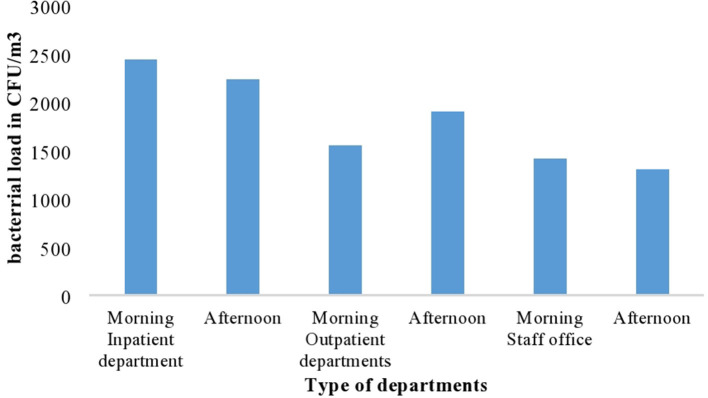
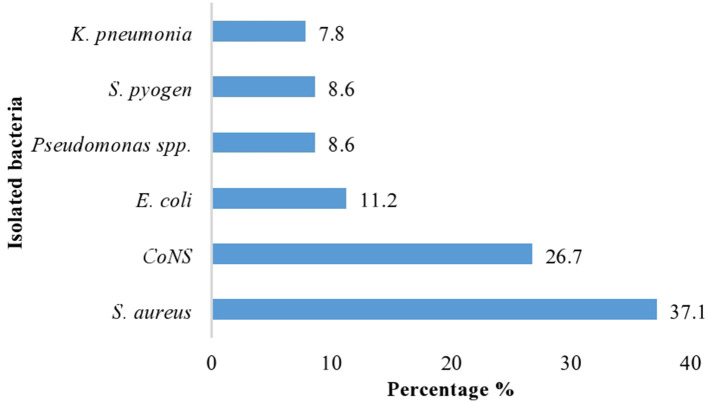
Background: Air is the agent of pathogenic microbes that cause significant problems in the hospital environment. Multidrug resistance poses a major therapeutic challenge to these airborne microorganisms in hospital indoor environments. Method and materials: This study was conducted at Adare General Hospital in Hawassa City, Sidama, Ethiopia. A cross-sectional study was conducted. The proportional allocation method was used to select the sampled 50 rooms from the total available rooms in each category of wards and staff offices. A total of 100 indoor air samples were collected using settle plates in all units twice a day, morning (9:00–4:00 a.m.) and afternoon (3:00–4:00 p.m.). The types and number of colonies were determined in the laboratory, and the pathogenic bacteria were isolated by appropriate bacteriological techniques. Antimicrobial susceptibility testing was performed on Mueller-Hinton agar for each potentially pathogenic bacterium isolated. For each bacterium, a total of 12 antibiotics were tested using the Kirby-Bauer disk diffusion method. The test organism was adjusted to McFarland turbidity standards of 0.5. Data were entered and analyzed using the SPSS version 25 window. Descriptive analysis and one-way analysis of variance were performed. Results: The indoor air bacterial load of Adare General Hospital was found in the range between 210 and 3,224 CFU/m 3 . The highest indoor air bacterial load was identified from the gynecology ward with a mean of 2,542.5CFU/m 3 at p < 0.05. From 100 indoor air samples, a total of 116 bacterial pathogen isolates were obtained. Gram-positive isolates predominated at 72.4%, of which 37.1% were Staphylococcus aureus , 26.7% were coagulase-negative Staphylococci , and the rest 8.6% were Streptococcus pyogenes . The isolation of pathogenic bacteria Staphylococcus aureus and coagulase-negative Staphylococci showed a high level of resistance to ampicillin. Conclusion: A high bacterial load was found in the study area as compared to different indoor air biological standards. Staphylococcus aureus and coagulase-negative Staphylococci were the isolated predominant bacteria. Attention should be given to preventing and minimizing those environmental factors that favor the multiplication of bacteria in the indoor environment of a hospital for the safe health of patients, visitors, and staff.
Overview
The claims and statistics of this paper haven’t been checked yet.
Run the check — free, no account needed. It reads the open-access text and checks the sources it cites.
Integrity signals
Registry
Cites
Statistics
Figures
Verification
Claims the paper makes
The claims and statistics of this paper haven’t been checked yet.
Run the check — free, no account needed. It reads the open-access text and checks the sources it cites.
Claims other papers make about this one
Each is checked against this paper’s own text: does it say what the citing paper says it does?
The source backs part of the claim, not all of it — or backs it for a different population, condition or comparison.
In the citing paper
“These studies also relied predominantly on conventional settle plate methods for microbial sampling, with inherent limitations of providing only semi-quantitative data influenced by air current [1, 2].”
From Indoor air quality, hygiene practices and the antimicrobial resistance profiles of airborne bacteria in selected areas of a tertiary health facility in Ibadan, Nigeria (2026) · cites this paper as [2]
Experimental — accuracy not yet measured
Self-check
Percentages, sums and reported differences re-computed from the paper’s own numbers.
The self-check needs the paper’s full text.
Citations
Cites
Genet, C., Kibru, G., & Tsegaye, W. (2011) · Ethiopian Journal of Health Sciences · doi:10.4314/ejhs.v21i1.69039 · Cited by 40
Research works printed but not linked: 34
- Kurutkan, 2015, An implementation on the social cost of hospital-acquired infections, Int J Clin Exp Med., 8, 4433
- Magill, 2014, Multistate point-prevalence survey ofhealthcare–associated infections, N Engl J Med., 370, 1198, 10.1056/NEJMoa1306801 · DOI · Paper page
- Khajehzadeh, 2017, How New Zealanders distribute their daily time between home indoors, home outdoors, and out of the home, Kotuitui., 12, 17, 10.1080/1177083X.2016.1187636 · DOI
- Barrasa-Villar, 2017, Impact on morbidity, mortality, and length of stay of hospital-acquired infections by resistant microorganisms, Clin Infect Dis., 65, 644, 10.1093/cid/cix411 · DOI
- Gelaw, 2014, Isolation of bacterial pathogens from patients with postoperative surgical site infections and possible sources of infections at the University of Gondar Hospital, Northwest Ethiopia, J Environ Occup Health., 3, 103, 10.5455/jeos.20140512124135 · DOI
- Dessie, 2016, Pattern of bacterial pathogens and their susceptibility isolated from surgical site infections at selected referral hospitals, Addis Ababa, Ethiopia, Int J Microbiol, 2016, 10.1155/2016/2418902 · DOI
- Diriba, 2016, Antibiotics susceptibility pattern of hospital indoor airborne bacteria in Hawassa University Teaching and Referral Hospital, South Ethiopia, Int J Mod Chem Appl Sci., 3, 287
- Hailemariam, 2016, Bacterial load and antibiotic susceptibility pattern of isolates in operating rooms at Hawassa University Referral Hospital, southern Ethiopia, J Microbiol Antimicrob., 8, 1, 10.5897/JMA2015.0349 · DOI
- Gebremariam, 2015, Microbial load of operating theatre at Ayder Referral Hospital, Northern Ethiopia, Afr J Microbiol Res., 9, 639
- Pollution, 2018, Child Health: Prescribing Clean Air
- Luksamijarulkul, 2014, Microbial contamination on used surgical masks among hospital personnel and microbial air quality in their working wards: a hospital in Bangkok, Oman Med J., 29, 346, 10.5001/omj.2014.92 · DOI
- Ogwang, 2013, The prevalence of hospital-associated infections can be decreased effectively in developing countries, J Hosp Infect., 84, 138, 10.1016/j.jhin.2013.02.016 · DOI
- Moghnieh, 2019, A compilation of antimicrobial susceptibility data from a network of 13 Lebanese hospitals reflecting the national situation during 2015–2016, Antimicrob Resist Infect Control., 8, 1, 10.1186/s13756-019-0487-5 · DOI
- Pasquarella, 2000, The index of microbial air contamination, J Hosp Infect., 46, 241, 10.1053/jhin.2000.0820 · DOI
- Andersson, 2012, Traffic flow in the operating room: an explorative and descriptive study on air quality during orthopedic trauma implant surgery, Am J Infect Control., 40, 750, 10.1016/j.ajic.2011.09.015 · DOI
- Patel, 2017, Performance Standards for Antimicrobial Susceptibility Testing
- 2016, Performance standards for antimicrobial susceptibility testing, Clin Lab Stand Inst., 35, 16
- Hameed, 2020, Molecular detection of blaOXA-51 in Carbapenem-resistant Acinetobacter baumannii Isolated from different clinical sources, Medico Legal Update., 20, 693, 10.37506/mlu.v20i4.1900 · DOI
- Caicedo Bejarano, 2021, Comparison of two techniques for the detection of environmental fungi in a university campus, Polish J Environ Stud., 30, 2995, 10.15244/pjoes/129911 · DOI
- Gizaw, 2016, High bacterial load of indoor air in hospital wards: the case of University of Gondar teaching hospital, Northwest Ethiopia, Multidiscip Respir Med., 11, 1, 10.1186/s40248-016-0061-4 · DOI
- Fekadu, 2015, Microbiological assessment of indoor air of Teaching hospital wards: a case of Jimma University specialized hospital, Ethiop J Health Sci., 25, 117, 10.4314/ejhs.v25i2.3 · DOI
- Shiferaw, 2016, Bacterial indoor-air load and its implications for healthcare-acquired infections in a teaching hospital in Ethiopia, Int J Infect Control., 12, 10.3396/ijic.v12i1.15808 · DOI
- Attaway, 2012, The intrinsic bacterial burden associated with intensive care unit hospital beds: effects of disinfection on population recovery and mitigation of potential infection risk, Am J Infect Control., 40, 907, 10.1016/j.ajic.2011.11.019 · DOI
- Sivagnanasundaram, 2019, Assessment of airborne bacterial and fungal communities in selected areas of a teaching hospital, Kandy, Sri Lanka, BioMed Res Int, 2019, 10.1155/2019/7393926 · DOI
- Wanner, 1993, Biological particles in indoor environments: European Collaborative Action. Indoor Air Quality & Its Impact on Man Report No 12.
- Bhatt, 2014, Multi-drug resistance bacterial isolates of surgical site infection, Open J Med Microbiol., 4, 203, 10.4236/ojmm.2014.44022 · DOI
- Nasiri, 2021, Contamination of obstetrics and gynecology hospital air by bacterial and fungal aerosols associated with nosocomial infections, J Environ Health Sci Eng., 19, 663, 10.1007/s40201-021-00637-6 · DOI
- Getachew, 2018, Surfaces and air bacteriology of selected wards at a referral hospital, Northwest Ethiopia: a cross-sectional study, Int J Microbiol, 2018, 10.1155/2018/6413179 · DOI
- Onifade, 2020, Bacteriological assessment of hospital air and selected surfaces in three referral hospitals in Makurdi Middle Belt Nigeria, Eur J Environ Public Health., 4, em0056, 10.29333/ejeph/8454 · DOI
- Kunwar, 2019, Bacteriological assessment of the indoor air of different hospitals of Kathmandu District, Int J Microbiol, 2019, 10.1155/2019/5320807 · DOI
- Mirhoseini, 2021, Quantitative and qualitative assessment of microbial aerosols in different indoor environments of a dental school clinic, Aerobiologia., 37, 217, 10.1007/s10453-020-09679-z · DOI
- Ling, 2019, Evaluation of the complexity of indoor air in hospital wards based on PM2.5, real-time PCR, adenosine triphosphate bioluminescence assay, microbial culture and mass spectrometry, BMC Infect Dis., 19, 1, 10.1186/s12879-019-4249-z · DOI
- Kadaifciler, 2014, Microbial contamination of dental unit waterlines and effect on quatre quality of indoor air, Environ Monit Assess, 186, 3431, 10.1007/s10661-014-3628-6 · DOI
- Bantie, 2014, Assessment of prescribing practice pattern in governmental health centers of Bahir Dar Town, Ethiopia, World J Pharm Sci., 2, 1184
Cited by
Sorted by citations
Fabiyi, O. C., & Ana, G. R. (2026) · Antimicrobial Resistance & Infection Control · doi:10.1186/s13756-026-01733-8 · Cited by 3
Metadata
- Authors
- Atalay, Y. A., Mengistie, E., Tolcha, A., Birhan, B., Asmare, G., Gebeyehu, N. A., & Gelaw, K. A.
- Affiliations
- Wolaita Sodo University (ET)
- Hawassa University (ET)
- Corresponding author
- Atalay, Yibeltal Assefa
- Venue
- Frontiers in Public Health
- Publisher
- Frontiers Media SA
- Published
- 2023-11-02
- Volume
- 11
- Pages
- 1194850-1194850
- ISSN
- 2296-2565 (ISSN-L)
- PMC
- PMC10653387
- OpenAlex
- W4388328201
- Cited by
- 15
- References
- 1
- Citations by year
- 2026: 6 · 2025: 4 · 2024: 5
- FWCI
- 1.72
- Type
- journal article
- Language
- en
- Open access
- gold
- doi.org
- Licence
- Locations
- Frontiers in Public Health (publishedVersion, cc-by)
- PubMed Central (publishedVersion, cc-by)
- PubMed (publishedVersion)
- DOAJ (DOAJ: Directory of Open Access Journals) (submittedVersion, cc-by-sa)
- Topics
- Physical Sciences › Environmental Science › Health, Toxicology and Mutagenesis › Indoor Air Quality and Microbial Exposure
- Health Sciences › Medicine › Infectious Diseases › Infection Control in Healthcare
- Health Sciences › Medicine › Pulmonary and Respiratory Medicine › Infection Control and Ventilation
- Keywords
- indoor air quality, airborne bacteria, hospital indoor environment, bacterial load, antibiotic susceptibility, multidrug resistance, Staphylococcus aureus, coagulase-negative staphylococci, Streptococcus pyogenes, ampicillin resistance, hospital wards, nosocomial infections, settle plates, Gram-positive bacteria
- MeSH terms
- Anti-Bacterial Agents, Bacteria, Coagulase, Cross-Sectional Studies, Ethiopia, Hospitals, General, Humans, Staphylococcal Infections, Air Pollution, Indoor, Bacterial Load
About these checks
Registry, retraction, Cites and statistics results are computed, not judged, with one exception: a printed reference that no index lists is read once by a model before it counts as a citation error. Claims are extracted by a model and kept only when their quote appears verbatim in the text; each cited source is then checked, with a model’s help, for whether it says what the claim relies on. Those verdicts can be wrong — read the claim’s quote and the cited source before relying on one.
Statistics and arithmetic are recomputed, not judged.
Confidence bands are shown only for fields calibrated on our annotated test set. None is calibrated yet, so no band is shown.
What counts as a claim ›How we measure confidence ›How we check this ›
Are you an author, or do you see a problem with this page? Request a review
