

How different judgment strategies affect accuracy in generative AI text discrimination: BERT-based clustering and hierarchical Bayesian logistic regression
Open accessThe DOI matches its Crossref record; 25 of the 25 references it cites were found in a registry or an index; none of the 33 sources its claims cite is checked for support yet.
Abstract
Background: Large language models (LLMs)-generated texts become increasingly similar to human writing. The purpose of this study was to examine (1) how individuals distinguish between human-written and LLM-generated texts, focusing on their judgment strategies; (2) the relationship between judgment strategies and detection accuracy; and (3) the interaction effects of gender, age, and frequency of large language model (LLM) use. Methods: Participants were asked to judge whether the given texts (e.g., public comments) were written by LLMs or humans and to explain their reasoning using open-ended questions. The public comments were written by humans and generated using seven LLMs (ChatGPT [4o and o1], Claude3.5, Gemini, Microsoft Copilot, Llama3.1, and Perplexity). First, we classified participants’ explanations of reasoning related to judgments into types using BERT-based clustering (i.e., Sentence-BERT and hierarchical cluster analysis). Results: BERT-based clustering suggested four interpretable clusters. Based on their characteristic patterns, we interpreted these clusters as four hypothetical judgment strategy types and tentatively proposed that they form a conceptual continuum: (1) Unsubstantiated intuition, (2) Stylistic-Cue, (3) Syntactic-Cue, and (4) Higher-Order Pattern Recognition (HOPR). A hierarchical Bayesian logistic regression analysis revealed that the detection accuracy varied across judgment types, with the HOPR type achieving relatively higher performance than the other strategy types, although its detection accuracy remained near the chance level. Additionally, we identified interaction effects between strategy type and gender; only female participants who used the HOPR strategy showed lower detection accuracy than male participants, although the qualitative interpretation of this difference warrants further empirical investigation. Conclusion: These findings emphasize the role of judgment strategies and individual differences in discriminating between human and LLM-generated content.
Overview
CoChat Summary
TL;DR
This secondary analysis of Japanese survey data used BERT-based clustering of participants’ free-text reasoning and hierarchical Bayesian logistic regression to relate judgment strategies to AI-text detection accuracy. Higher-order pattern recognition showed the highest relative accuracy, but all strategies remained near chance, with a gender interaction in that strategy.
Key findings
- BERT-based clustering yielded four interpretable judgment-strategy clusters: Unsubstantiated intuition (n = 61), Stylistic-Cue (n = 65), Syntactic-Cue (n = 48), and Higher-Order Pattern Recognition (HOPR; n = 216); the authors tentatively order them as a conceptual continuum.
- Descriptive accuracy was Unsubstantiated intuition 0.41, Stylistic-Cue 0.43, Syntactic-Cue 0.44, and HOPR 0.45; overall detection accuracy was 43.7% across seven LLM-generated texts and 45.4% for the human-written text.
- In hierarchical Bayesian logistic regression, only Unsubstantiated intuition and Stylistic-Cue intercepts excluded zero and were negative (−0.239, 94% HDI [−0.388, −0.087]; −0.430, 94% HDI [−0.750, −0.131]); pairwise comparison showed Stylistic-Cue lower than HOPR (−0.480, 94% HDI [−0.978, −0.030]).
- Only the HOPR cluster showed a gender interaction excluding zero (−0.690, 94% HDI [−1.162, −0.224]), with women in HOPR showing lower detection performance than men; age and LLM-use frequency interactions were not statistically supported. Random intercept SD was 0.509 (94% HDI [0.383, 0.631]).
Methods
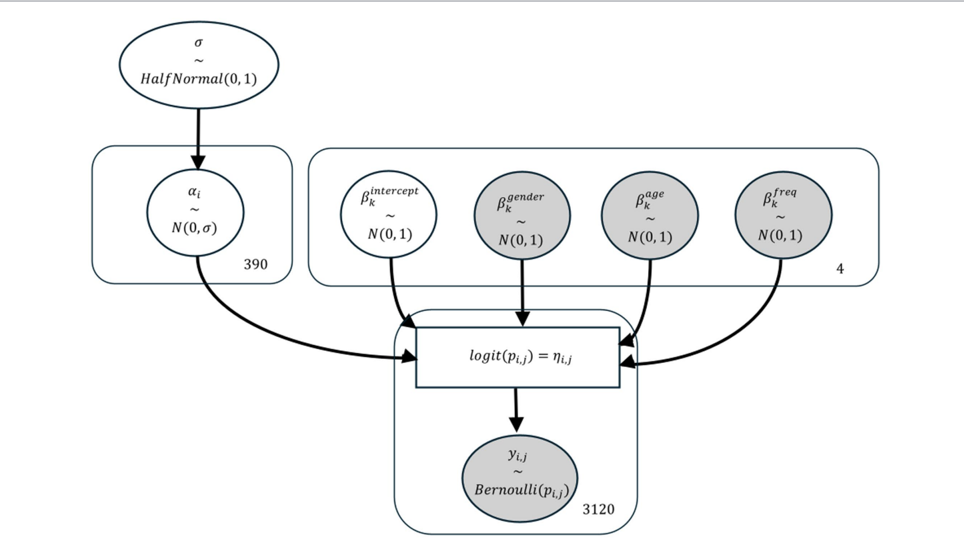
- Secondary analysis of Study 2 in Zaitsu et al. (2025), a Japanese web survey (Questant/Macromill) conducted January 24–25, 2025; N = 390 (227 men, 163 women; age 22–69, mean 47.8, median 49, SD 11.8), yielding 3,120 observations (390 × 8 texts).
- Stimuli were seven LLM-generated public comments (ChatGPT GPT-4o and o1, Claude3.5, Gemini, Microsoft Copilot, Llama3.1, Perplexity) plus one human-written public comment; participants judged authorship on a 7-point scale and gave open-ended reasoning.
- Analysis used Japanese Sentence-BERT embeddings plus hierarchical cluster analysis (Ward linkage) to classify strategies, then hierarchical Bayesian logistic regression with participant random intercepts and cluster-specific intercepts/interactions for gender, age, and LLM-use frequency; MCMC in PyMC used 4 chains, 5,000 draws per chain (1,000 tuning), with R̂ < 1.1.
Limitations
- Stated: clustering depended on BERT model choice; an alternative Japanese Sentence-BERT model produced different optimal cluster number/composition, so clusters are exploratory and representation-dependent. Also, k = 4 was chosen over statistically favored k = 2 for interpretability, trading statistical separation for theoretical resolution.
- Stated: stimuli were public comments only, so genre effects are unknown; cluster sizes were imbalanced (e.g., HOPR n = 216 vs Syntactic-Cue n = 48), which may affect stability/precision for smaller clusters; web-survey evidence is limited and causal interpretation is constrained because this was a secondary, non-pre-registered analysis.
- Stated/evident: participants gave a single retrospective free-text explanation after all eight judgments, so clusters reflect dominant reasoning tendency rather than per-judgment cognitive process; strategy types were not experimentally manipulated, making the System 1/System 2 mapping an interpretive hypothesis. The paper also notes the post hoc qualitative gender comparison was not statistically tested.
Model-written summary. Check it against the paper before relying on it.
Integrity signals
Registry
Cites
Statistics
Figures
Verification
Claims the paper makes
0 Valid · 0 Not valid · 27 Not checked · 46 Own results and interpretations
A result the paper reports from its own data — it cites no other source for it, so there is none to check. The quote shows it is in the paper.
In the paper
“Last, we interpreted Cluster 4 (n = 216) as “Higher-Order Pattern Recognition (HOPR)” type because this cluster was related to focusing on macro features of texts such as overall structure, repetitiveness, and content originality. For example, the participants explained, “Some texts were overly polished or structured and impressed me as artificial” and “When the text lacked originality in content,”
§ How different judgment strategies affect accuracy in generative AI text discrimination: BERT-based clustering and hierarchical Bayesian logistic regression > Results > Types of judgment strategies adopted by participants
plainstates an associationn = 216- Asserted: passes — The authors put it forward as true.
- Checkable: passes — It can be checked against evidence.
- Load-bearing: unclear — It is unclear whether the paper’s conclusions depend on it.
- Based: passes — The paper gives a reason why it holds.
A result the paper reports from its own data — it cites no other source for it, so there is none to check. The quote shows it is in the paper.
In the paper
“We obtained four types: (1) Unsubstantiated intuition, (2) Stylistic-Cue, (3) Syntactic-Cue, and (4) Higher-Order Pattern Recognition (HOPR).”
§ How different judgment strategies affect accuracy in generative AI text discrimination: BERT-based clustering and hierarchical Bayesian logistic regression > Discussion > Types of judgment strategies and their continuum (hypothesis 1)
plain- Asserted: passes — The authors put it forward as true.
- Checkable: passes — It can be checked against evidence.
- Load-bearing: passes — The paper’s conclusions depend on it.
- Based: passes — The paper gives a reason why it holds.
A result the paper reports from its own data — it cites no other source for it, so there is none to check. The quote shows it is in the paper.
In the paper
“only female participants who used the HOPR strategy showed lower detection accuracy than male participants”
§ How different judgment strategies affect accuracy in generative AI text discrimination: BERT-based clustering and hierarchical Bayesian logistic regression > Abstract > Results
plainstates an association- Asserted: passes — The authors put it forward as true.
- Checkable: passes — It can be checked against evidence.
- Load-bearing: unclear — It is unclear whether the paper’s conclusions depend on it.
- Based: passes — The paper gives a reason why it holds.
- Rests on an assumption not shown here.
A result the paper reports from its own data — it cites no other source for it, so there is none to check. The quote shows it is in the paper.
In the paper
“A hierarchical Bayesian logistic regression analysis revealed that the detection accuracy varied across judgment types”
§ How different judgment strategies affect accuracy in generative AI text discrimination: BERT-based clustering and hierarchical Bayesian logistic regression > Abstract > Results
plainstates an association- Asserted: passes — The authors put it forward as true.
- Checkable: passes — It can be checked against evidence.
- Load-bearing: passes — The paper’s conclusions depend on it.
- Based: passes — The paper gives a reason why it holds.
- Rests on an assumption not shown here.
A result the paper reports from its own data — it cites no other source for it, so there is none to check. The quote shows it is in the paper.
In the paper
“The posterior mean of σi was 0.509 (94% HDI [0.383, 0.631]), indicating substantial differences in baseline performance levels across participants (i.e., individual differences).”
§ How different judgment strategies affect accuracy in generative AI text discrimination: BERT-based clustering and hierarchical Bayesian logistic regression > Results > Associations between judgment strategies, performance level, and individual differences
hedged- Asserted: passes — The authors put it forward as true.
- Checkable: passes — It can be checked against evidence.
- Load-bearing: unclear — It is unclear whether the paper’s conclusions depend on it.
- Based: passes — The paper gives a reason why it holds.
20 more claims
Create a free account to see all 73 claims and to verify the 27 references still open.
- It may state two separate claims as one. 23
- Probably not a substantial claim. 33
- The quote only partly states this claim. 1
Statistics recomputed
Every reported test result, recomputed from its test statistic and degrees of freedom. A result shows as not adding up only once an independent check has confirmed it.
- Consistentt(791) = -0.25reported p = .8 · recomputed p = .803
“t(791) = −0.25, p = .80”
- Consistentχ²(5) = 0.13reported p = 1 · recomputed p = 1.000
“χ2(5,N=793)=0.13,p=1.00”
Self-check
Percentages, sums and reported differences re-computed from the paper’s own numbers.
Self-check results appear here once an independent check has confirmed them.
Citations
Cites
BERT: Pre-training of Deep Bidirectional Transformers for Language Understanding
Devlin, J., Chang, M.-W., Lee, K., & Toutanova, K. (2019) · Proceedings of the 2019 Conference of the North American Chapter of the Association for Computational Linguistics: Human Language Technologies, Volume 1 (Long and Short Papers) · doi:10.18653/v1/n19-1423 · Cited by 54,325
Silhouettes: A graphical aid to the interpretation and validation of cluster analysis
Rousseeuw, P. J. (1987) · Journal of Computational and Applied Mathematics · doi:10.1016/0377-0427(87)90125-7 · Cited by 21,392
(2011) · Cited by 14,317
Sentence-BERT: Sentence Embeddings using Siamese BERT-Networks
Reimers, N., & Gurevych, I. (2019) · Proceedings of the 2019 Conference on Empirical Methods in Natural Language Processing and the 9th International Joint Conference on Natural Language Processing (EMNLP-IJCNLP) · doi:10.18653/v1/d19-1410 · Cited by 12,778
Estimating the Number of Clusters in a Data Set Via the Gap Statistic
Tibshirani, R., Walther, G., & Hastie, T. (2001) · Journal of the Royal Statistical Society Series B: Statistical Methodology · doi:10.1111/1467-9868.00293 · Cited by 6,205
(1975) · CERN Document Server (European Organization for Nuclear Research) · Cited by 5,958
A dendrite method for cluster analysis
Caliński, T., & Harabasz, J. (1974) · Communications in Statistics · doi:10.1080/03610927408827101 · Cited by 4,480
Theory of fluid and crystallized intelligence: A critical experiment.
Cattell, R. B. (1963) · Journal of Educational Psychology · doi:10.1037/h0046743 · Cited by 2,536
The limited capacity model of mediated message processing
Lang, A. (2000) · Journal of Communication · doi:10.1111/j.1460-2466.2000.tb02833.x · Cited by 2,153
Testing of detection tools for AI-generated text
Weber-Wulff, D., Anohina-Naumeca, A., Bjelobaba, S., Foltýnek, T., Guerrero-Dib, J., Popoola, O., Šigut, P., & Waddington, L. (2023) · International Journal for Educational Integrity · doi:10.1007/s40979-023-00146-z · Cited by 582
Research works printed but not linked: 1
- MacQueen J. B. (1967) Some methods for classification and analysis of multivariate observations, Proceedings of the 5th Berkeley Symposium on Mathematical Statistics and Probability Berkeley, CA: University of California Press. 1, 281–297.
Cited by
Still being checked.
Metadata
- Authors
- Zaitsu, W., Jin, M., Ishihara, S., Tsuge, S., & Inaba, M.
- Affiliations
- Mejiro University (JP)
- School of Artificial Intelligence, Jilin International Studies University
- Faculty of Psychology, Mejiro University
- Daido University (JP)
- Ritsumeikan University (JP)
- Corresponding author
- Zaitsu, Wataru
- Venue
- Frontiers in Artificial Intelligence
- Publisher
- Frontiers Media SA
- Published
- 2026-10-09
- Volume
- 9
- Pages
- 1918939-1918939
- ISSN
- 2624-8212 (ISSN-L)
- PMC
- PMC13690780
- OpenAlex
- W7221115674
- Cited by
- 0
- References
- 25
- FWCI
- 0.00
- Type
- journal article
- Language
- en
- Open access
- gold
- doi.org
- Licence
- Locations
- Frontiers in Artificial Intelligence (publishedVersion, cc-by)
- SSRN Electronic Journal (submittedVersion)
- PubMed Central (publishedVersion, cc-by)
- PubMed (publishedVersion)
- DOAJ (DOAJ: Directory of Open Access Journals) (submittedVersion)
- Funders
- Japan Society for the Promotion of Science
- Topics
- Physical Sciences › Computer Science › Artificial Intelligence › Authorship Attribution and Profiling
- Social Sciences › Psychology › Social Psychology › Mental Health via Writing
- Physical Sciences › Computer Science › Artificial Intelligence › Topic Modeling
- Keywords
- LLM-generated text detection, judgment strategies, human vs AI text classification, public comment, gender differences, individual differences, syntactic cues, ChatGPT, large language models
About these checks
Registry, retraction, Cites and statistics results are computed, not judged, with one exception: a printed reference that no index lists is read once by a model before it counts as a citation error. Claims are extracted by a model and kept only when their quote appears verbatim in the text; each cited source is then checked, with a model’s help, for whether it says what the claim relies on. Those verdicts can be wrong — read the claim’s quote and the cited source before relying on one.
A language model drew the claims from the paper on 2026-11-26, under version 3 of the claim definition (model deepseek-v4.1-flash, prompt extract-v3).
A second model labelled each claim on 2026-11-26 (model jev-1.13-20260917, definition revision gold-guideline-v0.2).
Statistics and arithmetic are recomputed, not judged.
Confidence bands are shown only for fields calibrated on our annotated test set. None is calibrated yet, so no band is shown.
What counts as a claim ›How we measure confidence ›How we check this ›
Are you an author, or do you see a problem with this page? Request a review
Data sources
Bibliographic data: Semantic Scholar, OpenAlex, Crossref.
Contains information from the Semantic Scholar Academic Graph Datasets, made available under the ODC Attribution License (ODC-BY 1.0).
Semantic Scholar’s data is described in: Kinney, R., et al. (2023). The Semantic Scholar Open Data Platform. arXiv:2301.10140.
