

The utility of dynamic forest structure from GEDI lidar fusion in tropical mammal species distribution models
Open accessThe DOI matches its Crossref record; 129 of the 131 references it cites were found in a registry or an index, and 2 are not checked yet; none of the 56 sources its claims cite is checked for support yet.
Abstract
Remote sensing is an important tool for monitoring species habitat spatially and temporally. Species distribution models (SDM) often rely on remotely-sensed geospatial datasets to predict probability of occurrence and infer habitat preferences. Lidar measurements from the Global Ecosystem Dynamics Investigation (GEDI) are shedding light on three dimensional forest structure in regions of the world where this aspect of species habitat has previously been poorly quantified. Here we combine a large camera trap dataset of mammal species in Borneo and Sumatra with a diverse set of geospatial data to predict the probability of occurrence of 47 species. Multi-temporal GEDI predictors were created through fusion with Landsat time series, extending back to the year 2001. The availability of these GEDI-based forest structure predictors and other temporally-resolved predictor variables enabled temporal matching of species occurrences and hindcast predictions of species probability of occurrence at years 2001 and 2021. Our GEDI-Landsat fusion approach worked well for forest structure metrics related to canopy height (relative height of the 95th percentile of returned energy R 2 = 0.62 and relative RMSE = 41%) but, not surprisingly, was less accurate for metrics related to interior canopy vegetation structure (e.g., plant area volume density from 0 to 5 m above the ground R 2 = 0.05 and relative RMSE = 85%). For the SDM analyses, we tested several combinations of predictor sets and found that when considering a large pool of multiscale predictors, the exact composition, and whether GEDI Fusion predictors were included, didn’t have a large impact on generalized linear modeling (GLM) and Random Forest (RF) model performance. Adding GEDI Fusion predictors to a baseline set only meaningfully improved performance for some species (n = 4 for RF and n = 3 for GLM). However, when GEDI Fusion predictors were used in a smaller predictor set that is more suitable for hindcasting species probability of occurrence, more SDMs showed meaningful performance improvements relative to the baseline model (n = 9 for RF and n = 4 for GLM) and the relative importance of GEDI-based canopy structure predictors increased relative to when they were combined with the baseline predictor set. Moreover, as we examined predictor importance and partial dependence, the utility of GEDI Fusion predictors in hindcast models was evident in regards to ecological interpretability. We produced a catalog of probability of occurrence maps for all 47 mammals species at 90 m spatial resolution for years 2001 and 2021, enabling subsequent ecological interpretation and conservation analyses.
Checked 2026-11-23 · 2 references not checked yet
Overview
CoChat Summary
TL;DR
This study fused GEDI lidar with Landsat CCDC time series to create hindcastable forest structure predictors and used them in species distribution models for 47 Bornean and Sumatran mammals. GEDI Fusion canopy height was reasonably predicted but interior structure poorly, and adding GEDI Fusion predictors rarely improved SDM performance, though it aided ecological interpretability and produced 2001/2021 occurrence maps at 90 m.
Key findings
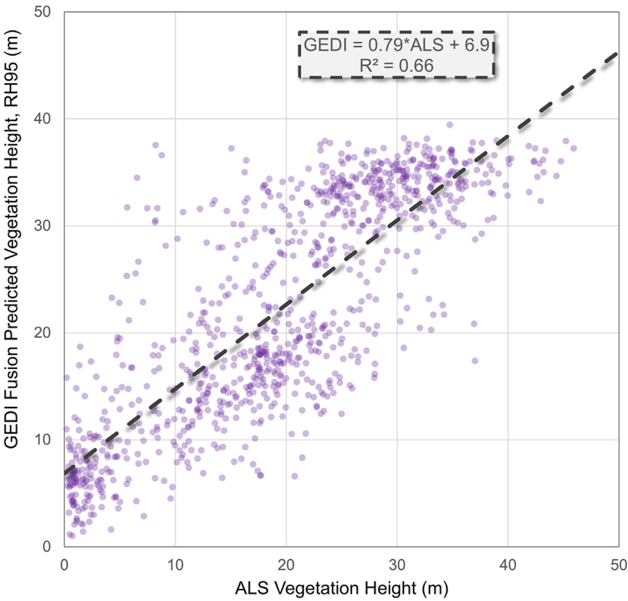
- GEDI-Landsat fusion predicted RH95 canopy height with R² = 0.62 and relative RMSE = 41% in Borneo (Sumatra: R² = 0.56, relative RMSE = 49%), but PAVD 0–5 m poorly (R² = 0.05; relative RMSE = 85% Borneo, 95% Sumatra). ALS comparison showed overestimation at low heights, underestimation above ~25 m, and saturation around 35 m.
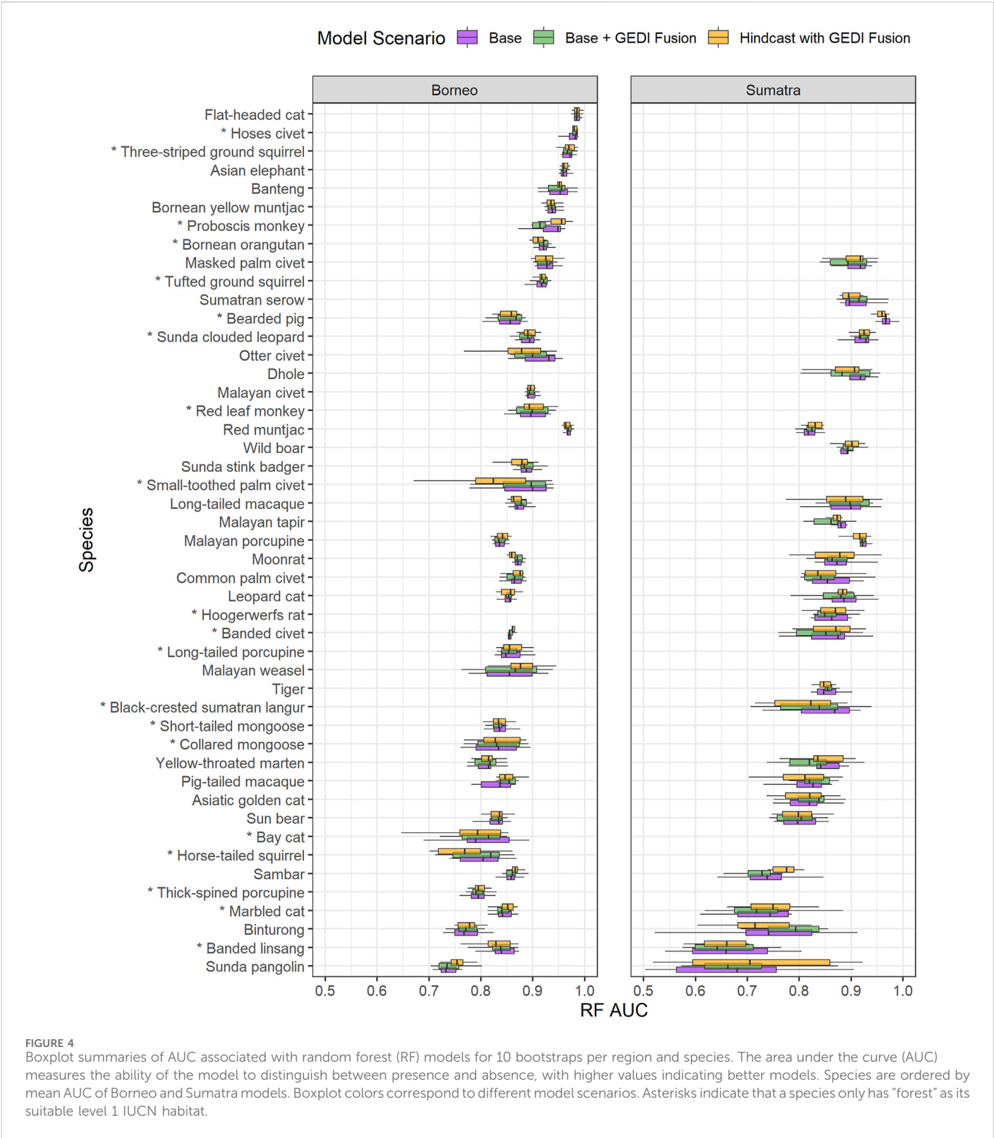
- Adding GEDI Fusion to the Base predictor set rarely improved SDM performance: meaningful >0.01 AUC improvement in 4 RF and 3 GLM cases; Base was meaningfully better in 10 RF and 11 GLM cases. In the Hindcast with GEDI Fusion scenario, 9 RF and 4 GLM cases improved over Base, while Base was better in 13 RF and 36 GLM cases.
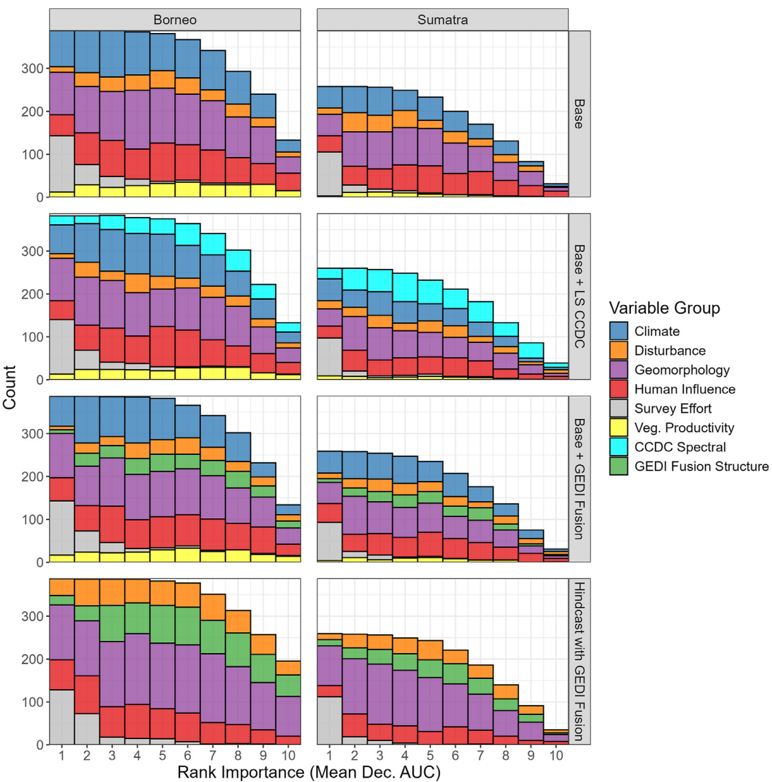
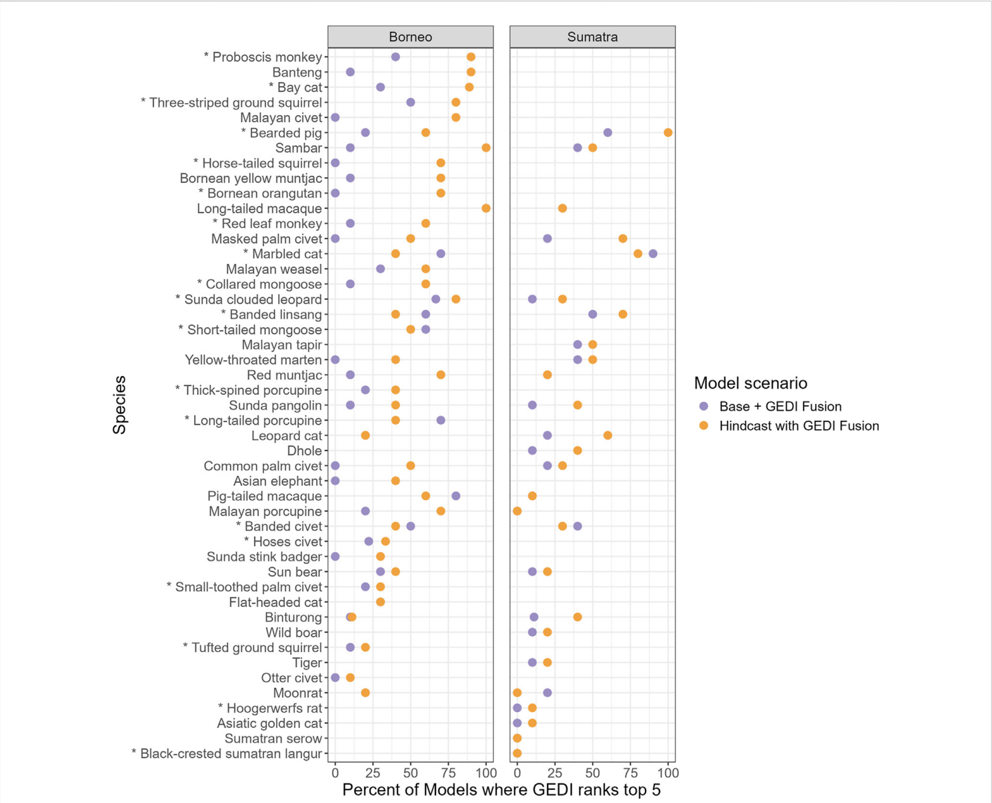
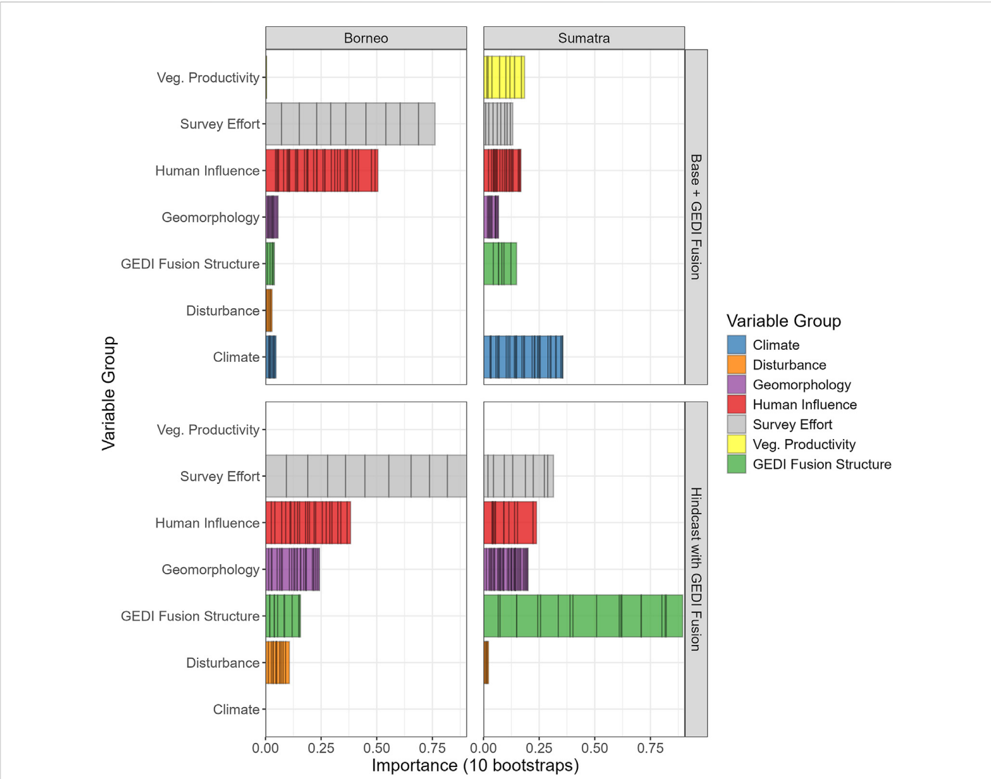
- RF outperformed GLM in approximately 75% of cases; the GEDI Fusion-only scenario had mean AUC approximately 0.04 (RF) and 0.09 (GLM) lower than other scenarios. GEDI Fusion predictors increased in relative importance in the Hindcast scenario and improved ecological interpretability; focal standard deviation metrics were often favored.
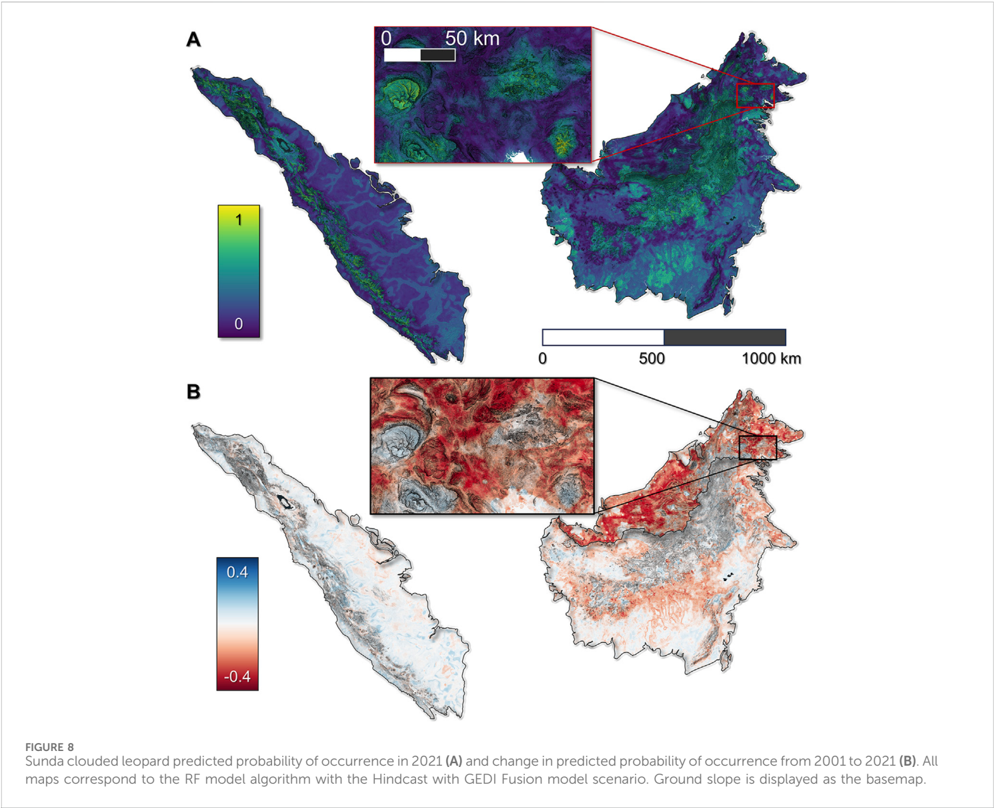
- The study produced probability of occurrence maps for all 47 mammal species at 90 m for 2001 and 2021; 11 species are endangered and 3 are critically endangered.
Methods
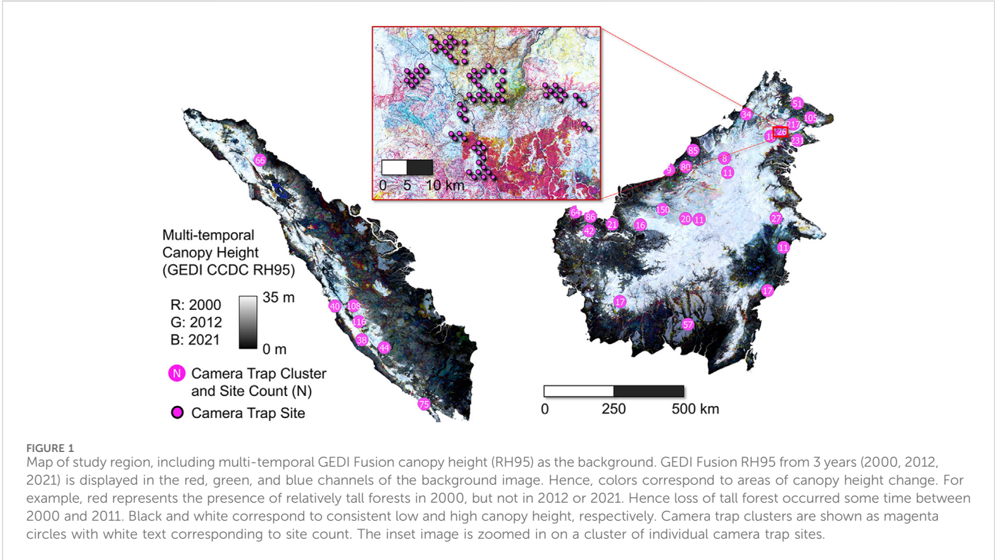
- Merged camera trap datasets from Borneo and Sumatra: 2,023 sites in Borneo and 879 in Sumatra; 47 mammal species; absence threshold of 30 camera trap nights; median effort was 56 nights in Borneo and 34 in Sumatra.
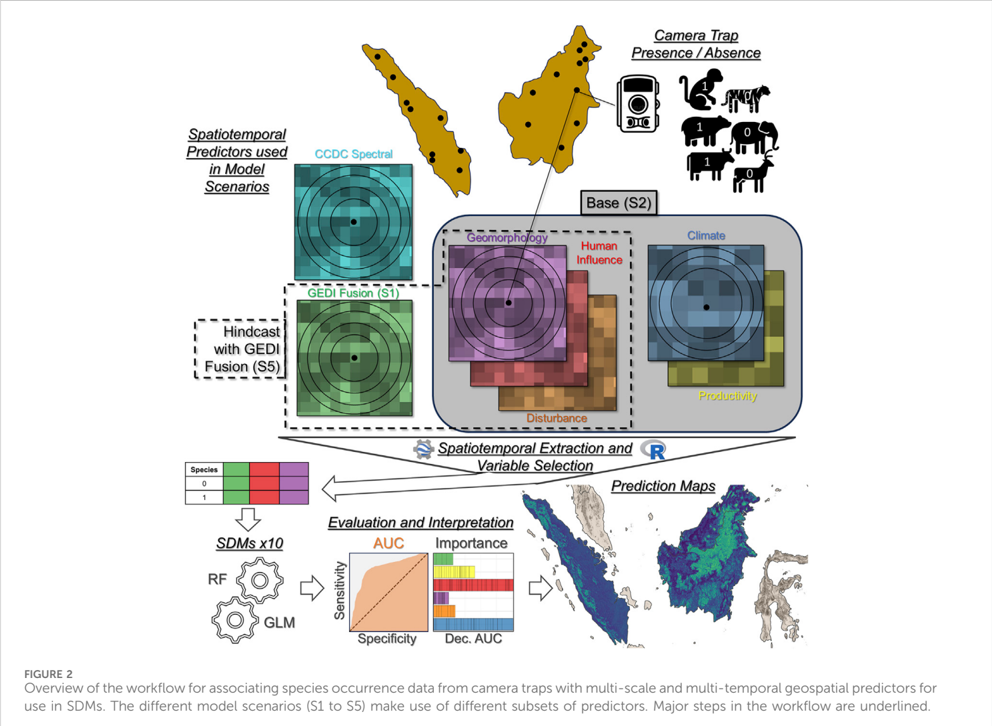
- Built multi-scale and multi-temporal predictors in Google Earth Engine: climate, geomorphology, human influence, productivity, Landsat CCDC spectral indices, and GEDI Fusion forest structure. GEDI metrics were fused with Landsat CCDC using Random Forest to predict continuous 90 m maps and hindcast to 2000–2021; validation used held-out GEDI observations and airborne laser scanning.
- Fit GLM and RF SDMs under five predictor scenarios (GEDI Fusion only, Base, Base + CCDC Spectral, Base + GEDI Fusion, Hindcast with GEDI Fusion), with VIF/GVIF variable selection, 10 bootstraps, AUC evaluation, and permutation importance.
Limitations
- The paper states GEDI Fusion predictions saturate around 35 m and lose discrimination for tall forests (30–40 m, possibly up to 70 m); PAVD 0–5 m was unreliable (R² = 0.05); GEDI Fusion predictors were highly correlated with each other and with climate/geomorphology, with only 2–3 informative PCA components.
- The paper states camera trap detection is imperfect; 30 nights were used to define absence; survey effort was the most important predictor; arboreal species are likely underestimated and understory density may bias detection; PAVD 0–5 m was poorly predicted.
- The paper states hindcast temporal fuzziness: GEDI Fusion predictors have a 3-year cadence and hindcasted predictions represent roughly 3–5 years; change estimates should only be made across periods greater than 3 years. Automated variable selection may also affect GEDI selection and importance, and expert knowledge would be beneficial.
Model-written summary. Check it against the paper before relying on it.
Integrity signals
Registry
Cites
Statistics
Figures

Verification
Claims the paper makes
0 Valid · 1 Not valid · 35 Not checked · 128 Own results and interpretations
A result the paper reports from its own data — it cites no other source for it, so there is none to check. The quote shows it is in the paper.
In the paper
“the relative importance of GEDI-based canopy structure predictors increased relative to when they were combined with the baseline predictor set.”
§ The utility of dynamic forest structure from GEDI lidar fusion in tropical mammal species distribution models > Abstract
plainstates a causen = 9- Asserted: passes — The authors put it forward as true.
- Checkable: passes — It can be checked against evidence.
- Load-bearing: passes — The paper’s conclusions depend on it.
- Based: passes — The paper gives a reason why it holds.
A result the paper reports from its own data — it cites no other source for it, so there is none to check. The quote shows it is in the paper.
In the paper
“when GEDI Fusion predictors were used in a smaller predictor set that is more suitable for hindcasting species probability of occurrence, more SDMs showed meaningful performance improvements relative to the baseline model (n = 9 for RF and n = 4 for GLM)”
§ The utility of dynamic forest structure from GEDI lidar fusion in tropical mammal species distribution models > Abstract
plainstates a causen = 9- Asserted: passes — The authors put it forward as true.
- Checkable: passes — It can be checked against evidence.
- Load-bearing: passes — The paper’s conclusions depend on it.
- Based: passes — The paper gives a reason why it holds.
A result the paper reports from its own data — it cites no other source for it, so there is none to check. The quote shows it is in the paper.
In the paper
“Our GEDI-Landsat fusion approach worked well for forest structure metrics related to canopy height (relative height of the 95th percentile of returned energy R 2 = 0.62 and relative RMSE = 41%)”
§ The utility of dynamic forest structure from GEDI lidar fusion in tropical mammal species distribution models > Abstract
boostedstates an association- Asserted: passes — The authors put it forward as true.
- Checkable: passes — It can be checked against evidence.
- Load-bearing: passes — The paper’s conclusions depend on it.
- Based: passes — The paper gives a reason why it holds.
A result the paper reports from its own data — it cites no other source for it, so there is none to check. The quote shows it is in the paper.
In the paper
“when considering a large pool of multiscale predictors, the exact composition, and whether GEDI Fusion predictors were included, didn't have a large impact on generalized linear modeling (GLM) and Random Forest (RF) model performance.”
§ The utility of dynamic forest structure from GEDI lidar fusion in tropical mammal species distribution models > Abstract
plain- Asserted: passes — The authors put it forward as true.
- Checkable: passes — It can be checked against evidence.
- Load-bearing: passes — The paper’s conclusions depend on it.
- Based: passes — The paper gives a reason why it holds.
A result the paper reports from its own data — it cites no other source for it, so there is none to check. The quote shows it is in the paper.
In the paper
“meaningfully improved performance for some species (n = 4 for RF and n = 3 for GLM).”
§ The utility of dynamic forest structure from GEDI lidar fusion in tropical mammal species distribution models > Abstract
plainstates a causen = 4- Asserted: passes — The authors put it forward as true.
- Checkable: passes — It can be checked against evidence.
- Load-bearing: passes — The paper’s conclusions depend on it.
- Based: passes — The paper gives a reason why it holds.
76 more claims
Create a free account to see all 164 claims and to verify the 54 references still open.
- It may state two separate claims as one. 46
- Probably not a substantial claim. 45
- The quote only partly states this claim. 2
Self-check
Percentages, sums and reported differences re-computed from the paper’s own numbers.
Each contradiction between two passages listed here was confirmed by an independent check.
Rated minor: it would not touch a result — a value no result rests on, a p-value that stays on the same side of the significance level, or a conflict that is clerical, resolved elsewhere in the paper, or outside its own findings.
In the paper
§ The utility of dynamic forest structure from GEDI lidar fusion in tropical mammal species distribution models > 3.4 SDM prediction maps
“Here we highlight the change in probability of occurrence from 2001 to 2021 for a single species with an IUCN endangered status, the Sunda Clouded Leopard (Figure 8B).”
§ The utility of dynamic forest structure from GEDI lidar fusion in tropical mammal species distribution models > 4.5 Moving forward with spaceborne lidar in biodiversity analyses
“| VU/D | * Sunda clouded leopard |”
Rated minor: it would not touch a result — a value no result rests on, a p-value that stays on the same side of the significance level, or a conflict that is clerical, resolved elsewhere in the paper, or outside its own findings.
In the paper
“| Base + CCDC Spectral | 30 | 2 | 5 | 16 | 5 | 5 |”
§ The utility of dynamic forest structure from GEDI lidar fusion in tropical mammal species distribution models > 4.5 Moving forward with spaceborne lidar in biodiversity analyses
Reported 39 · recomputed 37
Rated minor: it would not touch a result — a value no result rests on, a p-value that stays on the same side of the significance level, or a conflict that is clerical, resolved elsewhere in the paper, or outside its own findings.
In the paper
§ The utility of dynamic forest structure from GEDI lidar fusion in tropical mammal species distribution models > 4.2 Utility of GEDI fusion predictors in SDMs
“In the case of RH98 (canopy height), approximately half of the camera trap sites have predicted RH98 values greater than 30 m, which is around the height that saturation of RH98 predictions occurs (Figure 3).”
§ The utility of dynamic forest structure from GEDI lidar fusion in tropical mammal species distribution models > 2.3.6 Forest structure derived from GEDI Landsat fusion
“We selected the following metrics to model: RH50 (Height of Median Energy), RH95 (Canopy Height), Plant Area Index (PAI), Above Ground Biomass Density (AGBD), Foliage Height Diversity (FHD), Cover, and the number of modes in the returned waveform.”
Citations
Cites
Breiman, L. (2001) · Machine Learning · doi:10.1023/a:1010933404324 · Cited by 133,538
Biodiversity hotspots for conservation priorities
Myers, N., Mittermeier, R. A., Mittermeier, C. G., da Fonseca, G. A. B., & Kent, J. (2000) · Nature · doi:10.1038/35002501 · Cited by 31,710
Google Earth Engine: Planetary-scale geospatial analysis for everyone
Gorelick, N., Hancher, M., Dixon, M., Ilyushchenko, S., Thau, D., & Moore, R. (2017) · Remote Sensing of Environment · doi:10.1016/j.rse.2017.06.031 · Cited by 14,719
High-Resolution Global Maps of 21st-Century Forest Cover Change
Hansen, M. C., Potapov, P. V., Moore, R., Hancher, M., Turubanova, S. A., Tyukavina, A., Thau, D., Stehman, S. V., Goetz, S. J., Loveland, T. R., et al. (2013) · Science · doi:10.1126/science.1244693 · Cited by 11,704
Self-citationSpecies Distribution Models: Ecological Explanation and Prediction Across Space and Time
Elith, J., & Leathwick, J. R. (2009) · Annual Review of Ecology, Evolution, and Systematics · doi:10.1146/annurev.ecolsys.110308.120159 · Cited by 6,707
Climatologies at high resolution for the earth’s land surface areas
Karger, D. N., Conrad, O., Böhner, J., Kawohl, T., Kreft, H., Soria-Auza, R. W., Zimmermann, N. E., Linder, H. P., & Kessler, M. (2017) · Scientific Data · doi:10.1038/sdata.2017.122 · Cited by 4,171
Climatologies at high resolution for the earth’s land surface areas
Karger, D. N., Conrad, O., Böhner, J., Kawohl, T., Kreft, H., Soria-Auza, R. W., Zimmermann, N. E., Linder, H. P., & Kessler, M. (2017) · Zurich Open Repository and Archive (University of Zurich) · doi:10.5167/uzh-139381 · Cited by 3,598
ranger: A Fast Implementation of Random Forests for High Dimensional Data in C++ and R
Wright, M. N., & Ziegler, A. (2017) · Journal of Statistical Software · doi:10.18637/jss.v077.i01 · Cited by 3,340
Selecting pseudo‐absences for species distribution models: how, where and how many?
Barbet‐Massin, M., Jiguet, F., Albert, C. H., & Thuiller, W. (2012) · Methods in Ecology and Evolution · doi:10.1111/j.2041-210x.2011.00172.x · Cited by 2,716
MacArthur, R. H., & MacArthur, J. W. (1961) · Ecology · doi:10.2307/1932254 · Cited by 2,528
SoilGrids 2.0: producing soil information for the globe with quantified spatial uncertainty
Poggio, L., de Sousa, L. M., Batjes, N. H., Heuvelink, G. B. M., Kempen, B., Ribeiro, E., & Rossiter, D. (2021) · SOIL · doi:10.5194/soil-7-217-2021 · Cited by 2,333
Continuous change detection and classification of land cover using all available Landsat data
Zhu, Z., & Woodcock, C. E. (2014) · Remote Sensing of Environment · doi:10.1016/j.rse.2014.01.011 · Cited by 1,803
Mapping global forest canopy height through integration of GEDI and Landsat data
Potapov, P., Li, X., Hernandez-Serna, A., Tyukavina, A., Hansen, M. C., Kommareddy, A., Pickens, A., Turubanova, S., Tang, H., Silva, C. E., et al. (2021) · Remote Sensing of Environment · doi:10.1016/j.rse.2020.112165 · Cited by 1,686
Remote sensing for biodiversity science and conservation
Turner, W., Spector, S., Gardiner, N., Fladeland, M., Sterling, E., & Steininger, M. (2003) · Trends in Ecology & Evolution · doi:10.1016/s0169-5347(03)00070-3 · Cited by 1,404
The direct drivers of recent global anthropogenic biodiversity loss
Jaureguiberry, P., Titeux, N., Wiemers, M., Bowler, D. E., Coscieme, L., Golden, A. S., Guerra, C. A., Jacob, U., Takahashi, Y., Settele, J., et al. (2022) · Science Advances · doi:10.1126/sciadv.abm9982 · Cited by 1,121
Potapov, P., Turubanova, S., Hansen, M. C., Tyukavina, A., Zalles, V., Khan, A., Song, X.-P., Pickens, A., Shen, Q., & Cortez, J. (2021) · Nature Food · doi:10.1038/s43016-021-00429-z · Cited by 1,076
Dubayah, R., Blair, J. B., Goetz, S., Fatoyinbo, L., Hansen, M., Healey, S., Hofton, M., Hurtt, G., Kellner, J., Luthcke, S., et al. (2020) · Science of Remote Sensing · doi:10.1016/j.srs.2020.100002 · Cited by 1,042
Self-citationSpectralGPT: Spectral Remote Sensing Foundation Model
Hong, D., Zhang, B., Li, X., Li, Y., Li, C., Yao, J., Yokoya, N., Li, H., Ghamisi, P., Jia, X., et al. (2024) · IEEE Transactions on Pattern Analysis and Machine Intelligence · doi:10.1109/tpami.2024.3362475 · Cited by 930
Sexton, J. O., Song, X.-P., Feng, M., Noojipady, P., Anand, A., Huang, C., Kim, D.-H., Collins, K. M., Channan, S., DiMiceli, C., et al. (2013) · International Journal of Digital Earth · doi:10.1080/17538947.2013.786146 · Cited by 829
A high-resolution canopy height model of the Earth
Lang, N., Jetz, W., Schindler, K., & Wegner, J. D. (2023) · Nature Ecology & Evolution · doi:10.1038/s41559-023-02206-6 · Cited by 810 · cited 3×
“Several studies have produced global fusion maps of canopy height (Potapov et al., 2021; Lang et al., 2023), while relatively few studies have explored the ef fi cacy of fusion for mapping sub-canopy metrics such as the height of median returned energy or the amount of foliar material in different…”
InfluentialCorrelation and process in species distribution models: bridging a dichotomy
Dormann, C. F., Schymanski, S. J., Cabral, J., Chuine, I., Graham, C., Hartig, F., Kearney, M., Morin, X., Römermann, C., Schröder, B., et al. (2012) · Journal of Biogeography · doi:10.1111/j.1365-2699.2011.02659.x · Cited by 748
Multi-scale habitat selection modeling: a review and outlook
McGarigal, K., Wan, H. Y., Zeller, K. A., Timm, B. C., & Cushman, S. A. (2016) · Landscape Ecology · doi:10.1007/s10980-016-0374-x · Cited by 625
Self-citationLong-term (1990–2019) monitoring of forest cover changes in the humid tropics
Vancutsem, C., Achard, F., Pekel, J.-F., Vieilledent, G., Carboni, S., Simonetti, D., Gallego, J., Aragão, L. E. O. C., & Nasi, R. (2021) · Science Advances · doi:10.1126/sciadv.abe1603 · Cited by 611
Creation of forest edges has a global impact on forest vertebrates
Pfeifer, M., Lefebvre, V., Peres, C. A., Banks-Leite, C., Wearn, O. R., Marsh, C. J., Butchart, S. H. M., Arroyo-Rodríguez, V., Barlow, J., Cerezo, A., et al. (2017) · Nature · doi:10.1038/nature24457 · Cited by 520
Fourcade, Y., Besnard, A. G., & Secondi, J. (2018) · Global Ecology and Biogeography · doi:10.1111/geb.12684 · Cited by 500
Understanding the drivers ofSoutheastAsian biodiversity loss
Hughes, A. C. (2017) · Ecosphere · doi:10.1002/ecs2.1624 · Cited by 497
Hardwick, S. R., Toumi, R., Pfeifer, M., Turner, E. C., Nilus, R., & Ewers, R. M. (2015) · Agricultural and Forest Meteorology · doi:10.1016/j.agrformet.2014.11.010 · Cited by 433
Advances in Microclimate Ecology Arising from Remote Sensing
Zellweger, F., FRENNE, P. D., Lenoir, J., Rocchini, D., & Coomes, D. A. (2019) · Trends in Ecology & Evolution · doi:10.1016/j.tree.2018.12.012 · Cited by 431
Wilson, A. M., & Jetz, W. (2016) · PLOS Biology · doi:10.1371/journal.pbio.1002415 · Cited by 406
Advances in animal ecology from 3D-LiDAR ecosystem mapping
Davies, A. B., & Asner, G. P. (2014) · Trends in Ecology & Evolution · doi:10.1016/j.tree.2014.10.005 · Cited by 379
The area under the precision‐recall curve as a performance metric for rare binary events
Sofaer, H. R., Hoeting, J. A., & Jarnevich, C. S. (2019) · Methods in Ecology and Evolution · doi:10.1111/2041-210x.13140 · Cited by 375
Incorporating microclimate into species distribution models
Lembrechts, J. J., Nijs, I., & Lenoir, J. (2019) · Ecography · doi:10.1111/ecog.03947 · Cited by 372
Will remote sensing shape the next generation of species distribution models?
He, K. S., Bradley, B. A., Cord, A. F., Rocchini, D., Tuanmu, M., Schmidtlein, S., Turner, W., Wegmann, M., & Pettorelli, N. (2015) · Remote Sensing in Ecology and Conservation · doi:10.1002/rse2.7 · Cited by 352
Variable Importance Plots—An Introduction to the vip Package
Greenwell, B., & Boehmke, B. (2020) · The R Journal · doi:10.32614/rj-2020-013 · Cited by 334
Gradient modeling of conifer species using random forests
Evans, J. S., & Cushman, S. A. (2009) · Landscape Ecology · doi:10.1007/s10980-009-9341-0 · Cited by 328
Self-citationModelling species presence‐only data with random forests
Valavi, R., Elith, J., Lahoz‐Monfort, J. J., & Guillera‐Arroita, G. (2021) · Ecography · doi:10.1111/ecog.05615 · Cited by 307
Ecologically-Relevant Maps of Landforms and Physiographic Diversity for Climate Adaptation Planning
Theobald, D. M., Harrison-Atlas, D., Monahan, W. B., & Albano, C. M. (2015) · PLOS ONE · doi:10.1371/journal.pone.0143619 · Cited by 303
Forest structure, canopy architecture, and light transmittance in tropical wet forests
Montgomery, R. A., & Chazdon, R. L. (2001) · Ecology · doi:10.1890/0012-9658(2001)082[2707:fscaal]2.0.co;2 · Cited by 291
mRMRe: an R package for parallelized mRMR ensemble feature selection
De Jay, N., Papillon-Cavanagh, S., Olsen, C., El-Hachem, N., Bontempi, G., & Haibe-Kains, B. (2013) · Bioinformatics · doi:10.1093/bioinformatics/btt383 · Cited by 275
Monitoring biodiversity in the Anthropocene using remote sensing in species distribution models
Randin, C. F., Ashcroft, M. B., Bolliger, J., Cavender-Bares, J., Coops, N. C., Dullinger, S., Dirnböck, T., Eckert, S., Ellis, E., Fernández, N., et al. (2020) · Remote Sensing of Environment · doi:10.1016/j.rse.2019.111626 · Cited by 265
Precision-Recall-Gain Curves: PR Analysis Done Right
Flach, P. A., & Kull, M. (2015) · Bristol Research (University of Bristol) · doi:10.5555/2969239.2969333 · Cited by 256
Petitpierre, B., Broennimann, O., Kueffer, C., Daehler, C., & Guisan, A. (2017) · Global Ecology and Biogeography · doi:10.1111/geb.12530 · Cited by 253
Amatulli, G., McInerney, D., Sethi, T., Strobl, P., & Domisch, S. (2020) · Scientific Data · doi:10.1038/s41597-020-0479-6 · Cited by 247
High-resolution global map of smallholder and industrial closed-canopy oil palm plantations
Descals, A., Wich, S., Meijaard, E., Gaveau, D. L. A., Peedell, S., & Szantoi, Z. (2021) · Earth System Science Data · doi:10.5194/essd-13-1211-2021 · Cited by 242
Gao, S., Zhong, R., Yan, K., Ma, X., Chen, X., Pu, J., Gao, S., Qi, J., Yin, G., & Myneni, R. B. (2023) · Remote Sensing of Environment · doi:10.1016/j.rse.2023.113665 · Cited by 221
Defining spatial conservation priorities in the face of land-use and climate change
Faleiro, F. V., Machado, R. B., & Loyola, R. D. (2013) · Biological Conservation · doi:10.1016/j.biocon.2012.09.020 · Cited by 210
A global seamless 1 km resolution daily land surface temperature dataset (2003–2020)
Zhang, T., Zhou, Y., Zhu, Z., Li, X., & Asrar, G. R. (2022) · Earth System Science Data · doi:10.5194/essd-14-651-2022 · Cited by 188
GEDI L2A Elevation and Height Metrics Data Global Footprint Level V002
Dubayah, R., Hofton, M., Blair, J., Armston, J. D., Tang, H., & Luthcke, S. (2021) · Earth Observing System Data and Information System · doi:10.5067/gedi/gedi02_a.002 · Cited by 181
Correlation and persistence of hunting and logging impacts on tropical rainforest mammals
Brodie, J. F., Giordano, A. J., Zipkin, E. F., Bernard, H., Mohd‐Azlan, J., & Ambu, L. (2015) · Conservation Biology · doi:10.1111/cobi.12389 · Cited by 174
Self-citationUncovering Ecological Patterns with Convolutional Neural Networks
Brodrick, P. G., Davies, A. B., & Asner, G. P. (2019) · Trends in Ecology & Evolution · doi:10.1016/j.tree.2019.03.006 · Cited by 168
Human degradation of tropical moist forests is greater than previously estimated
Bourgoin, C., Ceccherini, G., Girardello, M., Vancutsem, C., Avitabile, V., Beck, P. S. A., Beuchle, R., Blanc, L., Duveiller, G., Migliavacca, M., et al. (2024) · Nature · doi:10.1038/s41586-024-07629-0 · Cited by 165
Deneu, B., Servajean, M., Bonnet, P., Botella, C., Munoz, F., & Joly, A. (2021) · PLoS Computational Biology · doi:10.1371/journal.pcbi.1008856 · Cited by 163
The Dynamic Habitat Indices (DHIs) from MODIS and global biodiversity
Radeloff, V. C., Dubinin, M., Coops, N. C., Allen, A. M., Brooks, T. M., Clayton, M. K., Costa, G. C., Graham, C. H., Helmers, D. P., Ives, A. R., et al. (2019) · Remote Sensing of Environment · doi:10.1016/j.rse.2018.12.009 · Cited by 163
Zwerts, J. A., Stephenson, P. J., Maisels, F., Rowcliffe, M., Astaras, C., Jansen, P. A., van der Waarde, J., Sterck, L. E. H. M., Verweij, P. A., Bruce, T., et al. (2021) · Conservation Science and Practice · doi:10.1111/csp2.568 · Cited by 152
Forest degradation drives widespread avian habitat and population declines
Betts, M. G., Yang, Z., Hadley, A. S., Smith, A. C., Rousseau, J. S., Northrup, J. M., Nocera, J. J., Gorelick, N., & Gerber, B. D. (2022) · Nature Ecology & Evolution · doi:10.1038/s41559-022-01737-8 · Cited by 139
Landscape-scale benefits of protected areas for tropical biodiversity
Brodie, J. F., Mohd-Azlan, J., Chen, C., Wearn, O. R., Deith, M. C. M., Ball, J. G. C., Slade, E. M., Burslem, D. F. R. P., Teoh, S. W., Williams, P. J., et al. (2023) · Nature · doi:10.1038/s41586-023-06410-z · Cited by 121
Self-citationMcLean, K. A., Trainor, A. M., Asner, G. P., Crofoot, M. C., Hopkins, M. E., Campbell, C. J., Martin, R. E., Knapp, D., & Jansen, P. A. (2016) · Landscape Ecology · doi:10.1007/s10980-016-0367-9 · Cited by 115
Schwartz, M., Ciais, P., Truchis, A. D., Chave, J., Ottlé, C., Vega, C., Wigneron, J., Nicolas, M., Jouaber, S., Liu, S., et al. (2023) · Earth system science data · doi:10.5194/essd-15-4927-2023 · Cited by 108
Macdonald, D. W., Bothwell, H. M., Kaszta, Z. M., Ash, E., Bolongon, G., Burnham, D., Can, Ö. E., Campos‐Arceiz, A., Channa, P., Clements, G. R., et al. (2019) · Diversity and Distributions · doi:10.1111/ddi.12967 · Cited by 104
Self-citationSub-meter tree height mapping of California using aerial images and LiDAR-informed U-Net model
Wagner, F. H., Roberts, S., Ritz, A. L., Carter, G., Dalagnol, R., Favrichon, S., Hirye, M. C. M., Brandt, M., Ciais, P., & Saatchi, S. S. (2024) · Remote Sensing of Environment · doi:10.1016/j.rse.2024.114099 · Cited by 89
Torresani, M., Rocchini, D., Alberti, A., Moudrý, V., Heym, M., Thouverai, E., Kacic, P., & Tomelleri, E. (2023) · Ecological Informatics · doi:10.1016/j.ecoinf.2023.102082 · Cited by 84
Wilson, J. W., Sexton, J. O., Todd Jobe, R., & Haddad, N. M. (2013) · Biological Conservation · doi:10.1016/j.biocon.2013.04.021 · Cited by 80
Sumatran tiger survival threatened by deforestation despite increasing densities in parks
Luskin, M. S., Albert, W. R., & Tobler, M. W. (2017) · Nature Communications · doi:10.1038/s41467-017-01656-4 · Cited by 79
Self-citationMilodowski, D. T., Coomes, D. A., Swinfield, T., Jucker, T., Riutta, T., Malhi, Y. S., Svátek, M., Kvasnica, J., Burslem, D. F. R. P., Ewers, R. M., et al. (2021) · Journal of Applied Ecology · doi:10.1111/1365-2664.13895 · Cited by 74
Self-citationThe World's Tallest Tropical Tree in Three Dimensions
Shenkin, A. F., Chandler, C. J., Boyd, D. S., Jackson, T., Disney, M. I., Majalap, N., Nilus, R., Foody, G. M., bin Jami, J., Reynolds, G., et al. (2019) · Frontiers in Forests and Global Change · doi:10.3389/ffgc.2019.00032 · Cited by 72
Self-citationKaszta, Ż., Cushman, S. A., Hearn, A. J., Burnham, D., Macdonald, E. A., Goossens, B., Nathan, S. K. S. S., & Macdonald, D. W. (2019) · Biological Conservation · doi:10.1016/j.biocon.2019.04.001 · Cited by 70
Self-citationIncorporating canopy structure from simulated GEDI lidar into bird species distribution models
Burns, P., Clark, M., Salas, L., Hancock, S., Leland, D., Jantz, P., Dubayah, R., & Goetz, S. J. (2020) · Environmental Research Letters · doi:10.1088/1748-9326/ab80ee · Cited by 66
Self-citationDeere, N. J., Guillera-Arroita, G., Swinfield, T., Milodowski, D. T., Coomes, D. A., Bernard, H., Reynolds, G., Davies, Z. G., & Struebig, M. J. (2020) · Proceedings of the National Academy of Sciences · doi:10.1073/pnas.2001823117 · Cited by 66
Macdonald, D. W., Bothwell, H. M., Hearn, A. J., Cheyne, S. M., Haidir, I. A., Hunter, L., Kaszta, Z. M., Linkie, M., Macdonald, E. A., Ross, J., et al. (2018) · Biological Conservation · doi:10.1016/j.biocon.2018.08.027 · Cited by 66
Self-citationGarland, L., Crosby, A. D., Hedley, R. W., Boutin, S. A., & Bayne, E. M. (2020) · Canadian Journal of Zoology · doi:10.1139/cjz-2019-0081 · Cited by 65
Benkendorf, D. J., Schwartz, S. D., Cutler, D. R., & Hawkins, C. P. (2023) · Ecological Modelling · doi:10.1016/j.ecolmodel.2023.110414 · Cited by 61
BioModelos: A collaborative online system to map species distributions
Velásquez‐Tibatá, J., Olaya-Rodríguez, M. H., López-Lozano, D., Gutiérrez, C., González, I., & Londoño, M. C. (2019) · PLoS ONE · doi:10.1371/journal.pone.0214522 · Cited by 61
Kaszta, Z. M., Cushman, S. A., Htun, S., Naing, H., Burnham, D., & Macdonald, D. W. (2020) · Landscape Ecology · doi:10.1007/s10980-020-00976-z · Cited by 61
Self-citationMulti-resolution gridded maps of vegetation structure from GEDI
Burns, P., Hakkenberg, C. R., & Goetz, S. J. (2024) · Scientific Data · doi:10.1038/s41597-024-03668-4 · Cited by 58
Self-citationHearn, A. J., Cushman, S. A., Goossens, B., Macdonald, E., Ross, J., Hunter, L. T. B., Abram, N. K., & Macdonald, D. W. (2018) · Biological Conservation · doi:10.1016/j.biocon.2018.04.016 · Cited by 52
Self-citationCanopy structure drives orangutan habitat selection in disturbed Bornean forests
Davies, A. B., Ancrenaz, M., Oram, F., & Asner, G. P. (2017) · Proceedings of the National Academy of Sciences · doi:10.1073/pnas.1706780114 · Cited by 50
Global seasonal dynamics of inland open water and ice
Pickens, A., Hansen, M. C., Stehman, S. V., Tyukavina, A., Potapov, P. V., Zalles, V., & HIGGINS, J. V. (2022) · Remote Sensing of Environment · doi:10.1016/j.rse.2022.112963 · Cited by 50
Life in the Canopy: Using Camera-Traps to Inventory Arboreal Rainforest Mammals in Borneo
Haysom, J. K., Deere, N. J., Wearn, O. R., Mahyudin, A., bin Jami, J., Reynolds, G., & Struebig, M. J. (2021) · Frontiers in Forests and Global Change · doi:10.3389/ffgc.2021.673071 · Cited by 49
Williams, S. H., Scriven, S. A., Burslem, D. F. R. P., Hill, J. K., Reynolds, G., Agama, A. L., Kugan, F., Maycock, C. R., Khoo, E., Hastie, A. Y. L., et al. (2019) · Conservation Biology · doi:10.1111/cobi.13450 · Cited by 47
Self-citationGEDI L3 Gridded Land Surface Metrics, Version 2
Dubayah, R., Luthcke, S. B., Sabaka, T. J., Nicholas, J. B., Preaux, S. A., & Hofton (2021) · Oak Ridge National Laboratory Distributed Active Archive Center for Biogeochemical Dynamics · doi:10.3334/ornldaac/1952 · Cited by 47
Shirk, A. J., Jones, G. M., Yang, Z., Davis, R. J., Ganey, J. L., Gutiérrez, R. J., Healey, S. P., Hedwall, S. J., Hoagland, S., Maes, R., et al. (2022) · Landscape Ecology · doi:10.1007/s10980-022-01457-1 · Cited by 46
Self-citationChiaverini, L., Macdonald, D. W., Hearn, A. J., Kaszta, Z. M., Ash, E., Bothwell, H. M., Can, Ö. E., Channa, P., Clements, G. R., Haidir, I. A., et al. (2023) · Ecological Informatics · doi:10.1016/j.ecoinf.2023.102026 · Cited by 44
Self-citationMoudrý, V., Gábor, L., Marselis, S., Pracná, P., Barták, V., Prošek, J., Navrátilová, B., Novotný, J., Potůčková, M., Gdulová, K., et al. (2024) · Ecosphere · doi:10.1002/ecs2.70026 · Cited by 43
Megafauna extinctions produce idiosyncratic Anthropocene assemblages
Amir, Z., Moore, J. H., Negret, P. J., & Luskin, M. S. (2022) · Science Advances · doi:10.1126/sciadv.abq2307 · Cited by 43
Self-citationPredicting microhabitat suitability for an endangered small mammal using sentinel-2 data
Valerio, F., Ferreira, E., Godinho, S., Pita, R., Mira, A., Fernandes, N., & Santos, S. M. (2020) · Remote Sensing · doi:10.3390/rs12030562 · Cited by 42
Pillay, R., Watson, J. E. M., Hansen, A. J., Jantz, P. A., Aragon-Osejo, J. L., Armenteras, D., Atkinson, S., Burns, P., Ervin, J., Goetz, S. J., et al. (2022) · Nature Ecology & Evolution · doi:10.1038/s41559-022-01915-8 · Cited by 39
Self-citationHow individual links affect network stability in a large‐scale, heterogeneous metacommunity
Brodie, J. F., Mohd‐Azlan, J., & Schnell, J. K. (2016) · Ecology · doi:10.1890/15-1613.1 · Cited by 39
Self-citationVoigt, M., Kühl, H. S., Ancrenaz, M., Gaveau, D., Meijaard, E., Santika, T., Sherman, J., Wich, S. A., Wolf, F., Struebig, M. J., et al. (2022) · Perspectives in Ecology and Conservation · doi:10.1016/j.pecon.2022.06.001 · Cited by 38
Evaluating GEDI data fusions for continuous characterizations of forest wildlife habitat
Vogeler, J. C., Fekety, P. A., Elliott, L., Swayze, N. C., Filippelli, S. K., Barry, B., Holbrook, J. D., & Vierling, K. T. (2023) · Frontiers in Remote Sensing · doi:10.3389/frsen.2023.1196554 · Cited by 37
Smith, A. B., Vogeler, J. C., Bjornlie, N. L., Squires, J. R., Swayze, N. C., & Holbrook, J. D. (2022) · Forest Ecology and Management · doi:10.1016/j.foreco.2022.120343 · Cited by 31
Predicting defaunation: accurately mapping bushmeat hunting pressure over large areas
Deith, M. C. M., & Brodie, J. F. (2020) · Proceedings of the Royal Society B: Biological Sciences · doi:10.1098/rspb.2019.2677 · Cited by 30
Self-citationGEDI L1B Geolocated Waveform Data Global Footprint Level V002
Dubayah, R., Luthcke, S., Blair, J., Hofton, M., Armston, J. D., & Tang, H. (2021) · Earth Observing System Data and Information System · doi:10.5067/gedi/gedi01_b.002 · Cited by 25
Crego, R., Masolele, M., Connette, G., & Stabach, J. (2021) · Remote Sensing · doi:10.3390/rs13204154 · Cited by 24
Chiaverini, L., Macdonald, D. W., Bothwell, H. M., Hearn, A. J., Cheyne, S. M., Haidir, I. A., Hunter, L., Kaszta, Z. M., Macdonald, E. A., Ross, J., et al. (2022) · Animal Conservation · doi:10.1111/acv.12771 · Cited by 24
Self-citationKe, A., & Luskin, M. S. (2017) · Oryx · doi:10.1017/s0030605317000382 · Cited by 24
Self-citationHearn, A. J., Cushman, S. A., Goossens, B., Ross, J., Macdonald, E. A., Hunter, L., & Macdonald, D. W. (2019) · Landscape Ecology · doi:10.1007/s10980-018-0758-1 · Cited by 23
Self-citationBrodie, J. F., Strimas‐Mackey, M., Mohd‐Azlan, J., Granados, A., Bernard, H., Giordano, A. J., & Helmy, O. E. (2017) · Proceedings of the Royal Society B Biological Sciences · doi:10.1098/rspb.2016.2335 · Cited by 22
Self-citationIntegrating spaceborne estimates of structural diversity of habitat into wildlife occupancy models
Killion, A. K., Honda, A., Trout, E., & Carter, N. H. (2023) · Environmental Research Letters · doi:10.1088/1748-9326/acce4d · Cited by 21
Chen, J., & Gao, M. (2021) · Figshare · doi:10.6084/m9.figshare.17004523 · Cited by 21
Scriven, S. A., Williams, S. H., Ghani, M. A. E., Agama, A. L., Benedick, S., Brodie, J. F., Hamer, K. C., McClean, C. J., Reynolds, G., & Hill, J. K. (2019) · Biotropica · doi:10.1111/btp.12708 · Cited by 20
Self-citationLiDAR data as a proxy for light availability improve distribution modelling of woody species
Wüest, R. O., Bergamini, A., Bollmann, K., & Baltensweiler, A. (2020) · Forest Ecology and Management · doi:10.1016/j.foreco.2019.117644 · Cited by 19
Quinn, C. A., Burns, P., Jantz, P. A., Salas, L. A., Goetz, S. J., & Clark, M. L. (2024) · Environmental Research Ecology · doi:10.1088/2752-664x/ad4bec · Cited by 18
Self-citationEcology, occurrence and distribution of wild felids in Sarawak, Malaysian Borneo
Mohd‐Azlan, J., Kaicheen, S. S., Lok, L., Yi, M. C. K., Maiwald, M. J., Helmy, O. E., Giordano, A. J., & Brodie, J. F. (2022) · Oryx · doi:10.1017/s0030605321001484 · Cited by 18
Self-citationPillay, R., Watson, J. E. M., Hansen, A. J., Burns, P., Virnig, A. L. S., Supples, C., Armenteras, D., González-del-Pliego, P., Aragon-Osejo, J., A. Jantz, P., et al. (2024) · Proceedings of the National Academy of Sciences · doi:10.1073/pnas.2413325121 · Cited by 17
Self-citationProjected development in Borneo and Sumatra will greatly reduce connectivity for an apex carnivore
Kaszta, Z. M., Cushman, S. A., Hearn, A. J., Sloan, S., Laurance, W. F., Haidir, I. A., & Macdonald, D. W. (2024) · The Science of The Total Environment · doi:10.1016/j.scitotenv.2024.170256 · Cited by 17
Self-citationLiu, S., Csillik, O., Ordway, E. M., Chang, L.-L., Longo, M., Keller, M., & Moorcroft, P. R. (2025) · Proceedings of the National Academy of Sciences · doi:10.1073/pnas.2401755122 · Cited by 16
Mid-sized felids threatened by habitat degradation in Southeast Asia
Decœur, H., Amir, Z., Mendes, C. P., Moore, J. H., & Luskin, M. S. (2023) · Biological Conservation · doi:10.1016/j.biocon.2023.110103 · Cited by 14
Self-citationPanjang, E., Lim, H. Y., Thomas, R. J., Goossens, B., Hearn, A. J., Macdonald, D. W., Ross, J., Wong, S. T., Guharajan, R., Mohamed, A., et al. (2024) · Global Ecology and Conservation · doi:10.1016/j.gecco.2024.e02962 · Cited by 13
Self-citationBinturong ecology and conservation in pristine, fragmented and degraded tropical forests
Honda, A., Amir, Z., Mendes, C. P., Moore, J. H., & Luskin, M. S. (2023) · Oryx · doi:10.1017/s0030605322001491 · Cited by 13
Self-citationCamTrapAsia : A dataset of tropical forest vertebrate communities from 239 camera trapping studies
Mendes, C. P., Albert, W. R., Amir, Z., Ancrenaz, M., Ash, E., Azhar, B., Bernard, H., Brodie, J. F., Bruce, T., Carr, E., et al. (2024) · Ecology · doi:10.1002/ecy.4299 · Cited by 13
Self-citationCrego, R. D., Fennessy, J., Brown, M. B., Connette, G., Stacy‐Dawes, J., Masiaine, S., & Stabach, J. A. (2024) · Animal Conservation · doi:10.1111/acv.12894 · Cited by 12
Luskin, M. S., Arnold, L., Sovie, A. R., Amir, Z., Chua, M. A. H., Dehaudt, B., Dunn, A., Nursamsi, I., Moore, J. H., & Mendes, C. P. (2023) · Wildlife Letters · doi:10.1002/wll2.12023 · Cited by 12
Self-citationBell, D. M., Gregory, M. J., & Yang, Z. (2024) · Forest Ecology and Management · doi:10.1016/j.foreco.2024.122239 · Cited by 12
Data for detailed temporal mapping of global human modification from 1990 to 2017
Theobald, D. M., Kennedy, C. M., Чэн, Б., Oakleaf, J. R., Baruch‐Mordo, S., & Kiesecker, J. (2020) · Figshare · doi:10.5281/zenodo.3963012 · Cited by 12
Swinfield, T., Milodowski, D. T., Jucker, T., Dalponte, M., & Coomes, D. A. (2020) · Edinburgh Research Explorer (University of Edinburgh) · doi:10.5281/zenodo.4020696 · Cited by 11
Sunda pangolins show inconsistent responses to disturbances across multiple scales
Nursamsi, I., Amir, Z., Decoeur, H., Moore, J. H., & Luskin, M. S. (2023) · Wildlife Letters · doi:10.1002/wll2.12010 · Cited by 11
Self-citationWall, J. L., Loken, B., & Brodie, J. F. (2021) · Global Ecology and Conservation · doi:10.1016/j.gecco.2021.e01642 · Cited by 10
Self-citationHonda, A., Beirne, C., Huarcaya, R. P., Mullisaca, F. M. P., Quispe, C. J. Q., Quispe, R. V., Flatt, E. J., & Whitworth, A. W. (2025) · Environmental Research Ecology · doi:10.1088/2752-664x/adb850 · Cited by 10
Nguyen, T. A., Ehbrecht, M., & Camarretta, N. (2023) · Landscape Ecology · doi:10.1007/s10980-023-01609-x · Cited by 9
Williams, P. J., Moeller, A. K., Granados, A., Bernard, H., Ong, R. C., & Brodie, J. F. (2022) · Oecologia · doi:10.1007/s00442-022-05252-2 · Cited by 9
Self-citationConnecting Landscapes: A decision support system to facilitate conservation led development
Jantz, P. A., Macdonald, D. W., Gonzalez, I., Hearn, A. J., Kaszta, Z. M., Landguth, E. L., Burnham, D., Goetz, S. J., Zeller, K. A., Loveridge, A. J., et al. (2025) · Environmental Modelling & Software · doi:10.1016/j.envsoft.2025.106576 · Cited by 8
Self-citationVegetation canopy height shapes bats’ occupancy: a remote sensing approach
Martins, F. C., Godinho, S., Guiomar, N., Medinas, D., Rebelo, H., Segurado, P., & Marques, J. T. (2024) · GIScience & Remote Sensing · doi:10.1080/15481603.2024.2374150 · Cited by 7
Comparing expedient and proactive approaches to the planning of protected area networks on Borneo
Macdonald, E. A., Cushman, S. A., Malhi, Y. S., & Macdonald, D. W. (2024) · npj Biodiversity · doi:10.1038/s44185-024-00052-8 · Cited by 5
Self-citationDirect comparisons of logging and agroforestry influence on tropical mammals in Sarawak, Borneo
Yi, M. C. K., Kaicheen, S. S., Brodie, J. F., & Mohd‐Azlan, J. (2022) · Biotropica · doi:10.1111/btp.13134 · Cited by 4
Self-citationConnecting Landscapes: A Decision Support System to Facilitate Conservation Led Development
Jantz, P., Macdonald, D., Gonzalez, I., Hearn, A., Kaszta, Z., Landguth, E., Burnham, D., Goetz, S., Zeller, K., Loveridge, A., et al. (2025) · doi:10.2139/ssrn.5097684 · Cited by 1
Self-citationGEDI L3 Gridded Land Surface Metrics, Version 1
Dubayah, R. O., Luthcke, S. B., Sabaka, T. J., Nicholas, J. B., Preaux, S., & Hofton, M. A. (2021) · ORNL Distributed Active Archive Center · doi:10.3334/ornldaac/1865
Hearn, A. J., Macdonald, J. R. D. W., Bolongon, G., Cheyne, S. M., Mohamed, A., Samejima, H., Brodie, J. F., Giordano, A., Alfred, R., Boonratana, R., et al. (2016) · Zenodo · doi:10.5281/zenodo.20251947
Self-citationCMS: LiDAR-derived Canopy Height, Elevation for Sites in Kalimantan, Indonesia, 2014
Melendy, L., Hagen, S., Sullivan, F. B., Pearson, T., Walker, S. M., Ellis, P., KUSTIYO, Sambodo, K. A., Roswintiarti, O., Hanson, M., et al. (2017) · ORNL Distributed Active Archive Center · doi:10.3334/ornldaac/1540
Swinfield, T., Milodowski, D., Jucker, T., Michele, D., & Coomes, D. (2020) · Zenodo · doi:10.5281/zenodo.4020697
Data for detailed temporal mapping of global human modification from 1990 to 2017
Theobald, D. M., Kennedy, C., Chen, B., Oakleaf, J., Baruch-Mordo, S., & Kiesecker, J. (2023) · Zenodo · doi:10.5281/zenodo.7534895
Research works printed but not linked: 2
- Macdonald, D. W., Bothwell, H. M., Kaszta, Ż., Ash, E., Bolongon, G., Burnham, D., et al. (2019b). Multi-scale habitat modelling identifies spatial conservation priorities for mainland clouded leopards (Neofelis nebulosa). Divers. Distributions 25 (10), 1639-1654. doi:10.1111/ddi.12967 · DOI
- R Core Team (2024). R: a language and environment for statistical computing. Vienna, Austria: R Foundation for Statistical Computing. Available online at: https://www.
Cited by
The role of GEDI spaceborne lidar in biodiversity analyses: a topical review
Torresani, M., Moudrý, V., Hakkenberg, C. R., Goetz, S. J., Coomes, D. A., Cotrina-Sánchez, A., Armston, J. D., Vogeler, J. C., Roy, D. P., Rocchini, D., et al. (2026) · Environmental Research Letters · doi:10.1088/1748-9326/ae608a · Cited by 5
Self-citationWei, C., Sweeney, C. P., Roberts, T., Keebler, H., Fink, D., Zuckerberg, B., Jarzyna, M. A., & Zhao, K. (2026) · Environmental Research Communications · doi:10.1088/2515-7620/ae718d · Cited by 2
Habitat connectivity shapes biodiversity outcomes in Indonesia's community‐managed forests
Hughes, L. J., Deere, N. J., Radinal, R., Primadona, E., Roddini, M., Massie, M., Seaman, D. J. I., Hutabarat, J. A., Budiharta, S., Avriandy, R., et al. (2026) · Journal of Applied Ecology · doi:10.1111/1365-2664.70518 · Cited by 1
OccuGAMs : Non‐linear occupancy and abundance modelling with imperfect detection
Sassen, J. M., Amir, Z., Clark, N. J., & Luskin, M. S. (2026) · Methods in Ecology and Evolution · doi:10.1111/2041-210x.70252 · Cited by 1
Self-citationKashongwe, H. B., Roy, D. P., Cho, M. S., Hakkenberg, C. R., & Bwangoy, J. R. B. (2026) · Environmental Research Letters · doi:10.1088/1748-9326/ae8a66 · Cited by 1
Self-citation
Metadata
- Authors
- Burns, P., Kaszta, Z., Cushman, S. A., Brodie, J. F., Hakkenberg, C. R., Jantz, P., Deith, M., Luskin, M. S., Ball, J. G. C., Mohd-Azlan, J., Burslem, D. F. R. P., Cheyne, S. M., Haidir, I., Hearn, A. J., Slade, E., Williams, P. J., Macdonald, D. W., & Goetz, S. J.
- Affiliations
- Northern Arizona University (US)
- Universiti Malaysia Sarawak (MY)
- University of British Columbia (CA)
- The University of Queensland (AU)
- University of Cambridge (GB)
- University of Aberdeen (GB)
- University of Oxford (GB)
- Michigan State University (US)
- Corresponding author
- Burns, Patrick
- ORCID
- Venue
- Frontiers in Remote Sensing
- Publisher
- Frontiers Media SA
- Published
- 2025-05-12
- Volume
- 6
- Pages
- 1563430
- ISSN
- 2673-6187 (ISSN-L)
- OpenAlex
- W4410300361
- Semantic Scholar
- 1789f98de6a05d84a604bc49982375f817b7b134
- Cited by
- 13
- References
- 127
- Citations by year
- 2026: 11 · 2025: 2
- FWCI
- 6.03
- Type
- journal article
- Language
- en
- Open access
- gold
- doi.org
- Licence
- Locations
- Frontiers in Remote Sensing (publishedVersion, cc-by)
- Oxford University Research Archive (ORA) (University of Oxford) (publishedVersion)
- Unimas Institutional Repository (Universiti Malaysia Sarawak) (acceptedVersion)
- Apollo (University of Cambridge) (submittedVersion, cc-by)
- Aberdeen University Research Archive (Aberdeen University) (submittedVersion)
- DOAJ (DOAJ: Directory of Open Access Journals) (submittedVersion)
- Funders
- National Aeronautics and Space Administration (NNL15AA03C 80NSSC21K0189)
- Topics
- Life Sciences › Agricultural and Biological Sciences › Forestry › Remote Sensing and LiDAR Applications
- Physical Sciences › Environmental Science › Ecological Modeling › Species Distribution and Climate Change
- Physical Sciences › Environmental Science › Ecology › Wildlife Ecology and Conservation
- Keywords
- GEDI LiDAR, tropical mammals, species distribution modeling, canopy height, habitat suitability, Borneo, Sumatra, camera trap data, predictor importance, partial dependence, forest structure metrics, random forest, generalized linear models
About these checks
Registry, retraction, Cites and statistics results are computed, not judged, with one exception: a printed reference that no index lists is read once by a model before it counts as a citation error. Claims are extracted by a model and kept only when their quote appears verbatim in the text; each cited source is then checked, with a model’s help, for whether it says what the claim relies on. Those verdicts can be wrong — read the claim’s quote and the cited source before relying on one.
A language model drew the claims from the paper on 2026-11-23, under version 3 of the claim definition (model deepseek-v4.1-flash, prompt extract-v3).
A second model labelled each claim on 2026-11-23 (model jev-1.13-20260917, definition revision gold-guideline-v0.2).
Statistics and arithmetic are recomputed, not judged.
Confidence bands are shown only for fields calibrated on our annotated test set. None is calibrated yet, so no band is shown.
What counts as a claim ›How we measure confidence ›How we check this ›
Are you an author, or do you see a problem with this page? Request a review
Data sources
Bibliographic data: Semantic Scholar, OpenAlex, Crossref.
Contains information from the Semantic Scholar Academic Graph Datasets, made available under the ODC Attribution License (ODC-BY 1.0).
Semantic Scholar’s data is described in: Kinney, R., et al. (2023). The Semantic Scholar Open Data Platform. arXiv:2301.10140.
