

Companion animal adoption and relinquishment during the COVID-19 pandemic: Peri-pandemic pets at greatest risk of relinquishment
Open accessThe DOI matches its Crossref record; 42 of the 43 references it cites were found in a registry or an index; 54 of the 92 sources its claims cite were checked for support.
Abstract
The prevalence of self-reported adoption and relinquishment of cats and dogs during the pandemic was established, with pets acquired near or during the pandemic at higher risk of relinquishment.
Overview
CoChat Summary
## TL;DR
This cross-sectional online survey found that 4.06% of respondents considered giving up their cat or dog, 0.74% had already done so, and 0.2% moved from consideration to relinquishment over follow-up. Relinquishment risk was higher for pets acquired within 6 months before COVID-19 was declared a pandemic, for pets acquired as gifts, and among male respondents; financial constraints were the most commonly cited reason.
## Key findings
- Across the three surveys, 4.06% of participants considered giving up their pet (168/3945), 0.74% relinquished their pet (28/3945), and 0.2% considered and then later gave up their pet (8/3945).
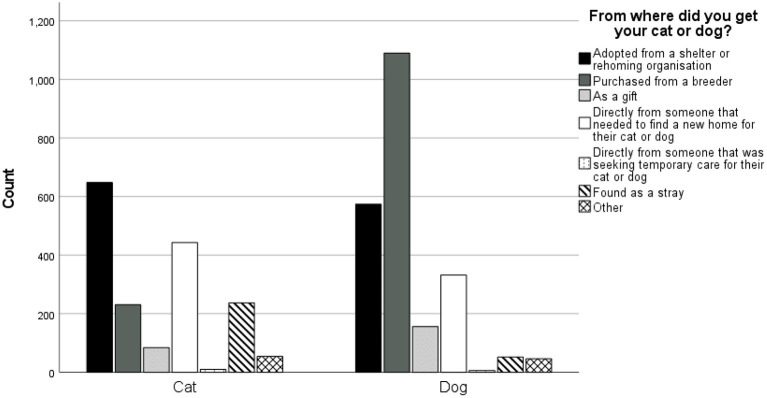
- In the logistic regression, compared with pets given as a gift, relinquishment likelihood was 38.7% lower for pets sourced from a shelter (P < 0.001), 31.2% lower for those from a breeder, and 24.4% lower for those acquired directly from someone needing to find a new home; pets acquired < 6 months before COVID-19 was declared a pandemic were 3 times more likely to be considered for or be given up, and pets acquired after that point were 2 times more likely (both P < 0.001).
- There was no effect of species (cat vs. dog) on relinquishment (P = 0.835), but 65.0% of those considering relinquishment and 72.2% of those who had already relinquished identified as male.
- Financial constraints were the most mentioned reason for both considering relinquishment and actual relinquishment, followed by health concerns specific to COVID-19 and behavioral problems.
## Methods
- Cross-sectional online survey study with two follow-up questionnaires, conducted as part of the CAARP project.
- Participants were recruited via Prolific Academic; 4,000 study places were allocated evenly by sex/gender category (2,000 male and 2,000 female), and after exclusions 3,945 responses were analyzed from participants in 27 countries.
- Survey 1 (11 Aug 2020) assessed pet species, source, acquisition timing, online acquisition, and whether participants had considered giving up their pet; survey 2 (17–24 Aug 2020) and survey 3 (31 Mar–8 Apr 2021) followed participants who had considered or already given up their pet.
- Analysis included descriptive statistics, chi-square tests for online acquisition by species and acquisition timing, and binary logistic regression predicting “giving up pet” from species, source, online acquisition, and timing of acquisition; SPSS v25 was used.
## Limitations
- The paper states that results may not be generalizable because most participants were white, in full-time employment, and largely from the UK and USA, and because Prolific users tend to be white, highly English-fluent, middle-income, and have a third-level qualification.
- The paper notes that the follow-up retention rate for all participants considering relinquishment could not be established because only a sub-sample responded to survey 3.
- Evident from the text: the sample was self-selected from an online panel and the study relied on self-reported relinquishment and reasons, which may introduce selection and social desirability bias.
Model-written summary. Check it against the paper before relying on it.
Integrity signals
Registry
Cites
Statistics
Figures
Verification
Claims the paper makes
44 Valid · 6 Not valid · 28 Not checked · 116 Own results and interpretations
The cited sources that could be checked couldn’t confirm or dispute this claim.
In the paper
“In general, newly acquired pets are more likely to be relinquished.”
§ Companion animal adoption and relinquishment during the COVID-19 pandemic: Peri-pandemic pets at greatest risk of relinquishment > 1. Introduction
What the sources say
- Not checked — no full text of the sourcecites [21] Shore ER Petersen CL Douglas DK. Moving as a reason for pet relinquishment: a closer look. J Appl Anim Welfare Sci. (2003) 6: 39– 52. 10.1207/S15327604JAWS0601_04 12795858 source
- Not checked — no full text of the sourcecites [22] Shore ER. Returning a recently adopted companion animal: adopters' reasons for and reactions to the failed adoption experience. J Appl Anim Welfare Sci.. (2005) 8: 187– 98. 10.1207/s15327604jaws0803_3 16468947 source
- Could not verifycites [10] Powell L Houlihan C Stone M Gitlin I Ji X Reinhard CL. Animal shelters' response to the COVID-19 pandemic: a pilot survey of 14 shelters in the Northeastern United States. Animals. (2021) 11: 2669. 10.3390/ani11092669 34573635 PMC8468430 sourceExperimental — accuracy not yet measured
The Results (section 3.1) compare shelter intake and owner relinquishments in 2019 and 2020, and the Discussion (section 4) reports fewer owner relinquishments during the pandemic. Neither passage compares newly acquired pets with longer-owned pets. Searches for recent acquisition, adoption returns, and ownership duration found no such comparison in our copy. (LLM, conf=0.72)
hedgedstates an association- Asserted: passes — The authors put it forward as true.
- Checkable: passes — It can be checked against evidence.
- Load-bearing: passes — The paper’s conclusions depend on it.
- Based: passes — The paper gives a reason why it holds.
The cited sources support only part of this claim — read each source’s verdict below.
In the paper
“Recent studies that surveyed companion animal owners during the COVID-19 pandemic had a largely female participant base (26, 27).”
§ Companion animal adoption and relinquishment during the COVID-19 pandemic: Peri-pandemic pets at greatest risk of relinquishment > 1. Introduction
What the sources say
- Supportedcites [26] Jalongo MR. Pet Keeping in the time of COVID-19: the canine and feline companions of young children. Early Childhood Educ J. (2021) 18: 1– 11. 10.1007/s10643-021-01251-9 34426724 PMC8372227 source
The Conclusion describes pandemic-era research on people and their pets as relying largely on online surveys and says that recruiting through social media tends to produce predominantly female samples. This supports the citing sentence’s broad characterization, though the paper does not say every survey had that composition. (LLM, conf=0.89)
- Partly supportedcites [27] Duarte Cardoso S da Graça Pereira G de Sousa L Faraco CB Piotti P Pirrone F. Factors behind the relinquishment of dogs and cats by their guardians in Portugal. J Appl Anim Welfare Sci. (2022) 13: 1– 12. 10.1080/10888705.2022.2087183 35698728 sourceExperimental — accuracy not yet measured
Our copy confirms the gender skew for this study: Section 3.3 (Data Description) reports that the 36 relinquisher guardians were 'mostly female (n = 35)' with the same in the NREL group (n = 34 females), and the Additional information section states 'there were significantly fewer male than female participants,' attributing this to online-survey limitations and noting higher female participation in other companion-animal guardianship surveys (Pirrone et al., 2015a, b; 2016; d'Ovidio & Pirrone, 2018). What our copy does not support is the temporal qualifier: no passage in the Methods (Section 2), Discussion (Section 4) or elsewhere says the questionnaire was administered during the COVID-19 pandemic — it only records that the questionnaire was available for 19 months and that sources were accessed in July 2021. So the 'largely female participant base' part of the claim is supported for this source, while 'during the COVID-19 pandemic' is not stated in it. (LLM, conf=0.72)
plain- Asserted: passes — The authors put it forward as true.
- Checkable: passes — It can be checked against evidence.
- Load-bearing: unclear — It is unclear whether the paper’s conclusions depend on it.
- Based: passes — The paper gives a reason why it holds.
- Supported
The cited sources support only part of this claim — read each source’s verdict below.
In the paper
“Dolan et al. (16) found that when approached outside animal shelters and informed about support services, 88% of people were willing to consider alternatives to relinquishment and left the shelter with their companion animals.”
§ Companion animal adoption and relinquishment during the COVID-19 pandemic: Peri-pandemic pets at greatest risk of relinquishment > 1. Introduction
What the sources say
- Partly supportedcites [16] Dolan ED Scotto J Slater M Weiss E. Risk factors for dog relinquishment to a Los Angeles municipal animal shelter. Animals. (2015) 5: 1311– 28. 10.3390/ani5040413 26690483 PMC4693217 sourceExperimental — accuracy not yet measured
The Results (§3.2) report that 146 relinquishment-group participants (88.0%) chose to pursue information about services rather than proceed to surrender their dogs. The paper explicitly says that three undecided participants left with their dogs; it does not establish that all 146 who chose services did so. The 88% also refers to surveyed relinquishers, not everyone approached outside the shelter. (LLM, conf=0.86)
plain- Asserted: passes — The authors put it forward as true.
- Checkable: passes — It can be checked against evidence.
- Load-bearing: passes — The paper’s conclusions depend on it.
- Based: passes — The paper gives a reason why it holds.
- Partly supported
The cited sources support only part of this claim — read each source’s verdict below.
In the paper
“The COVID-19 pandemic has created a situation globally where companion animals may be at increased risk of relinquishment and abandonment due to multiple interrelated factors.”
§ Companion animal adoption and relinquishment during the COVID-19 pandemic: Peri-pandemic pets at greatest risk of relinquishment > Abstract
What the sources say
- Supportedcites [3] Vincent A Mamzer H Ng Z Farkas KJ. People and their pets in the times of the COVID-19 pandemic. Soc Register. (2020) 4: 111– 28. 10.14746/sr.2020.4.3.06 source
The 'REPERCUSSIONS OF THE PANDEMIC FOR COMPANION ANIMAL CARE' section states that living in a pandemic makes pet care a challenge and that coping by reducing stress 'may look like surrendering a pet to a shelter, or relinquishing a pet to a veterinary clinic requesting euthanasia,' and that pets of people without financial means 'may be abandoned' — matching the claim's hedged 'may be at increased risk.' The 'ECONOMIC AND CARE BURDEN' section supplies the multiple interrelated factors (job/income loss, added costs, daily care routines becoming too great a burden), and the same repercussions section notes 'international concerns of a higher probability of euthanasia of animals in zoological gardens and animal shelters,' while the Abstract frames companion animals as vulnerable 'in the face of a global pandemic.' The global scope is thus carried by the paper's own international/global framing alongside its US-based shelter reports. (LLM, conf=0.88)
- Partly supportedcites [4] Applebaum JW Tomlinson CA Matijczak A McDonald SE Zsembik BA. The concerns, difficulties, and stressors of caring for pets during COVID-19: Results from a large survey of US pet owners. Animals. (2020) 10: 1882. 10.3390/ani10101882 33076475 PMC7602525 sourceExperimental — accuracy not yet measured
The Introduction (§1.2) describes several pandemic-related pressures—including behavioral changes, disrupted pet services, eviction, and financial hardship—that may lead owners to separate from pets. The Conclusions (§5) explicitly warn that these issues could increase relinquishment or abandonment. The paper concerns U.S. pet owners, however, and does not establish that the risk is increased globally. (LLM, conf=0.86)
- Not checked — no full text of the sourcecites [12] Mallapaty S. Coronavirus can infect cats-dogs, not so much. Nature. (2020) 10.1038/d41586-020-00984-8 32238897 source
hedgedstates a possible cause- Asserted: passes — The authors put it forward as true.
- Checkable: passes — It can be checked against evidence.
- Load-bearing: passes — The paper’s conclusions depend on it.
- Based: passes — The paper gives a reason why it holds.
- Supported
The sources with a verdict support this claim; the rest weren’t checked yet, have no full text we could read, or their verdicts aren’t rated yet.
In the paper
“The decision to relinquish a companion animal can take weeks and months of consideration, with pet owners trying to find an alternative home themselves before approaching an animal shelter (13, 16).”
§ Companion animal adoption and relinquishment during the COVID-19 pandemic: Peri-pandemic pets at greatest risk of relinquishment > 1. Introduction
What the sources say
- Not checked — no full text of the sourcecites [13] Sharkin BS Ruff LA. Broken bonds: Understanding the experience of pet relinquishment. In: The Psychology of the Human-Animal Bond. New York, NY: Springer (2011). p. 275– 87. source
- Supportedcites [16] Dolan ED Scotto J Slater M Weiss E. Risk factors for dog relinquishment to a Los Angeles municipal animal shelter. Animals. (2015) 5: 1311– 28. 10.3390/ani5040413 26690483 PMC4693217 source
The Introduction reports that the decision to relinquish lasted weeks to months for many people and that some tried to re-home their animals. The Discussion likewise says many people considered relinquishment for a month or more. These passages support the citing sentence, though the paper reports the timing and re-homing findings from earlier studies. (LLM, conf=0.92)
plain- Asserted: passes — The authors put it forward as true.
- Checkable: passes — It can be checked against evidence.
- Load-bearing: passes — The paper’s conclusions depend on it.
- Based: passes — The paper gives a reason why it holds.
84 more claims · 7 with their cited sources checked
Create a free account to see all 194 claims and to verify the 6 references still open.
- Probably not a substantial claim. 88
- It may state two separate claims as one. 39
Statistics recomputed
Every reported test result, recomputed from its test statistic and degrees of freedom. A result shows as not adding up only once an independent check has confirmed it.
- Consistentχ²(10) = 123.35reported p < .001 · recomputed p < .001
“X2 (10) = 123.350, p < .001”
Self-check
Percentages, sums and reported differences re-computed from the paper’s own numbers.
Each contradiction between two passages listed here was confirmed by an independent check.
Rated major: it would touch a result — a value a result rests on, reported and recomputed p-values on opposite sides of the significance level, two passages that conflict with no sign which is right, or a cited work retracted before this paper was published.
In the paper
§ Companion animal adoption and relinquishment during the COVID-19 pandemic: Peri-pandemic pets at greatest risk of relinquishment > 3. Results > 3.4. Follow-up surveys
“Of those invited, n = 153 usable responses were received.”
§ Companion animal adoption and relinquishment during the COVID-19 pandemic: Peri-pandemic pets at greatest risk of relinquishment > 2. Methods > 2.2. Procedure
“was completed between 17th to 24th of August 2020, by those that had reported that they had considered, or had already given up a cat or dog, with n = 181 usable responses.”
Rated major: it would touch a result — a value a result rests on, reported and recomputed p-values on opposite sides of the significance level, two passages that conflict with no sign which is right, or a cited work retracted before this paper was published.
In the paper
“Considering data from the three surveys, 4.06% of participants considered giving up their pet (168/3945), 0.74% (28/3945) gave up their pet, and 0.2% considered and then did give up their pet (8/3945).”
§ Companion animal adoption and relinquishment during the COVID-19 pandemic: Peri-pandemic pets at greatest risk of relinquishment > 4. Discussion > 4.1. Relinquishment of cats and dogs during the COVID-19 pandemic
Reported 4.06 · recomputed 4.258555
Citations
Cites
Beyond the Turk: Alternative platforms for crowdsourcing behavioral research
Peer, E., Brandimarte, L., Samat, S., & Acquisti, A. (2017) · Journal of Experimental Social Psychology · doi:10.1016/j.jesp.2017.01.006 · Cited by 2,957 · cited 2×
“Prolific Academic has been shown to provide high quality, reliable data, and has a diverse participant pool (30).”
BackgroundBeasley, T. M., & Schumacker, R. E. (1995) · The Journal of Experimental Education · doi:10.1080/00220973.1995.9943797 · Cited by 748
New, J. C., Salman, M. D., King, M., Scarlett, J. M., Kass, P. H., & Hutchison, J. M. (2000) · Journal of Applied Animal Welfare Science · doi:10.1207/s15327604jaws0303_1 · Cited by 324 · cited 3×
“(29) appear to have used the same dataset of 12 USA shelters in their studies.”
BackgroundScarlett, J. M., Salman, M. D., New, Jr., & Kass, P. H. (1999) · Journal of Applied Animal Welfare Science · doi:10.1207/s15327604jaws0201_4 · Cited by 204
Applebaum, J. W., Tomlinson, C. A., Matijczak, A., McDonald, S. E., & Zsembik, B. A. (2020) · Animals · doi:10.3390/ani10101882 · Cited by 191
Shore, E. R. (2005) · Journal of Applied Animal Welfare Science · doi:10.1207/s15327604jaws0803_3 · Cited by 174 · cited 2×
“For example, Shore et al. (21) found that 47.4% of animals relinquished to Midwestern USA animal shelters were in the home for less than a year.”
BackgroundInfluentialHuman–dog relationships during the COVID-19 pandemic: booming dog adoption during social isolation
Morgan, L., Protopopova, A., Birkler, R. I. D., Itin-Shwartz, B., Sutton, G. A., Gamliel, A., Yakobson, B., & Raz, T. (2020) · Humanities and Social Sciences Communications · doi:10.1057/s41599-020-00649-x · Cited by 165 · cited 1×
“There has been an increased adoption of pets during the pandemic, including an increase in impulse buying (23, 24).”
BackgroundA Scoping Review of Published Research on the Relinquishment of Companion Animals
Coe, J. B., Young, I., Lambert, K., Dysart, L., Nogueira Borden, L., & Rajić, A. (2014) · Journal of Applied Animal Welfare Science · doi:10.1080/10888705.2014.899910 · Cited by 155
Did the COVID-19 Pandemic Spark a Public Interest in Pet Adoption?
Ho, J., Hussain, S., & Sparagano, O. (2021) · Frontiers in Veterinary Science · doi:10.3389/fvets.2021.647308 · Cited by 123
COVID-19 and pets: When pandemic meets panic
Parry, N. M. A. (2020) · Forensic Science International: Reports · doi:10.1016/j.fsir.2020.100090 · Cited by 115
Research works printed but not linked: 1
- Veloso AFB. Pet abandonment due to suspected COVID-19 transmission. Communications. (2022) 44: 119– 130. Available online at: https://www.academia.edu/70860126/Pet_Abandonment_Due_to_Suspected_COVID_19_Transmission
Cited by
Kisley, M. A., Chung, E. J., & Levitt, H. (2024) · Animals · doi:10.3390/ani14172606 · Cited by 42
“However, at the height of the pandemic in late 2020 and early 2021, Carroll and colleagues [35] conducted a multi-national online survey of 3945 animal owners, a small percentage of whom had relinquished ( 1”
BackgroundResultInfluentialImproving travel experience for hotel guests: Policy recommendations for pet-friendly hotels
Koufodontis, N. I., & Melissourgou, P. (2024) · International Journal of Hospitality Management · doi:10.1016/j.ijhm.2024.103828 · Cited by 29
When Having a Pet Becomes a Luxury You Can No Longer Afford
Muldoon, J. C., & Williams, J. M. (2024) · Anthrozoös · doi:10.1080/08927936.2024.2351276 · Cited by 28
“Whilst research on people ’ s relationships with pets during the pandemic highlighted the complexities involved (e.g., Appiah et al., 2022; Carroll et al., 2022; Vincent et al., 2020), the speci fi c impact of economic vulnerability on the care of the pet and people ’ s mental health have rarely…”
Alemayehu, T., Oguttu, B., Rupprecht, C. E., & Niyas, V. K. M. (2024) · International Journal of Infectious Diseases · doi:10.1016/j.ijid.2024.01.008 · Cited by 17
Packer, R. M. A., Brand, C. L., Belshaw, Z., Pegram, C., Dale, F. C., Stevens, K., & O'Neill, D. G. (2023) · Animals · doi:10.3390/ani13132186 · Cited by 15
“Free-time as an acquisition motivator, and the potential for it to change with household circumstances remains a risk factor for relinquishment [67], and indeed, recent evidence suggests that pets acquired during the pandemic were twice as likely to be considered for, or be, given up compared to those acquired > 6 mon…”
BackgroundWhen and Why Cats Are Returned to Shelters
Mundschau, V., & Suchak, M. (2023) · Animals · doi:10.3390/ani13020243 · Cited by 24
“The needs of each community will vary [30] and may change over time, especially during social/economic shifts [21,26,28], but by knowing the most common reasons for return, as well as the time frames owners are most likely to return in, shelters can target their support to those individuals.”
BackgroundResultInfluentialOwner expectations and surprises of dog ownership experiences in the United Kingdom
Anderson, K. L., Holland, K. E., Casey, R. A., Cooper, B., & Christley, R. (2024) · Frontiers in Veterinary Science · doi:10.3389/fvets.2024.1331793 · Cited by 21
How Does Access to Veterinary Care Relate to Animal Welfare?
Croney, C., Applebaum, J. W., Delgado, M., & Stella, J. L. (2025) · Advances in Small Animal Care · doi:10.1016/j.yasa.2025.06.014 · Cited by 22
Carroll, G., Torjussen, A., & Reeve, C. (2023) · Animal Welfare · doi:10.1017/awf.2023.77 · Cited by 13
“Carroll et al. (2022) assessed the source of acquisition (online: yes/no), finding a trend for greater likelihood of considering giving up or giving a pet up in those acquired from an online source.”
BackgroundResultInfluentialSelf-citationBielby, J., Ferguson, A. M., Rendle, M., & McMillan, K. M. (2023) · PLoS ONE · doi:10.1371/journal.pone.0288725 · Cited by 8
“Temporally, one of the concerns with this study may be that the data were collected over the year following the UK Covid-19 pandemic lockdown, and several studies have highlighted an increase in trade in more traditional companion animals during that time [58].”
BackgroundCarroll, G., Reeve, C., & Torjussen, A. (2024) · Animal Welfare · doi:10.1017/awf.2024.15 · Cited by 11
“However, it has also been suggested that pet relinquishment and abandonment increased due to fear of zoonotic transmission (Huang et al. 2021; Carroll et al. 2022).”
BackgroundInfluentialSelf-citationBoonhoh, W., Poolkhet, C., Waran, N. K., & Wongtawan, T. (2025) · Applied Animal Behaviour Science · doi:10.1016/j.applanim.2025.106717 · Cited by 12
Silva, A. J. (2025) · Journal of Management Development · doi:10.1108/jmd-04-2024-0144 · Cited by 13
Impact of the 2007–2008 United States Economic Crisis on Pet Ownership
Crespo, P., & Faytong‐Haro, M. (2022) · Animals · doi:10.3390/ani12213010 · Cited by 7
“As adoption availability increases [4], people who want to adopt but cannot do it due to availability could be more likely to do so after the crisis [14].”
BackgroundEllis, A., Loughnan, S., Hawkins, R. D., & Stanton, S. C. E. (2024) · Animals · doi:10.3390/ani14111606 · Cited by 8
“Common causes of relinquishment include having too many animals, poor human health, no longer wanting the animal, housing issues, animal behavioral issues, financial issues, life changes, poor animal health, undesirable animal characteristics, and personal issues [62,63].”
BackgroundHow Guilt Drives Emotional Exhaustion in Work–Pet Family Conflict
Silva, A. J. (2024) · Animals · doi:10.3390/ani14233503 · Cited by 10
“Since the onset of the recent pandemic, the global number of companion animals or pets has increased significantly [1,2].”
E-Pet: Regulating the weight of the Dogs through Automation and IoT Utilizing Calorie Tracker
Amoroso, S. K. N., Carlos, H. P. Q., Santelices, M. V. H., Valencia, J. C. R., Noriega, E. M. E. A., & Gallego, M. P. (2023) · IEEE International Conference on Recent Advances and Innovations in Engineering (ICRAIE) · doi:10.1109/icraie59459.2023.10468154 · Cited by 2
“In 2018 research published in The Jouro nal f Veterinary Behavior [7], more than 80% of dog owners said their dogs demonstrated indications of emotional eating, or "stress eating," when they were "unhappy."”
BackgroundLeelakajornkit, S., Dumniem, N., Wataganara, P., Maison, S., & Ponglowhapan, S. (2024) · The Thai Journal of Veterinary Medicine · doi:10.56808/2985-1130.3658 · Cited by 2
Self-reported motivation in the pursuit and choice of companion dogsPreprint
Udvarhelyi-Tóth, K. M., Iotchev, I. B., Enikö Kubinyi, B., & Turcsán, B. (2024) · Research Square · doi:10.21203/rs.3.rs-3946531/v1 · Cited by 1
(2024) · doi:10.46784/e-avm.v17i2.384 · Cited by 1
“However, the pandemic has also been accompanied by concerning reports of animal abuse and abandonment (Carroll et al., 2022), raising questions about the impact of public sentiments on human-animal interactions during this challenging period.”
Hawkins, R. D., Ellis, A., & Robinson, C. (2024) · medRxiv · doi:10.1101/2024.11.20.24317636 · Cited by 1
Investigating Factors Associated With Stress in Guardians of Dogs Under 12 Months of Age
Costa, A. G., Nielsen, T., Christley, R., Tuke, J., & Hazel, S. J. (2024) · Anthrozoös · doi:10.1080/08927936.2024.2418699 · Cited by 1
“Carroll et al. (2022) investigated the e ff ect of the pandemic on guardian relinquishment, reporting 4.1% of guardians (encompassing dogs and cats of all ages) contemplated giving up their companion animal, but only 0.7% actually did so, reinforcing that not all guardians who consider rehoming do…”
InfluentialPet Watching System with IoT Devices and Chatbots
(2024) · doi:10.1109/icce59016.2024.10444223 · Cited by 1
Choosing Companions: Pet Adoption Preferences in Portugal – a Cross-Sectional StudyPreprint
Afonso, P., Quintas, H., Cardoso, L., & Coelho, A. C. (2024) · Preprints.org · doi:10.20944/preprints202401.0562.v1 · Cited by 1
Cat Bites in Southern Mexico: Epidemiological Patterns and One Health Perspective
(2026) · doi:10.1155/vmi/6825008
“It is reported that a large number of pets were relinquished during the pandemic, apparently due to fnancial problems, health problems associated with COVID-19, and behavioral problems [24], and thus less aggressions occurred.”
Andrianto, M. S., Widyastuti, H., & Hidayati, N. (2024) · IOP Conference Series Earth and Environmental Science · doi:10.1088/1755-1315/1359/1/012124 · Cited by 1
Investigation of the Faecal Microbiome and Household Factors Associated with Intercat AggressionPreprint
Chottianchai, T., Sriphavatsarakom, P., & Phumthanakorn, N. (2026) · SSRN Electronic Journal · doi:10.2139/ssrn.7315494
Qiu, T., Maher, S., Hall, E., & Westman, M. E. (2026) · Animals · doi:10.3390/ani16020321 · Cited by 2
“The COVID-19 pandemic resulted in huge shifts in pet ownership globally, with a significant surge observed in both animal adoptions and animal surrenders [1].”
Behavioral Health and Mental Well-being of Sheltered Animals
Cussen, V. A., & Reid, P. J. (2025) · CABI eBooks · doi:10.1079/9781800624313.0018 · Cited by 1
Ellis, A., Opitz, M., Loughnan, S., & Hawkins, R. D. (2026) · Journal of Eating Disorders · doi:10.1186/s40337-026-01643-5 · Cited by 1
“However, other work has found that pet owners experience unique stressors related to their pets, and higher levels of depression and anxiety than non-pet owners [4, 12, 21, 31, 52].”
Evaluation of Risk Factors for Companion Animal Abandonment and Rehoming in Chile
Valdivia, J. V., Cisternas, C. M., Ubilla, M. J., Cañon–Jones, H., & Contreras, G. C. (2026) · Journal of Applied Animal Welfare Science · doi:10.1080/10888705.2026.2698606
“Companion animal overpopulation continues to escalate globally (Bernete Perdomo et al., 2021; Carroll et al., 2022), leading to millions of animals crowded in shelters and high rates of euthanasia (Coate & Knight, 2010; Reese et al., 2017).”
Episcopio‐Sturgeon, D. J., Steele, Z. T., & Pienaar, E. F. (2026) · Anthrozoös · doi:10.1080/08927936.2026.2614161
Activities promoting self-expansion for dog guardians: An exploratory study
Ellis, A., Hawkins, R. D., Stanton, S. C. E., & Loughnan, S. (2026) · Human-Animal Interactions · doi:10.1079/hai.2026.0010
Anthony, R., & Cerqueira, P. H. R. (2025) · Agriculture · doi:10.3390/agriculture15050454
Dell, C. A., Pavelich, A. R., Woodsworth, J., MUMFORD, E. L., Gillett, J., Wu, H., & Carver, L. (2026) · CABI One Health · doi:10.1079/cabionehealth.2026.0008 · Cited by 3
Preadoption/prepurchase counseling
Hunter, T., Rockman, M., & Seymour, R. (2024) · Elsevier eBooks · doi:10.1016/b978-0-323-99868-0.00026-1
Langes, M. D., & Normando, S. (2023) · Journal of Applied Animal Ethics Research · doi:10.1163/25889567-bja10040
Metadata
- Authors
- Carroll, G. A., Torjussen, A., & Reeve, C.
- Affiliations
- Queen's University Belfast (GB)
- University of Sussex (GB)
- Corresponding author
- Carroll, Grace A.
- Venue
- Frontiers in Veterinary Science
- Publisher
- Frontiers Media SA
- Published
- 2022-09-30
- Volume
- 9
- Pages
- 1017954-1017954
- ISSN
- 2297-1769 (ISSN-L)
- PMC
- PMC9563850
- OpenAlex
- W4298109414
- Cited by
- 40
- References
- 43
- Citations by year
- 2026: 8 · 2025: 8 · 2024: 16 · 2023: 7 · 2022: 1
- FWCI
- 4.83
- Type
- journal article
- Language
- en
- Open access
- gold
- doi.org
- Licence
- Locations
- Frontiers in Veterinary Science (publishedVersion, cc-by)
- PubMed Central (publishedVersion, cc-by)
- PubMed (publishedVersion)
- Research Portal (Queen's University Belfast) (submittedVersion, cc-by)
- DOAJ (DOAJ: Directory of Open Access Journals) (submittedVersion, cc-by-sa)
- Topics
- Life Sciences › Agricultural and Biological Sciences › Animal Science and Zoology › Human-Animal Interaction Studies
- Life Sciences › Agricultural and Biological Sciences › Animal Science and Zoology › Animal Behavior and Welfare Studies
- Social Sciences › Law › Animal Law and Welfare
- Keywords
- pet adoption, COVID-19 pandemic, cats, dogs, pet abandonment, financial constraints, owner gender, human-animal bond
About these checks
Registry, retraction, Cites and statistics results are computed, not judged, with one exception: a printed reference that no index lists is read once by a model before it counts as a citation error. Claims are extracted by a model and kept only when their quote appears verbatim in the text; each cited source is then checked, with a model’s help, for whether it says what the claim relies on. Those verdicts can be wrong — read the claim’s quote and the cited source before relying on one.
The claim verdicts this report counts are experimental: their accuracy is not yet measured.
A language model drew the claims from the paper on 2026-10-10, under version 3 of the claim definition (model deepseek-v4.1-flash, prompt extract-v3).
A second model labelled each claim on 2026-10-10 (model jev-1.13-20260917, definition revision gold-guideline-v0.2).
Cited sources are checked with a language model’s help (gpt-6-sol and qwen3.8-omni-flash).
Statistics and arithmetic are recomputed, not judged.
Confidence bands are shown only for fields calibrated on our annotated test set. None is calibrated yet, so no band is shown.
What counts as a claim ›How we measure confidence ›How we check this ›
Are you an author, or do you see a problem with this page? Request a review
Data sources
Bibliographic data: Semantic Scholar, OpenAlex, Crossref.
Contains information from the Semantic Scholar Academic Graph Datasets, made available under the ODC Attribution License (ODC-BY 1.0).
Semantic Scholar’s data is described in: Kinney, R., et al. (2023). The Semantic Scholar Open Data Platform. arXiv:2301.10140.
