

Tobacco Taxes as the Unsung Hero: Impact of a Tax Increase on Advancing Sustainable Development in Colombia
Open accessThe DOI matches its Crossref record; 53 of the 61 references it cites were found in a registry or an index, and 1 are not checked yet; 9 of the 31 sources its claims cite were checked for support.
Abstract
Objective: Tobacco taxes are a well-established cost-effective policy to prevent Noncommunicable Diseases. This paper evaluates the expected effects of a tobacco tax increase on the Sustainable Development Goals in Colombia. Methods: We use microsimulation to build an artificial society that mimics the observed characteristics of Colombia’s population, and from there we simulate the behavioral response to a tax increase of COP$4,750 and the subsequent effects in all SDGs. Results: The tobacco tax hike reduces the number of smokers and smoking intensity, decreases premature mortality, healthcare costs, poverty and catastrophic expenditure on healthcare, increases health, income and gender equity, and strengthens domestic resource mobilization even in the presence of illicit cigarettes.
Verified 2026-11-25 · 1 reference not checked yet
Overview
CoChat Summary
## TL;DR
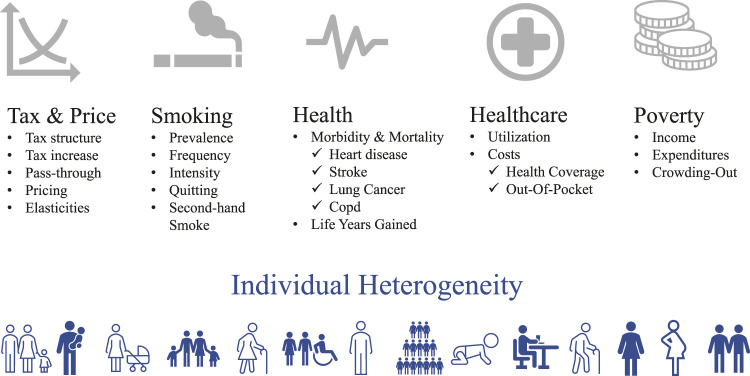
This paper uses microsimulation to estimate how raising Colombia’s tobacco excise tax from COP$2,350 to COP$7,000 could affect health, poverty, education, public finances, gender equality, and environmental outcomes tied to the SDGs. It finds substantial reductions in smoking and smoking-related harm, alongside large gains in tax revenue and other sustainable development indicators.
## Key findings
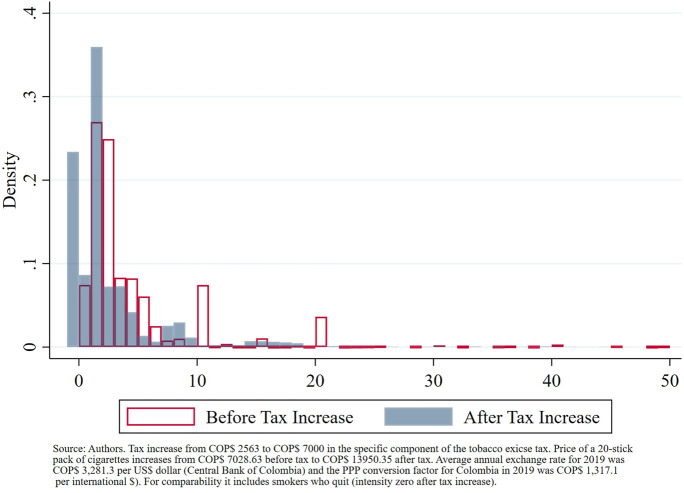
- The simulated tax hike reduces smokers from 4.51 million to 3.45 million and lowers smoking intensity from 2.01 to 1.78 cigarettes per day among continuing smokers.
- Annual cigarette consumption falls from 332.3 million to 215.5 million 20-stick packs.
- Premature mortality from smoking declines from 2.3 million to 1.8 million deaths, a reduction of 445.0 thousand averted deaths; the paper also estimates 7.9 million years of life gained and 15.9 million deaths averted from household second-hand smoke exposure.
- The policy is estimated to reduce healthcare costs by COP$2,157.4 billion, out-of-pocket healthcare spending by COP$194.2 billion, avert 28.96 thousand people falling into poverty, avert 337.6 thousand people facing catastrophic healthcare expenditure, and raise tax revenue from COP$797.1 billion to COP$1,359.3 billion.
- The paper also estimates 3.37 million lost years of education averted, 1,753 million cigarette butts kept out of landfills, and 1.7 trillion liters of water pollution avoided.
## Methods
- The study uses a static microsimulation based on an Extended Cost-Effectiveness Analysis (ECEA) framework to simulate the effects of a tobacco tax increase on multiple Sustainable Development Goals.
- The synthetic population is built from the 2019 Quality of Life Survey (ECV), with 289,558 individuals in 93,993 households, expanded to represent 49,670,800 people in 15,999,298 households in Colombia.
- Smoking prevalence in the survey is adjusted using the 2019 Survey on Consumption of Psychoactive Substances (SCPS) to address underreporting, and the model is run with 500 Monte Carlo simulations; aggregate outcomes are then calculated for SDG-related indicators.
## Limitations
- The paper states that the model is static, so time is not explicitly modeled; households do not evolve over time, and the model does not capture age of initiation or intentions to start smoking.
- The text makes evident that results depend on survey-based inputs and adjustment procedures for underreporting, so they are limited by the quality of the underlying self-reported data and the assumptions used to impute missing smokers (said in the text: underreport bias; made evident: reliance on imputation).
Model-written summary. Check it against the paper before relying on it.
Integrity signals
Registry
Cites
Statistics
Figures
Verification
Claims the paper makes
7 Valid · 2 Not valid · 10 Not checked · 40 Own results and interpretations
The cited sources support only part of this claim — read each source’s verdict below.
In the paper
“there is some work in microsimulation on tobacco taxes [10–14]; however, most of that work is limited to the health dimension of SD with an emphasis on burden of disease, and the work connecting health with SD is considerably scarce.”
§ Tobacco Taxes as the Unsung Hero: Impact of a Tax Increase on Advancing Sustainable Development in Colombia > Introduction
What the sources say
- Not checked — no full text of the sourcecites [10] Pichon-Riviere A Bardach A Augustovski F Alcaraz A Reynales-Shigematsu LM Pinto MT Economic Impact of Smoking on Health Systems in Latin America: A Study of Seven Countries and its Extrapolation to the Regional Level. Pan Am J Public Health (2016) 40: 1– 9. 28001196
- Not checked — no full text of the sourcecites [11] Pichon-Riviere A Augustovski F Bardach A Colantonio L. Development and Validation of a Microsimulation Economic Model to Evaluate the Disease Burden Associated with Smoking and the Cost-Effectiveness of Tobacco Control Interventions in Latin America. Value in Health (2011) 14: S51– S59. 10.1016/j.jval.2011.05.010 21839900 source
- Partly supportedcites [12] Yang W Zou Q Tan E Watkins L Beronja K Hogan PF Future Health and Economic Impact of Comprehensive Tobacco Control in DoD: A Microsimulation Approach. Mil Med (2018) 183: e104– e112. 10.1093/milmed/usx015 29401346 sourceExperimental — accuracy not yet measured
Our copy confirms this paper is itself microsimulation work on tobacco price/tax policy — the DISCUSSION (p. 1) states it 'modeled the complex relationships among smoking status, clinical measures, demographic characteristics, disease incidence, mortality risk, and medical costs' and simulated 'the future health and economic consequences' of a policy including a 5% price increase, and the Methods ('Simulating Smoking Status Change Under Status Quo and Policy Scenarios') apply Liu 2010 and Levy 2005 price elasticities to initiation, cessation and relapse. However, no passage in our copy (searched: microsimulation of tobacco taxes limited to health/burden of disease, sustainable development, state of the literature, first study to combine health and cost) makes the field-level generalization the claim attributes to it — that most such work is confined to the health dimension and that health-plus-economic work is scarce. On the contrary, this paper jointly models health and lifetime medical-cost outcomes, so it does not exemplify the 'health-only' characterization; the closest it comes is the narrower statement that 'Most studies reviewed estimated the impact of price changes on smoking prevalence,' which concerns prevalence elasticities, not microsimulation scope or burden of disease. (LLM, conf=0.70)
- Partly supportedcites [13] Kim D Chen C Tysinger B Park S Chong MZ Wang L Smoking, Life Expectancy, and Chronic Disease in South Korea, Singapore, and the United States: A Microsimulation Model. Health Econ (2019) 30: 92– 104. 10.1002/hec.3978 31802569 PMC7269831 sourceExperimental — accuracy not yet measured
The Methodology (Smoking intervention simulation; page unavailable) models eliminating smoking among light and heavy smokers and measures life expectancy and chronic disease, supporting this paper as an example of health-focused smoking microsimulation. It does not simulate a tobacco tax; the Introduction mentions taxation only as a possible intervention. Nor does this paper establish that most tobacco-tax microsimulation work is health-limited or that work connecting health with sustainable development is scarce. (LLM, conf=0.83)
- Not checked — no full text of the sourcecites [14] IOM. In: Wallace R Geller A OgawaAyano V, editors. Assessing the Use of Agent-Based Models for Tobacco Regulationlish. Washington, DC: Institute of Medicine (IOM), The National Academies Press (2015). 10.17226/19018 26247084 source
plain- Asserted: passes — The authors put it forward as true.
- Checkable: passes — It can be checked against evidence.
- Load-bearing: passes — The paper’s conclusions depend on it.
- Based: passes — The paper gives a reason why it holds.
The sources with a verdict support this claim; the rest weren’t checked yet, have no full text we could read, or their verdicts aren’t rated yet.
In the paper
“The simulation modeling of behaviors and states builds upon the Extended Cost-Effectiveness Analysis (ECEA) model [32, 33], specifically the aggregated compartmental model used for studying the effect of cigarette price increases in middle-income countries [34].”
§ Tobacco Taxes as the Unsung Hero: Impact of a Tax Increase on Advancing Sustainable Development in Colombia > Methods > Simulation of Behaviors and States
What the sources say
- Supportedcites [32] Verguet S Kim JJ Jamison DT. Extended Cost-Effectiveness Analysis for Health Policy Assessment: A Tutorial. In:, 34 (2016). p. 913– 23. 10.1007/s40273-016-0414-z PharmacoEconomics 27374172 PMC4980400 source
The Abstract and Discussion describe ECEA as a quantitative approach to health policy assessment, identifying the framework that the citing authors say their simulation builds upon. The specific aggregated compartmental model is attributed to citation [34], not to this tutorial. (LLM, conf=0.87)
- Not checked — no full text of the sourcecites [33] Verguet S Jamison DT. Health Policy Analysis: Applications of Extended Cost-Effectiveness Analysis Methodology. In: Jamison DT, editor. Disease Control Priorities: Improving Health and Reducing Poverty. 3rd ed., Vol. 9. Washington, DC: The International Bank for Reconstruction and Development/The World Bank (2017). Chap. Ch.8. ISBN: 978-1-4648-0527-1. 30212165 source
- Supportedcites [34] Global Tobacco Economics Consortium. The Health, Poverty, and Financial Consequences of a Cigarette price Increase Among 500 Million Male Smokers in 13 Middle Income Countries: Compartmental Model Study. BMJ (2018) 361: k1162. 10.1136/bmj.k1162 29643096 PMC5894369 source
The Methods section identifies this study as a compartmental model assessing the effects of a cigarette price increase across income groups in 13 countries. In the citing sentence, this source [34] identifies the specific compartmental model; the separate citations [32, 33] accompany the ECEA foundation. (LLM, conf=0.91)
plain- Asserted: passes — The authors put it forward as true.
- Checkable: passes — It can be checked against evidence.
- Load-bearing: passes — The paper’s conclusions depend on it.
- Based: passes — The paper gives a reason why it holds.
- Supported
The cited sources support only part of this claim — read each source’s verdict below.
In the paper
“the reduction of the crowding-out effect of tobacco expenditure caused by the tobacco tax increase studied in several LMIC, including Chile, with similar cultural and socioeconomic conditions [46].”
§ Tobacco Taxes as the Unsung Hero: Impact of a Tax Increase on Advancing Sustainable Development in Colombia > Results > System 1: The Society
What the sources say
- Partly supportedcites [46] Paraje G Araya D. Relationship between Smoking and Health and Education Spending in Chile. Tob Control (2018) 27: 560– 7. 10.1136/tobaccocontrol-2017-05385710.1136/tobaccocontrol-2017-053857 28986435 PMC6109233 sourceExperimental — accuracy not yet measured
The Discussion reports that tobacco spending is associated with lower health and education budget shares in Chile and that increased tobacco taxes could free resources for poorer households. But the Methodology says the analysis does not establish causality, and the paper does not show that tax increases reduced crowding out in Chile or the other LMICs it discusses. (LLM, conf=0.86)
plainstates a cause- Asserted: passes — The authors put it forward as true.
- Checkable: passes — It can be checked against evidence.
- Load-bearing: passes — The paper’s conclusions depend on it.
- Based: passes — The paper gives a reason why it holds.
- Partly supported
Every source the paper cites for this claim was checked and supports it.
In the paper
“This unintended increase is caused by the tobacco industry’s typical response to tobacco taxes, overshifting the tax to the consumer to maintain and increase their profits [55].”
§ Tobacco Taxes as the Unsung Hero: Impact of a Tax Increase on Advancing Sustainable Development in Colombia > Results > System 2: The Economy
What the sources say
- Supportedcites [55] Gilmore AB Fooks G Drope J Bialous SA Jackson RR. Exposing and Addressing Tobacco Industry Conduct in Low-Income and Middle-Income Countries. Lancet (2015) 385(15): 1029– 43. 10.1016/S0140-6736(15)60312-9 25784350 PMC4382920 source
The Price section says tobacco companies overshift taxes by raising prices beyond the tax increase, enabling them to increase profits. It describes overshifting as the overall pattern in established markets, while noting that companies may absorb tax increases on their cheapest brands. (LLM, conf=0.91)
plainstates a cause- Asserted: passes — The authors put it forward as true.
- Checkable: passes — It can be checked against evidence.
- Load-bearing: passes — The paper’s conclusions depend on it.
- Based: passes — The paper gives a reason why it holds.
- Supported
The cited sources support only part of this claim — read each source’s verdict below.
In the paper
“out of 6 trillion cigarettes smoked globally, 4.5 trillion (75%) are littered in the environment [60]”
§ Tobacco Taxes as the Unsung Hero: Impact of a Tax Increase on Advancing Sustainable Development in Colombia > Results > The Earth’s System
What the sources say
- Partly supportedcites [60] Curtis C Novotny TE Lee K Freiberg M McLaughlin I. Tobacco Industry Responsibility for Butts: a Model Tobacco Waste Act. Tob Control (2017) 26: 113– 7. 10.1136/tobaccocontrol-2015-052737 26931480 PMC5256370 sourceExperimental — accuracy not yet measured
The Introduction reports almost 6.3 trillion cigarettes consumed globally in 2012, broadly supporting the claim's approximate 6 trillion. But it estimates that one- to two-thirds of butts are discarded into the surrounding environment, landfills, or storm drains—not 75% littered in the environment. It does not report the claimed 4.5 trillion figure. (LLM, conf=0.88)
plain- Asserted: passes — The authors put it forward as true.
- Checkable: passes — It can be checked against evidence.
- Load-bearing: passes — The paper’s conclusions depend on it.
- Based: passes — The paper gives a reason why it holds.
- Partly supported
33 more claims
Create a free account to see all 59 claims and to verify the 4 references still open.
- It may state two separate claims as one. 16
- Probably not a substantial claim. 7
- The quote only partly states this claim. 1
Citations
Cites
Murray, C. J. L., Aravkin, A. Y., Zheng, P., Abbafati, C., Abbas, K. M., Abbasi-Kangevari, M., Abd-Allah, F., Abdelalim, A., Abdollahi, M., Abdollahpour, I., et al. (2020) · The Lancet · doi:10.1016/s0140-6736(20)30752-2 · Cited by 9,854 · cited 1×
“This Original Article is part of the IJPH Special Issue “Health in all Sustainable Development Goals” Noncommunicable diseases are the leading cause of death and burden of disease worldwide [1].”
BackgroundIn search of how people change: Applications to addictive behaviors.
Prochaska, J. O., DiClemente, C. C., & Norcross, J. C. (1992) · American Psychologist · doi:10.1037/0003-066x.47.9.1102 · Cited by 8,596
Determinants of social desirability bias in sensitive surveys: a literature review
Krumpal, I. (2013) · Quality & Quantity · doi:10.1007/s11135-011-9640-9 · Cited by 2,860 · cited 1×
“Since ECV is a household survey, questions are asked to each respondent in presence of other household members, causing a significant underreport due to social desirability bias [27]; to correct for this bias, we adjust the data on whether the person smokes or not using smoking prevalence by age and gender from the Su…”
MethodA Conceptual Framework for Action on the Social Determinants of Health
UNSPECIFIED (2010) · University Libraries (University of Maryland) · doi:10.13016/17cr-aqb9 · Cited by 2,325
The Age of Sustainable Development
Sachs, J. D. (2015) · Columbia University Press eBooks · doi:10.7312/sach17314 · Cited by 1,901 · cited 1×
“As pointed out by [18] such definition holistically intends to “make sense of the interactions of three complex systems that sustain human life: the world economy, the global society, and the Earth’s physical environment.”
BackgroundHandbook of development economics
Chenery, H. B., Srinivasan, T. N., Behrman, J. R., Schultz, T., Strauss, J. A., Rodrik, D., & Rosenzweig, M. R. (1988) · Cited by 874
Health as human capital: synthesis and extensions
Becker, G. S. (2007) · Oxford Economic Papers · doi:10.1093/oep/gpm020 · Cited by 438 · cited 1×
“System 2: The Economy Education Human capital plays a central role on economic growth [47] as well as on development [48], with education and health [49] being “the two most important sources of human capital: knowledge capital and health capital” [50].”
BackgroundNugent, R., Bertram, M. Y., Jan, S., Niessen, L. W., Sassi, F., Jamison, D. T., Pier, E. G., & Beaglehole, R. (2018) · The Lancet · doi:10.1016/s0140-6736(18)30667-6 · Cited by 373 · cited 1×
“Aggregate Indicators Finally, the estimation of aggregate indicators is done by defining a metric for the dimensions of SD relevant for tobacco control [35] based on the variables and individual heterogeneity included in the model.”
MethodExposing and addressing tobacco industry conduct in low-income and middle-income countries
Gilmore, A. B., Fooks, G., Drope, J., Bialous, S. A., & Jackson, R. R. (2015) · The Lancet · doi:10.1016/s0140-6736(15)60312-9 · Cited by 372 · cited 1×
“This unintended increase is caused by the tobacco industry’s typical response to tobacco taxes, overshifting the tax to the consumer to maintain and increase their profits [55].”
BackgroundIntersectionality and why it matters to global health
Kapilashrami, A., & Hankivsky, O. (2018) · The Lancet · doi:10.1016/s0140-6736(18)31431-4 · Cited by 367
Research works printed but not linked: 30
- HHS. The Health Consequences of Smoking - 50 Years of Progress. A Report of the Surgeon General. Atlanta, GA: Department of Health and Human Services (HHS) (2014). Tech. rep. U.S.
- NCI and WHO. The Economics of Tobacco and Tobacco Control. Tech. Rep. NCI Tobacco Control Monograph Series 21. In: Department of Health and Human Services. Bethesda, MD; Geneva, CH: National Institutes of Health, U.S National Cancer Institute (NCI), World Health Organization (WHO) (2016).
- FCTC. Gender-Responsive Tobacco Control: Evidence and Options for Policies and Programmes. Geneva, CH: World Health Organization (WHO) Framework Convention on Tobacco Control, Secretariat (2018). Tech. rep.
- UN. Agenda for Development. New York (NY): United Nations (1997). Tech. rep. A/RES/51/240. United Nations (UN), fifty-first session.
- UN. Transforming Our World: The 2030 Agenda for Sustainable Development. New York (NY): United Nations (2015). Tech. rep. A/70/L.1. United Nations (UN). General Assembly. Seventieth session.
- Chaloupka FJ Jeffrey D Erika S Violeta V Michal S Maryam M Tobacconomics Cigarette Tax Scorecard. 2nd ed. Chicago, IL: Health Policy Center, Institute for Health Research and Policy, University of Illinois Chicago (2021). Tech. rep.
- UNDP. Investment Case for Tobacco Control in Colombia. In: The Case for Scaling-Up WHO FCTC Implementation. New York (NY): United Nations (2019). Tech. rep. United Nations Development Program (UNDP), Who Framework Convention on Tobacco Control Secretariat (FCTC), Pan American Health Organization (PAHO), Research Triangle Institute (RTI).
- Minsalud and OPS. Impuestos al tabaco en Colombia. Actualización de cifras en el marco del proyecto Framework Convention for Tobacco Control 2030. Washington (DC): Organización Panamericana de la Salud (2021). Tech. rep. Ministerio de Salud y Protección Social, Republica de Colombia (Minsalud), Organización Panamericana de la Salud (OPS).
- Congreso de la República de Colombia. Proyecto de Ley 365 de 2020C. Bogotá, Colombia: Congreso de la República (2020).
- Jha P Marquez P Dutta S. Tripling Tobacco Taxes: Key for Achieving the UN Sustainable Development Goals by 2030. Washington (DC): Published in Investing in Health: World Bank Blogs, world Bank (2017).
- DANE. Metodología General Encuesta Nacional de Calidad de Vida. República de Colombia: Producción Estadística PES, Dirección de Metodología y Producción Estadística DIMPE, Departamento Administrativo Nacional de Estadística (DANE) (2020). Tech. rep.
- DANE and Minjusticia. Metodología General. Encuesta Nacional de Consumo de Sustancias Psicoactivas en población general (ENCSPA). República de Colombia: Producción Estadística - PES, Dirección de Metodología y Producción Estadística - DIMPE, Departamento Administrativo Nacional de Estadística (DANE) y Ministerio de Justicia y del Derecho (Minjusticia) (2020). Tech. rep.
- OID. Inter-American Uniform Drug Use Data System. Protocol of the Household Survey on Drug Use. Instruments to Conduct National Studies on Drug Use in the General Population. Washington (DC): Organization of American States (2011). Tech. rep. Inter-American Observatory on Drugs (OID), Comisión Interamericana para el control del abuso de drogas (CICAD), Organization of American States (OAS).
- DANE. Encuesta Nacional de Calidad de Vida 2018. In: Metodología de cálculo de la variable ingreso. República de Colombia: Departamento Administrativo Nacional de Estadística (DANE) (2019). Tech. rep.
- WHO. WHO Framework Convention on Tobacco Control. Geneva, CH: World Health Organization (WHO) (2004). Tech. rep.
- Fundacion Salutia. ERICA: Encuesta de Riesgo Cardiovascular 2017 (2018). ISBN: 978-958-58266-7-0.
- Lavrov V. Ukraine’s ‘lost’ Cigaretttes Flood Europe: Big Tobacco’s Overproduction Fuels $2 Billion Black Market. International Consortium of Investigative Journalists (2014).
- Chambers M. British-American Tobacco Ltd V HMRC First-Tier Tribunal (Tax Chamber). London, United Kingdom: Monckton Chambers (2017). 14 February 2017; [2017] UKFTT 167 (TC): Tribunal clarifies tobacco manufacturers’ anti-smuggling duties.
- WHO. WHO Protocol to Eliminate Illicit Trade in Tobacco Products (2013). Tech. rep. 23741895
- Llorente B Maldonado N. Colombia: Illicit Cigarette Trade. In: Dutta S, editor. Confronting Illicit Tobacco Trade: A Global Review of Country Experiences. Washington, DC: The World Bank (2019). p. 292– 321.
- WHO. Tobacco and its Environmental Impact: An Overview. Geneva, CH: World Health Organization (WHO) (2017). Tech. rep.
- BAT. Performance Summary 2019. Cautionary Statement and Other Information. British American Tobacco (BAT). p. 2020. Tech. rep. p.l.c. (No. 3407696).
- Branston R. Addressing Industry Profits as Part of Tobacco Control. Union for International Cancer Control (2021).
- Meléndez M Vásquez T. Análisis de la competencia en la industria colombiana de cigarrillos. Bogota, Colombia: Fedesarrollo (2009).
- Congreso de la República de Colombia. Proyecto de Ley 339 de 2020C. Bogota, Colombia: Congreso de la Republica (2020).
- Congreso de la República de Colombia. Proyecto de Ley 010 de 2020S. Bogota, Colombia: Congreso de la Republica (2020).
- DANE. Actualización de las líneas de pobreza monetaria. República de Colombia: Departamento Administrativo Nacional de Estadística (DANE) (2020). Tech. rep.
- DANE. Pobreza monetaria en Colombia. República de Colombia: Departamento Administrativo Nacional de Estadística (DANE) (2018). Tech. rep. Boletín técnico COM-030-PD-001-r-004 V8.
- Bank W. Confronting Illicit Tobacco Trade: A Global Review of Country Experiences, editor. Dutta S, Washington, DC: The World Bank (2019).
- Ross H. Understanding and Measuring Cigarette Tax Avoidance and Tax Evasion. A Methodological Guide. Tech. Rep. Prepared for the Economics of Tobacco Control Project, School of Economics. Chicago, IL: University of Cape Town, Tobacconomics, Health Policy Center, Institute for Health Research, and Policy, University of Illinois at Chicago. (2015).
Cited by
Crowding out and impoverishing effect of tobacco in Mexico
Sánchez, A. M., & Gómez, A. G. (2023) · Tobacco Control · doi:10.1136/tc-2022-057791 · Cited by 24
“13 This translates into an increase of 15 million people in India living under the poverty threshold.”
BackgroundHealth Taxes: Policy and Practice
Lauer, J. A., Sassi, F., Soucat, A. L. B., & Vigo, A. (2021) · WORLD SCIENTIFIC (EUROPE) eBooks · doi:10.1142/q0365 · Cited by 53
Interventions for Tobacco Prevention and Control in Humanitarian Settings: A Scoping Review
Gudi, N., Mathias, E. G., Swain, A., Gupta, V., Raj, E. A., Pattanshetty, S. M., ZODPEY, S. P., & Brand, H. (2024) · Nicotine & Tobacco Research · doi:10.1093/ntr/ntae135 · Cited by 4
“Maldonado et al. (2022) 26 found that tobacco tax hike reduces the number of smokers (from 4.51 to 3.45 MM smokers) and smoking intensity, resulting in a drop in the number of cigarettes smoked in Colombia (from 332.3 to 215.5 MM of 20-stick packs).”
InfluentialBeneficios del impuesto a los cigarros en México: análisis por sexo y quintil de ingreso
Reynales-Shigematsu, L. M., Sáenz-de-Miera, B., Llorente, B. A., Maldonado, N. D., Shanon, G., & Jha, P. (2022) · Revista Panamericana de Salud Pública · doi:10.26633/rpsp.2022.80 · Cited by 5
Self-citationTobacco Tax Policy and Its Impact on Health Finance in Different Countries: A Systematic Review
Gunnara, H., Daswito, R., Martias, I., & Harianja, R. R. (2023) · Journal of Health Sciences and Epidemiology · doi:10.62404/jhse.v2i2.44 · Cited by 1
“Consequently, only a small fraction of these costs are directly borne by individuals or households, namely through out-of-pocket expenditure (Maldonado et al., 2022).”
BackgroundMoral dilemma in deciding on the amount of excise tax on tobacco products in the Czech Republic
Simotová, V., & Votava, M. (2023) · Journal of Entrepreneurship and Sustainability Issues · doi:10.9770/jesi.2023.11.2(26
Tobacco consumption, gender and caregiving: a case study in Argentina
Cruces, G., Puig, J., Lunghi, I., Muñoz, M. F., & Paraje, G. R. (2025) · Tobacco Control · doi:10.1136/tc-2025-059272
Gerstenblüth, M., González, C., & Triunfo, P. (2026) · Nicotine & Tobacco Research · doi:10.1093/ntr/ntag127
The impoverishing effect of tobacco expenditures
Merkaj, E., Imami, D., Zhllima, E., & Drope, J. M. (2026) · Scientific Reports · doi:10.1038/s41598-026-57409-1
“Previous evidence has shown that price-based interventions, such as increased tobacco excise taxes, can effectively reduce smoking prevalence, particularly among poorer populations who are more price-sensitive 38 .”
Metadata
- Authors
- Maldonado, N., Llorente, B., Reynales-Shigematsu, L. M., Saenz-de-Miera, B., Jha, P., & Shannon, G.
- Affiliations
- Instituto Nacional de Salud Pública (MX)
- University of Toronto (CA)
- Corresponding author
- Maldonado, Norman
- Venue
- International Journal of Public Health
- Publisher
- Frontiers Media SA
- Published
- 2022-03-30
- Volume
- 67
- Pages
- 1604353-1604353
- ISSN
- 1661-8556 (ISSN-L)
- 1661-8564
- PMC
- PMC9006985
- OpenAlex
- W4220878631
- Semantic Scholar
- 272ed60717b447c06843003b66e02556d8c30ab9
- Cited by
- 12
- References
- 61
- Citations by year
- 2026: 5 · 2025: 1 · 2024: 1 · 2023: 3 · 2022: 1
- FWCI
- 0.93
- Type
- journal article
- Language
- en
- Open access
- gold
- doi.org
- Licence
- Locations
- International Journal of Public Health (publishedVersion, cc-by)
- PubMed Central (publishedVersion, cc-by)
- PubMed (publishedVersion)
- DOAJ (DOAJ: Directory of Open Access Journals) (submittedVersion)
- UCL Discovery (University College London) (submittedVersion)
- Greater South Information System
- Funders
- International Development Research Centre
- Topics
- Health Sciences › Medicine › Public Health, Environmental and Occupational Health › Smoking Behavior and Cessation
- Health Sciences › Medicine › Public Health, Environmental and Occupational Health › Global Public Health Policies and Epidemiology
- Social Sciences › Economics, Econometrics and Finance › Economics and Econometrics › Economic and Fiscal Studies
- Keywords
- tobacco taxation, tobacco tax increase, Sustainable Development Goals, smoking prevalence, non-communicable diseases, premature mortality, health care costs, poverty, catastrophic health expenditure, gender equity, domestic resource mobilization, Colombia
- MeSH terms
- Smoking Prevention, Sustainable Development, Colombia, Commerce, Humans, Taxes, Tobacco Products
About these checks
Registry, retraction, Cites and statistics results are computed, not judged, with one exception: a printed reference that no index lists is read once by a model before it counts as a citation error. Claims are extracted by a model and kept only when their quote appears verbatim in the text; each cited source is then checked, with a model’s help, for whether it says what the claim relies on. Those verdicts can be wrong — read the claim’s quote and the cited source before relying on one.
The claim verdicts this report counts are experimental: their accuracy is not yet measured.
A language model drew the claims from the paper on 2026-10-10, under version 3 of the claim definition (model deepseek-v4.1-flash, prompt extract-v3).
A second model labelled each claim on 2026-10-10 (model jev-1.13-20260917, definition revision gold-guideline-v0.2).
Cited sources are checked with a language model’s help (qwen3.8-omni-flash and gpt-6-sol).
Statistics and arithmetic are recomputed, not judged.
Confidence bands are shown only for fields calibrated on our annotated test set. None is calibrated yet, so no band is shown.
What counts as a claim ›How we measure confidence ›How we check this ›
Are you an author, or do you see a problem with this page? Request a review
Data sources
Bibliographic data: Semantic Scholar, OpenAlex, Crossref.
Contains information from the Semantic Scholar Academic Graph Datasets, made available under the ODC Attribution License (ODC-BY 1.0).
Semantic Scholar’s data is described in: Kinney, R., et al. (2023). The Semantic Scholar Open Data Platform. arXiv:2301.10140.
