

How Do Digital Capabilities Affect Organizational Performance in the Public Sector? The Mediating Role of the Organizational Agility
Open accessThe DOI matches its Crossref record; 62 of the 63 references it cites were found in a registry or an index; 13 of the 41 sources its claims cite were checked for support.
Abstract
As public sector agencies face rising imperatives to digitally transform citizen services, data systems, and internal operations, questions persist as to whether investments in big data analytics and automation capabilities, evidenced to drive organizational performance in private industry, translate to bureaucratic government contexts. This research quantitatively investigates the link between digital capabilities and organizational performance in the Jordanian ministry of Justice. Survey data collected from 292 public officials assessed capabilities in data-driven decision making, flexible automation, and interactive constituent communications alongside organizational agility and performance indexes spanning efficiency, quality, and satisfaction metrics. Structural equation modeling analysis reveals that digital capabilities relate significantly to heightened agility and all targeted performance areas. Improved agility mediates over half the performance impact attributable to upgraded technical systems, highlighting the vital role of evolving digitally enabled flexibility in realizing returns on analytics and process modernization initiatives. Findings validate the applicability of conclusions on digitization returns formed in corporate environments to public sector contexts, contingent on bundled change management programming enabling both technical and adaptive capacity building across the workforce. As global regions expand e-governance programs premised on harnessing emerging technologies to enhance civic institutions, this research offers generalizable models guiding multifaceted preparations to amplify impact.
Overview
CoChat Summary
TL;DR
This study surveyed 292 employees at Jordan’s Ministry of Justice and used PLS-SEM to test whether digital capabilities relate to organizational performance and whether organizational agility mediates that link. Digital capabilities were significantly associated with both agility and performance, but the indirect mediation path through agility was not statistically significant.
Key findings
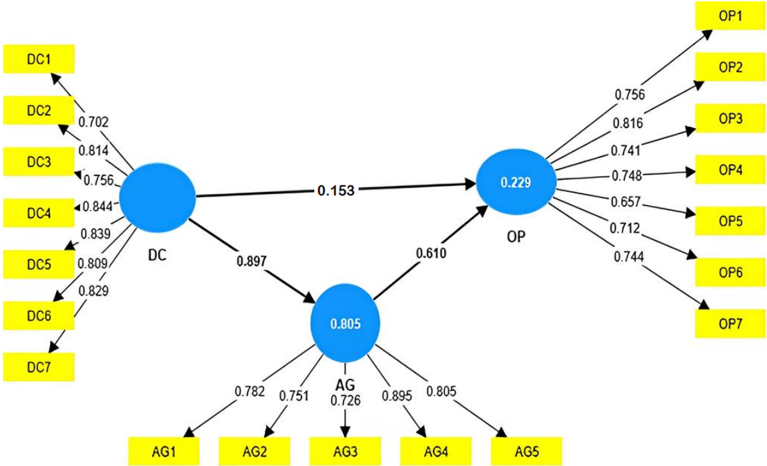
- Digital capabilities positively related to organizational performance (β = 0.153, t = 8.681, p < 0.001) and to organizational agility (β = 0.897, t = 71.214, p < 0.001); organizational agility positively related to performance (β = 0.610, t = 3.691, p < 0.001).
- The hypothesized mediation path DC → AG → OP was not supported: indirect effect β = 0.467, t = 1.173, p = 0.241.
- The model explained R² = 0.229 of variance in organizational performance and R² = 0.805 in organizational agility; f² was 0.891 for DC → AG and 0.342 for AG → OP.
- Reliability/validity: Cronbach’s alpha was 0.906 for digital capabilities, 0.864 for organizational performance, and 0.852 for organizational agility; composite reliability was 0.913, 0.877, and 0.860; AVE was 0.641, 0.548, and 0.630, respectively.
Methods
- Target population was all 4,400 employees at Jordan’s Ministry of Justice; Krejcie and Morgan’s table recommended 354, the study targeted 360, and 292 valid online survey responses were received (81.1% response rate).
- Measures: 7-item digital capabilities scale adapted from Mollah et al. (5-point Poor–Excellent), 7-item organizational performance scale from Bradley et al. (5-point agreement), and 5-item organizational agility scale from Nafei (5-point agreement).
- Analysis used exploratory factor analysis, Cronbach’s alpha and composite reliability, and PLS-SEM in SmartPLS 4 with bootstrapping of 500 subsamples; R² and f² effect sizes were reviewed.
Limitations
- Stated: the cross-sectional single-agency sample limits generalizability; the authors call for expanded inquiry across varied public institutional forms and longitudinal tracking for lag effects.
- Stated: data are not publicly available due to Jordan Ministry of Justice internal data release policies; the research received no external funding.
- Evident: the study relies on self-report survey data from one ministry, and the mediation hypothesis was not supported even though the abstract states that improved agility mediates over half the performance impact; the cross-sectional design cannot establish causal direction.
Model-written summary. Check it against the paper before relying on it.
Integrity signals
Registry
Cites
Statistics
Figures

Verification
Claims the paper makes
12 Valid · 1 Not valid · 30 Not checked · 41 Own results and interpretations
The cited sources support only part of this claim — read each source’s verdict below.
In the paper
“The findings quantify a definitive impact of mature analytics capabilities on realizing process optimization and planning improvements within public sector contexts.”
What the sources say
- Partly supportedcites Awan et al. 2021 matched to “Big data analytics capability and decision-making: The role of data-driven insight on circular economy performance” (2021) sourceExperimental — accuracy not yet measured
The Discussion (p. 25) reports a significant relationship between big-data analytics capability and decision-making quality, with implications for firms’ circular-economy performance. But the Methodology (p. 17) identifies the surveyed organizations as predominantly Czech manufacturing firms, not public-sector organizations. The paper does not establish a definitive impact on public-sector process optimization and planning improvements, or assess analytics maturity as such. (LLM, conf=0.90)
boostedstates a cause- Asserted: passes — The authors put it forward as true.
- Checkable: passes — It can be checked against evidence.
- Load-bearing: passes — The paper’s conclusions depend on it.
- Based: passes — The paper gives a reason why it holds.
- Partly supported
The cited sources support only part of this claim — read each source’s verdict below.
In the paper
“Advanced analytical systems enable public agencies to more rapidly adapt programming based on external shifts (Mergel et al. 2019).”
- Also stated in: § 1. Introduction · plain
“Real-time data processing into actionable insights fosters more flexible and responsive organizational forms across the public sector (Houghton et al. 2008).”
- Also stated in: § 2.3. Organizational Agility · plain
“Enhanced digital capabilities directly enable organizational agility by providing data-driven insights for decision making combined with integrated platforms allowing seamless responses (Houghton et al. 2008).”
What the sources say
- Partly supportedcites Mergel et al. 2019 matched to “Defining digital transformation: Results from expert interviews” (2019) sourceExperimental — accuracy not yet measured
The Summative synthesis says public administrations aim to respond and adapt to environmental changes by adopting new technology. The codebook also includes big data and data-driven approaches among those technologies. Neither passage establishes that advanced analytical systems make agencies adapt their programming more rapidly. (LLM, conf=0.83)
- Not matchedcites Houghton et al. 2008
An author–year citation the paper’s reference list doesn’t settle. We don’t search these by name.
plainstates a cause- Asserted: passes — The authors put it forward as true.
- Checkable: passes — It can be checked against evidence.
- Load-bearing: passes — The paper’s conclusions depend on it.
- Based: passes — The paper gives a reason why it holds.
- Also stated in: § 1. Introduction · plain
The cited sources support only part of this claim — read each source’s verdict below.
In the paper
“Specifically, digital era governance now compels public sector agencies to exhibit greater nimbleness in recalibrating resource allocations, service delivery modes, and policies based on shifts in external environments and constituent expectations (Mergel et al. 2019).”
What the sources say
- Partly supportedcites Mergel et al. 2019 matched to “Defining digital transformation: Results from expert interviews” (2019) sourceExperimental — accuracy not yet measured
The Introduction and §3.5 (pages not available in our copy) say that environmental changes and stakeholder demands drive public-sector digital transformation, including changes to service delivery. They do not say agencies must rapidly recalibrate resource allocations or policies; §3.5 instead notes a conservative, cautionary approach to change. (LLM, conf=0.86)
plainstates a cause- Asserted: passes — The authors put it forward as true.
- Checkable: passes — It can be checked against evidence.
- Load-bearing: passes — The paper’s conclusions depend on it.
- Based: passes — The paper gives a reason why it holds.
- Partly supported
The cited sources support only part of this claim — read each source’s verdict below.
In the paper
“Specifically, agility allows government entities to overcome inertia and actively respond to waves of sociotechnical changes opened up by digitalization in order to serve citizens in more effective, responsive, and innovative ways (Mergel et al. 2019).”
What the sources say
- Partly supportedcites Mergel et al. 2019 matched to “Defining digital transformation: Results from expert interviews” (2019) sourceExperimental — accuracy not yet measured
The Summative synthesis (§3.5; page unavailable) says public administrations aim to adapt to technological change and citizens’ expectations for better online services. It also describes a conservative, cautionary approach and proposes changes in bureaucratic culture and staff mindsets as conditions for lasting change. It does not establish that agility itself allows governments to overcome inertia or deliver more innovative services. (LLM, conf=0.83)
plainstates a cause- Asserted: passes — The authors put it forward as true.
- Checkable: passes — It can be checked against evidence.
- Load-bearing: passes — The paper’s conclusions depend on it.
- Based: passes — The paper gives a reason why it holds.
- Partly supported
The cited sources support only part of this claim — read each source’s verdict below.
In the paper
“Results affirm applicability of dynamic capability and agility-focused theories to state entities pursuing technology-enabled advancement (Mergel et al. 2019).”
What the sources say
- Partly supportedcites Mergel et al. 2019 matched to “Defining digital transformation: Results from expert interviews” (2019) sourceExperimental — accuracy not yet measured
Section 4.1 (page not provided) says the interview findings support and extend theoretical perspectives on technology-enabled transformation of public administrations. But the paper identifies those perspectives as Fountain’s technology-enactment framework and Digital Era Governance, not dynamic-capability or agility-focused theories. The claim’s specific identification of the theories is therefore unsupported. (LLM, conf=0.84)
plain- Asserted: passes — The authors put it forward as true.
- Checkable: passes — It can be checked against evidence.
- Load-bearing: passes — The paper’s conclusions depend on it.
- Based: passes — The paper gives a reason why it holds.
- Rests on an assumption not shown here.
- Partly supported
36 more claims
Create a free account to see all 84 claims and to verify the 10 references still open.
- Probably not a substantial claim. 30
- It may state two separate claims as one. 13
- The quote only partly states this claim. 3
Self-check
Percentages, sums and reported differences re-computed from the paper’s own numbers.
Each contradiction between two passages listed here was confirmed by an independent check.
Rated major: it would touch a result — a value a result rests on, reported and recomputed p-values on opposite sides of the significance level, two passages that conflict with no sign which is right, or a cited work retracted before this paper was published.
In the paper
§ How Do Digital Capabilities Affect Organizational Performance in the Public Sector? The Mediating Role of the Organizational Agility
“Improved agility mediates over half the performance impact attributable to upgraded technical systems, highlighting the vital role of evolving digitally enabled flexibility in realizing returns on analytics and process modernization initiatives.”
§ 4.3. Hypothesis Testing Results
“While the directionality aligns with the hypothesized mediating role, the path did not achieve statistical significance. Therefore, full mediation of the digital capabilities-performance link by agility was not empirically established based on the sample.”
Rated major: it would touch a result — a value a result rests on, reported and recomputed p-values on opposite sides of the significance level, two passages that conflict with no sign which is right, or a cited work retracted before this paper was published.
In the paper
“Analysis of this indirect effect path revealed a beta coefficient of 0.467 (t = 1.173, p = 0.241).”
Reported 0.467 · recomputed 0.54717
Rated minor: it would not touch a result — a value no result rests on, a p-value that stays on the same side of the significance level, or a conflict that is clerical, resolved elsewhere in the paper, or outside its own findings.
In the paper
§ 2.4. Linking Constructs
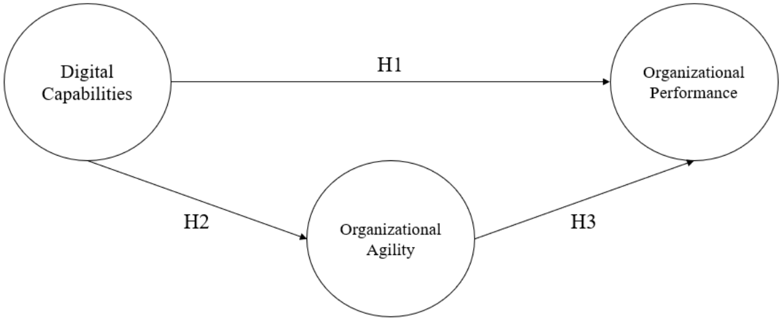
“the proposed conceptual framework of the study, which posits the three hypotheses linking digital capabilities, organizational agility, and performance in the public sector”
§ H3: Organizational agility positively affects organizational performance .
“Therefore, the fourth hypothesis of this study is considered as follows: H4: The positive relationship between digital capabilities and organizational performance is mediated by organizational agility .”
Rated minor: it would not touch a result — a value no result rests on, a p-value that stays on the same side of the significance level, or a conflict that is clerical, resolved elsewhere in the paper, or outside its own findings.
In the paper
§ 4.2. Measurement Model Evaluation
“All items exhibited strong factor loadings, exceeding the 0.70 threshold, and were statistically significant with p-values under 0.05.”
§ 4.2. Measurement Model Evaluation
“| OP5 | 0.657 | 4.34 | 0.662 | 0.046 |”
Citations
Cites
Statistical Power Analysis for the Behavioral Sciences
Cohen, J. (2013) · doi:10.4324/9780203771587 · Cited by 25,373
Determining sample size for research activities
Krejcie, R. V., & Morgan, D. W. (1970) · Educational and Psychological Measurement · doi:10.1177/001316447003000308 · Cited by 18,930 · cited 1×
“Based on Krejcie and Morgan’s (Krejcie and Morgan 1970) sample size table for a population of 4400, the recommended representative sample size is 354.”
MethodTeece, D., Peteraf, M., & Leih, S. (2016) · California Management Review · doi:10.1525/cmr.2016.58.4.13 · Cited by 2,317 · cited 1×
“Parallel debates persist on whether organizational agility constitutes an innate enterprise trait dependent on existing structures and culture versus a dynamic capability inviting development and cultivation (Teece et al. 2016).”
BackgroundDefining digital transformation: Results from expert interviews
Mergel, I., Edelmann, N., & Haug, N. (2019) · Government Information Quarterly · doi:10.1016/j.giq.2019.06.002 · Cited by 1,990 · cited 6×
“…counters this view, finding that public agencies investing more aggressively in digital modernization and cultivating sophisticated technical capabilities directly strengthen internal processes and decision quality to positively impact public sector performance outcomes (Mergel et al. 2019).”
BackgroundInfluentialDigital innovation and transformation: An institutional perspective
Hinings, B., Gegenhuber, T., & Greenwood, R. (2018) · Information and Organization · doi:10.1016/j.infoandorg.2018.02.004 · Cited by 1,537 · cited 4×
“Finally, taking an iterative approach to digitization itself through controlled pilots and experimental partnerships allows features of organizational agility to emerge (Hinings et al. 2018).”
BackgroundInfluentialLu, Y., & Ramamurthy, K. (. (2011) · MIS Quarterly · doi:10.2307/41409967 · Cited by 1,309 · cited 6×
“These empirical works have confirmed the mediated pathway from advanced capabilities enabling greater agility, which then manifests in positive performance outcomes across governmental entities (Lu and Ramamurthy 2011).”
BackgroundInfluentialTallon, P. P., & Pinsonneault, A. (2011) · MIS Quarterly · doi:10.2307/23044052 · Cited by 1,187 · cited 2×
“…indicating that investment in integrated data architectures, automation tools, and analytics platforms linked to measurable performance gains provide evidentiary justification for proposing and prioritizing progressive digitization initiatives even amid budget constraints or risk-averse climates.”
BackgroundUnderstanding digital transformation
Vial, G. (2021) · Managing Digital Transformation · doi:10.4324/9781003008637-4 · Cited by 896
Optimal structure, market dynamism, and the strategy of simple rules
Davis, J. P., Eisenhardt, K. M., & Bingham, C. B. (2009) · Administrative Science Quarterly · doi:10.2189/asqu.2009.54.3.413 · Cited by 804 · cited 1×
“Empirically testing this proposition has yielded mixed results on whether public agencies suffer any systematic agility gap (Davis et al. 2009).”
ResultPavlou, P. A., & El Sawy, O. A. (2010) · Information Systems Research · doi:10.1287/isre.1100.0280 · Cited by 613 · cited 1×
“Conceptualizing returns on analytics adoption and digitization as mediated through flexibility cultivation signifies public officials must anchor technical roadmaps to complementary organizational realignments.”
Background
Research works printed but not linked: 1
- Pollitt, Christopher, and Geert Bouckaert. 2017. Public Management Reform: A Comparative Analysis-into the Age of Austerity . Oxford: Oxford University Press.
Cited by
Setiawan, B., Pamungkas, B., Mekaniwati, A., & Kusuma, P. M. (2025) · The Bottom Line Managing Library Finances · doi:10.1108/bl-08-2024-0120 · Cited by 102
Tao, J., Aamir, M., Shoaib, M., Yasir, N., & Babar, M. A. (2025) · Sustainability · doi:10.3390/su17062462 · Cited by 42
“A sample item from the questionnaire is “The demand for our plant’s products is unstable and unpredictable”.”
Bronzo, M., Barbosa, M. W., de Sousa, P. R., Júnior, N. T., & de Oliveira, M. P. V. (2024) · Administrative Sciences · doi:10.3390/admsci14080181 · Cited by 28
“…can help companies ensure data accuracy (veracity), deal with the speed of data generation and dissemination (velocity), manage the sheer volume of data, handle a wide range of data types and sources (Barbosa et al. 2022), and positively impact organizational performance (Atobishi et al. 2024).”
BackgroundAyoub, H. S., & Sopuru, J. C. (2026) · Sustainability · doi:10.3390/su18031157 · Cited by 60
Alkhawaldah, R. A., Alshalabi, F. S., Alshawabkeh, Z. A. E., et al. (2024) · Human Systems Management · doi:10.1177/01672533241295510 · Cited by 18
“41,59 User competence and training are also vital components in the relationship between e-government and administrative empowerment.”
InfluentialKhattak, S. I., Ali, M. I., Khan, M. A., & Kakar, A. S. (2025) · Journal of Engineering and Technology Management · doi:10.1016/j.jengtecman.2025.101873 · Cited by 31
Fischer, C., & Neumann, O. (2024) · Information Polity · doi:10.3233/ip-249007 · Cited by 22
“So far agile government has mainly been studied and conceptualized from a macro (e.g. Greve et al., 2020) and meso (e.g. Atobishi et al., 2024; Walsh et al., 2002) level perspective, which follows the idea of agile government as a procedural and project management approach (meso) relying on…”
Silva, M., & Rodrigues, R. (2025) · Administrative Sciences · doi:10.3390/admsci15050189 · Cited by 27
“In the context of public administration, such personal development may improve job performance, equip employees for new roles, and increase their adaptability to complex and evolving environments (Atobishi et al., 2024).”
InfluentialSetiawan, N., Rahmiati, A., & Soewarno, N. (2025) · International Journal of Innovation Science · doi:10.1108/ijis-03-2025-0152 · Cited by 10
Vadithe, R. N., Sreenu, N., Kesari, B., Chiranjeevi, V., Mudavath, C. B. N., & Rajput, R. C. (2025) · Engineering Construction & Architectural Management · doi:10.1108/ecam-01-2025-0076 · Cited by 20
David, S., Vîrlănuța, F. O., Bacalum, S., Bărbuță‐Mișu, N., & MIHAI, I. O. (2025) · Canadian Journal of Administrative Sciences / Revue Canadienne des Sciences de l Administration · doi:10.1002/cjas.70007 · Cited by 11
Danso, E. K., & Opoku, R. A. (2025) · Public Administration and Development · doi:10.1002/pad.70000 · Cited by 23
“Some studies have identified a positive relationship between adaptive capacity and organizational performance in the public sector (Nordin et al. 2024; Atobishi et al. 2024).”
Javaid, Z. K., Khan, K., Anjum, A. R., & Batool, S. (2025) · ESIC MARKET Economic and Business Journal · doi:10.7200/esicm.56.419 · Cited by 15
Main Challenges of E-Leadership in Municipal Administrations in the Post-Pandemic Context
Toleikienė, R., Juknevičienė, V., Rybnikova, I., Menzel, V., Āboliņa, I., & Reinholde, I. (2024) · Administrative Sciences · doi:10.3390/admsci14050088 · Cited by 10
Ren, L., Deng, S., Men, L., & Boudouaia, A. (2025) · Humanities and Social Sciences Communications · doi:10.1057/s41599-025-05378-7 · Cited by 22
“DC positively impact organizations by enhancing leadership performance and gaining competitive advantage (Atobishi et al., 2024).”
de Gennaro, D., Barone, L. D., Buonocore, F., & Riemma, F. (2026) · Management Decision · doi:10.1108/md-09-2025-2659 · Cited by 12
Digitalization, finance, and resource efficiency: advancing pakistan’s circular economy
Bukhari, S., Ahmad, I., Mustafa, G., Nabi, A. A., & Zaman, K. (2025) · SN Business & Economics · doi:10.1007/s43546-025-00994-6 · Cited by 6
“Digitalization that exceeds institutional readiness and regulatory oversight may overwhelm organizational capacities with information volume and complexity (Atobishi et al. 2024 ).”
Phan, T. T., Nguyen, P., Corvello, V., & Pham, T. T. P. (2026) · Journal of Innovation & Knowledge · doi:10.1016/j.jik.2025.100931 · Cited by 11
Rewiring industrial futures: The role of AI-enabled digital twins in energy productivity transitions
He, Y. (2026) · International Review of Economics & Finance · doi:10.1016/j.iref.2026.104898 · Cited by 7
Zhou, Y., Zhong, W., Liu, L., et al. (2025) · Sustainability · doi:10.3390/su17020509 · Cited by 4
Ortega, R. V., & Amaya, L. Y. (2025) · Revista Española de la Transparencia · doi:10.51915/ret.407 · Cited by 3
“According to Atobishi et al. (2024), “instruments designed to measure digital capabilities in the public sector should demonstrate high levels of internal consistency, with alpha coefficients ranging from 0.87 to 0.90” (p. 14).”
InfluentialAlmazrouei, M., & Alnahhal, M. J. (2025) · International Journal of Public Leadership · doi:10.1108/ijpl-06-2025-0094 · Cited by 16
Alshahrani, A., & Hakim, T. S. (2026) · Sustainability · doi:10.3390/su18031349 · Cited by 9
Role of dynamic capabilities in public sector performance: a strategic management perspective
Mwanza, P. M., & Dar, J. A. (2025) · International Journal of Research in Business and Social Science (2147-4478) · doi:10.20525/ijrbs.v14i4.4122 · Cited by 15
“Similarly, government institutions leveraging data analytics, artificial intelligence, and digital transformation rely on sensing capabilities to enhance decision-making, regulatory compliance, and citizen engagement (Atobishi et al., 2024).”
InfluentialAbbas, F. (2025) · Journal of Management Development · doi:10.1108/jmd-11-2024-0366 · Cited by 6
Nawaz, A., & Alotaibi, A. (2025) · Construction Innovation · doi:10.1108/ci-04-2025-0167 · Cited by 2
D’Alberto, G., Raj, K., Tiburcio, V. A., & Coraglia, U. M. (2025) · Buildings · doi:10.3390/buildings15193457 · Cited by 7
Ullah, A., Sun, X., Yalan, W., & Ali, A. (2026) · International Journal of Information Management · doi:10.1016/j.ijinfomgt.2026.103059 · Cited by 9
Al-Hashimy, H. N. H., Yao, J., Pitchay, A. A., & Azhar, Z. (2026) · Future Business Journal · doi:10.1186/s43093-026-00827-4 · Cited by 6
Shatila, K. (2026) · Strategy and Leadership · doi:10.1108/sl-01-2026-0020 · Cited by 10
Putri, E., Ramadhan, A., Akbar, A. M., Wibawa, M. A., Febriyanti, R. I., & Prahastiwi, A. L. (2026) · Shirkah Journal of Economics and Business · doi:10.22515/shirkah.v11i1.988 · Cited by 2
Al-Hashimy, H. N. H., Yao, J., & Pitchay, A. A. (2026) · International Journal of Productivity and Performance Management · doi:10.1108/ijppm-05-2025-0408 · Cited by 5
Public-sector digital transformation in the age of generative AI
Jonathan, G. M. (2026) · Discover Artificial Intelligence · doi:10.1007/s44163-026-02077-3 · Cited by 2
“By contrast, the pres-ent corpus distinguishes among infrastructure, interoperability, AI systems, blockchain applications, open-data ecosystems, cybersecurity, data quality, and digital overload [54, 57, 100, 108, 109, 112, 115, 117, 118].”
A Review of Information and Communication Technology (ICT) and Management in Organisations
Moussa, M., Rana, V., & Pereira, B. (2025) · Springer eBooks · doi:10.1007/978-981-96-2516-1_3 · Cited by 2
Broasca, L. S., Cosma, A., & Dimian, G. C. (2025) · Journal of Social and Economic Statistics · doi:10.2478/jses-2025-0001 · Cited by 1
The impact of IT capability on organizational agility and performance: the role of IT spending
Panda, S. (2025) · Information Discovery and Delivery · doi:10.1108/idd-09-2024-0134 · Cited by 2
Dijital Liderliğin Dijital Örgütsel Dönüşüm Sürecine Etkisi: Örgütsel Çevikliğin Aracı Rolü
Köksoy, E., & Oktaysoy, O. (2025) · Uluslararası Ekonomi İşletme ve Politika Dergisi · doi:10.29216/ueip.1693412 · Cited by 13
Hyasat, O. A., & Falahat, M. (2025) · EDPACS · doi:10.1080/07366981.2025.2563961 · Cited by 3
“When these capabilities are effectively integrated into organizational systems and aligned with organizational goals, they help ensure secure operations, minimize disruptions, and enhance overall performance (Atobishi et al., 2024).”
Tambaip, B., Tjilen, A. P., Riyanto, P., & Ohoiwutun, Y. (2025) · Journal of Governance and Regulation · doi:10.22495/jgrv15i1art1 · Cited by 4
“This aligns with OB theory, which underscores the role of organizational capacity in determining the success of public policy (Atobishi et al., 2024).”
Radhi, S. R. (2026) · European journal of management, economics and business. · doi:10.59324/ejmeb.2026.3(2).02 · Cited by 1
Alzahmi, O., El-mohamady, M., & Hanafy, H. A. (2026) · Global Journal of Flexible Systems Management · doi:10.1007/s40171-026-00484-0 · Cited by 6
“…have predominantly conceptualized agility as a mediating mechanism that transmits the effects of leadership or digital capabilities to performance outcomes (Atobishi et al., 2024), the present study provides empirical evidence that strategic agility can also function as a contextual moderator.”
InfluentialTrust, Digital Capability, and Knowledge Sharing: An Opportunity for Technological Innovation
Nanduri, R. K., & Rincón, L. C. (2026) · Administrative Sciences · doi:10.3390/admsci16030139 · Cited by 6
Alsheikh, G. A. A., Alnawafleh, E. A. T., Obeidat, A. M., Yaseen, H., & Al‐Adwan, A. S. (2026) · Human Systems Management · doi:10.1177/01672533261439553 · Cited by 3
Development of the artificial intelligence powered service innovation capability scale
Zhou, J., Zhang, Y., & Wang, H. Y. (2026) · Service Industries Journal · doi:10.1080/02642069.2026.2681048 · Cited by 3
“Compared to previous studies, which primarily focus on technological agility (Hadjielias et al., 2022) or organizational structural agility (Atobishi et al., 2024), our research expands the perspective on agility by emphasizing how the integration of AI technology and service innovation drives…”
von Lucke, J., Fitsilis, F., & Gagnon, S. (2024) · International Journal of Parliamentary Studies · doi:10.1163/26668912-bja10089 · Cited by 1
Hajazi, M. U. A., Razalli, M. R., & Yusoff, Y. M. (2025) · International Journal of Business and Society · doi:10.33736/ijbs.9545.2025
“…more bureaucratic and hierarchical (Abdul Ghani Azmi & Hashim, 2022), public service organizations have more institutional constraints that restrict their flexibility and autonomy and are exposed to more intense scrutiny from politicians, interest groups, and the public (Atobishi et al., 2024).”
Nayef, B. F. A., & Aljubouri, A. H. F. (2025) · KnE Social Sciences · doi:10.18502/kss.v10i19.19644
Aceh, D. A., Lumbanraja, P., Absah, Y., & Dalimunthe, R. F. (2025) · Studies in big data · doi:10.1007/978-3-031-97613-1_22 · Cited by 1
Zikri, M., & Prasojo, E. (2026) · Ilomata International Journal of Social Science · doi:10.61194/ijss.v7i1.1942 · Cited by 4
Hasbullah, & Darwis (2026) · Humanities Journal. · doi:10.31893/humanitj.2026023
“Studies have emphasized bureaucratic efficiency, performance measurement, and the role of digitalization in improving service delivery (Atobishi et al., 2024; Latupeirissa et al., 2024).”
Maqbuli, H. A., & Al-Mahmoudi, F. M. (2026) · Social Sciences & Humanities Open · doi:10.1016/j.ssaho.2026.102573 · Cited by 11
Nazir, S., Mehmood, S., & Junxia, L. (2026) · Risk Management · doi:10.1057/s41283-026-00202-1
“Particularly in internationally interconnected networks, supply-chain risk management necessitates comprehensive strategies that combine knowledge integration with proactive risk and crisis management techniques (Liu and Wang 2025 ; Atobishi et al. 2024).”
Building competent IT freshers: modelling digital era training frameworks
Pandey, S., & Dash, M. K. (2026) · European journal of training and development · doi:10.1108/ejtd-10-2025-0242 · Cited by 1
Portrayal of defense bureaucracy reform at Indonesia for effective public governance service
Harefa, F., Aziz, Y. M. A., Fauzi, T. H., et al. (2026) · Multidisciplinary Science Journal · doi:10.31893/multiscience.2026481
“The infiltration of transnational ideologies and digital radicalism undermines national cohesion, while political intervention and information manipulation threaten governmental stability and public trust(Atobishi et al., 2024).”
Digital Cost of Quality management in Moroccan agri-food firms: adoption insights and benefits
Barakat, O., Elassimi, T., & BOUHSAIN, I. (2025) · IEEE International Conference on Advanced Technologies in Supply Chain Management (ATSCM) · doi:10.1109/atscm67505.2025.11473424
“This lens also explains heterogeneity in outcomes: similar tools yield different results depending on whether firms have developed VRIN-like bundles of capabilities around digital CoQ[26].”
Guangul, M., Debela, T., & Duressa, Z. (2026) · Research Square · doi:10.21203/rs.3.rs-8950068/v1
Kyriakidou-Zacharoudiou, A., Tsappi, E., & Georgiades, M. (2026) · Sustainability · doi:10.3390/su18104762 · Cited by 1
“Empirical evidence indicates that digital infrastructures influence performance indirectly, often through mediating mechanisms such as organizational agility [26].”
Al-Sabri, F., & Manea'a, A. (2026) · International Journal of Electronic Governance · doi:10.1504/ijeg.2026.156077
Caputo, A., taddeucci, L., Mello, P. A., & Vainieri, M. (2026) · Public Policy and Administration · doi:10.1177/09520767261457334
Hossain, M. A., Tat, H. H., Rahman, A. A., & Balo, B. K. (2026) · Discover Sustainability · doi:10.1007/s43621-026-03872-9 · Cited by 1
Shahadat, M. M. H., Jahed, M. A., & Fekete‐Farkas, M. (2026) · Research Journal of Textile and Apparel · doi:10.1108/rjta-04-2025-0081
بررسی تأثیر دولت الکترونیک بر بهره¬وری سازمانی (مطالعهی موردی: پوهنتون هرات)
محمودی, م. ج., ناصری, ا. ا., & امیری, ع. ا. (2026) · Baharestan Scientific Research Quarterly Journal · doi:10.61438/bsrqj.v4i1.319
Alsaber, A., AlReshaid, F. A., Alkandari, A. M., Aljamaan, A., Alaslawi, H. A., Wadani, R. A., & Alothman, B. (2026) · Cogent Business & Management · doi:10.1080/23311975.2026.2702168
BULIGA, E.-L., OLTEANU, A.-R., & LĂŢEA, C.-D. (2026) · Proceedings of the ... International Conference on Business Excellence · doi:10.2478/picbe-2026-0006
Mokhohlouloane, F. T. C., & Ngo-Henha, P. E. (2026) · European Journal of Management Issues · doi:10.15421/192607
Li, S., Ullah, S., & Younas, M. W. (2026) · Applied Spatial Analysis and Policy · doi:10.1007/s12061-026-09957-2
“The expansion of manufacturing, logistics, and export-oriented sectors has increased the demand for digital administrative tools, such as automated permitting systems, electronic customs platforms, and supply chain traceability solutions (Atobishi et al., 2024; Luo et al., 2022).”
La Transformación digital, capacidades organizativas y agilidad en cooperativas del sector solidario
Soto, S. L. C., Salazar-Tabima, J., Cabo, V. G., & Quintero-Sepúlveda, C. (2026) · Prisma social · doi:10.65598/rps.6064 · Cited by 1
Yuniantoro, A., Kumorotomo, W., Djunaedi, A., & Ratminto, R. (2026) · Journal of Governance and Regulation · doi:10.22495/jgrv15i3art8
The impact of digital infrastructure on the common prosperity of Chinese cities
Cao, B., Zhang, K., Liu, Y., & Wang, Y. (2026) · Economic Analysis and Policy · doi:10.1016/j.eap.2026.08.022 · Cited by 1
Karnsomdee, P., & Khornok, C. (2026) · Frontiers in Political Science · doi:10.3389/fpos.2026.1851616
Digital transformation capabilities and firm performance: role of operational strategy alignment
Jung, S., & Oh, S. J. (2026) · Management Decision · doi:10.1108/md-03-2025-0728
Acharjya, B., Das, S., Foropon, C. R. H., & Belal, H. M. (2026) · Benchmarking An International Journal · doi:10.1108/bij-02-2026-0131 · Cited by 1
Organizing Islamic Tarbiyah to Create Superior Character in the Era of Society 5.0 for Students
Reni, W. O. (2026) · JURNAL IQRA · doi:10.25217/ji.v11i2.7735
Beyond AI Adoption: How Knowledge Absorptive Capacity Enables Organizational Innovation in SMEsPreprint
Bac, T. C., & Nhon, H. T. (2026) · SSRN Electronic Journal · doi:10.2139/ssrn.7354065
Veizaga, P. E., Mena, W. V. C., Rios-Rios, R., Aguiar, D. P. R., & Valenzuela, B. F. G. (2026) · ASCE MAGAZINE · doi:10.70577/asce.v5i3.1090
Chen, Z. (2026) · Leadership & Organization Development Journal · doi:10.1108/lodj-11-2025-1003
Kuručev, D. V., & Gutesa, A. (2026) · International Symposium Engineering Management and Competitiveness (EMC) · doi:10.5937/emc26191v
Interoperabilidad tecnológica y capacidad de respuesta estratégica en gobiernos locales
Rodríguez, N. R. Y., & Cesme, A. G. E. (2026) · Visión Académica · doi:10.70577/z28t0x67
Planificación adaptativa y transformación estratégica en gobiernos locales
Álvarez, C. V. P., & Daquilema, J. A. V. (2026) · Saber Estratégico Internacional · doi:10.70577/s.e.v4i3.111
“A su vez, Atobishi et al. (2024), mediante 292 respuestas válidas de funcionarios públicos, sostienen que las instituciones enfrentan crecientes imperativos para transformar digitalmente los servicios ciudadanos, los sistemas de datos y las operaciones internas.”
Mecanismos de seguimiento y evaluación para la efectividad operativa en gobiernos locales
Bravo, A. G. R., & Muentes, N. M. L. (2026) · Ciencia Interdisciplinaria Internacional · doi:10.70577/cieninter.v4i3.124
Gestión por indicadores y eficiencia operativa en gobiernos municipales descentralizados
Gonzalez, J. A. Z., & Pérez, A. V. A. (2026) · Visión Académica · doi:10.70577/wdfnj562
Sustainable Government Performance Through Learning Competence and Organizational Culture
FALAH, T. R. F., Sudirman, I., Juniarti, A. T., et al. (2026) · Academia Open · doi:10.21070/acopen.11.2026.14740
Modeling organizational capacity development through faculty development programs
Salajegheh, M., Mirzazadeh, A., & Gandomkar, R. (2026) · Medical Teacher · doi:10.1080/0142159x.2026.2733151
Alqudah, A. Z. (2026) · International Journal of Computations Information and Manufacturing (IJCIM) · doi:10.54489/ijcim.v6i1.620
“…enablers as a single, undifferentiated construct, collapsing the technological, behavioural and psychological facets of digital transformation into one broad notion of ‘intelligence’ and thereby obscuring which facet actually drives knowledge outcomes (Mikalef et al., 2020; Atobishi et al., 2024).”
InfluentialSinha, K. K., Shirokova, G., & Bystrov, A. (2026) · Technological Forecasting and Social Change · doi:10.1016/j.techfore.2026.124901 · Cited by 1
Kurniyanta, A., Astuti, E. S., Nuzula, N. F., & Fahrudi, A. N. L. I. (2026) · Problems and Perspectives in Management · doi:10.21511/ppm.24(3).2026.49
Bilgin, H., Yorulmaz, Y. İ., Korkmaz, Z. S., & Vaněček, D. (2026) · SAGE Open · doi:10.1177/21582440261491188
Alshamlan, H. (2026) · Research Square · doi:10.21203/rs.3.rs-10974589/v1
Metadata
- Authors
- Atobishi, T., Moh’d Abu Bakir, S., & Nosratabadi, S.
- Affiliations
- King Faisal University (SA)
- Department of Business Administration, Amman Arab University, Amman 11953, Jordan
- Magyar Agrár- és Élettudományi Egyetem (HU)
- Corresponding author
- Atobishi, Thabit
- Venue
- Administrative Sciences
- Publisher
- MDPI AG
- Published
- 2024-02-19
- Volume
- 14
- Issue
- 2
- Pages
- 37
- ISSN
- 2076-3387 (ISSN-L)
- OpenAlex
- W4391948128
- Cited by
- 94
- References
- 63
- Citations by year
- 2026: 61 · 2025: 28 · 2024: 5
- FWCI
- 149.59
- Type
- journal article
- Language
- en
- Open access
- gold
- doi.org
- Licence
- Locations
- Administrative Sciences (publishedVersion, cc-by)
- Econstor (Econstor) (submittedVersion, cc-by)
- RePEc: Research Papers in Economics (submittedVersion)
- DOAJ (DOAJ: Directory of Open Access Journals) (submittedVersion, cc-by-sa)
- Topics
- Social Sciences › Political Science and International Relations › E-Government and Public Services
- Social Sciences › Business, Management and Accounting › Management Information Systems › Information Technology Governance and Strategy
- Social Sciences › Political Science and International Relations › Public Administration and Political Analysis
- Keywords
- digital capabilities, organizational performance, public sector, organizational agility, mediating effect, digital transformation, digital governance, data-driven decision making, flexible automation, constituent communication, Ministry of Justice, Jordan, change management, public officials
About these checks
Registry, retraction, Cites and statistics results are computed, not judged, with one exception: a printed reference that no index lists is read once by a model before it counts as a citation error. Claims are extracted by a model and kept only when their quote appears verbatim in the text; each cited source is then checked, with a model’s help, for whether it says what the claim relies on. Those verdicts can be wrong — read the claim’s quote and the cited source before relying on one.
The claim verdicts this report counts are experimental: their accuracy is not yet measured.
A language model drew the claims from the paper on 2026-10-10, under version 3 of the claim definition (model deepseek-v4.1-flash, prompt extract-v3).
A second model labelled each claim on 2026-10-10 (model jev-1.13-20260917, definition revision gold-guideline-v0.2).
Cited sources are checked with a language model’s help (gpt-6-sol).
Statistics and arithmetic are recomputed, not judged.
Confidence bands are shown only for fields calibrated on our annotated test set. None is calibrated yet, so no band is shown.
What counts as a claim ›How we measure confidence ›How we check this ›
Are you an author, or do you see a problem with this page? Request a review
Data sources
Bibliographic data: Semantic Scholar, OpenAlex, Crossref.
Contains information from the Semantic Scholar Academic Graph Datasets, made available under the ODC Attribution License (ODC-BY 1.0).
Semantic Scholar’s data is described in: Kinney, R., et al. (2023). The Semantic Scholar Open Data Platform. arXiv:2301.10140.
