

Aircraft Assembly Snags: Human Errors or Lack of Production Design?
Open accessThe DOI matches its Crossref record; 23 of the 24 references it cites were found in a registry or an index.
Abstract
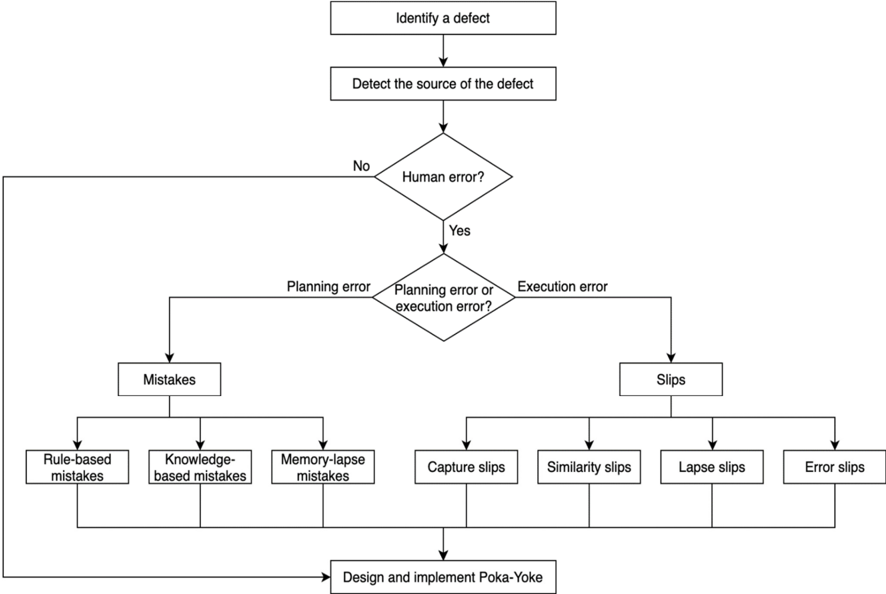
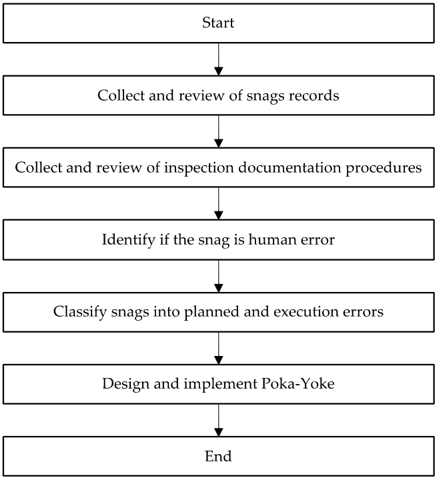
To err is an intrinsic human trait, which means that human errors, at some point, are inevitable. Business improvement tools and practices neglect to deal with the root causes of human error; hence, they ignore certain design considerations that could possibly prevent or minimise such errors from occurring. Recognising this gap, this paper seeks to conceptualise a model that incorporates cognitive science literature based on a mistake-proofing concept, thereby offering a deeper, more profound level of human error analysis. An exploratory case study involving an aerospace assembly line was conducted to gain insights into the model developed. The findings of the case study revealed four different causes of human errors, as follows: (i) description similarity error, (ii) capture errors, (iii) memory lapse errors, and (iv) interruptions. Based on this analysis, error-proofing measures have been proposed accordingly. This paper lays the foundation for future work on the psychology behind human errors in the aerospace industry and highlights the importance of understanding human errors to avoid quality issues and rework in production settings, where labour input is of paramount importance.
Overview
The claims and statistics of this paper haven’t been checked yet.
Free: it reads the open-access text and checks the first 5 claims that cite a source we can check. Create a free account to check every claim.
Integrity signals
Registry
Cites
Statistics
Figures
Verification
Claims the paper makes
The claims and statistics of this paper haven’t been checked yet.
Free: it reads the open-access text and checks the first 5 claims that cite a source we can check. Create a free account to check every claim.
Claims other papers make about this one
Each is checked against this paper’s own text: does it say what the citing paper says it does?
The cited source doesn’t support the claim as written.
In the citing paper
“Human error is the most common cause of failures in automated production lines.”
From Poka Yoke in Smart Production Systems with Pick-to-Light Implementation to Increase Efficiency (2023) · cites this paper as [13]
Checked by a reasoning model — may be wrong.
Experimental — accuracy not yet measured
Self-check
Percentages, sums and reported differences re-computed from the paper’s own numbers.
The self-check needs the paper’s full text.
Citations
Cites
Reason, J. (1990) · doi:10.1017/cbo9781139062367 · Cited by 5,108
Categorization of action slips
Norman, D. A. (1981) · Psychological Review · doi:10.1037/0033-295x.88.1.1 · Cited by 1,736
Design rules based on analyses of human error
Norman, D. A. (1983) · Communications of the ACM · doi:10.1145/2163.358092 · Cited by 460
Pacaux-Lemoine, M.-P., Trentesaux, D., Zambrano Rey, G., & Millot, P. (2017) · Computers & Industrial Engineering · doi:10.1016/j.cie.2017.05.014 · Cited by 315 · cited 1×
“Nevertheless, the level of adaption required to facilitate the different changes in each industry cannot be achieved without some necessary level of human intervention on the shop floor [3].”
BackgroundDeming, W. E. (2018) · The MIT Press eBooks · doi:10.7551/mitpress/11457.001.0001 · Cited by 280
Developing a systemic lessons learned knowledge model for organisational learning through projects
Duffield, S., & Whitty, S. J. (2015) · International Journal of Project Management · doi:10.1016/j.ijproman.2014.07.004 · Cited by 178
Poka-Yoke: Improving Product Quality by Preventing Defects
Shimbun, N. K. (1989) · Productivity Press eBooks · doi:10.1201/b15419 · Cited by 152
Torres, Y., Nadeau, S., & Landau, K. (2021) · Applied Sciences · doi:10.3390/app11020749 · Cited by 108
Using Convolutional Neural Networks to Automate Aircraft Maintenance Visual Inspection
Dogru, A., Bouarfa, S., Arizar, R., & Aydogan, R. (2020) · doi:10.20944/preprints202011.0527.v1 · Cited by 86
THE HUMAN SIDE OF MISTAKE‐PROOFING
Stewart, D. M., & Grout, J. R. (2001) · Production and Operations Management · doi:10.1111/j.1937-5956.2001.tb00086.x · Cited by 73
Research works printed but not linked: 8
- 13. Kolarik, W.J. Creating Quality: Concepts, Systems, Strategies, and Tools; McGraw-Hill Inc.: New York, NY, USA, 1995.
- 14. Juran, J.M.; Gryna, F.M. Quality Control Handbook; McGraw Hill: New York, NY, USA, 1974.
- 15. Nof, S.Y.; Wilhelm, W.E.; Warnecke, H. Industrial Assembly; Springer Science & Business Media: Hong Kong, China, 2012.
- 17. Monden, Y. Toyota Production System. An Integrated Apprpach to Just-in-Time; Springer: Berlin/Heidelberg, Germany, 1983.
- 18. Shingo, S. Zero Quality Control: Source Inspection and the Poka-Yoke System; CRC Press: Tokyo, Japan, 1986.
- 26. Norman, D. The Design of Everyday Things: Revised and Expanded Edition; Basic Books: New York, NY, USA, 2013.
- 32. Reason, J.T.; Mycielska, K. Absent-Minded?: The Psychology of Mental Lapses and Everyday Errors; Prentice Hall: Hoboken, NJ, USA, 1982.
- 34. Reason, J.T. Actions not as planned: The price of automatization. In Aspects of Consciousness; Underwood, G., Stevens, R., Eds.; Academic Press: Cambridge, MA, USA, 1979; pp. 1-67.
Cited by
Human-centric zero-defect manufacturing: State-of-the-art review, perspectives, and challenges
Wan, P. K., & Leirmo, T. L. (2022) · Computers in Industry · doi:10.1016/j.compind.2022.103792 · Cited by 121
Alqahtani, F. M., & Noman, M. A. (2024) · Systems · doi:10.3390/systems12110479 · Cited by 30
Poka Yoke in Smart Production Systems with Pick-to-Light Implementation to Increase Efficiency
Trojanowska, J., Husár, J., Hrehova, S., & Knapčíková, L. (2023) · Applied Sciences · doi:10.3390/app132111715 · Cited by 23
Applying AcciMap and STAMP to the analysis of human error in complex manual assembly
Torres, Y., Nadeau, S., & Landau, K. (2022) · Human Factors and Ergonomics in Manufacturing & Service Industries · doi:10.1002/hfm.20964 · Cited by 25
“This is the case in the aerospace industry which heavily relies on human work (Alogla & Alruqi, 2021; Beuß et al., 2019; Judt et al., 2020).”
BackgroundRamesh, K., Deshmukh, S. S., Ray, T., & Parimi, C. (2025) · Journal of Manufacturing Processes · doi:10.1016/j.jmapro.2025.03.112 · Cited by 14
Advancing human-centric zero defect manufacturing: a theoretical framework and practical insights
Fani, V., Bucci, I., Bandinelli, R., & Rossi, M. (2025) · International Journal of Production Research · doi:10.1080/00207543.2025.2579770 · Cited by 11
“HZDM goes beyond mere error reduction, aiming to harness human creativity and problem-solving abilities to improve processes and outcomes (Alogla and Alruqi 2021; Getachew, Beshah, and Mulugeta 2024).”
Alogla, A. A., Alzahrani, A., & Alghamdi, A. M. (2023) · Aerospace · doi:10.3390/aerospace10040381 · Cited by 10
Self-citationIndustrial Applications of AI in Aircraft Manufacturing: A PRISMA Systematic Literature Review
Bougault, P., Haddad, R., & Ma, L. (2026) · Production Engineering Archives · doi:10.30657/pea.2026.32.5 · Cited by 6
“Given the inevitability of manual operations and human errors, workplaces should be designed to accommodate workers' limitations, including both their cognitive and physical constraints (Alogla et al., 2021; Kadir et al., 2019).”
Zhang, Y., Lou, S., Zhang, Y., Pan, D., Fan, Y., Ye, J., Ren, L., Hu, B., Tang, X., Chen, L., et al. (2024) · Journal of Engineering Design · doi:10.1080/09544828.2024.2398396 · Cited by 3
“These errors encompass unintended touches and potential mistakes arising from unfamiliarity, inattention, reflex actions, and habitual behaviors (Alogla and Alruqi 2021; Dhillon 1989; Lee, Han, and Yoo 2019).”
Aircraft Manufacturing, Safety and Control
Kuşhan, M. C., & Diltemiz, S. F. (2025) · IntechOpen eBooks · doi:10.5772/intechopen.1006780 · Cited by 1
Metal Additive Manufacturing for Industry 4.0 Aerospace: Review and Research AgendaPreprint
Alogla, A. A. (2023) · Preprints.org · doi:10.20944/preprints202308.1052.v1 · Cited by 1
Self-citationSimulation and Experience Enhancement of Inspection Points: the Case of Makkah in Ramadhan
Alogla, A. A., & Alhasani, A. S. (2023) · IEEE European Technology and Engineering Management Summit (E-TEMS) · doi:10.1109/e-tems57541.2023.10424036
“…we build the alternative model based on the concept of Poka Yoke which is a Japanese term that refers to a technique of mistake-proofing or error prevention by designing and implementing mechanisms or tools that detect and prevent errors from occurring or being made in the first place [32].”
MethodSelf-citationDesigning Aircraft in a Way that Reduces Human Error
Demirci, S. (2025) · IntechOpen eBooks · doi:10.5772/intechopen.1008506
Information Support for Human Error Prevention During Augmented Reality Assisted Manual Assembly
Wang, J., Shi, T., & Xiong, H. (2025) · Springer series in design and innovation · doi:10.1007/978-981-95-0211-0_38
Li, Q., Jiang, Y., Cheng, J., Chen, W., Zhao, P., Qiao, X., Cheng, C., & Yuan, Y. (2025) · IEEE/ASME International Conference on Advanced Intelligent Mechatronics · doi:10.1109/aim64088.2025.11175744
Mapping and reduction of extra manufacturing orders.
Danielsson, A., & Ekstrand, K. (2023) · Diva portal (Dalarna University Library)
A comprehensive review of robotic assembly of aerospace components
Zhao, L., Li, X., Zhao, H., Zhang, J., & Ding, H. (2026) · Journal of Manufacturing Systems · doi:10.1016/j.jmsy.2026.06.011 · Cited by 1
Metadata
- Authors
- Alogla, A. A., & Alruqi, M.
- Affiliations
- Umm al-Qura University (SA)
- Shaqra University (SA)
- Corresponding author
- Alogla, Ageel Abdulaziz
- Venue
- Aerospace
- Publisher
- MDPI AG
- Published
- 2021-12-10
- Volume
- 8
- Issue
- 12
- Pages
- 391
- ISSN
- 2226-4310 (ISSN-L)
- OpenAlex
- W4200578848
- Cited by
- 16
- References
- 24
- Citations by year
- 2026: 2 · 2025: 5 · 2024: 2 · 2023: 5 · 2022: 2
- FWCI
- 0.68
- Type
- journal article
- Language
- en
- Open access
- gold
- doi.org
- Licence
- Locations
- Aerospace (publishedVersion, cc-by)
- DOAJ (DOAJ: Directory of Open Access Journals) (submittedVersion, cc-by-sa)
- Topics
- Social Sciences › Human Factors and Ergonomics › Ergonomics and Human Factors
- Social Sciences › Human Factors and Ergonomics › Human-Automation Interaction and Safety
- Physical Sciences › Engineering › Safety, Risk, Reliability and Quality › Risk and Safety Analysis
- Keywords
- human error, aircraft assembly, aerospace manufacturing, poka-yoke, cognitive science, interruptions, production design, root cause analysis, rework
About these checks
Registry, retraction, Cites and statistics results are computed, not judged, with one exception: a printed reference that no index lists is read once by a model before it counts as a citation error. Claims are extracted by a model and kept only when their quote appears verbatim in the text; each cited source is then checked, with a model’s help, for whether it says what the claim relies on. Those verdicts can be wrong — read the claim’s quote and the cited source before relying on one.
Statistics and arithmetic are recomputed, not judged.
Confidence bands are shown only for fields calibrated on our annotated test set. None is calibrated yet, so no band is shown.
What counts as a claim ›How we measure confidence ›How we check this ›
Are you an author, or do you see a problem with this page? Request a review
Data sources
Bibliographic data: Semantic Scholar, OpenAlex, Crossref.
Contains information from the Semantic Scholar Academic Graph Datasets, made available under the ODC Attribution License (ODC-BY 1.0).
Semantic Scholar’s data is described in: Kinney, R., et al. (2023). The Semantic Scholar Open Data Platform. arXiv:2301.10140.
