

Milpa, a Long-Standing Polyculture for Sustainable Agriculture
Open accessThe DOI matches its Crossref record; 260 of the 265 references it cites were found in a registry or an index, and 1 are not checked yet; none of the 358 sources its claims cite is checked for support yet.
Abstract
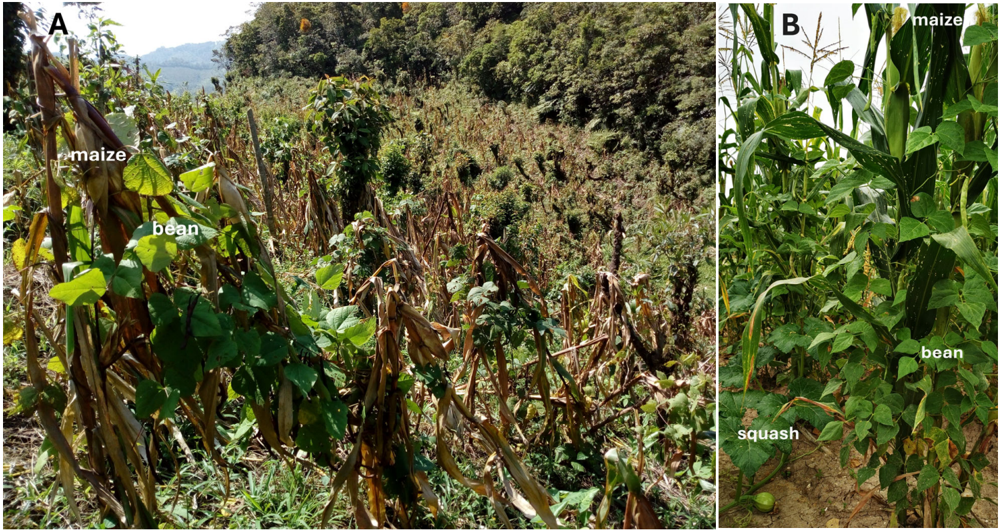
Polyculture, or intercropping, is the practice of growing two or more crops simultaneously in time and space. The milpa is a systematic polyculture involving the simultaneous cultivation of maize (Zea mays), beans (Phaseolus spp.), squash (Cucurbita spp.), and other crops. Milpa polyculture initially emerged in the Mesoamerican region (Mexico and Central America) through the concurrent processes of managing, utilizing, and domesticating its constituent crops. It subsequently spread throughout the Americas via the diffusion of maize and the convergence of its domestication with that of its companion crops and other domesticated plants in the continent. Mesoamerican farmers made an outstanding contribution by domesticating and bringing together crops with contrasting morphological and physiological traits that are ecologically, agronomically, and nutritionally complementary. Despite its importance, few quantitative evaluations of this polyculture exist. However, these evaluations indicate that its productivity and land efficiency use (Land equivalent ratio = 1.34) are comparable to those of other intercrops studied on a global scale. We emphasize the importance of transdisciplinary efforts to study this polyculture and highlight its potential applications related to ecological interactions, plant microbiomes and breeding in order to reach sustainable production goals.
Checked 2026-11-24 · 1 reference not checked yet
Overview
CoChat Summary
TL;DR
This review synthesizes the origin, diffusion, agrobiodiversity, productivity, and multifunctionality of the Mesoamerican milpa polyculture (maize–bean–squash and associated crops), reporting an average Land Equivalent Ratio (LER) of 1.34. It argues that milpa is a long-standing, ecologically complementary system with potential for sustainable agriculture, while noting limited quantitative research, labor/mechanization constraints, and lack of current census data on its extent.
Key findings
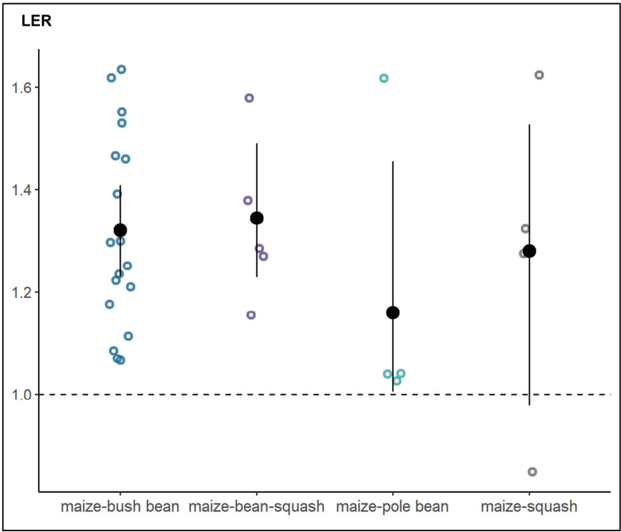
- Milpa is a systematic polyculture of maize (*Zea mays*), beans (*Phaseolus* spp.), squash (*Cucurbita* spp.), and other crops, originating in Mesoamerica and spreading through the Americas. Experimental evaluations report an average LER of 1.27; milpa polyculture has the highest LER at 1.34, compared with maize–bush bean (1.32), maize–squash (1.28), and maize–pole bean (1.16), and is comparable to global intercrop values (global LER 1.2–1.3). The 1.34 value indicates potential to conserve up to 25% of land compared with monocrops or binary intercrops.
- Milpa agrobiodiversity includes over 260 maize races (90% of global maize diversity), 59–65 maize landraces in Mexico, and useful plant richness ranging from 109 species in temperate regions to 122 in dryland regions and up to 149 species in Téenek milpa agroecosystems; 250 quelite species are registered in Mexico, 127 of them associated with milpa agroecosystems.
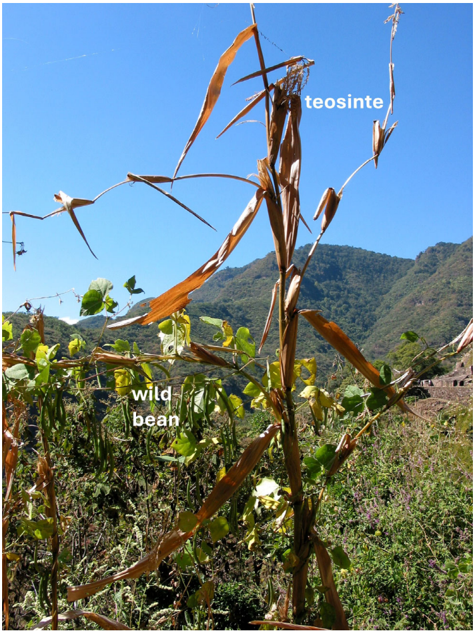
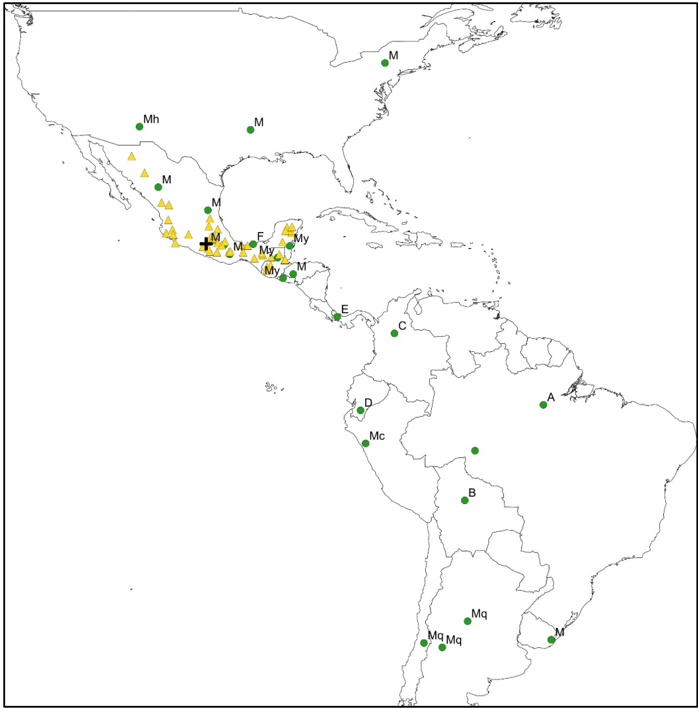
- Archaeobotanical and domestication evidence places maize domestication at approximately 9000 years ago from teosinte in the Middle Balsas River Basin, *Cucurbita pepo* remains at 10,000 years ago in central Mexico, and the earliest maize pollen at 8700 calendar years BP at Xihuatoxtla. Maize and squash were grown at lake edges between 10,000 and 5000 BP; the maize–bean–squash association is preserved at Joya de Cerén, El Salvador, ca. 592–660 CE, and by 1400 CE had been adopted in North America.
- Nutritionally, beans and squash have two to three times the protein content of maize; 37 species associated with Lacandon milpas in Chiapas could nearly meet the daily dietary needs of a family of five, except for saturated fat, cholesterol, sodium, calcium, and iodine. Labor reports range from 27 to 401 workdays per crop cycle per hectare, though the original source indicates the more demanding treatment does not exceed 118 workdays per hectare.
Methods
- Review and database searches: Web of Science “intercropping” yielded 10,329 records, only 18 of which included “intercropping AND milpa” (2 August 2023); “milpa NOT alta” yielded 236 records, narrowed to 63, of which 52 reported definitions and geographic information. Three recurrent meanings were found: milpa as site/agro-ecosystem (17 mentions), cultivation system (34 mentions), and polyculture (45 mentions). Additional archaeobotanical records, Google Scholar, books, book chapters, dissertations, journal articles, and Mexican agricultural census data were consulted.
- LER productivity comparison: on 1 March 2024, Web of Science searches for maize–*Phaseolus*–intercropping–LER, maize–*Cucurbita*–intercropping, and maize–squash–beans–intercropping yielded 39, 15, and 7 results, respectively. Only three papers reported LER values specifically for the traditional maize–bean–squash triad, plus three additional works; total analyzed reports were 18 maize–bush bean, 4 maize–pole bean, 4 maize–squash, and 5 milpa polyculture. Five maize–bean papers with coefficients of variation were used as an indicator of stability, and average LER values were taken or calculated.
- Information was organized by first presenting the main meanings of milpa, then focusing on milpa as polyculture from a historical perspective, covering origin and diffusion, current state, structural/ecological/agronomic traits, multifunctionality, limitations, and future prospects including microbiome and breeding.
Limitations
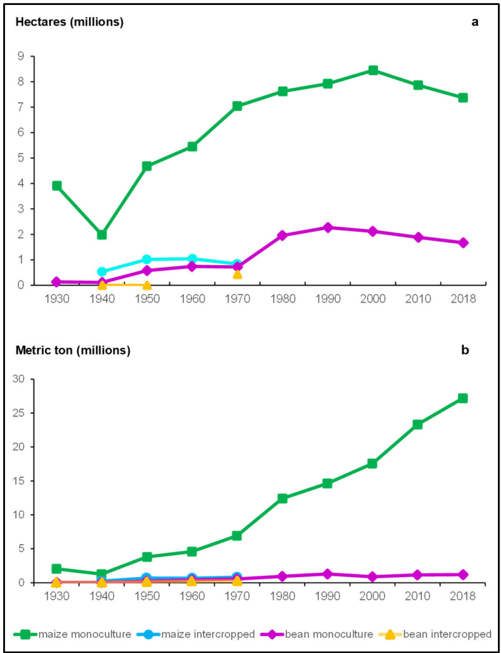
- The paper states that few quantitative evaluations of milpa polyculture exist; research is limited, especially regarding different methodologies, arrangements, densities, and LER values reported. National agricultural censuses from the past five decades lack data quantifying milpa’s geolocation, extent, and persistence, and the stability of milpa polyculture has not been quantitatively determined.
- The paper identifies adoption constraints including higher labor requirements, low mechanization, and lack of basic and applied knowledge. Mechanization challenges are noted for planting and harvesting, the latter due to crops’ different maturation periods.
- Evident from the text: the LER synthesis rests on a small, heterogeneous set of studies, and some included LER values are extreme or confounded—e.g., Amador and Gliessman reported 0.56–2.03; Molina-Anzures et al. found LER values greater than 3.0 but did not separate polyculture yield from fruit tree yield; Ebel et al. reported 1.6; Zhang et al. reported 1.17. The review itself notes methodological differences among these studies.
Model-written summary. Check it against the paper before relying on it.
Integrity signals
Registry
Cites
Statistics
Figures
Verification
Claims the paper makes
0 Valid · 6 Not valid · 175 Not checked · 44 Own results and interpretations
A result the paper reports from its own data — it cites no other source for it, so there is none to check. The quote shows it is in the paper.
In the paper
“However, these evaluations indicate that its productivity and land efficiency use (Land equivalent ratio = 1.34) are comparable to those of other intercrops studied on a global scale.”
§ Review Milpa, a Long-Standing Polyculture for Sustainable Agriculture > Abstract
hedged- Asserted: passes — The authors put it forward as true.
- Checkable: passes — It can be checked against evidence.
- Load-bearing: passes — The paper’s conclusions depend on it.
- Based: passes — The paper gives a reason why it holds.
- Rests on an assumption not shown here.
A result the paper reports from its own data — it cites no other source for it, so there is none to check. The quote shows it is in the paper.
In the paper
“Despite its importance, few quantitative evaluations of this polyculture exist.”
§ Review Milpa, a Long-Standing Polyculture for Sustainable Agriculture > Abstract
plain- Asserted: passes — The authors put it forward as true.
- Checkable: passes — It can be checked against evidence.
- Load-bearing: passes — The paper’s conclusions depend on it.
- Based: passes — The paper gives a reason why it holds.
- Rests on an assumption not shown here.
A result the paper reports from its own data — it cites no other source for it, so there is none to check. The quote shows it is in the paper.
In the paper
“However, research on this system is limited, especially in topics that are needed in order to face socioeconomic and technological issues, including labor, mechanization, and the scientific and technical basis for its improvement as assemblage.”
§ Review Milpa, a Long-Standing Polyculture for Sustainable Agriculture > 1. Introduction
plain- Asserted: passes — The authors put it forward as true.
- Checkable: passes — It can be checked against evidence.
- Load-bearing: passes — The paper’s conclusions depend on it.
- Based: passes — The paper gives a reason why it holds.
- Rests on an assumption not shown here.
None of the sources cited for this claim have been checked yet.
In the paper
“Only three papers [96,106,107] reported LER values specifically on the traditional maize-bean-squash triad.”
§ Review Milpa, a Long-Standing Polyculture for Sustainable Agriculture > 2. Methodology
What the sources say
- Not checked yetcites [96] Molina-Anzures, M.F.; Chávez-Servia, J.L.; Gil-Muñoz, A.; López, P.A.; Hernández-Romero, E.; Ortiz-Torres, E. Productive efficiencies in corn, bean and squash (Cucurbita pepo L.) associations, intercropped with rows of fruit trees. Phyton 2016, 85, 36-50. [CrossRef] source
- Not checked yetcites [106] Zhang, 2014, Root Foraging Elicits Niche Complementarity-Dependent Yield Advantage in the Ancient ‘Three Sisters’ (Maize/Bean/Squash) Polyculture, Ann. Bot. source
- Not checked yetcites [107] Kapayou, 2023, Reuniting the Three Sisters: Collaborative Science with Native Growers to Improve Soil and Community Health, Agric. Hum. Values source
plain- Asserted: passes — The authors put it forward as true.
- Checkable: passes — It can be checked against evidence.
- Load-bearing: passes — The paper’s conclusions depend on it.
- Based: passes — The paper gives a reason why it holds.
A result the paper states — it cites no source for it, so there is none to check. The quote shows it is in the paper.
In the paper
“However, it is important to note the lack of research on milpa polyculture, especially regarding the different methodologies, arrangements, densities, and LER values reported in these studies.”
§ Review Milpa, a Long-Standing Polyculture for Sustainable Agriculture > 6.4. Productivity and Stability
plain- Asserted: passes — The authors put it forward as true.
- Checkable: passes — It can be checked against evidence.
- Load-bearing: unclear — It is unclear whether the paper’s conclusions depend on it.
- Based: passes — The paper gives a reason why it holds.
82 more claims
Create a free account to see all 225 claims and to verify the 352 references still open.
- It may state two separate claims as one. 90
- Probably not a substantial claim. 67
- The quote only partly states this claim. 1
Self-check
Percentages, sums and reported differences re-computed from the paper’s own numbers.
Each contradiction between two passages listed here was confirmed by an independent check.
Rated minor: it would not touch a result — a value no result rests on, a p-value that stays on the same side of the significance level, or a conflict that is clerical, resolved elsewhere in the paper, or outside its own findings.
In the paper
§ Review Milpa, a Long-Standing Polyculture for Sustainable Agriculture > 9. Conclusions
“The average land equivalent ratio for milpa (LER) is 1.34, indicating that this polyculture has the potential to conserve up to 25% of land when compared to monocultures or binary intercrops.”
§ Review Milpa, a Long-Standing Polyculture for Sustainable Agriculture > 6.4. Productivity and Stability
“In these evaluations, the milpa polyculture (maize-bean-squash) exhibited the highest LER value (1.34), compared to its crop component intercrops (1.32 for maizebush bean, 1.28 for maize-squash and 1.16 for maize and pole bean combinations; Figure 8).”
Citations
Cites
Food Security: The Challenge of Feeding 9 Billion People
Godfray, H. C. J., Beddington, J. R., Crute, I. R., Haddad, L., Lawrence, D., Muir, J. F., Pretty, J., Robinson, S., Thomas, S. M., & Toulmin, C. (2010) · Science · doi:10.1126/science.1185383 · Cited by 11,943
Biodiversity and ecosystem functioning: Current knowledge and future challenges
Loreau, M., Naeem, S., Inchausti, P., Bengtsson, J., Grime, J. P., Hector, A., Hooper, D. U., Huston, M. A., Raffaelli, D., Schmid, B., et al. (2001) · Science · doi:10.1126/science.1064088 · Cited by 4,649
Plant–microbiome interactions: from community assembly to plant health
Trivedi, P., Leach, J. E., Tringe, S. G., Sa, T., & Singh, B. K. (2020) · Nature Reviews Microbiology · doi:10.1038/s41579-020-0412-1 · Cited by 3,904
Green Revolution: Impacts, limits, and the path ahead
Pingali, P. L. (2012) · Proceedings of the National Academy of Sciences · doi:10.1073/pnas.0912953109 · Cited by 2,442
Biodiversity and ecosystem stability in a decade-long grassland experiment
Tilman, D., Reich, P. B., & Knops, J. M. H. (2006) · Nature · doi:10.1038/nature04742 · Cited by 2,311
Intercropping Its Importance And Research Needs Part 1. Competition And Yield Advantages Vol-32
Willey, R. W. (1979) · MPKV ; Maharastra eBooks · Cited by 1,934
Beyond Global Warming: Ecology and Global Change
Vitousek, P. M. (1994) · Ecology · doi:10.2307/1941591 · Cited by 1,839
Vandermeer, J. H. (1989) · Cambridge University Press eBooks · doi:10.1017/cbo9780511623523 · Cited by 1,697
Diversity of Rhizobium-Phaseolus vulgaris symbiosis: overview and perspectives
Martínez-Romero, E. (2003) · Plant and Soil · doi:10.1023/a:1024199013926 · Cited by 1,539
Cardinale, B. J., Wright, J. P., Cadotte, M. W., Carroll, I. T., Hector, A., Srivastava, D. S., Loreau, M., & Weis, J. J. (2007) · Proceedings of the National Academy of Sciences · doi:10.1073/pnas.0709069104 · Cited by 1,537
Research works printed but not linked: 26
- Food and Agriculture Organization of the United Nations (Ed.) The Future of Food and Agriculture: Trends and Challenges; Food and Agriculture Organization of the United Nations: Rome, Italy, 2017.
- Willey, R.W. Intercropping-Its Importance and Research Need. Part 1. Competition and Yield Advantage. Field Crop Abstr. 1979, 32, 1-10.
- Lynam, J.K.; Sanders, J.H.; Mason, S.C. Economic and Risk in Multiple Cropping. In Multiple Cropping Systems; Macmillan: New York, NY, USA, 1986; pp. 250-266.
- Vandermeer, J. Intercropping. In Agroecology; McGraw-Hill: New York, NY, USA, 1990; pp. 481-516.
- Roncal-García, S.; Soto-Pinto, L.; Castellanos-Albores, J. Sistemas agroforestales y almacenamiento de carbono en comunidades indígenas de Chiapas, México. Interciencia 2008, 33, 200-206.
- Carrera, C. Acercamiento Gramatical a La Lengua Mazateca de Mazatlán Villa de Flores, Oaxaca; INALI: Mexico City, Mexico, 2011. 125. Méndez, R.M. La Milpa en el Sur de México. Ecofronteras 2011, 43, 22-26. 126. Casas, A.; Viveros, J.L.; Caballero, J. Etnobotánica Mixteca: Sociedad, Cultura y Recursos Naturales En La Montaña de Guerrero; INI-CONACULTA: Mexico City, Mexico, 1994. 127. Krumholz, J.A.; Dolson, M.K.; Hernández, M. Diccionario Popoloca de San Juan Atzingo, Puebla; Instituto Lingüístico de Verano: Mexico City, Mexico, 1995. 128.
- Pastor, S.; López, L. Consideraciones Sobre La Agricultura Prehispánica En El Sector Central de Las Sierras de Córdoba (Argentina). In Arqueología de La Agricultura, Casos de Estudios En La Región Andina Argentina; Ediciones Magna: Tucumán, Argentina, 2010; pp. 208-233. 140. Poma de Ayala, F.G. Nueva Coronica y Buen Gobierno; Université de Paris: Paris, France, 1936. 141.
- Casas, 2016, Origen de La Domesticación y La Agricultura: Cómo y Por Qué, Domesticación En El Continente Americano, Volume 1, 189
- Vavilov, N.I. (1992). Origin and Geography of Cultivated Plants, Cambridge University Press.
- 1967, Origen de Phaseolus vulgaris L. (Frijol Común), Agrociencia, 1, 99
- Flannery, K.V. (1986). Guilá Naquitz, Archaic Foraging and Early Agriculture in Oaxaca, Mexico, Academic Press.
- Jardel Peláez, E.J.; Graf Montero, S.H.; Santana, C.E.; Ávila Palafox, R. Biodiversité et viabilité de l'agriculture paysanne dans la Réserve de Biosphère Sierra de Manantlán, Mexique. Rev. D'ethnoécologie 2013, 3, 1426. [CrossRef] 184. Salinas, A.D.; Bonet, A.; Gepts, P. The Wild Relative of Phaseolus vulgaris in Middle America. In Genetic Resources of Phaseolus Beans: Their Maintenance, Domestication, Evolution and Utilization; Gepts, P., Ed.; Springer: Dordrecht, The Netherlands, 1988; pp. 163-184. [CrossRef] 185. Azurdia, C. Maíz Silvestre de Guatemala: Distribución, Diversidad Genética y Conservación; Conap: Guatemala City, Guatemala, 2022. 186. Lira, R. Recopilación y Análisis de Información de Las Especies de Los Géneros Cucurbita y Sechium En México; Informe final; Conabio: Mexico City, Mexico, 2009. 187. Kato, A.; Mera, L.M.; Serratos, J.A.; Mapes, C.; Bye, R. Origen y Diversificación Del Maíz: Una Revisión Analítica; Conabio: Mexico City, Mexico, 2009. 188.
- Ávila-González, H.; González-Elixondo, M.; Piedra-Leandro, N.L.; Castro-Castro, A.; Amador-Sierra, B.R.; Luna-Vargas, U.; Ramírez-Maciel, R. Agrobiodiversidad de Durango, Una Primera Aproximación; CONHACYT: Mexico City, Mexico, 2024. 215. Gómez, N.O.; Hernández, C.; Cantú, M.A. Manejo y Uso Sustentable Del Agroecosistema En Guerrero. In Resultados En Conservación, Uso y Aprovechamiento Sustentable de Recursos Fitogenéticos Para La Alimentación y La Agricultura; SNICS: Mexico City, Mexico, 2015; pp. 113-118. 216. Carrera-Valtierra, J.A. Manejo y Uso Sustentable Del Agroecosistema Milpa En Razas de Maíz Con Problemas de Pérdida de Diversidad En Michoacán. In Resultados En Conservación, Uso y Aprovechamiento Sustentable de Recursos Fitogenéticos Para La Alimentación y La Agricultura; SNICS: Mexico City, Mexico, 2015; pp. 80-83. 217. Hernández-Márquez, I.; Rojas-Rojas, D. Conservación In Situ de Maíces Criollos Bajo El Sistema Milpa En El Estado de Morelos. In Resultados En Conservación, Uso y Aprovechamiento Sustentable de Recursos Fitogenéticos Para La Alimentación y La Agricultura; SNICS: Mexico City, Mexico, 2015; pp. 58-60. 218.
- Hernández, G.J.; Gil, M.A.; López, P.A.; López, S.H.; González, R.G.; Valdivia, B.R. Manejo Integral Del Agroecosistema En Nayarit. In Resultados En Conservación, Uso y Aprovechamiento Sustentable de Recursos Fitogenéticos Para La Alimentación y La Agricultura; SNICS: Mexico City, Mexico, 2015; pp. 62-66. 219.
- Guerrero, M.J.; Ortega, A.; Cota, O.; Cubedo, A. Manejo Integral Del Agroecosistema En Sonora. In Resultados En Conservación, Uso y Aprovechamiento Sustentable de Recursos Fitogenéticos Para La Alimentación y La Agricultura; SNICS: Mexico City, Mexico, 2015; pp. 96-99. 220.
- Newson, 1993, The Demographic Collapse of Native Peoples of the Americas, 1492–1650, Proc. Br. Acad., 81, 247
- Newson, L.A. The Demographic Collapse of Native Peoples of the Americas, 1492-1650. Proc. Br. Acad. 1993, 81, 247-288. 224. Hernández, J.E.; León, J. Neglected Crops, 1492 from a Different Perspective; FAO: Rome, Italy, 1994. 225.
- Mota-Cruz, C. (2008). Plantas Comestibles En La Sierra Negra de Puebla, México. [Master’s Dissertation, Colegio de Postgraduados].
- Bye, 1981, Quelites—Ethnoecology of Edible Greens—Past, Present, and Future, J. Ethnobiol., 1, 109
- Mota-Cruz, C. (2023, January 19–21). El Policultivo de Milpa, Una Experiencia Agroecológica En México. Proceedings of the Cultivando Sistemas Alimentarios Locales de Base Agroecológica, Sevilla, Spain.
- Wal, 2021, Physiological and Microclimatic Effects of Different Agricultural Management Practices with Maize, Bot. Sci., 99, 132
- Sangakkara, 2012, Impact of Associated Intercrops on Growth and Yield of Maize (Zea mays L.) in Major Seasons of South Asia, Maydica, 57, 6
- Charani, 2018, The Competitive Ability of Maize (Zea mays L.)-Common Bean (Phaseolus vulgaris L.) Intercrops against Weeds, Rev. Fac. Agron., 35, 40
- 2015, Distribución de raíces y de radiación solar en el dosel de maíz y frijol intercalados, Agrociencia, 49, 513
- Momirović, N.; Oljača, S.; Simić, M.; Oljača, M.; Janošević, B. Productivity of Intercropping Maize (Zea mays L.) and Pumkins (Cucurbita maxima Duch.) Under Conventional vs. Conservation Farming System. Turk. J. Field Crops 2015, 20, 92-98. 295.
- Ortega-Paczka, R. (1985). Variedades y Razas Mexicanas de Maíz y Su Evaluación En Cruzamientos Con Líneas de Clima Templado Como Material de Partida Para Mejoramiento. [Ph.D. Dissertation, N.I. Vavilov Plant Institute].
Cited by
The Milpa diet: a functional, sustainable pattern for human and planetary health
Fernández-Demeneghi, R., Sánchez-Jiménez, M. A., Huerta, C., Vargas-Moreno, I., Rosas-Sánchez, G. U., Ramírez-Rodríguez, R., Huerta, G. P., & Álvarez-Ramírez, M. M. (2026) · Frontiers in Nutrition · doi:10.3389/fnut.2026.1790861 · Cited by 4
Chiorese, P., Manalil, S., & Muniraj, I. (2026) · Frontiers in Sustainable Food Systems · doi:10.3389/fsufs.2026.1843955 · Cited by 1
Characteristics, mechanisms and prospects of nitrogen leaching in intercropping systems: A review
Dong, K., & Zhang, Y. (2026) · Agriculture Ecosystems & Environment · doi:10.1016/j.agee.2026.110464 · Cited by 1
Ethnobotany of Food Plants Traded in Renmin Market, Youjiang District, Baise City, China
Huang, B., Shen, W., Zhang, Y., Niu, J., Lv, L., Cen, X., Saensouk, P., Boonma, T., Saensouk, S., & Jitpromma, T. (2026) · Diversity · doi:10.3390/d18040196 · Cited by 1
The milpa diet and metabolic health: nutritional, processing, and mechanistic perspectives
Cardona‐Herrera, R., Pérez‐Carrillo, E., Franco‐Robles, E., & Ozuna, C. (2026) · Trends in Food Science & Technology · doi:10.1016/j.tifs.2026.106155
Metadata
- Authors
- Mota-Cruz, C., Casas, A., Ortega-Paczka, R., Perales, H., Vega-Peña, E., & Bye, R.
- Affiliations
- Universidad Nacional Autónoma de México (MX)
- Chapingo Autonomous University (MX)
- El Colegio de la Frontera Sur (MX)
- Corresponding author
- Mota-Cruz, Cecilio
- Casas, Alejandro
- ORCID
- Venue
- Agriculture
- Publisher
- MDPI AG
- Published
- 2025-08-13
- Volume
- 15
- Issue
- 16
- Pages
- 1737
- ISSN
- 2077-0472 (ISSN-L)
- OpenAlex
- W4413176185
- Semantic Scholar
- 7a4f84bca72b9fed4920f82e61d11d7542931bab
- Cited by
- 16
- References
- 265
- Citations by year
- 2026: 16
- FWCI
- 5.68
- Type
- journal article
- Language
- en
- Open access
- gold
- doi.org
- Licence
- Locations
- Agriculture (publishedVersion, cc-by)
- DOAJ (DOAJ: Directory of Open Access Journals) (submittedVersion)
- Funders
- PAPIIT, DGAPA UNAM (IN224023, CBF-2025-I-1572)
- CONAHCYT (IN224023, CBF-2025-I-1572)
- Topics
- Life Sciences › Agricultural and Biological Sciences › Agronomy and Crop Science › Agronomic Practices and Intercropping Systems
- Life Sciences › Agricultural and Biological Sciences › Agronomy and Crop Science › Agricultural Productivity and Crop Improvement
- Life Sciences › Agricultural and Biological Sciences › Forestry › Agroforestry and silvopastoral systems
- Keywords
- milpa, polyculture, intercropping, maize, beans, squash, Mesoamerican agriculture, crop domestication, land equivalent ratio, sustainable agriculture, plant microbiome, ecological interactions, crop breeding
About these checks
Registry, retraction, Cites and statistics results are computed, not judged, with one exception: a printed reference that no index lists is read once by a model before it counts as a citation error. Claims are extracted by a model and kept only when their quote appears verbatim in the text; each cited source is then checked, with a model’s help, for whether it says what the claim relies on. Those verdicts can be wrong — read the claim’s quote and the cited source before relying on one.
A language model drew the claims from the paper on 2026-11-24, under version 3 of the claim definition (model deepseek-v4.1-flash, prompt extract-v3).
A second model labelled each claim on 2026-11-24 (model jev-1.13-20260917, definition revision gold-guideline-v0.2).
Statistics and arithmetic are recomputed, not judged.
Confidence bands are shown only for fields calibrated on our annotated test set. None is calibrated yet, so no band is shown.
What counts as a claim ›How we measure confidence ›How we check this ›
Are you an author, or do you see a problem with this page? Request a review
How to cite
Cite CoChat for the checks on this page, and the paper for its own findings.
- This page
- CoChat. (2026). Citation check: Milpa, a Long-Standing Polyculture for Sustainable Agriculture. https://app.cochat.ai/papers/10.3390/agriculture15161737
- The paper
- Mota-Cruz, C., Casas, A., Ortega-Paczka, R., Perales, H., Vega-Peña, E., & Bye, R. (2025). Milpa, a Long-Standing Polyculture for Sustainable Agriculture. Agriculture. https://doi.org/10.3390/agriculture15161737
Data sources
Bibliographic data: Semantic Scholar, OpenAlex, Crossref.
Contains information from the Semantic Scholar Academic Graph Datasets, made available under the ODC Attribution License (ODC-BY 1.0).
Semantic Scholar’s data is described in: Kinney, R., et al. (2023). The Semantic Scholar Open Data Platform. arXiv:2301.10140.
