

Milpa, a Long-Standing Polyculture for Sustainable Agriculture
Open accessThe DOI matches its Crossref record; 260 of the 265 references it cites were found in a registry or an index, and 1 are not checked yet; none of the 358 sources its claims cite is checked for support yet.
Abstract
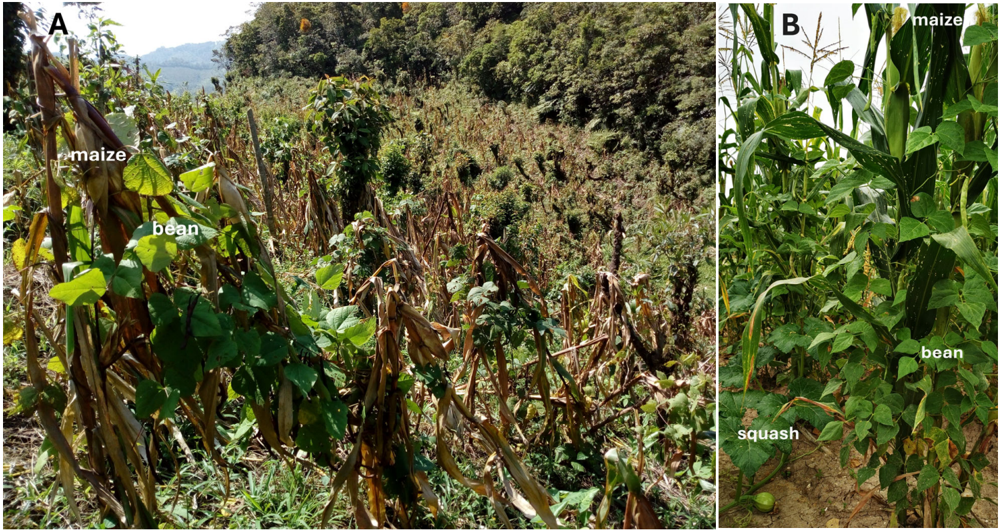
Polyculture, or intercropping, is the practice of growing two or more crops simultaneously in time and space. The milpa is a systematic polyculture involving the simultaneous cultivation of maize (Zea mays), beans (Phaseolus spp.), squash (Cucurbita spp.), and other crops. Milpa polyculture initially emerged in the Mesoamerican region (Mexico and Central America) through the concurrent processes of managing, utilizing, and domesticating its constituent crops. It subsequently spread throughout the Americas via the diffusion of maize and the convergence of its domestication with that of its companion crops and other domesticated plants in the continent. Mesoamerican farmers made an outstanding contribution by domesticating and bringing together crops with contrasting morphological and physiological traits that are ecologically, agronomically, and nutritionally complementary. Despite its importance, few quantitative evaluations of this polyculture exist. However, these evaluations indicate that its productivity and land efficiency use (Land equivalent ratio = 1.34) are comparable to those of other intercrops studied on a global scale. We emphasize the importance of transdisciplinary efforts to study this polyculture and highlight its potential applications related to ecological interactions, plant microbiomes and breeding in order to reach sustainable production goals.
Checked 2026-11-25 · 1 reference not checked yet
Overview
CoChat Summary
TL;DR
This review synthesizes the origin, diffusion, agrobiodiversity, productivity, and multifunctionality of the Mesoamerican milpa polyculture (maize–bean–squash and associated crops), reporting an average Land Equivalent Ratio (LER) of 1.34. It argues that milpa is a long-standing, ecologically complementary system with potential for sustainable agriculture, while noting limited quantitative research, labor/mechanization constraints, and lack of current census data on its extent.
Key findings
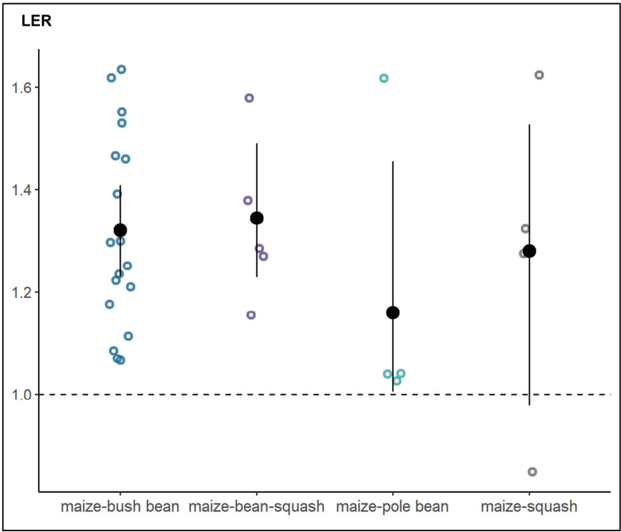
- Milpa is a systematic polyculture of maize (*Zea mays*), beans (*Phaseolus* spp.), squash (*Cucurbita* spp.), and other crops, originating in Mesoamerica and spreading through the Americas. Experimental evaluations report an average LER of 1.27; milpa polyculture has the highest LER at 1.34, compared with maize–bush bean (1.32), maize–squash (1.28), and maize–pole bean (1.16), and is comparable to global intercrop values (global LER 1.2–1.3). The 1.34 value indicates potential to conserve up to 25% of land compared with monocrops or binary intercrops.
- Milpa agrobiodiversity includes over 260 maize races (90% of global maize diversity), 59–65 maize landraces in Mexico, and useful plant richness ranging from 109 species in temperate regions to 122 in dryland regions and up to 149 species in Téenek milpa agroecosystems; 250 quelite species are registered in Mexico, 127 of them associated with milpa agroecosystems.
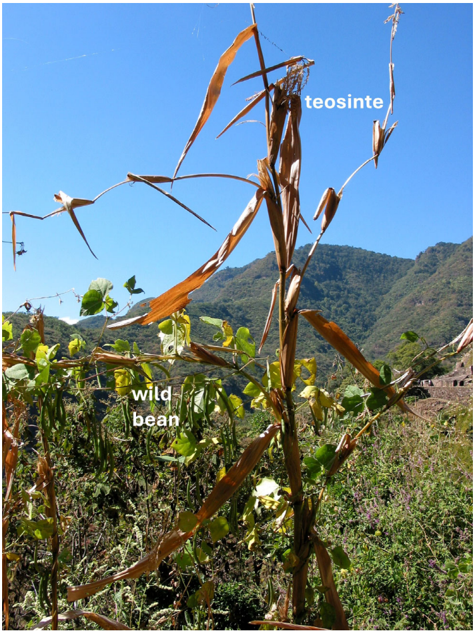
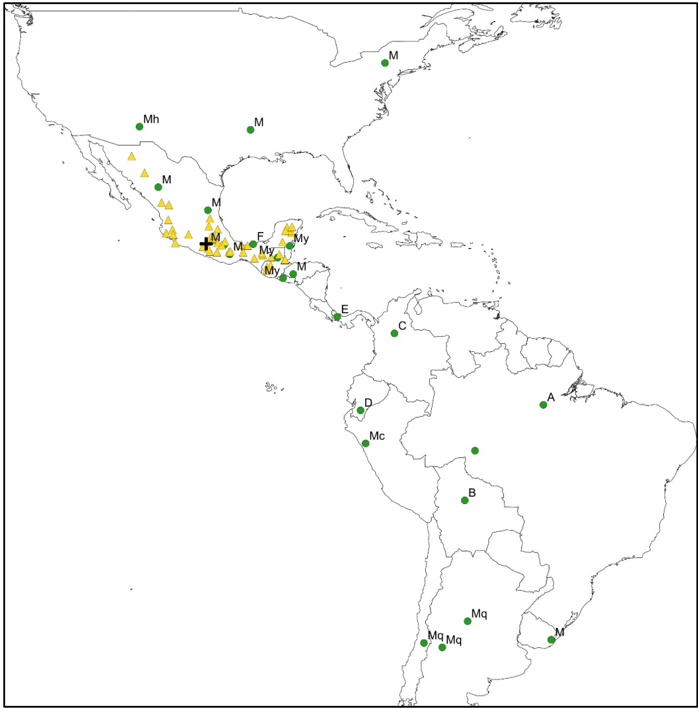
- Archaeobotanical and domestication evidence places maize domestication at approximately 9000 years ago from teosinte in the Middle Balsas River Basin, *Cucurbita pepo* remains at 10,000 years ago in central Mexico, and the earliest maize pollen at 8700 calendar years BP at Xihuatoxtla. Maize and squash were grown at lake edges between 10,000 and 5000 BP; the maize–bean–squash association is preserved at Joya de Cerén, El Salvador, ca. 592–660 CE, and by 1400 CE had been adopted in North America.
- Nutritionally, beans and squash have two to three times the protein content of maize; 37 species associated with Lacandon milpas in Chiapas could nearly meet the daily dietary needs of a family of five, except for saturated fat, cholesterol, sodium, calcium, and iodine. Labor reports range from 27 to 401 workdays per crop cycle per hectare, though the original source indicates the more demanding treatment does not exceed 118 workdays per hectare.
Methods
- Review and database searches: Web of Science “intercropping” yielded 10,329 records, only 18 of which included “intercropping AND milpa” (2 August 2023); “milpa NOT alta” yielded 236 records, narrowed to 63, of which 52 reported definitions and geographic information. Three recurrent meanings were found: milpa as site/agro-ecosystem (17 mentions), cultivation system (34 mentions), and polyculture (45 mentions). Additional archaeobotanical records, Google Scholar, books, book chapters, dissertations, journal articles, and Mexican agricultural census data were consulted.
- LER productivity comparison: on 1 March 2024, Web of Science searches for maize–*Phaseolus*–intercropping–LER, maize–*Cucurbita*–intercropping, and maize–squash–beans–intercropping yielded 39, 15, and 7 results, respectively. Only three papers reported LER values specifically for the traditional maize–bean–squash triad, plus three additional works; total analyzed reports were 18 maize–bush bean, 4 maize–pole bean, 4 maize–squash, and 5 milpa polyculture. Five maize–bean papers with coefficients of variation were used as an indicator of stability, and average LER values were taken or calculated.
- Information was organized by first presenting the main meanings of milpa, then focusing on milpa as polyculture from a historical perspective, covering origin and diffusion, current state, structural/ecological/agronomic traits, multifunctionality, limitations, and future prospects including microbiome and breeding.
Limitations
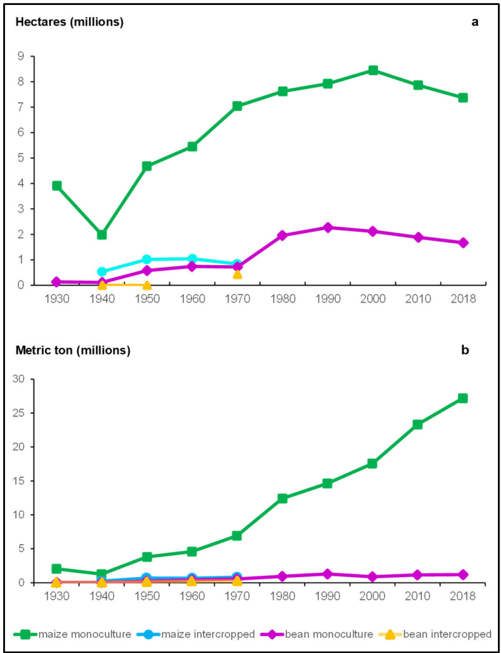
- The paper states that few quantitative evaluations of milpa polyculture exist; research is limited, especially regarding different methodologies, arrangements, densities, and LER values reported. National agricultural censuses from the past five decades lack data quantifying milpa’s geolocation, extent, and persistence, and the stability of milpa polyculture has not been quantitatively determined.
- The paper identifies adoption constraints including higher labor requirements, low mechanization, and lack of basic and applied knowledge. Mechanization challenges are noted for planting and harvesting, the latter due to crops’ different maturation periods.
- Evident from the text: the LER synthesis rests on a small, heterogeneous set of studies, and some included LER values are extreme or confounded—e.g., Amador and Gliessman reported 0.56–2.03; Molina-Anzures et al. found LER values greater than 3.0 but did not separate polyculture yield from fruit tree yield; Ebel et al. reported 1.6; Zhang et al. reported 1.17. The review itself notes methodological differences among these studies.
Model-written summary. Check it against the paper before relying on it.
Integrity signals
Registry
Cites
Statistics
Figures
Verification
Claims the paper makes
0 Valid · 6 Not valid · 175 Not checked · 44 Own results and interpretations
A result the paper reports from its own data — it cites no other source for it, so there is none to check. The quote shows it is in the paper.
In the paper
“However, these evaluations indicate that its productivity and land efficiency use (Land equivalent ratio = 1.34) are comparable to those of other intercrops studied on a global scale.”
§ Review Milpa, a Long-Standing Polyculture for Sustainable Agriculture > Abstract
hedged- Asserted: passes — The authors put it forward as true.
- Checkable: passes — It can be checked against evidence.
- Load-bearing: passes — The paper’s conclusions depend on it.
- Based: passes — The paper gives a reason why it holds.
- Rests on an assumption not shown here.
A result the paper reports from its own data — it cites no other source for it, so there is none to check. The quote shows it is in the paper.
In the paper
“Despite its importance, few quantitative evaluations of this polyculture exist.”
§ Review Milpa, a Long-Standing Polyculture for Sustainable Agriculture > Abstract
plain- Asserted: passes — The authors put it forward as true.
- Checkable: passes — It can be checked against evidence.
- Load-bearing: passes — The paper’s conclusions depend on it.
- Based: passes — The paper gives a reason why it holds.
- Rests on an assumption not shown here.
A result the paper reports from its own data — it cites no other source for it, so there is none to check. The quote shows it is in the paper.
In the paper
“However, research on this system is limited, especially in topics that are needed in order to face socioeconomic and technological issues, including labor, mechanization, and the scientific and technical basis for its improvement as assemblage.”
§ Review Milpa, a Long-Standing Polyculture for Sustainable Agriculture > 1. Introduction
plain- Asserted: passes — The authors put it forward as true.
- Checkable: passes — It can be checked against evidence.
- Load-bearing: passes — The paper’s conclusions depend on it.
- Based: passes — The paper gives a reason why it holds.
- Rests on an assumption not shown here.
None of the sources cited for this claim have been checked yet.
In the paper
“Only three papers [96,106,107] reported LER values specifically on the traditional maize-bean-squash triad.”
§ Review Milpa, a Long-Standing Polyculture for Sustainable Agriculture > 2. Methodology
What the sources say
- Not checked yetcites [96] Molina-Anzures, M.F.; Chávez-Servia, J.L.; Gil-Muñoz, A.; López, P.A.; Hernández-Romero, E.; Ortiz-Torres, E. Productive efficiencies in corn, bean and squash (Cucurbita pepo L.) associations, intercropped with rows of fruit trees. Phyton 2016, 85, 36-50. [CrossRef] source
- Not checked yetcites [106] Zhang, 2014, Root Foraging Elicits Niche Complementarity-Dependent Yield Advantage in the Ancient ‘Three Sisters’ (Maize/Bean/Squash) Polyculture, Ann. Bot. source
- Not checked yetcites [107] Kapayou, 2023, Reuniting the Three Sisters: Collaborative Science with Native Growers to Improve Soil and Community Health, Agric. Hum. Values source
plain- Asserted: passes — The authors put it forward as true.
- Checkable: passes — It can be checked against evidence.
- Load-bearing: passes — The paper’s conclusions depend on it.
- Based: passes — The paper gives a reason why it holds.
A result the paper states — it cites no source for it, so there is none to check. The quote shows it is in the paper.
In the paper
“However, it is important to note the lack of research on milpa polyculture, especially regarding the different methodologies, arrangements, densities, and LER values reported in these studies.”
§ Review Milpa, a Long-Standing Polyculture for Sustainable Agriculture > 6.4. Productivity and Stability
plain- Asserted: passes — The authors put it forward as true.
- Checkable: passes — It can be checked against evidence.
- Load-bearing: unclear — It is unclear whether the paper’s conclusions depend on it.
- Based: passes — The paper gives a reason why it holds.
82 more claims
Create a free account to see all 225 claims and to verify the 352 references still open.
- It may state two separate claims as one. 90
- Probably not a substantial claim. 67
- The quote only partly states this claim. 1
Self-check
Percentages, sums and reported differences re-computed from the paper’s own numbers.
Each contradiction between two passages listed here was confirmed by an independent check.
Rated minor: it would not touch a result — a value no result rests on, a p-value that stays on the same side of the significance level, or a conflict that is clerical, resolved elsewhere in the paper, or outside its own findings.
In the paper
§ Review Milpa, a Long-Standing Polyculture for Sustainable Agriculture > 9. Conclusions
“The average land equivalent ratio for milpa (LER) is 1.34, indicating that this polyculture has the potential to conserve up to 25% of land when compared to monocultures or binary intercrops.”
§ Review Milpa, a Long-Standing Polyculture for Sustainable Agriculture > 6.4. Productivity and Stability
“In these evaluations, the milpa polyculture (maize-bean-squash) exhibited the highest LER value (1.34), compared to its crop component intercrops (1.32 for maizebush bean, 1.28 for maize-squash and 1.16 for maize and pole bean combinations; Figure 8).”
Citations
Cites
Food Security: The Challenge of Feeding 9 Billion People
Godfray, H. C. J., Beddington, J. R., Crute, I. R., Haddad, L., Lawrence, D., Muir, J. F., Pretty, J., Robinson, S., Thomas, S. M., & Toulmin, C. (2010) · Science · doi:10.1126/science.1185383 · Cited by 11,943
Biodiversity and ecosystem functioning: Current knowledge and future challenges
Loreau, M., Naeem, S., Inchausti, P., Bengtsson, J., Grime, J. P., Hector, A., Hooper, D. U., Huston, M. A., Raffaelli, D., Schmid, B., et al. (2001) · Science · doi:10.1126/science.1064088 · Cited by 4,649
Plant–microbiome interactions: from community assembly to plant health
Trivedi, P., Leach, J. E., Tringe, S. G., Sa, T., & Singh, B. K. (2020) · Nature Reviews Microbiology · doi:10.1038/s41579-020-0412-1 · Cited by 3,904
Green Revolution: Impacts, limits, and the path ahead
Pingali, P. L. (2012) · Proceedings of the National Academy of Sciences · doi:10.1073/pnas.0912953109 · Cited by 2,442
Biodiversity and ecosystem stability in a decade-long grassland experiment
Tilman, D., Reich, P. B., & Knops, J. M. H. (2006) · Nature · doi:10.1038/nature04742 · Cited by 2,311
Intercropping Its Importance And Research Needs Part 1. Competition And Yield Advantages Vol-32
Willey, R. W. (1979) · MPKV ; Maharastra eBooks · Cited by 1,934
Beyond Global Warming: Ecology and Global Change
Vitousek, P. M. (1994) · Ecology · doi:10.2307/1941591 · Cited by 1,839
A single domestication for maize shown by multilocus microsatellite genotyping
Matsuoka, Y., Vigouroux, Y., Goodman, M. M., Sanchez G., J., Buckler, E., & Doebley, J. (2002) · Proceedings of the National Academy of Sciences · doi:10.1073/pnas.052125199 · Cited by 1,789
Vandermeer, J. H. (1989) · Cambridge University Press eBooks · doi:10.1017/cbo9780511623523 · Cited by 1,697
Diversity of Rhizobium-Phaseolus vulgaris symbiosis: overview and perspectives
Martínez-Romero, E. (2003) · Plant and Soil · doi:10.1023/a:1024199013926 · Cited by 1,539
Cardinale, B. J., Wright, J. P., Cadotte, M. W., Carroll, I. T., Hector, A., Srivastava, D. S., Loreau, M., & Weis, J. J. (2007) · Proceedings of the National Academy of Sciences · doi:10.1073/pnas.0709069104 · Cited by 1,537
The breeding of crop ideotypes
Donald, C. M. (1968) · Euphytica · doi:10.1007/bf00056241 · Cited by 1,433
Tilman, D. (1999) · Proceedings of the National Academy of Sciences · doi:10.1073/pnas.96.11.5995 · Cited by 1,406
Improving intercropping: a synthesis of research in agronomy, plant physiology and ecology
Brooker, R. W., Bennett, A. E., Cong, W., Daniell, T. J., George, T. S., Hallett, P. D., Hawes, C., Iannetta, P. P. M., Jones, H. G., Karley, A. J., et al. (2015) · New Phytologist · doi:10.1111/nph.13132 · Cited by 1,386
Bender, S. F., Wagg, C., & van der Heijden, M. G. A. (2016) · Trends in Ecology & Evolution · doi:10.1016/j.tree.2016.02.016 · Cited by 1,272
Biodiversity Conservation in Traditional Coffee Systems of Mexico
Moguel, P., & Toledo, V. M. (1999) · Conservation Biology · doi:10.1046/j.1523-1739.1999.97153.x · Cited by 1,009
Piperno, D. R., Ranere, A. J., Holst, I., Iriarte, J., & Dickau, R. (2009) · Proceedings of the National Academy of Sciences · doi:10.1073/pnas.0812525106 · Cited by 719
National food production stabilized by crop diversity
Renard, D., & Tilman, D. (2019) · Nature · doi:10.1038/s41586-019-1316-y · Cited by 623
Benefits of increasing plant diversity in sustainable agroecosystems
Isbell, F., Adler, P. R., Eisenhauer, N., Fornara, D., Kimmel, K., Kremen, C., Letourneau, D. K., Liebman, M., Polley, H. W., Quijas, S., et al. (2017) · Journal of Ecology · doi:10.1111/1365-2745.12789 · Cited by 616
Syndromes of production in intercropping impact yield gains
Li, C., Hoffland, E., Kuyper, T. W., Yu, Y., Zhang, C., Li, H., Zhang, F., & van der Werf, W. (2020) · Nature Plants · doi:10.1038/s41477-020-0680-9 · Cited by 604
The properties of agroecosystems
Conway, G. R. (1987) · Agricultural Systems · doi:10.1016/0308-521x(87)90056-4 · Cited by 592
The new Green Revolution: Sustainable intensification of agriculture by intercropping
Martin-Guay, M.-O., Paquette, A., Dupras, J., & Rivest, D. (2018) · Science of The Total Environment · doi:10.1016/j.scitotenv.2017.10.024 · Cited by 562
Yu, Y., Stomph, T.-J., Makowski, D., & van der Werf, W. (2015) · Field Crops Research · doi:10.1016/j.fcr.2015.09.010 · Cited by 466
The Future of Complementarity: Disentangling Causes from Consequences
Barry, K. E., Mommer, L., van Ruijven, J., Wirth, C., Wright, A. J., Bai, Y., Connolly, J., De Deyn, G. B., de Kroon, H., Isbell, F., et al. (2019) · Trends in Ecology & Evolution · doi:10.1016/j.tree.2018.10.013 · Cited by 459
Long-term increased grain yield and soil fertility from intercropping
Li, X.-F., Wang, Z.-G., Bao, X.-G., Sun, J.-H., Yang, S.-C., Wang, P., Wang, C.-B., Wu, J.-P., Liu, X.-R., Tian, X.-L., et al. (2021) · Nature Sustainability · doi:10.1038/s41893-021-00767-7 · Cited by 457
Piperno, D. R., & Flannery, K. V. (2001) · Proceedings of the National Academy of Sciences · doi:10.1073/pnas.98.4.2101 · Cited by 435
Piperno, D. R. (2011) · Current Anthropology · doi:10.1086/659998 · Cited by 427
Van Deynze, A., Zamora, P., Delaux, P.-M., Heitmann, C., Jayaraman, D., Rajasekar, S., Graham, D., Maeda, J., Gibson, D., Schwartz, K. D., et al. (2018) · PLOS Biology · doi:10.1371/journal.pbio.2006352 · Cited by 396
Diseases in Intercropping Systems
Boudreau, M. A. (2013) · Annual Review of Phytopathology · doi:10.1146/annurev-phyto-082712-102246 · Cited by 379
Agroecology: Researching the Ecological Basis for Sustainable Agriculture
Gliessman, S. R. (1990) · Ecological Studies · doi:10.1007/978-1-4612-3252-0_1 · Cited by 359
In situ Management and Domestication of Plants in Mesoamerica
Casas, A., Otero-Arnaiz, A., Perez-Negron, E., & Valiente-Banuet, A. (2007) · Annals of Botany · doi:10.1093/aob/mcm126 · Cited by 352
Self-citationThe Initial Domestication of Cucurbita pepo in the Americas 10,000 Years Ago
Smith, B. D. (1997) · Science · doi:10.1126/science.276.5314.932 · Cited by 351
Population structure and genetic diversity of New World maize races assessed by DNA microsatellites
Vigouroux, Y., Glaubitz, J. C., Matsuoka, Y., Goodman, M. M., Sánchez G., J., & Doebley, J. (2008) · American Journal of Botany · doi:10.3732/ajb.0800097 · Cited by 324
Multiproxy evidence highlights a complex evolutionary legacy of maize in South America
Kistler, L., Maezumi, S. Y., Gregorio de Souza, J., Przelomska, N. A. S., Malaquias Costa, F., Smith, O., Loiselle, H., Ramos-Madrigal, J., Wales, N., Ribeiro, E. R., et al. (2018) · Science · doi:10.1126/science.aav0207 · Cited by 315
Origin and Environmental Setting of Ancient Agriculture in the Lowlands of Mesoamerica
Pope, K. O., Pohl, M. E. D., Jones, J. G., Lentz, D. L., Nagy, C. V., Vega, F. J., & Quitmyer, I. R. (2001) · Science · doi:10.1126/science.292.5520.1370 · Cited by 291
Bitocchi, E., Bellucci, E., Giardini, A., Rau, D., Rodriguez, M., Biagetti, E., Santilocchi, R., Spagnoletti Zeuli, P., Gioia, T., Logozzo, G., et al. (2013) · New Phytologist · doi:10.1111/j.1469-8137.2012.04377.x · Cited by 267
Starch grains on human teeth reveal early broad crop diet in northern Peru
Piperno, D. R., & Dillehay, T. D. (2008) · Proceedings of the National Academy of Sciences · doi:10.1073/pnas.0808752105 · Cited by 266
The productive performance of intercropping
Li, C., Stomph, T.-J., Makowski, D., Li, H., Zhang, C., Zhang, F., & van der Werf, W. (2023) · Proceedings of the National Academy of Sciences · doi:10.1073/pnas.2201886120 · Cited by 264
Isozymatic and Morphological Diversity in the Races of Maize of Mexico
Sanchez G., J. J., Goodman, M. M., & Stuber, C. W. (2000) · Economic Botany · doi:10.1007/bf02866599 · Cited by 241
Sanjur, O. I., Piperno, D. R., Andres, T. C., & Wessel-Beaver, L. (2002) · Proceedings of the National Academy of Sciences · doi:10.1073/pnas.012577299 · Cited by 240
Postma, J. A., & Lynch, J. P. (2012) · Annals of Botany · doi:10.1093/aob/mcs082 · Cited by 235
Hybridization of maize and teosinte, in mexico and guatemala and the improvement of maize
Wllkes, H. G. (1977) · Economic Botany · doi:10.1007/bf02866877 · Cited by 233
Beans (Phaseolus ssp.) as a Model for Understanding Crop Evolution
Bitocchi, E., Rau, D., Bellucci, E., Rodriguez, M., Murgia, M. L., Gioia, T., Santo, D., Nanni, L., Attene, G., & Papa, R. (2017) · Frontiers in Plant Science · doi:10.3389/fpls.2017.00722 · Cited by 225
Plant biodiversity promotes sustainable agriculture directly and via belowground effects
Cappelli, S. L., Domeignoz-Horta, L. A., Loaiza, V., & Laine, A.-L. (2022) · Trends in Plant Science · doi:10.1016/j.tplants.2022.02.003 · Cited by 216
Watling, J., Shock, M. P., Mongeló, G. Z., Almeida, F. O., Kater, T., De Oliveira, P. E., & Neves, E. G. (2018) · PLOS ONE · doi:10.1371/journal.pone.0199868 · Cited by 216
The Evolutionary Potential of Lacandon Maya Sustained-Yield Tropical Forest Agriculture
Nigh, R. B. (1980) · Journal of Anthropological Research · doi:10.1086/jar.36.1.3629550 · Cited by 215
(2020) · Advances in Agronomy · doi:10.1016/bs.agron.2019.10.002 · Cited by 214
Genomic estimation of complex traits reveals ancient maize adaptation to temperate North America
Swarts, K., Gutaker, R. M., Benz, B., Blake, M., Bukowski, R., Holland, J., Kruse-Peeples, M., Lepak, N., Prim, L., Romay, M. C., et al. (2017) · Science · doi:10.1126/science.aam9425 · Cited by 212
Dickau, R., Ranere, A. J., & Cooke, R. G. (2007) · Proceedings of the National Academy of Sciences · doi:10.1073/pnas.0611605104 · Cited by 207
Tsubo, M., Walker, S., & Mukhala, E. (2001) · Field Crops Research · doi:10.1016/s0378-4290(01)00142-3 · Cited by 207
The legacy of 4,500 years of polyculture agroforestry in the eastern Amazon
Maezumi, S. Y., Alves, D., Robinson, M., de Souza, J. G., Levis, C., Barnett, R. L., Almeida de Oliveira, E., Urrego, D., Schaan, D., & Iriarte, J. (2018) · Nature Plants · doi:10.1038/s41477-018-0205-y · Cited by 205
Evidence for cultivar adoption and emerging complexity during the mid-Holocene in the La Plata basin
Iriarte, J., Holst, I., Marozzi, O., Listopad, C., Alonso, E., Rinderknecht, A., & Montaña, J. (2004) · Nature · doi:10.1038/nature02983 · Cited by 205
Diversity in Plant Breeding: A New Conceptual Framework
Litrico, I., & Violle, C. (2015) · Trends in Plant Science · doi:10.1016/j.tplants.2015.07.007 · Cited by 203
Long-term evidence for ecological intensification as a pathway to sustainable agriculture
MacLaren, C., Mead, A., van Balen, D., Claessens, L., Etana, A., de Haan, J., Haagsma, W., Jäck, O., Keller, T., Labuschagne, J., et al. (2022) · Nature Sustainability · doi:10.1038/s41893-022-00911-x · Cited by 200
Phylogeny of the Genus Phaseolus (Leguminosae): A Recent Diversification in an Ancient Landscape
Delgado-Salinas, A., Bibler, R., & Lavin, M. (2006) · Systematic Botany · doi:10.1600/036364406779695960 · Cited by 195
Isakson, S. R. (2009) · The Journal of Peasant Studies · doi:10.1080/03066150903353876 · Cited by 191
Allelopathy as a Tool in the Management of Biotic Resources in Agroecosystems
Luisa Anaya, A. (1999) · Critical Reviews in Plant Sciences · doi:10.1016/s0735-2689(99)00397-4 · Cited by 191
Agroecology: The Ecology of Sustainable Food Systems, Second Edition
Gliessman, S. R. (2006) · doi:10.1201/b17420 · Cited by 190
Biological Efficiencies in Multiple-Cropping Systems
Francis, C. A. (1989) · Advances in Agronomy · doi:10.1016/s0065-2113(08)60522-2 · Cited by 186
Manejo de la vegetación, domesticación de plantas y origen de la agricultura en Mesoamérica
Casas, A., Caballero, J., Mapes, C., & Zárate, S. (2017) · Botanical Sciences · doi:10.17129/botsci.1537 · Cited by 185
Self-citationDisentangling Domestication from Food Production Systems in the Neotropics
Clement, C. R., Casas, A., Parra-Rondinel, F. A., Levis, C., Peroni, N., Hanazaki, N., Cortés-Zárraga, L., Rangel-Landa, S., Alves, R. P., Ferreira, M. J., et al. (2021) · Quaternary · doi:10.3390/quat4010004 · Cited by 184
Self-citationEvidence of human occupation in Mexico around the Last Glacial Maximum
Ardelean, C. F., Becerra-Valdivia, L., Pedersen, M. W., Schwenninger, J.-L., Oviatt, C. G., Macías-Quintero, J. I., Arroyo-Cabrales, J., Sikora, M., Ocampo-Díaz, Y. Z. E., Rubio-Cisneros, I. I., et al. (2020) · Nature · doi:10.1038/s41586-020-2509-0 · Cited by 178
2 Prehistoric agricultural methods as models for sustainability
Denevan, W. M. (1995) · Advances in plant pathology · doi:10.1016/s0736-4539(06)80004-8 · Cited by 173
Plant Management in the Tehuacán-Cuicatlán Valley, Mexico1
Blancas, J., Casas, A., Rangel-Landa, S., Moreno-Calles, A., Torres, I., Pérez-Negrón, E., Solís, L., Delgado-Lemus, A., Parra, F., Arellanes, Y., et al. (2010) · Economic Botany · doi:10.1007/s12231-010-9133-0 · Cited by 170
Self-citationThe Maya milpa: fire and the legacy of living soil
Nigh, R., & Diemont, S. A. (2013) · Frontiers in Ecology and the Environment · doi:10.1890/120344 · Cited by 167
Iriarte, J., Elliott, S., Maezumi, S. Y., Alves, D., Gonda, R., Robinson, M., Gregorio de Souza, J., Watling, J., & Handley, J. (2020) · Quaternary Science Reviews · doi:10.1016/j.quascirev.2020.106582 · Cited by 165
Two teosintes made modern maize
Yang, N., Wang, Y., Liu, X., Jin, M., Vallebueno-Estrada, M., Calfee, E., Chen, L., Dilkes, B. P., Gui, S., Fan, X., et al. (2023) · Science · doi:10.1126/science.adg8940 · Cited by 164
Phaseolus (Fabaceae) in Archaeology: AMS
Kaplan, L., & Lynch, T. F. (1999) · Economic Botany · doi:10.1007/bf02866636 · Cited by 162
The domestication ofcucurbita (Cucurbitaceae)
Nee, M. (1990) · Economic Botany · doi:10.1007/bf02860475 · Cited by 159
Origins of the Maya Forest Garden: Maya Resource Management
Ford, A., & Nigh, R. (2009) · Journal of Ethnobiology · doi:10.2993/0278-0771-29.2.213 · Cited by 156
Reassessing Coxcatlan Cave and the early history of domesticated plants in Mesoamerica
Smith, B. D. (2005) · Proceedings of the National Academy of Sciences · doi:10.1073/pnas.0502847102 · Cited by 154
The Productivity of Maguey Terrace Agriculture in Central Mexico during the Aztec Period
Evans, S. T. (1990) · Latin American Antiquity · doi:10.2307/971983 · Cited by 150
Piperno, D. R., Moreno, J. E., Iriarte, J., Holst, I., Lachniet, M., Jones, J. G., Ranere, A. J., & Castanzo, R. (2007) · Proceedings of the National Academy of Sciences · doi:10.1073/pnas.0703442104 · Cited by 149
Gómez-Pompa, A. (1987) · Mexican Studies/Estudios Mexicanos · doi:10.2307/4617029 · Cited by 147
Garcı́a-Frapolli, E., Ayala‐Orozco, B., Bonilla‐Moheno, M., Espadas‐Manrique, C., & Ramos‐Fernández, G. (2007) · Landscape and Urban Planning · doi:10.1016/j.landurbplan.2007.03.007 · Cited by 142
Benefits of intensive agricultural intercropping
Tilman, D. (2020) · Nature Plants · doi:10.1038/s41477-020-0677-4 · Cited by 131
The Wild Relative of Phaseolus Vulgaris in Middle America
Delgado‐Salinas, A., Bonet, A., & Gepts, P. (1988) · Current plant science and biotechnology in agriculture · doi:10.1007/978-94-009-2786-5_9 · Cited by 131
Zhang, C., Postma, J. A., York, L. M., & Lynch, J. P. (2014) · Annals of Botany · doi:10.1093/aob/mcu191 · Cited by 130
Interactions of bush bean intercropped with field and sweet maize
Santalla, M., Rodiño, A. P., Casquero, P. A., & Ron, A. M. D. (2001) · European Journal of Agronomy · doi:10.1016/s1161-0301(01)00104-6 · Cited by 126
Nitrogen fixation and transfer in intercrop systems
Stern, W. R. (1993) · Field Crops Research · doi:10.1016/0378-4290(93)90121-3 · Cited by 125
Cultivated Plants of South and Central America
Sauer, C. O. (1950) · Cited by 119
Breeding Beyond Monoculture: Putting the “Intercrop” Into Crops
Bourke, P. M., Evers, J. B., Bijma, P., van Apeldoorn, D. F., Smulders, M. J. M., Kuyper, T. W., Mommer, L., & Bonnema, G. (2021) · Frontiers in Plant Science · doi:10.3389/fpls.2021.734167 · Cited by 117
Long-term man–environment interactions in the Bolivian Amazon: 8000 years of vegetation dynamics
Brugger, S. O., Gobet, E., van Leeuwen, J. F. N., Ledru, M., Colombaroli, D., van der Knaap, W. O., Lombardo, U., Escobar‐Torrez, K., Finsinger, W., Rodrigues, L., et al. (2015) · Quaternary Science Reviews · doi:10.1016/j.quascirev.2015.11.001 · Cited by 115
Rationalising mixed cropping under indigenous conditions: The example of Northern Nigeria
Norman, D. W. (1974) · The Journal of Development Studies · doi:10.1080/00220387408421509 · Cited by 110
Quintana-Ascencio, P. F., González‐Espinosa, M., Ramírez-Marcial, N., Domínguez-Vázquez, G., & Martínez‐Icó, M. (1996) · Biotropica · doi:10.2307/2389074 · Cited by 106
Kwak, M., Kami, J. A., & Gepts, P. (2009) · Crop Science · doi:10.2135/cropsci2008.07.0421 · Cited by 105
Silva, C., Vinuesa, P., Eguiarte, L. E., Martínez‐Romero, E., & Souza, V. (2003) · Applied and Environmental Microbiology · doi:10.1128/aem.69.2.884-893.2003 · Cited by 104
YILMAZ, Ş., Atak, M., & Erayman, M. (2008) · DergiPark (Istanbul University) · Cited by 101
The Wild Ancestor of Phaseolus Vulgaris in South America
Brücher, H. (1988) · Current plant science and biotechnology in agriculture · doi:10.1007/978-94-009-2786-5_10 · Cited by 100
Los sistemas agroforestales tradicionales de México: Una aproximación biocultural
Isabel Moreno-Calles, A., M. Toledo, V., & Casas, A. (2013) · Botanical Sciences · doi:10.17129/botsci.419 · Cited by 99
Self-citationGardening and Farming Before A.D. 1000: Patterns of Prehistoric Cultivation North of Mexico
Ford, R. I. (1981) · Journal of Ethnobiology · Cited by 96
Potential of indigenous crop microbiomes for sustainable agriculture
Chen, Q.-L., Hu, H.-W., He, Z.-Y., Cui, L., Zhu, Y.-G., & He, J.-Z. (2021) · Nature Food · doi:10.1038/s43016-021-00253-5 · Cited by 95
Emerging evidence of plant domestication as a landscape-level process
Allaby, R. G., Stevens, C. J., Kistler, L., & Fuller, D. Q. (2022) · Trends in Ecology & Evolution · doi:10.1016/j.tree.2021.11.002 · Cited by 93
A Model for Nitrogen Fixation in Cereal Crops
Bennett, A. B., Pankievicz, V. C. S., & Ané, J.-M. (2020) · Trends in Plant Science · doi:10.1016/j.tplants.2019.12.004 · Cited by 93
Moreno-Espíndola, I. P., Ferrara-Guerrero, M. J., Luna-Guido, M. L., Ramírez-Villanueva, D. A., de León-Lorenzana, A. S., Gómez-Acata, S., González-Terreros, E., Ramírez-Barajas, B., Navarro‐Noya, Y. E., Sánchez-Rodríguez, L. M., et al. (2018) · Frontiers in Microbiology · doi:10.3389/fmicb.2018.02737 · Cited by 91
Automating Agroecology: How to Design a Farming Robot Without a Monocultural Mindset?
Ditzler, L., & Driessen, C. (2022) · Journal of Agricultural and Environmental Ethics · doi:10.1007/s10806-021-09876-x · Cited by 87
Weih, M., Karley, A. J., Newton, A. C., Kiær, L. P., Scherber, C., Rubiales, D., Adam, E., Ajal, J., Brandmeier, J., Pappagallo, S., et al. (2021) · Agriculture · doi:10.3390/agriculture11030255 · Cited by 87
Archaeological Central American maize genomes suggest ancient gene flow from South America
Kistler, L., Thakar, H. B., VanDerwarker, A. M., Domic, A., Bergström, A., George, R. J., Harper, T. K., Allaby, R. G., Hirth, K., & Kennett, D. J. (2020) · Proceedings of the National Academy of Sciences · doi:10.1073/pnas.2015560117 · Cited by 85
Hartter, J., Lucas, C. M., Gaughan, A. E., & Aranda, L. L. (2007) · Applied Geography · doi:10.1016/j.apgeog.2007.07.013 · Cited by 82
The Archaic Diet in Mesoamerica: Incentive for Milpa Development and Species Domestication
Zizumbo-Villarreal, D., Flores-Silva, A., & Colunga-García Marín, P. (2012) · Economic Botany · doi:10.1007/s12231-012-9212-5 · Cited by 81
Schmook, B. I., van Vliet, N., Radel, C., Manzón, M., & McCandless, S. R. (2013) · Human Ecology · doi:10.1007/s10745-012-9557-5 · Cited by 78
Zea mays on the South American Periphery: Chronology and Dietary Importance
Gil, A. F. (2003) · Current Anthropology · doi:10.1086/367972 · Cited by 78
Genetic diversity and structure of a worldwide collection of Phaseolus coccineus L.
Spataro, G., Tiranti, B., Arcaleni, P., Bellucci, E., Attene, G., Papa, R., Zeuli, P. S., & Negri, V. (2011) · Theoretical and Applied Genetics · doi:10.1007/s00122-011-1530-y · Cited by 78
Chemistry, technology, and nutritive value of maize tortillas
Bressani, R. (1990) · Food Reviews International · doi:10.1080/87559129009540868 · Cited by 77
Terminal pleistocene/early holocene human adaptation in coastal ecuador: the las vegas evidence
Stothert, K. E., Piperno, D. R., & Andres, T. C. (2003) · Quaternary International · doi:10.1016/s1040-6182(02)00200-8 · Cited by 75
The Origins of Plant Cultivation in South America
(2009) · University of Alabama Press eBooks · doi:10.2307/jj.30347261.16 · Cited by 75
Pre-pottery farmers on the Pacific coast of southern Mexico
Kennett, D. J., Piperno, D. R., Jones, J. G., Neff, H., Voorhies, B., Walsh, M. K., & Culleton, B. J. (2010) · Journal of Archaeological Science · doi:10.1016/j.jas.2010.07.035 · Cited by 74
Moreno-Calles, A. I., Casas, A., García-Frapolli, E., & Torres-García, I. (2012) · Agroforestry Systems · doi:10.1007/s10457-011-9460-x · Cited by 74
Self-citationThe farming system and traditional agroforestry systems in the Maya community of San Jose, Belize
Levasseur, V., & Olivier, A. (2000) · Agroforestry Systems · doi:10.1023/a:1006327403980 · Cited by 70
Review of agronomic research on the milpa, the traditional polyculture system of Mesoamerica
Fonteyne, S., Castillo Caamal, J. B., Lopez-Ridaura, S., Van Loon, J., Espidio Balbuena, J., Osorio Alcalá, L., Martínez Hernández, F., Odjo, S., & Verhulst, N. (2023) · Frontiers in Agronomy · doi:10.3389/fagro.2023.1115490 · Cited by 66
The Age of Common Beans (Phaseolus vulgaris) in the Northeastern United States
Hart, J. P., & Scarry, C. M. (1999) · American Antiquity · doi:10.2307/2694210 · Cited by 66
Rainfall variability, food insecurity and migration in Cabricán, Guatemala
Milan, A., & Ruano, S. (2014) · Climate and Development · doi:10.1080/17565529.2013.857589 · Cited by 65
Lopez-Ridaura, S., Barba-Escoto, L., Reyna-Ramirez, C. A., Sum, C., Palacios-Rojas, N., & Gerard, B. (2021) · Scientific Reports · doi:10.1038/s41598-021-82784-2 · Cited by 65
Ethnobotany of Mexico: Interactions of People and Plants in Mesoamerica
(2016) · Ethnobiology · doi:10.1007/978-1-4614-6669-7 · Cited by 65
Self-citationLandaverde‐González, P., Quezada‐Euán, J. J. G., Theodorou, P., Murray, T. E., Husemann, M., Ayala, R., Moo‐Valle, H., Vandame, R., & Paxton, R. J. (2017) · Journal of Applied Ecology · doi:10.1111/1365-2664.12860 · Cited by 63
COMPARING PERFORMANCE OF CROP SPECIES MIXTURES AND PURE STANDS
van der Werf, W., Zhang, L., Li, C., Chen, P., Chen, F., Xu, Z. W., Zhang, C., Gu, C., Bastiaans, L., Makowski, D., et al. (2021) · Frontiers of Agricultural Science and Engineering · doi:10.15302/j-fase-2021413 · Cited by 63
Maintenance of Squash (Cucurbita spp.) Landrace Diversity by Farmers' Activities in Mexico
Montes‐Hernández, S., Merrick, L. C., & Eguiarte, L. E. (2005) · Genetic Resources and Crop Evolution · doi:10.1007/s10722-003-6018-4 · Cited by 62
Blair, M. W., Pantoja, W., & Muñoz, L. C. (2012) · Theoretical and Applied Genetics · doi:10.1007/s00122-012-1900-0 · Cited by 61
Biodiversity and Edible Plants of Mexico
Mapes, C., & Basurto, F. (2016) · Ethnobiology · doi:10.1007/978-1-4614-6669-7_5 · Cited by 59
Rodríguez-Robayo, K. J., Méndez-López, M. E., Molina-Villegas, A., & Juárez, L. (2020) · Journal of Rural Studies · doi:10.1016/j.jrurstud.2020.04.029 · Cited by 59
Disturbance and land use effect on functional diversity of the arbuscular mycorrhizal fungi
Aguilar, D. T., Barois, I., & Sangabriel-Conde, W. (2015) · Agroforestry Systems · doi:10.1007/s10457-015-9852-4 · Cited by 58
Plant Material from a Cave on the Rio Zape, Durango, Mexico
Brooks, R. H., Kaplan, L., Cutler, H. C., & Whitaker, T. W. (1962) · American Antiquity · doi:10.2307/277801 · Cited by 57
Dillehay, T. D., Bonavia, D., Goodbred, S., Pino, M., Vasquez, V., Tham, T. R., Conklin, W., Splitstoser, J., Piperno, D., Iriarte, J., et al. (2012) · Antiquity · doi:10.1017/s0003598x00062451 · Cited by 53
Nassary, E. K., Baijukya, F. P., & Ndakidemi, P. A. (2020) · Agriculture · doi:10.3390/agriculture10040117 · Cited by 53
Humphries, S. (1993) · Human Ecology · doi:10.1007/bf00890072 · Cited by 53
Emergy Evaluation of Lacandon Maya Indigenous Swidden Agroforestry in Chiapas, Mexico
Diemont, S. A. W., Martin, J. F., & Levy‐Tacher, S. I. (2005) · Agroforestry Systems · doi:10.1007/s10457-005-6073-2 · Cited by 51
Food Yields and Nutrient Analyses of the Three Sisters: A Haudenosaunee Cropping System
Mt.Pleasant, J. (2016) · Ethnobiology Letters · doi:10.14237/ebl.7.1.2016.721 · Cited by 51
Manejo orgánico de la milpa: rendimiento de maíz, frijol y calabaza en monocultivo y policultivo
Ebel, R., Pozas Cárdenas, J. G., Soria Miranda, F., & Cruz González, J. (2017) · REVISTA TERRA LATINOAMERICANA · doi:10.28940/terra.v35i2.166 · Cited by 50
Serrano-Serrano, M. L., Hernández-Torres, J., Castillo-Villamizar, G., Debouck, D. G., & Chacón Sánchez, M. I. (2010) · Molecular Phylogenetics and Evolution · doi:10.1016/j.ympev.2009.08.028 · Cited by 49
Rebollar, E. A., Sandoval‐Castellanos, E., Roessler, K., Gaut, B. S., Alcaraz, L. D., Benítez, M., & Escalante, A. E. (2017) · Frontiers in Microbiology · doi:10.3389/fmicb.2017.02478 · Cited by 49
Advances in Breeding for Mixed Cropping – Incomplete Factorials and the Producer/Associate Concept
Haug, B., Messmer, M. M., Enjalbert, J., Goldringer, I., Forst, E., Flutre, T., Mary-Huard, T., & Hohmann, P. (2021) · Frontiers in Plant Science · doi:10.3389/fpls.2020.620400 · Cited by 49
Soto‐Pinto, L., Colmenares, S. E., Kánter, M. B., López-Cruz, A., Lugo, E. I. J. E., Hernández, B. H., & Jiménez‐Soto, E. (2022) · Frontiers in Sustainable Food Systems · doi:10.3389/fsufs.2021.756611 · Cited by 48
SISTEMAS AGRofoRESTALES y ALMACENAMIENTo dE CARBoNo EN CoMuNIdAdES INdÍGENAS d E CHIAPAS, Méx ICo
Roncal-García, S. M., Soto‐Pinto, L., Castellanos‐Albores, J., Ramírez-Marcial, N., & de Jong, B. (2008) · Redalyc (Universidad Autónoma del Estado de México) · Cited by 47
The domestication of Cucurbita argyrosperma as revealed by the genome of its wild relative
Barrera-Redondo, J., Sánchez-de la Vega, G., Aguirre-Liguori, J. A., Castellanos-Morales, G., Gutiérrez-Guerrero, Y. T., Aguirre-Dugua, X., Aguirre-Planter, E., Tenaillon, M. I., Lira-Saade, R., & Eguiarte, L. E. (2021) · Horticulture Research · doi:10.1038/s41438-021-00544-9 · Cited by 46
Swidden Counts: A Petén, Guatemala, Milpa System
Schwartz, N. B., & Amilcar Rolando Corzo, M. (2015) · Journal of Anthropological Research · doi:10.3998/jar.0521004.0071.104 · Cited by 46
Historical perspectives on multiple cropping.
Plucknett, D. L., Smith, N. J. H., & Francis, C. A. (1986) · Cited by 46
Jiménez, J., Guachamín-Tello, A. M., Romero, M., & Constantine, A. (2015) · Quaternary International · doi:10.1016/j.quaint.2015.08.025 · Cited by 45
Teran, S., & Rasmussen, C. H. (1995) · Biodiversity and Conservation · doi:10.1007/bf00058422 · Cited by 45
Enhancing planned and associated biodiversity in French farming systems
Casagrande, M., Alletto, L., Naudin, C., Lenoir, A., Siah, A., & Celette, F. (2017) · Agronomy for Sustainable Development · doi:10.1007/s13593-017-0463-5 · Cited by 44
Modeling Illustrates That Genomic Selection Provides New Opportunities for Intercrop Breeding
Bančič, J., Werner, C. R., Gaynor, R. C., Gorjanc, G., Odeny, D. A., Ojulong, H. F., Dawson, I. K., Hoad, S. P., & Hickey, J. M. (2021) · Frontiers in Plant Science · doi:10.3389/fpls.2021.605172 · Cited by 44
Gebeyehu, S., Simane, B., & Kirkby, R. (2006) · European Journal of Agronomy · doi:10.1016/j.eja.2006.01.005 · Cited by 44
Thierfelder, C., Mhlanga, B., Nyagumbo, I., Kalala, K., Simutowe, E., Chiduwa, M., MacLaren, C., Silva, J. V., & Ngoma, H. (2024) · Agriculture, Ecosystems & Environment · doi:10.1016/j.agee.2023.108819 · Cited by 42
Vecino, G. S., Marín, C. A. M., & Salas, L. V. C. (2014) · Quaternary International · doi:10.1016/j.quaint.2014.09.018 · Cited by 41
Genomic characterization of a diazotrophic microbiota associated with maize aerial root mucilage
Higdon, S. M., Pozzo, T., Kong, N. T., Huang, B. C., Yang, M. L., Jeannotte, R., Brown, C. T., Bennett, A. B., & Weimer, B. C. (2020) · PLoS ONE · doi:10.1371/journal.pone.0239677 · Cited by 41
The Role of Nahuatl in the Formation of Mesoamerica as a Linguistic Area
Brown, C. H. (2011) · Language Dynamics and Change · doi:10.1163/221058212x643969 · Cited by 41
Pérez-García, O., & del Castillo, R. F. (2016) · Agriculture Ecosystems & Environment · doi:10.1016/j.agee.2016.05.002 · Cited by 41
Cultivation of maize landraces by small-scale shade coffee farmers in western El Salvador
Olson, M. B., Morris, K. S., & Méndez, V. E. (2012) · Agricultural Systems · doi:10.1016/j.agsy.2012.05.005 · Cited by 40
Shift in beneficial interactions during crop evolution
Fréville, H., Montazeaud, G., Forst, E., David, J., Papa, R., & Tenaillon, M. I. (2022) · Evolutionary Applications · doi:10.1111/eva.13390 · Cited by 40
Parsons, D., Ramírez-Avilés, L., Cherney, J. H., Ketterings, Q. M., Blake, R. W., & Nicholson, C. F. (2009) · Agriculture Ecosystems & Environment · doi:10.1016/j.agee.2009.05.011 · Cited by 40
Veen, G. F., Wubs, E. R. J., Bardgett, R. D., Barrios, E., Bradford, M. A., Carvalho, S., De Deyn, G. B., de Vries, F. T., Giller, K. E., Kleijn, D., et al. (2019) · Frontiers in Ecology and Evolution · doi:10.3389/fevo.2019.00300 · Cited by 38
Keleman, A., Hellin, J., & Flores, D. (2013) · Human Ecology · doi:10.1007/s10745-013-9566-z · Cited by 37
Falkowski, T. B., Chankin, A., Diemont, S. A. W., & Pedian, R. W. (2019) · Food Security · doi:10.1007/s12571-019-00901-6 · Cited by 37
Selection for improved yield in inter-specific mixtures or intercrops
Wright, A. J. (1985) · Theoretical and Applied Genetics · doi:10.1007/bf00570909 · Cited by 37
The response of maize/Phaseolus intercropping to applied nitrogen on Oxisols in northern Zambia
Siame, J., Willey, R. W., & Morse, S. (1998) · Field Crops Research · doi:10.1016/s0378-4290(97)00063-4 · Cited by 37
Kapayou, D. G., Herrighty, E. M., Hill, C. G., Camacho, V. C., Nair, A., Winham, D. M., & McDaniel, M. D. (2023) · Agriculture and Human Values · doi:10.1007/s10460-022-10336-z · Cited by 36
Which Recurrent Selection Scheme To Improve Mixtures of Crop Species? Theoretical Expectations
Sampoux, J.-P., Giraud, H., & Litrico, I. (2020) · G3 Genes|Genomes|Genetics · doi:10.1534/g3.119.400809 · Cited by 36
(1976) · ASA Special Publications · doi:10.2134/asaspecpub27 · Cited by 36
LA MILpA MAYA YUCATECA EN EL SIGLO XVI: EVIDENCIAS ETNOHISTÓRICAS Y CONJETURAS
Méndez, R. M. (2015) · ETNOBIOLOGÍA · Cited by 35
Oljača, S., Cvetkovic, R., Kovačević, D., Vasić, G., & Momirović, N. (2000) · The Journal of Agricultural Science · doi:10.1017/s0021859699008321 · Cited by 34
Albino-Garduño, R., Fernández, A. T., Cortés-Flores, J. I., Livera-Muñoz, M., Mendoza-Castillo, M. C., del Progreso, N. S. F., & de México, E. (2015) · LA Referencia (Red Federada de Repositorios Institucionales de Publicaciones Científicas) · Cited by 34
Daniels, A. E., Painter, K., & Jane Southworth, B. (2007) · Agriculture Ecosystems & Environment · doi:10.1016/j.agee.2007.07.003 · Cited by 34
Organic Fertilisation, Soil Quality and Human Health
Lichtfouse, É. (2012) · Sustainable agriculture reviews · doi:10.1007/978-94-007-4113-3 · Cited by 34
Mina-Vargas, A., McKeown, P. C., Flanagan, N. S., Debouck, D. G., Kilian, A., Hodkinson, T. R., & Spillane, C. (2016) · Annals of Botany · doi:10.1093/aob/mcw138 · Cited by 33
Convergence or Divide in the Movement for Sustainable and Just Agriculture
Altieri, M. A. (2012) · Sustainable agriculture reviews · doi:10.1007/978-94-007-4113-3_1 · Cited by 32
Aguirre-Noyola, J. L., Rosenblueth, M., Santiago-Martínez, M. G., & Martínez-Romero, E. (2021) · Frontiers in Microbiology · doi:10.3389/fmicb.2021.740818 · Cited by 32
Belowground cascading biotic interactions trigger crop diversity benefits
Li, C., Lambers, H., Jing, J., Zhang, C., Bezemer, T. M., Klironomos, J., Cong, W.-F., & Zhang, F. (2024) · Trends in Plant Science · doi:10.1016/j.tplants.2024.04.010 · Cited by 31
DIVERSIDAD MORFOLÓGICA DE CALABAZA CULTIVADA EN EL CENTRO-ORIENTE DE YUCATÁN, MÉXICO
Canul-Kú, J., Ramírez-Vallejo, P., Castillo‐González, F., & Chávez‐Servia, J. L. (2005) · Revista Fitotecnia Mexicana · doi:10.35196/rfm.2005.4.339 · Cited by 30
Intercropping in traditional farming systems
Jodha, N. S. (1980) · The Journal of Development Studies · doi:10.1080/00220388008421770 · Cited by 29
A Study of the Milpa System of La Venta Island and Its Archaeological Implications
Drucker, P., & Heizer, R. F. (1960) · Journal of Anthropological Research · doi:10.1086/soutjanth.16.1.3629053 · Cited by 29
Mukhala, E., de Jager, J. M., Rensburg, L. D. V., & Walker, S. (1999) · Nutrition Research · doi:10.1016/s0271-5317(99)00028-7 · Cited by 28
Bermeo, A., Couturier, S., & Galeana-Pizaña, J. M. (2014) · Applied Geography · doi:10.1016/j.apgeog.2014.06.003 · Cited by 28
Hanfets, a barley and wheat mixture in Eritrea: Yield, stability and farmer preferences
Woldeamlak, A., Grando, S., Maatougui, M., & Ceccarelli, S. (2008) · Field Crops Research · doi:10.1016/j.fcr.2008.06.007 · Cited by 28
Glomeromycota associated with Mexican native maize landraces in Los Tuxtlas, Mexico
Sangabriel-Conde, W., Maldonado-Mendoza, I. E., Mancera-López, M. E., Cordero-Ramírez, J. D., Trejo-Aguilar, D., & Negrete-Yankelevich, S. (2015) · Applied Soil Ecology · doi:10.1016/j.apsoil.2014.10.017 · Cited by 28
Variability in nitrogen fixation of common bean (Phaseolus vulgaris L.) intercropped with maize
Tsai, S. M., Da Silva, P. M., Cabezas, W. L., & Bonetti, R. (1993) · Plant and Soil · doi:10.1007/bf00016337 · Cited by 28
Goodman, M. M., & Brown, W. L. (1988) · Agronomy Monographs · doi:10.2134/agronmonogr18.3ed.c2 · Cited by 27
Bitew, Y., Derebe, B., Worku, A., & Chakelie, G. (2021) · PLoS ONE · doi:10.1371/journal.pone.0257203 · Cited by 26
Griffing, B. (1976) · Genetics · doi:10.1093/genetics/82.4.723 · Cited by 25
Manejo de huertos familiares periurbanos de San Miguel Tlaixpan, Texcoco, Estado de México
Gaytán-Ávila, C., Vibrans, H., Garza, H. N., & Jiménez-Velázquez, M. A. (2001) · Botanical Sciences · doi:10.17129/botsci.1646 · Cited by 25
Crop Diversity in Peasant and IndustrializedAgriculture: Mexico and California
Brush, S. B., Tadesse, D., & Dusen, E. V. (2003) · Society & Natural Resources · doi:10.1080/08941920309198 · Cited by 25
Francis, C. A., de Prager, M. S., & Tejada, G. (1982) · Field Crops Research · doi:10.1016/0378-4290(82)90028-4 · Cited by 25
A global dataset of experimental intercropping and agroforestry studies in horticulture
Paut, R., Garreau, L., Ollivier, G., Sabatier, R., & Tchamitchian, M. (2024) · Scientific Data · doi:10.1038/s41597-023-02831-7 · Cited by 24
Learning from Agricultural Heritage? Lessons of Sustainability from Italian “Coltura Promiscua”
Ferrario, V. (2021) · Sustainability · doi:10.3390/su13168879 · Cited by 24
Kin selection theory and the design of cooperative crops
Biernaskie, J. M. (2022) · Evolutionary Applications · doi:10.1111/eva.13418 · Cited by 24
Physiological and microclimatic consequences of variation in agricultural management of maize
Pérez-Hernández, R. G., Cach‐Pérez, M. J., Aparacio-Fabre, R., van der Wal, H., & Rodríguez‐Robles, U. (2020) · Botanical Sciences · doi:10.17129/botsci.2640 · Cited by 24
Landscape management and polyculture in the ancient gardens and fields at Joya de Cerén, El Salvador
Slotten, V., Lentz, D., & Sheets, P. (2020) · Journal of Anthropological Archaeology · doi:10.1016/j.jaa.2020.101191 · Cited by 24
Caddo Agriculture on the Western Frontier of the Eastern Woodlands
Perttula, T. K. (2008) · Plains Anthropologist · doi:10.1179/pan.2008.006 · Cited by 24
Herbicidas en la milpa: Estrategias de aplicación y su impacto sobre el consumo de arvenses
Loera, R. D. M.-D., Ferguson, B. G., Rivera, H. R. P., & Charbonnier, F. S. J. (2019) · Ecosistemas y Recursos Agropecuarios · doi:10.19136/era.a6n18.2076 · Cited by 24
Cabrera, R., García-López, H., Aguirre-von-Wobeser, E., Orozco-Avitia, J. A., & Gutiérrez-Saldaña, A. H. (2020) · Biological Control · doi:10.1016/j.biocontrol.2020.104285 · Cited by 23
Las especies subutilizadas de la milpa
Mazari, M. E. L., Boettler, R. B., & cvu (2015) · Cited by 23
Htet, M. N. S., Wang, H., Yadav, V., Sompouviseth, T., & Feng, B. (2022) · Sustainability · doi:10.3390/su14106022 · Cited by 22
The Mesoamerican milpa agroecosystem fosters greater arthropod diversity compared to monocultures
Grof-Tisza, P., Muller, M. H., Gónzalez-Salas, R., Bustos-Segura, C., & Benrey, B. (2024) · Agriculture, Ecosystems & Environment · doi:10.1016/j.agee.2024.109074 · Cited by 22
Agroforestry systems of a Zapotec community in the Northern Sierra of Oaxaca, Mexico
Pascual-Mendoza, S., Medina, G. I. M., Saynes-Vásquez, A., & Vásquez‐Dávila, M. A. (2020) · Botanical Sciences · doi:10.17129/botsci.2423 · Cited by 22
Pastor, S., López, L., & Rivero, D. E. (2012) · Before Farming · doi:10.3828/bfarm.2012.4.4 · Cited by 22
V censos agrícola-ganadero y ejidal, 1970
de Estadística, M. D. G. (1975) · Dirección General de Estadística eBooks · Cited by 22
Pérez-García, O., & del Castillo, R. F. (2017) · Agriculture Ecosystems & Environment · doi:10.1016/j.agee.2017.07.024 · Cited by 20
Ramírez, Q. O., Bocco, G., & Solís‐Castillo, B. (2019) · Agroecology and Sustainable Food Systems · doi:10.1080/21683565.2019.1646374 · Cited by 20
Jácome, L. G. G., García-Frapolli, E., Bonilla‐Moheno, M., Rangel-Rivera, C. E., Benítez, M., & Ramos‐Fernández, G. (2020) · Frontiers in Sustainable Food Systems · doi:10.3389/fsufs.2020.522657 · Cited by 19
La milpa comedero-trampa como una estrategia de cacería tradicional maya
Santos-Fita, D., Naranjo Piñera, E. J., Baltazar, E. B., Estrada Lugo, E. I. J., Mariaca Méndez, R., & Macario Mendoza, P. A. (2013) · Estudios de Cultura Maya · doi:10.1016/s0185-2574(13)71387-x · Cited by 19
Factors in the suppression of weeds by squash interplanted in corn
FUJIYOSHI, P. T., GLIESSMAN, S. R., & LANGENHEIM, J. H. (2007) · Weed Biology and Management · doi:10.1111/j.1445-6664.2007.00242.x · Cited by 19
El Maíz, fundamento de la cultura popular mexicana
Populares, M. N. D. C. (1982) · Cited by 19
Research works printed but not linked: 26
- Food and Agriculture Organization of the United Nations (Ed.) The Future of Food and Agriculture: Trends and Challenges; Food and Agriculture Organization of the United Nations: Rome, Italy, 2017.
- Willey, R.W. Intercropping-Its Importance and Research Need. Part 1. Competition and Yield Advantage. Field Crop Abstr. 1979, 32, 1-10.
- Lynam, J.K.; Sanders, J.H.; Mason, S.C. Economic and Risk in Multiple Cropping. In Multiple Cropping Systems; Macmillan: New York, NY, USA, 1986; pp. 250-266.
- Vandermeer, J. Intercropping. In Agroecology; McGraw-Hill: New York, NY, USA, 1990; pp. 481-516.
- Roncal-García, S.; Soto-Pinto, L.; Castellanos-Albores, J. Sistemas agroforestales y almacenamiento de carbono en comunidades indígenas de Chiapas, México. Interciencia 2008, 33, 200-206.
- Carrera, C. Acercamiento Gramatical a La Lengua Mazateca de Mazatlán Villa de Flores, Oaxaca; INALI: Mexico City, Mexico, 2011. 125. Méndez, R.M. La Milpa en el Sur de México. Ecofronteras 2011, 43, 22-26. 126. Casas, A.; Viveros, J.L.; Caballero, J. Etnobotánica Mixteca: Sociedad, Cultura y Recursos Naturales En La Montaña de Guerrero; INI-CONACULTA: Mexico City, Mexico, 1994. 127. Krumholz, J.A.; Dolson, M.K.; Hernández, M. Diccionario Popoloca de San Juan Atzingo, Puebla; Instituto Lingüístico de Verano: Mexico City, Mexico, 1995. 128.
- Pastor, S.; López, L. Consideraciones Sobre La Agricultura Prehispánica En El Sector Central de Las Sierras de Córdoba (Argentina). In Arqueología de La Agricultura, Casos de Estudios En La Región Andina Argentina; Ediciones Magna: Tucumán, Argentina, 2010; pp. 208-233. 140. Poma de Ayala, F.G. Nueva Coronica y Buen Gobierno; Université de Paris: Paris, France, 1936. 141.
- Casas, 2016, Origen de La Domesticación y La Agricultura: Cómo y Por Qué, Domesticación En El Continente Americano, Volume 1, 189
- Vavilov, N.I. (1992). Origin and Geography of Cultivated Plants, Cambridge University Press.
- 1967, Origen de Phaseolus vulgaris L. (Frijol Común), Agrociencia, 1, 99
- Flannery, K.V. (1986). Guilá Naquitz, Archaic Foraging and Early Agriculture in Oaxaca, Mexico, Academic Press.
- Jardel Peláez, E.J.; Graf Montero, S.H.; Santana, C.E.; Ávila Palafox, R. Biodiversité et viabilité de l'agriculture paysanne dans la Réserve de Biosphère Sierra de Manantlán, Mexique. Rev. D'ethnoécologie 2013, 3, 1426. [CrossRef] 184. Salinas, A.D.; Bonet, A.; Gepts, P. The Wild Relative of Phaseolus vulgaris in Middle America. In Genetic Resources of Phaseolus Beans: Their Maintenance, Domestication, Evolution and Utilization; Gepts, P., Ed.; Springer: Dordrecht, The Netherlands, 1988; pp. 163-184. [CrossRef] 185. Azurdia, C. Maíz Silvestre de Guatemala: Distribución, Diversidad Genética y Conservación; Conap: Guatemala City, Guatemala, 2022. 186. Lira, R. Recopilación y Análisis de Información de Las Especies de Los Géneros Cucurbita y Sechium En México; Informe final; Conabio: Mexico City, Mexico, 2009. 187. Kato, A.; Mera, L.M.; Serratos, J.A.; Mapes, C.; Bye, R. Origen y Diversificación Del Maíz: Una Revisión Analítica; Conabio: Mexico City, Mexico, 2009. 188.
- Ávila-González, H.; González-Elixondo, M.; Piedra-Leandro, N.L.; Castro-Castro, A.; Amador-Sierra, B.R.; Luna-Vargas, U.; Ramírez-Maciel, R. Agrobiodiversidad de Durango, Una Primera Aproximación; CONHACYT: Mexico City, Mexico, 2024. 215. Gómez, N.O.; Hernández, C.; Cantú, M.A. Manejo y Uso Sustentable Del Agroecosistema En Guerrero. In Resultados En Conservación, Uso y Aprovechamiento Sustentable de Recursos Fitogenéticos Para La Alimentación y La Agricultura; SNICS: Mexico City, Mexico, 2015; pp. 113-118. 216. Carrera-Valtierra, J.A. Manejo y Uso Sustentable Del Agroecosistema Milpa En Razas de Maíz Con Problemas de Pérdida de Diversidad En Michoacán. In Resultados En Conservación, Uso y Aprovechamiento Sustentable de Recursos Fitogenéticos Para La Alimentación y La Agricultura; SNICS: Mexico City, Mexico, 2015; pp. 80-83. 217. Hernández-Márquez, I.; Rojas-Rojas, D. Conservación In Situ de Maíces Criollos Bajo El Sistema Milpa En El Estado de Morelos. In Resultados En Conservación, Uso y Aprovechamiento Sustentable de Recursos Fitogenéticos Para La Alimentación y La Agricultura; SNICS: Mexico City, Mexico, 2015; pp. 58-60. 218.
- Hernández, G.J.; Gil, M.A.; López, P.A.; López, S.H.; González, R.G.; Valdivia, B.R. Manejo Integral Del Agroecosistema En Nayarit. In Resultados En Conservación, Uso y Aprovechamiento Sustentable de Recursos Fitogenéticos Para La Alimentación y La Agricultura; SNICS: Mexico City, Mexico, 2015; pp. 62-66. 219.
- Guerrero, M.J.; Ortega, A.; Cota, O.; Cubedo, A. Manejo Integral Del Agroecosistema En Sonora. In Resultados En Conservación, Uso y Aprovechamiento Sustentable de Recursos Fitogenéticos Para La Alimentación y La Agricultura; SNICS: Mexico City, Mexico, 2015; pp. 96-99. 220.
- Newson, 1993, The Demographic Collapse of Native Peoples of the Americas, 1492–1650, Proc. Br. Acad., 81, 247
- Newson, L.A. The Demographic Collapse of Native Peoples of the Americas, 1492-1650. Proc. Br. Acad. 1993, 81, 247-288. 224. Hernández, J.E.; León, J. Neglected Crops, 1492 from a Different Perspective; FAO: Rome, Italy, 1994. 225.
- Mota-Cruz, C. (2008). Plantas Comestibles En La Sierra Negra de Puebla, México. [Master’s Dissertation, Colegio de Postgraduados].
- Bye, 1981, Quelites—Ethnoecology of Edible Greens—Past, Present, and Future, J. Ethnobiol., 1, 109
- Mota-Cruz, C. (2023, January 19–21). El Policultivo de Milpa, Una Experiencia Agroecológica En México. Proceedings of the Cultivando Sistemas Alimentarios Locales de Base Agroecológica, Sevilla, Spain.
- Wal, 2021, Physiological and Microclimatic Effects of Different Agricultural Management Practices with Maize, Bot. Sci., 99, 132
- Sangakkara, 2012, Impact of Associated Intercrops on Growth and Yield of Maize (Zea mays L.) in Major Seasons of South Asia, Maydica, 57, 6
- Charani, 2018, The Competitive Ability of Maize (Zea mays L.)-Common Bean (Phaseolus vulgaris L.) Intercrops against Weeds, Rev. Fac. Agron., 35, 40
- 2015, Distribución de raíces y de radiación solar en el dosel de maíz y frijol intercalados, Agrociencia, 49, 513
- Momirović, N.; Oljača, S.; Simić, M.; Oljača, M.; Janošević, B. Productivity of Intercropping Maize (Zea mays L.) and Pumkins (Cucurbita maxima Duch.) Under Conventional vs. Conservation Farming System. Turk. J. Field Crops 2015, 20, 92-98. 295.
- Ortega-Paczka, R. (1985). Variedades y Razas Mexicanas de Maíz y Su Evaluación En Cruzamientos Con Líneas de Clima Templado Como Material de Partida Para Mejoramiento. [Ph.D. Dissertation, N.I. Vavilov Plant Institute].
Cited by
The Milpa diet: a functional, sustainable pattern for human and planetary health
Fernández-Demeneghi, R., Sánchez-Jiménez, M. A., Huerta, C., Vargas-Moreno, I., Rosas-Sánchez, G. U., Ramírez-Rodríguez, R., Huerta, G. P., & Álvarez-Ramírez, M. M. (2026) · Frontiers in Nutrition · doi:10.3389/fnut.2026.1790861 · Cited by 4
“It fosters local economies, strengthens food sovereignty, and dignifies the rural sector, countering the stigmatization that has marginalized indigenous foodways (14, 18, 55).”
Chiorese, P., Manalil, S., & Muniraj, I. (2026) · Frontiers in Sustainable Food Systems · doi:10.3389/fsufs.2026.1843955 · Cited by 1
Characteristics, mechanisms and prospects of nitrogen leaching in intercropping systems: A review
Dong, K., & Zhang, Y. (2026) · Agriculture Ecosystems & Environment · doi:10.1016/j.agee.2026.110464 · Cited by 1
Ethnobotany of Food Plants Traded in Renmin Market, Youjiang District, Baise City, China
Huang, B., Shen, W., Zhang, Y., Niu, J., Lv, L., Cen, X., Saensouk, P., Boonma, T., Saensouk, S., & Jitpromma, T. (2026) · Diversity · doi:10.3390/d18040196 · Cited by 1
The milpa diet and metabolic health: nutritional, processing, and mechanistic perspectives
Cardona‐Herrera, R., Pérez‐Carrillo, E., Franco‐Robles, E., & Ozuna, C. (2026) · Trends in Food Science & Technology · doi:10.1016/j.tifs.2026.106155
Metadata
- Authors
- Mota-Cruz, C., Casas, A., Ortega-Paczka, R., Perales, H., Vega-Peña, E., & Bye, R.
- Affiliations
- Universidad Nacional Autónoma de México (MX)
- Chapingo Autonomous University (MX)
- El Colegio de la Frontera Sur (MX)
- Corresponding author
- Mota-Cruz, Cecilio
- Casas, Alejandro
- ORCID
- Venue
- Agriculture
- Publisher
- MDPI AG
- Published
- 2025-08-13
- Volume
- 15
- Issue
- 16
- Pages
- 1737
- ISSN
- 2077-0472 (ISSN-L)
- OpenAlex
- W4413176185
- Semantic Scholar
- 7a4f84bca72b9fed4920f82e61d11d7542931bab
- Cited by
- 16
- References
- 265
- Citations by year
- 2026: 16
- FWCI
- 5.68
- Type
- journal article
- Language
- en
- Open access
- gold
- doi.org
- Licence
- Locations
- Agriculture (publishedVersion, cc-by)
- DOAJ (DOAJ: Directory of Open Access Journals) (submittedVersion)
- Funders
- PAPIIT, DGAPA UNAM (IN224023, CBF-2025-I-1572)
- CONAHCYT (IN224023, CBF-2025-I-1572)
- Topics
- Life Sciences › Agricultural and Biological Sciences › Agronomy and Crop Science › Agronomic Practices and Intercropping Systems
- Life Sciences › Agricultural and Biological Sciences › Agronomy and Crop Science › Agricultural Productivity and Crop Improvement
- Life Sciences › Agricultural and Biological Sciences › Forestry › Agroforestry and silvopastoral systems
- Keywords
- milpa, polyculture, intercropping, maize, beans, squash, Mesoamerican agriculture, crop domestication, land equivalent ratio, sustainable agriculture, plant microbiome, ecological interactions, crop breeding
About these checks
Registry, retraction, Cites and statistics results are computed, not judged, with one exception: a printed reference that no index lists is read once by a model before it counts as a citation error. Claims are extracted by a model and kept only when their quote appears verbatim in the text; each cited source is then checked, with a model’s help, for whether it says what the claim relies on. Those verdicts can be wrong — read the claim’s quote and the cited source before relying on one.
A language model drew the claims from the paper on 2026-11-24, under version 3 of the claim definition (model deepseek-v4.1-flash, prompt extract-v3).
A second model labelled each claim on 2026-11-24 (model jev-1.13-20260917, definition revision gold-guideline-v0.2).
Statistics and arithmetic are recomputed, not judged.
Confidence bands are shown only for fields calibrated on our annotated test set. None is calibrated yet, so no band is shown.
What counts as a claim ›How we measure confidence ›How we check this ›
Are you an author, or do you see a problem with this page? Request a review
Data sources
Bibliographic data: Semantic Scholar, OpenAlex, Crossref.
Contains information from the Semantic Scholar Academic Graph Datasets, made available under the ODC Attribution License (ODC-BY 1.0).
Semantic Scholar’s data is described in: Kinney, R., et al. (2023). The Semantic Scholar Open Data Platform. arXiv:2301.10140.
